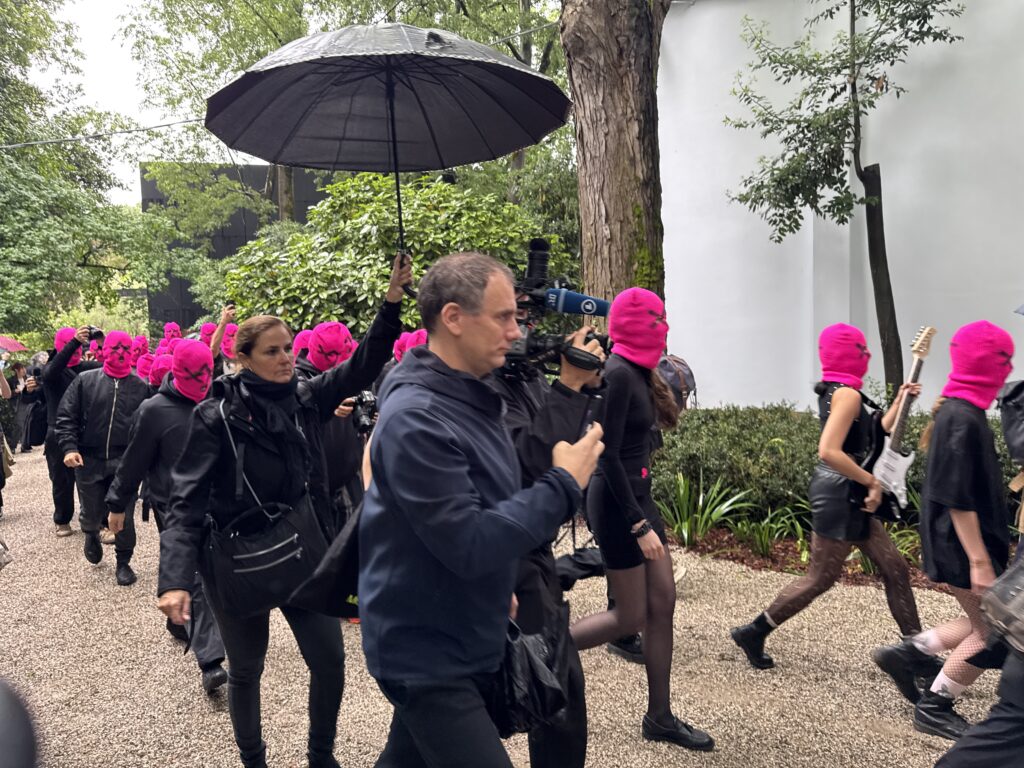
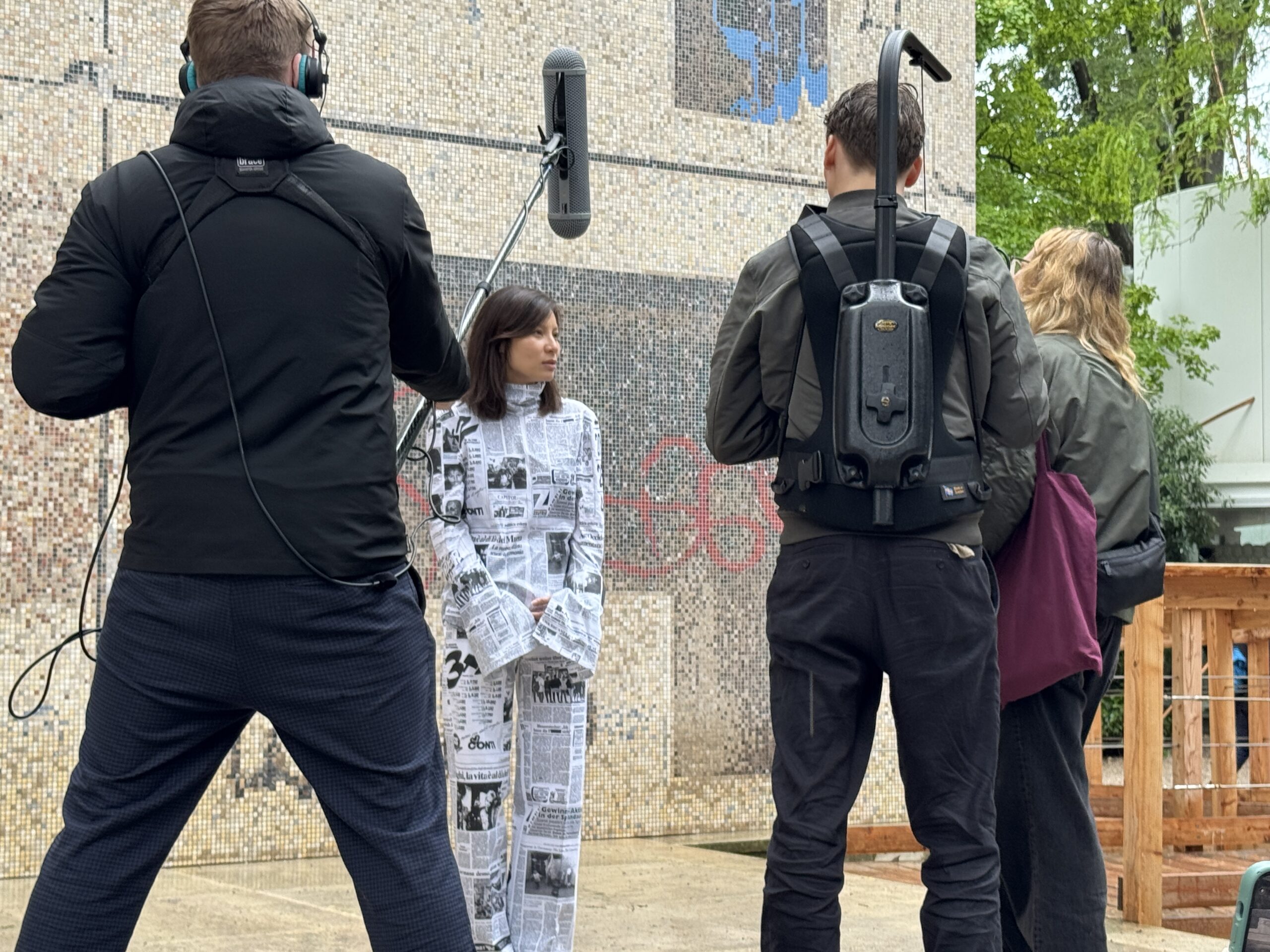
Rain brightens the foliage of the Giardini’s Edenic grounds, sturdy hotel-loaned umbrellas and hot pink balaclavas are the accessories du jour, and Pussy Riot’s Nadya Tolokonnikova takes shelter beneath the red-marble portico of the Czech and Slovak pavilion as the press huddles around her. So much for the secrecy of the Google doc instructions circulated via Telegram in advance of the action!
I’ve done very little legwork in advance of my trip to Venice, thinking I’ll sift through my inbox en route from New York and play it by ear upon my arrival. That said, in April, I did get in touch with my old friend when I hear she’ll be in town. So, I’ve planned that on the first day of the vernissage, Wednesday, May 6, at 10:30 am, I’ll go—only to observe—Pussy Riot and Femen (the Ukrainian-founded feminist group known for their semi-nude public disruptions) as they protest Russia’s return to the Biennale. And the artist-activists meeting spot seems like an apt place to begin my account of my dizzying trip to Venice, given the last few weeks’ steady stream of headlines detailing the exhibition’s internal strife—beginning with the exhibition jurors’ letter stating their refusal to consider countries whose leaders are charged with crimes against humanity (both Netanyahu and Putin have been issued arrest warrants by the International Criminal Court). Then, they resigned, and then…well, read on.
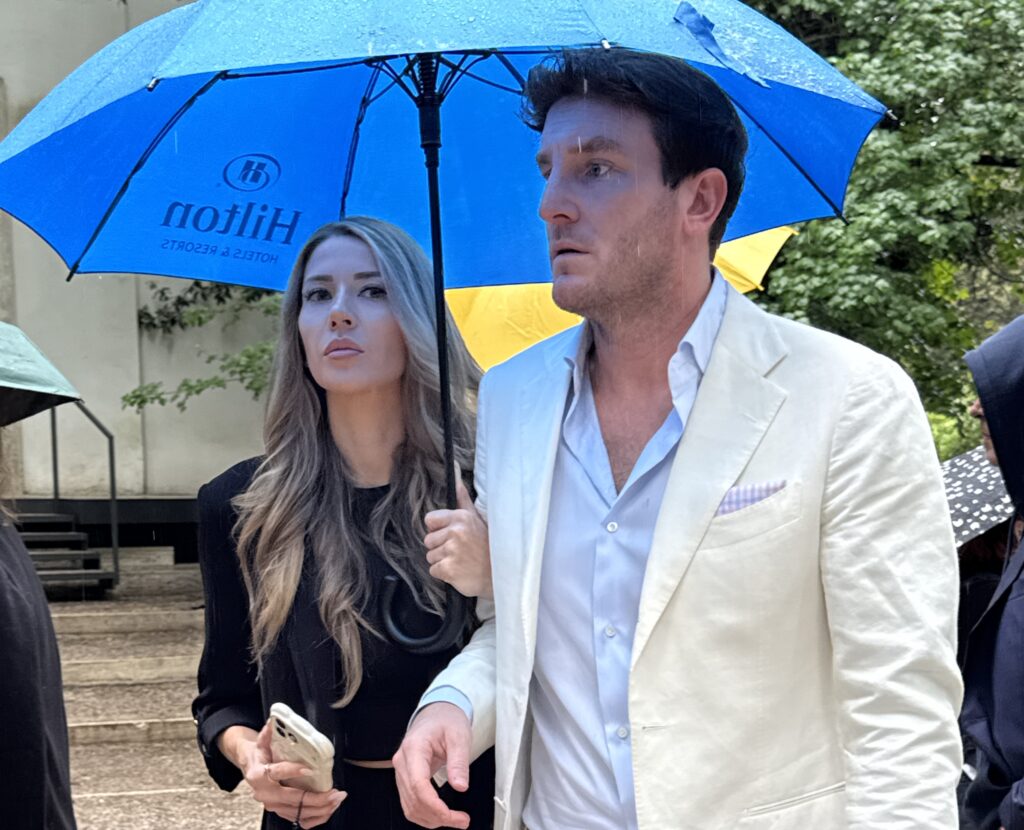
It’s not all sympathetic onlookers and members of the media who’ve gathered to watch Nadya et al storm the Russian pavilion in the vicinity. As the contingent of black-clad performers gathers, whispering in the bushes, I mingle nearby with fellow writers. One in-the-know reporter-acquaintance of mine points out that Matthew Taylor, a project manager of sorts associated with Trump’s threatened Garden of Heroes, loiters behind a column in aviator-frame sun glasses; and, walking towards us like two particularly doomed characters from White Lotus, Biennale edition, is alt-right media entrepreneur Ryan Coyne, treasurer of the American Arts Conservancy (the organization supporting the U.S. pavilion, led by luxury pet food purveyor Jenni Parido) and maybe his wife. I’m told sculptor Alma Allen, the exceptionally random pick granted the dubious honor of representing the country—after better (and wiser) artists demurred, has been at odds with the indifferent curatorial team all week, bad vibes pervading the pavilion. Imagine that.
When Pussy Riot and Femen march, feet crunching on the gravel path, I fall behind, letting more determined videographers push ahead to see the telegenic vignette unfold. Plumes of fuchsia smoke rise against the backdrop of the pavilion’s cerulean façade, eventually joined by blue and yellow clouds representing the flag of Ukraine. I can make out chants of “Blood is Russia’s art,” see fists in the air through breaks in the thicket of raised iPhones. Then, in Pussy Riot’s tradition of simulacra-savvy guerrilla punk, they debut a boombox-karaoke version of the hardcore rager “Disobey,” which will be fully realized only when the audio is swapped for a studio recording in the edit and posted.
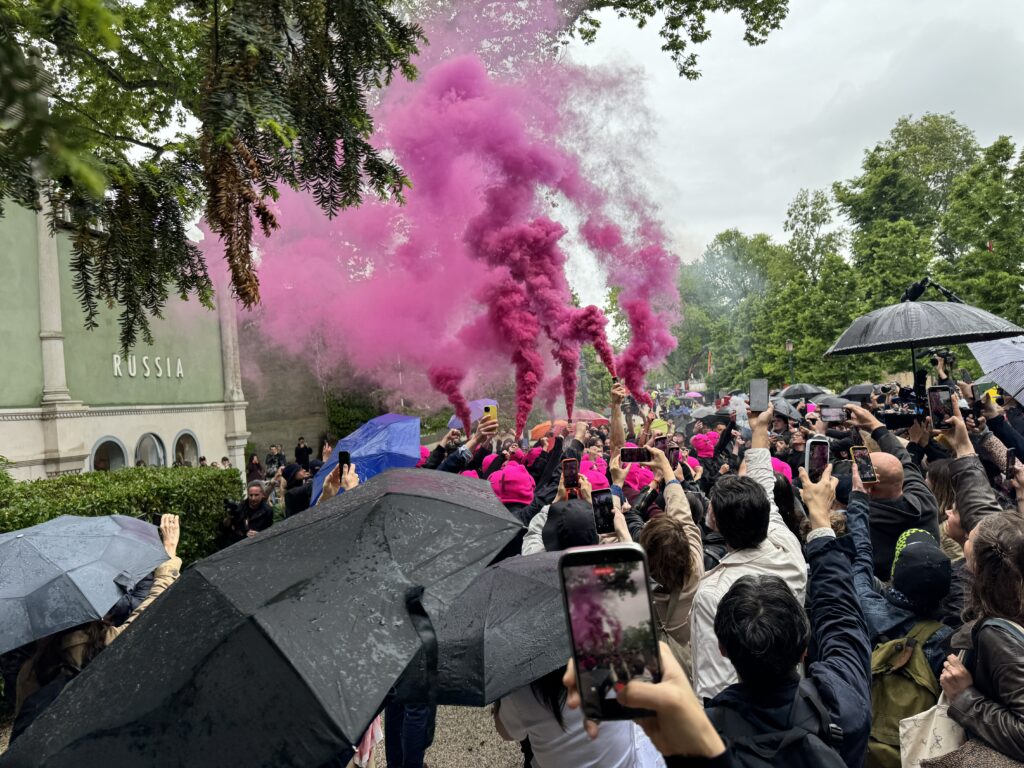
From afar, soft-power plays for legitimacy by both the dispossessed and powerful rogue states at this “Olympics of the art world” seem to proceed abstractly and politely, mediated by bureaucracy and art. But, right now, here in the Giardini—in this “It’s a Small World” village-of-nations board game—the realm of the symbolic feels rather real and raw, the labor behind the smoke-and-mirrors spectacle awkwardly, powerfully visible. Over the next few days, modes of “disruption” engineered for Instagram will join older, scalable, more disruptive tactics of dissent.
Coincidentally, poetically, the timing works out so that I leave the Pussy Riot action to meet fierce pussy. The core members of the queer AIDS-activist and art collective formed in 1991—artists Joy Episalla, Carrie Yamaoka—are with Jo-ey Tang, curator of their multipart project “arms ache avid aeon,” in the Giardini’s central curated pavilion. It’s here, unsurprisingly, that I first acutely feel the presence—and loss—of Koyo Kouoh, whose exhibition title “In Minor Keys,” and the accompanying text she wrote before her tragic, untimely passing last year, has taken on perhaps unusual importance as a touchstone and spiritual anchor for conversations. In a fractious moment (“the anxious cacophony of the present”), she invokes an extended sonic metaphor, a musical and poetic counter to “orchestral bombast and goose-step military marches” as well as an alternate sense of “minor keys” as “small islands.” Particularly resonant in the context of the sinking city’s expanded and dispersed landscape of seemingly infinite exhibitions and events, she writes of “an archipelago of oases: gardens, courtyards, compounds, lofts, dance floors—the other worlds that artists make, the intimate and convivial universes that refresh and sustain even in terrible times…”
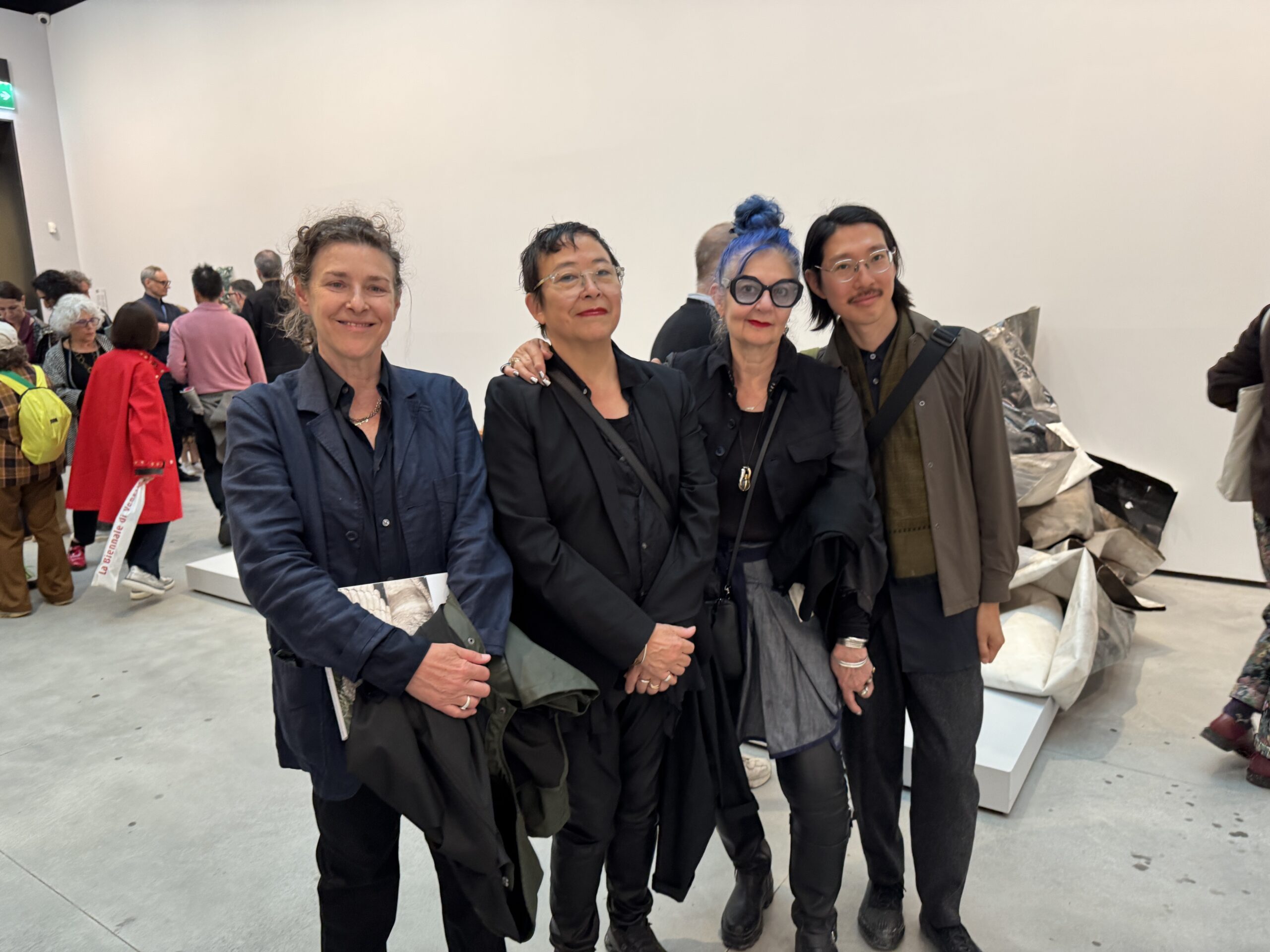
If the individual formal concerns of fierce pussy’s members, on display in the characteristically distinct and harmonizing objects and images of the gallery, reflect Kouoh’s interest in quieter, melancholic tones (one of Joy’s “foldtograms,” a sculpture of crumpled photographic paper exposed to light, darkroom chemicals, and brackish water, sprawls behind the group as they pose for a picture), their collaborative public projects strike a slightly sharper note. Zoe tells me about the censorship of their commissioned poster, which welcomes queer and trans people to Venice and features a pointed fierce pussification of a winged lion (a reminder that, Biennale or no, we’re in Meloni’s Italy), and she explains the execution of their DIY backup plan (she slips the collective’s self-produced sticker versions of the work into my bag).
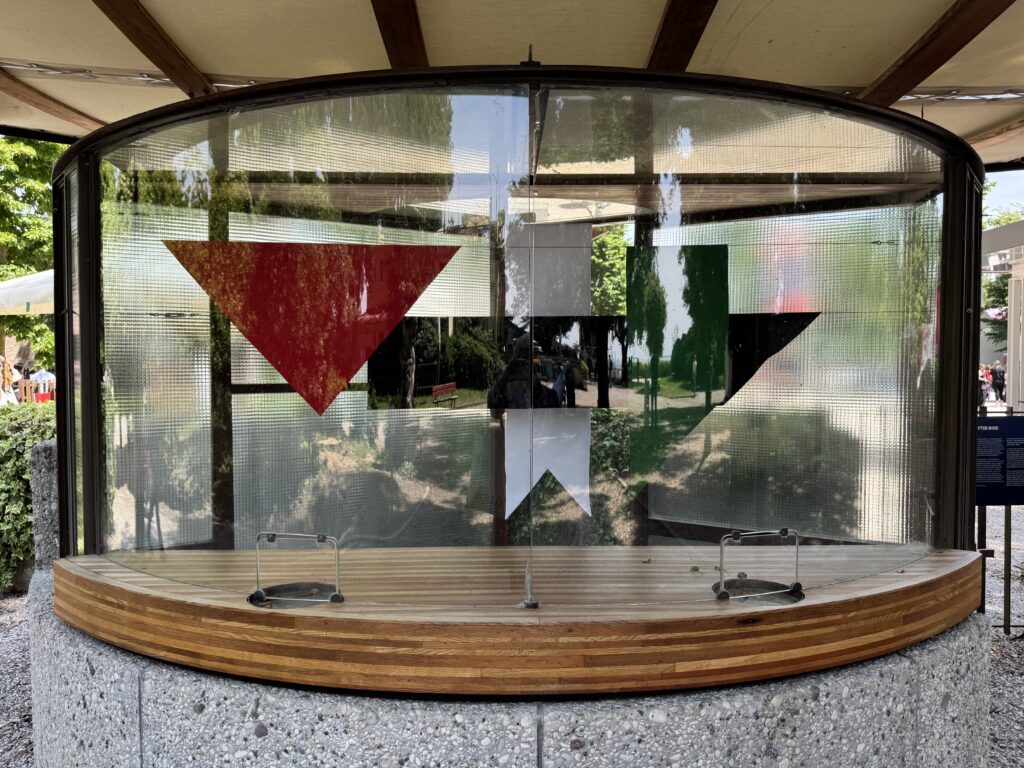
And, in a refrain I hear often while discussing Israel’s contested participation, Zoe decries the lack of a Palestinian pavilion in the Giardini. (Even the small nation of Bulgari—well, technically, not a country, more like a luxury brand—has one!) She hints at fierce pussy’s symbolic remonstrance and redress, which they’ve enacted in the Biglietteria Scarpa, the historic ticket kiosk just outside the Giardini’s gate, but she doesn’t want to give the surprise away. When I return Friday, I see that the Kouoh-commissioned artists have filled the repurposed structure, now a miniature “pavilion,” with a deconstructed Palestinian flag.
It’s just past 12:30 now, and I head to the opening of the Austrian Pavilion, hoping to be among the first witnesses to the hotly anticipated performance-installation “Seaworld Venice” by the feminist choreographer Florentina Holzinger. I stand at the outskirts of a dense crowd, unable to see the choreographer as she addresses us. From where I stand, her remarks, with their incendiary aspirations, seem not to land. After all, it’s a preview, and—as with the Pussy Riot performance—the press-heavy audience is relatively impassive: recording, not reacting. “There is no jury! No prize! Everything is crumbling,” Holzinger proclaims (according to the scattered notes I text myself). No doubt the latent drama of her words will surface in the social-media retelling of the moment, I think, naïvely underestimating the Instagram splash she’ll soon make with her “underwater amusement park, sewage treatment plant and sacred building,” and her performance as a nude human clapper for a massive bell. I take off, calculating that I don’t have time now to wait on the line that this crowd will soon form. Big mistake!
I duck into the nearby Polish Pavilion and find another sea world. Artists Bogna Burska and Daniel Kotowski, in collaboration with a choir, present a lushly numinous video-installation inspired by “more-than-human” life: hearing and Deaf people, underwater, perform a sui generis opera of sorts inspired by humpback whale communication and the movements of schools of fish. Another of my favorites in this stretch of national pavilions is Greece, where Andreas Angelidakis, with “Escape Room,” transforms the gallery into Plato’s cave reimagined as a gay club/video game populated by—among other things—MAGA merch.
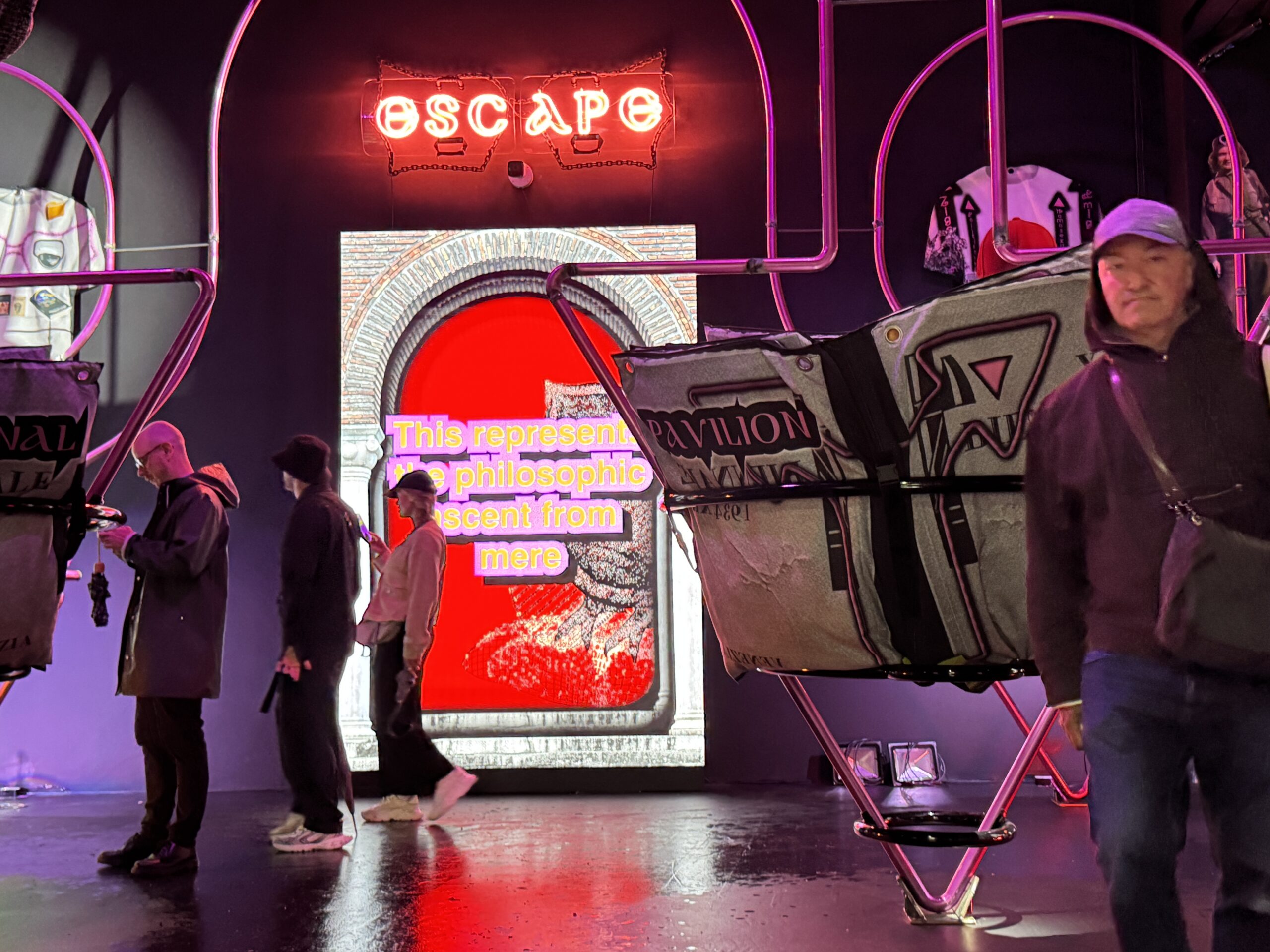
Angelidakis’s impulse to use the historic architectural space of the Biennale to remember its ideological functions (the Greek Pavilion, whose post-neoclassical design is associated with official fascist aesthetics, was inaugurated in 1934, the year Hitler and Mussolini met in Venice) shares its site-specific seriousness with the German Pavilion, which strikes me as the strongest presentation in the Giardini.
“Ruin,” as the two-person show curated by Kathleen Reinhardt is titled, begins with an unflashy but arresting (once you register what you’re looking at) large-scale gesture. Artist Sung Tieu has blanketed the building’s façade with a trompe l’oeil mosaic recreation of an abandoned East Berlin apartment block, the housing complex for Vietnamese contract workers where the artist grew up. Inside is a remarkable installation by Henrike Naumann—who died of cancer at 41 just a few months before the opening—on walls painted mint green, the color of abandoned East German army barracks. It’s a rich and sickly backdrop for her stark encyclopedia of forms, history-laden objects and artifacts indexing domestic interiors.
Speaking of interiors, enough about the Giardini—for now. In beginning my diary in the rain, watching Nadya’s pre-protest gaggle, I haven’t explained my unusual (for me) situation. I’m in Venice, and later in Umbria, on the Quattro Gatti press trip, hosted in style by the Biennale’s official gin (that is to say, really, the art-loving Mordant family), along with a group of new friends: writer-editors for design and travel magazines, a designer, a chef, a musician, a renowned spirits (as in alcohol, not apparitions) journalist. Our exquisite itinerary, while not one I would have imagined for myself as an art critic, is truly a gift. It’s my first Biennale and I quickly realize that the both the exhibition and its vast surrounding hubbub is a scene of unmanageable excess: so much art. Decision fatigue sets in fast; I’m glad to be handed martinis and surrender to someone else’s plan.
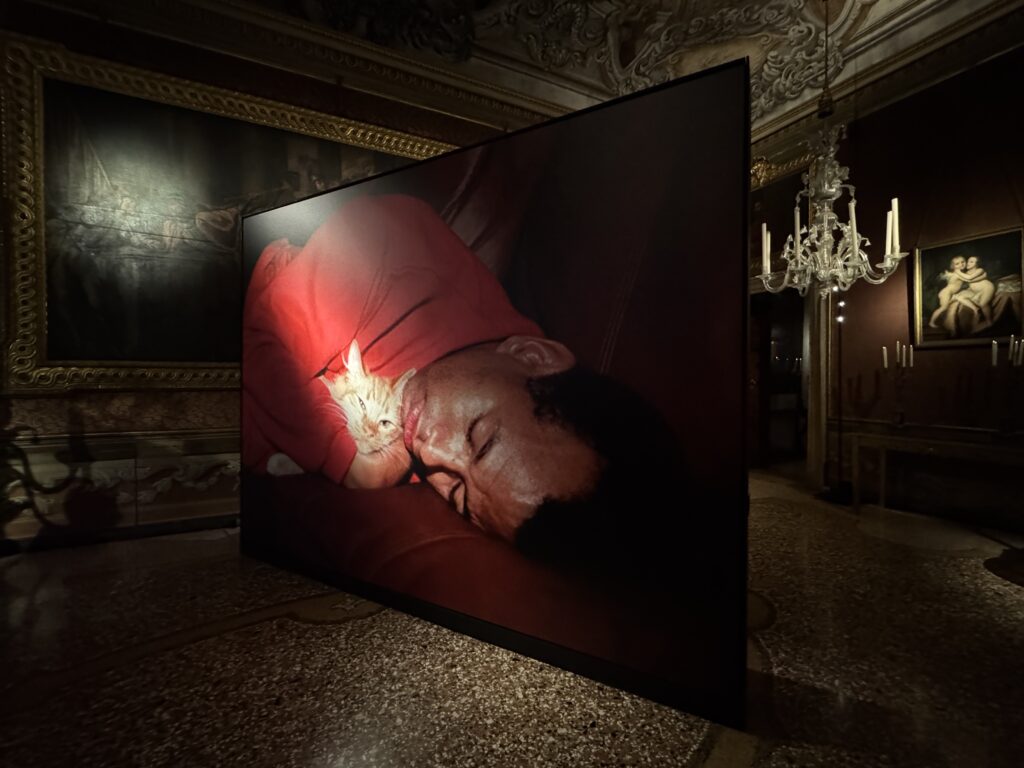
Our first night, after dropping off our bags, we set off for the 15th century Palazzo Pisani Moretta, now home to Fondazione Dries Van Noten and the exhibition “The Only True Protest Is Beauty,” curated by the retired designer and Geert Bruloot. I’m not sure what to think of the title, borrowed from Phil Ochs, the American protest singer of the 1960s and ’70s. Unmoored from any stated political stance and unrelated to the eclectic array of work on view—mannequins dressed in Christian Lacroix and Comme des Garçons preside over partition-scale Steven Shearer photos and craft-intensive sculpture—it’s a curious choice for a moment in the art world when protest is less abstract and evasion less likely to go unnoticed. But, I realize, this is not exactly “the art world” (or my art world), it’s the place that fashion touches it, where beauty is less subject to interrogation. And so, accepting the show’s logic of personal taste, I’m swept away by the foolproof juxtaposition of lovingly chosen contemporary objects and semi-derelict Rococo interiors. (Chiara Pisani remodeled and redecorated it in the mid-18th century.)
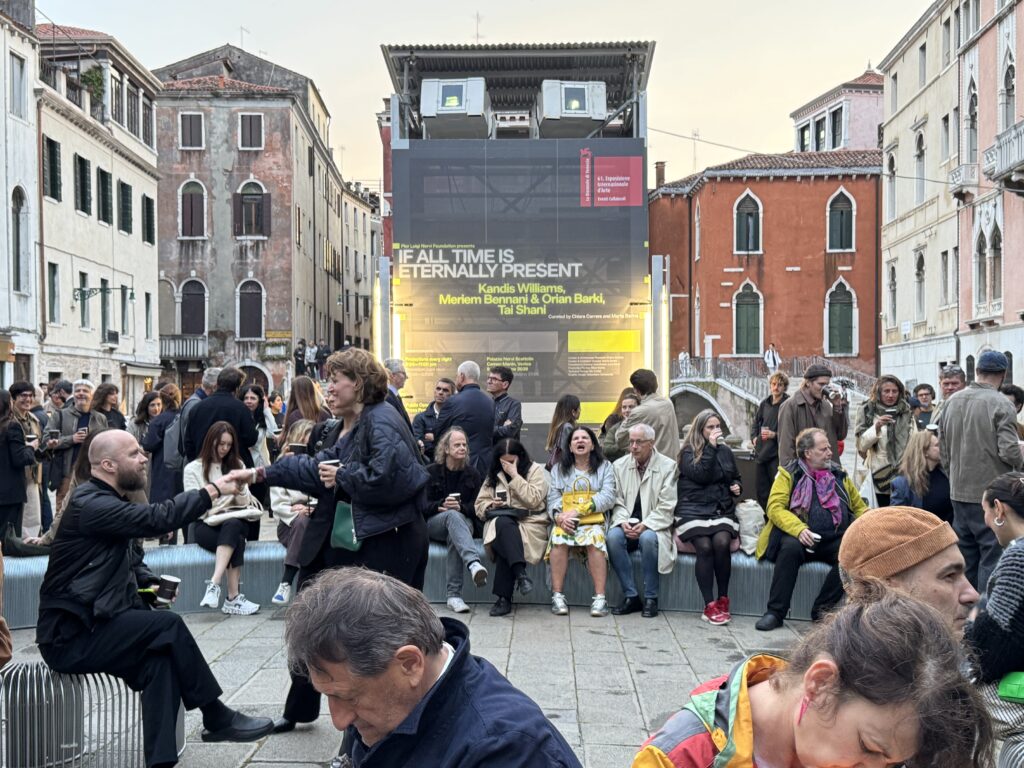
The next evening (post-Giardini), I go off itinerary for a bit, absenting myself briefly from golden hour cocktails at the St. Regis with a few of our group to check out the opening of the outdoor video exhibition “If All Time is Eternally Present” in Campo Manin square. It’s a very different crowd. Paper cups of warm kombucha and dry falafel hors d’oeuvres circulate as we wait for the sun to set and imagery to appear on Palazzo Nervi Scattolin’s modernist concrete façade. I’m not expecting to see Meriem Bennani and Orian Barki’s animated episodic series 2 Lizards, 2020, and when it plays, it’s almost like running into an old friend. Covid-era art has mostly, it seems, been put away at the bottom of a drawer. I feel not nostalgic, but a combination of relief and something else, that at least some of it has held up: the lizards are absurdly spot on and hilarious in their navigation of lockdown’s surreal conditions. (“Are you following this hantavirus thing?” I hear someone behind me ask their companion.)
Thursday is devoted to the Arsenale. While I do visit the national pavilions, and enjoy the glorious sun after the previous day’s slog in the intermittent downpour, it seems to me, almost immediately, that the expertly paced main exhibition is where Kouoh’s concept is realized, to rather breathtaking effect, at the level of atmosphere. It’s where I want to spend the most time. Meandering though lines—sound, scent, poetry, and a motif of circular enclosure—are established with the meditative first room by Lebanese Australian artist Khaled Sabsabi, where looping video projections morph the all-over brushwork of his curved, mural-scale, freestanding paintings.
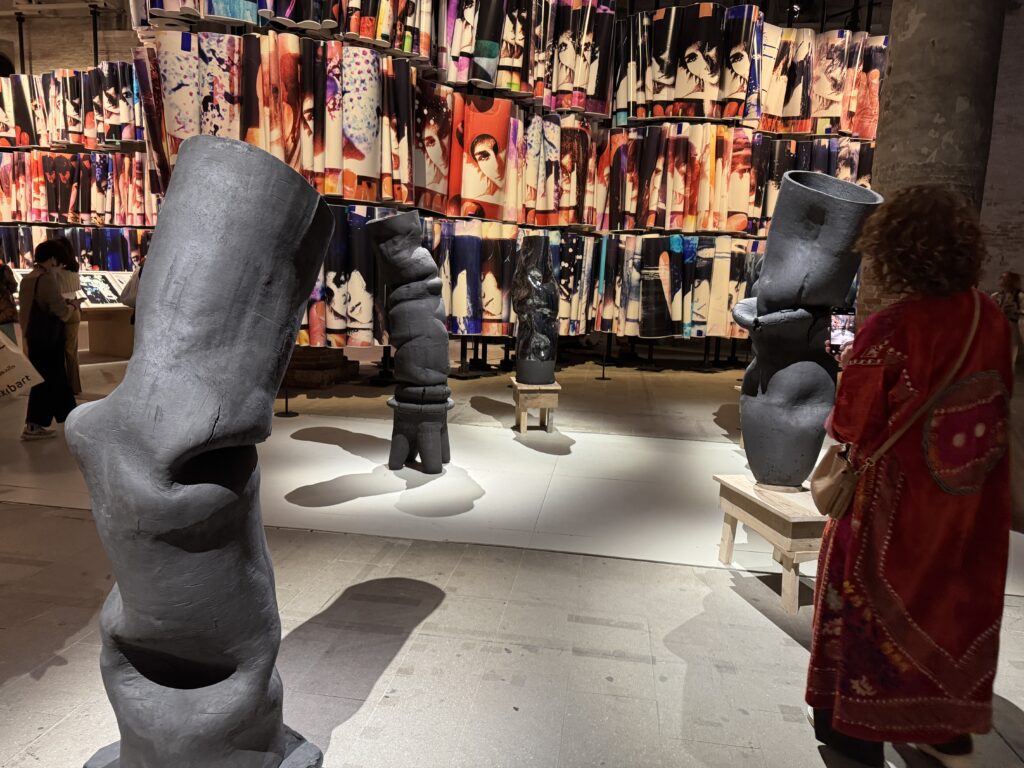
The sensitive ordering of installation works as different Sabsabi’s, Cauleen Smith’s multisensorial lounge The Wanda Coleman Songbook, 2024, and Tabita Rezaire’s Omo Elu and Mother Trinity, 2024, with its ritual-evoking configuration of small objects and textile hangings, links them as anchor points in an almost invisible exhibition structure. Standouts for me include a quiet moment for Cameroonian painter and playwright Werewere Liking’s canvases and the placement of Ranti Bam’s black-clay guardian vessels in front of Carrie Schneider’s snaking, kilometer-long installation of a continuous photographic print (a scrutinizing, opulent tribute to eight moving-image seconds of La Jetée).
Cocktails at another fairytale palazzo on the Grand Canal (the Aman Venice). Dinner at the (possibly more beautiful) Orient Express. I fall asleep on a pile of press materials and exhibition pamphlets, dead to the world, savoring a few extra hours in the morning after the Quattro Gatti travel party has left for Umbria. I have another day here, in Venice, to try to fill in the gaps in my art viewing (impossible).
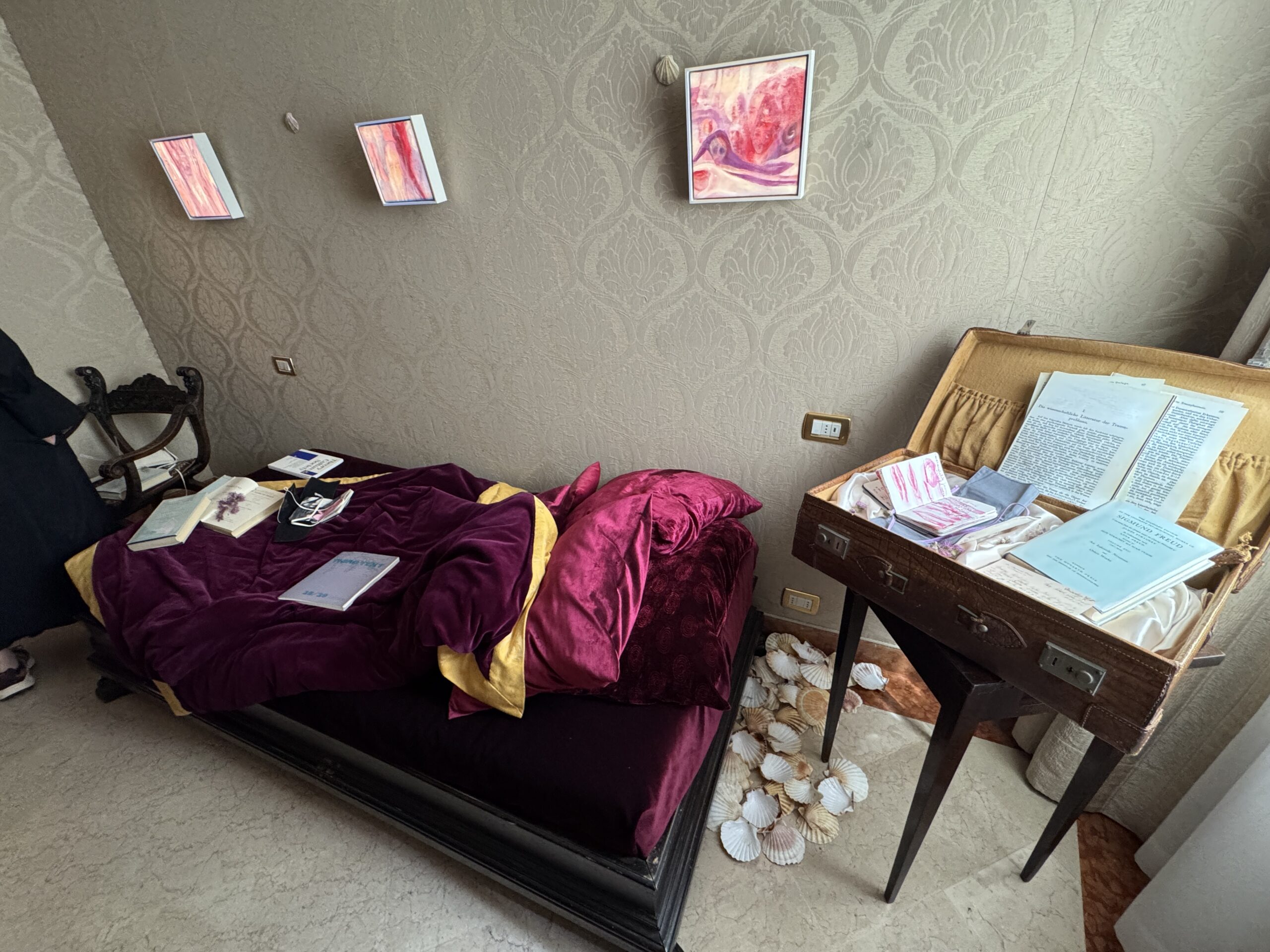
First, I walk to the Hotel Metropole. Despite my failure to secure an appointment online, I’m allowed in with the 11:30 group to the room where, between 1895 and 1899, Freud party wrote The Interpretation of Dreams. Artist and feminist-psychoanalytic theorist Bracha L. Ettinger has, with a light, scenographic touch, occupied the fabled space, installing seven small etheric paintings and staging dreamlike, novelistic arrangements of books, notes, and seashells. It would be better to go in one at a time, of course, and really snoop through the materials, lie down for a while. I feel too much like a tourist, self-conscious, like I’m visiting literary graves at Père Lachaise.
I do realize, having consulted a flurry of Whatsapp updates from friends over the last few days, that the Arsenale will likely be overtaken, shut down, by a mass action protesting Israel’s participation in the exhibition. It doesn’t occur to me, until I arrive at the Giardini, that artists and workers there will be striking in solidarity. The Austria Pavilion is closed. Belgium too. Nearly everything on my list. So, I go to the U.S. Pavilion and soak it in. Alma Allen’s presentation is, just as you have heard, worse than nothing much. Here, contempt for art is shown not through “orchestral bombast”—neoclassical slop, naked propaganda, “traditional” imagery—but through profound indifference, the decision to show an anodyne placeholder, just whatever. At the Russian Pavilion, I refused a shot of vodka, and briefly watched the rather terrifying Russian musical trio Phurpa, whose ritual practice—as I understand it—derives from the shamanistic belief system of pre-Buddhist Tibet.
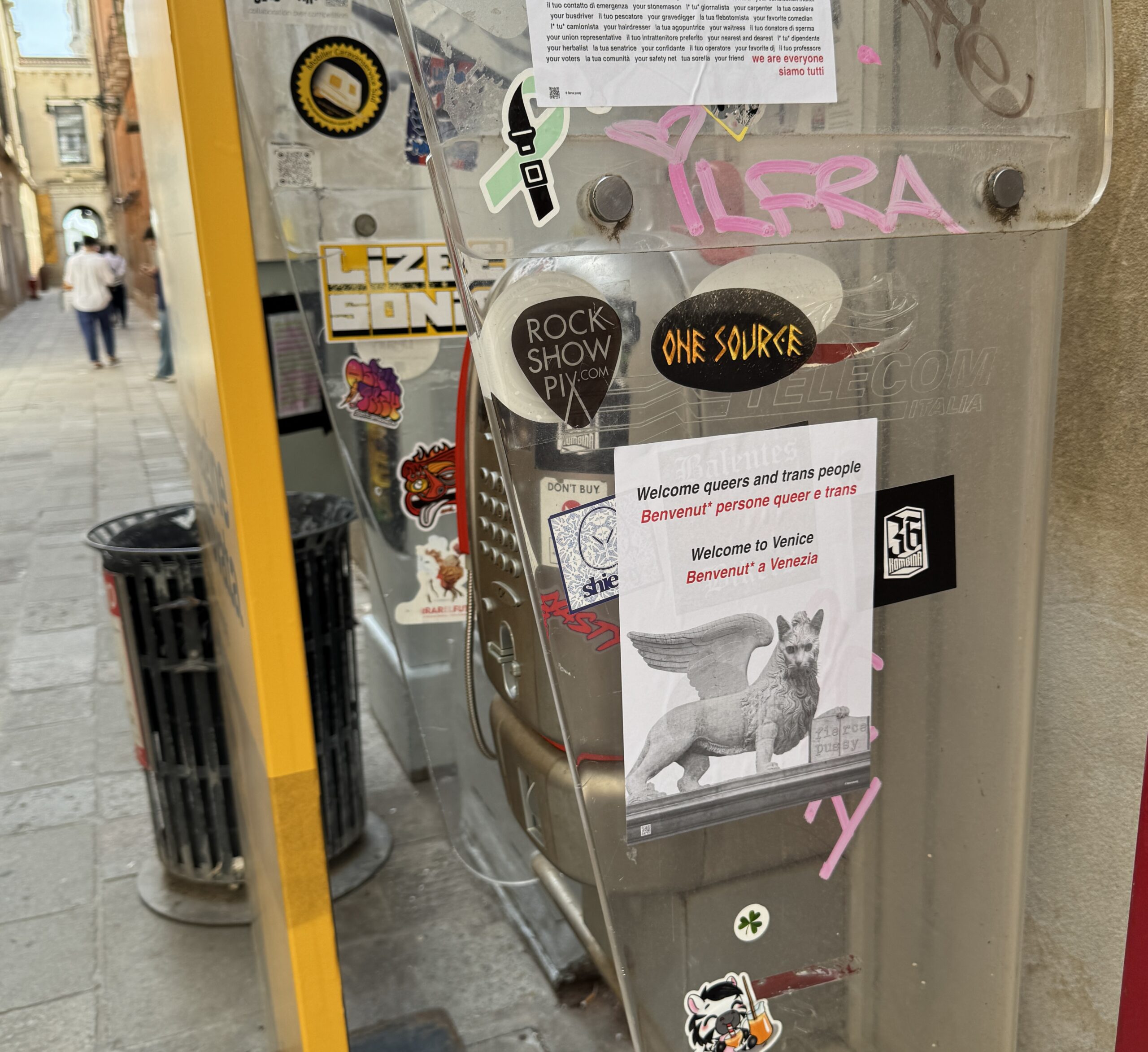
On my walk back to the St. Regis, where I’ve left my luggage, I spot fierce pussy stickers in the wild. I think of the collective’s printed cats when I read, peering at Instagram in an Umbrian olive grove the next day, of the latest development in the Biennale’s fraught negotiations—or lack of negotiations—with participating artists. As a rejoinder to the official solution to the jurors’ resignation—the ad hoc establishment of a democratically awarded visitors prize—more than a hundred artists have withdrawn their work from consideration. It will be funny, I guess, to someone, when Alma Allen wins the Golden Lion.
More of our favorite stories from CULTURED
Danielle Mckinney Shares the Advice That Keeps Her Painting Even on Her Worst Days
What Not Having Mental Imagery Implies for Psychoanalysis, Trauma, and Our Sense of Self
Meet the Woman Who Curated the Art on Miranda Priestly’s Walls
Mina Stone’s Guide to Eating, Buying, and Cooking With Chocolate (More) Safely
Can Raising Children Make You a Better Artist? Four Artist Mothers Weigh In
Sign up for our newsletter here to get these stories direct to your inbox.

 in your life?