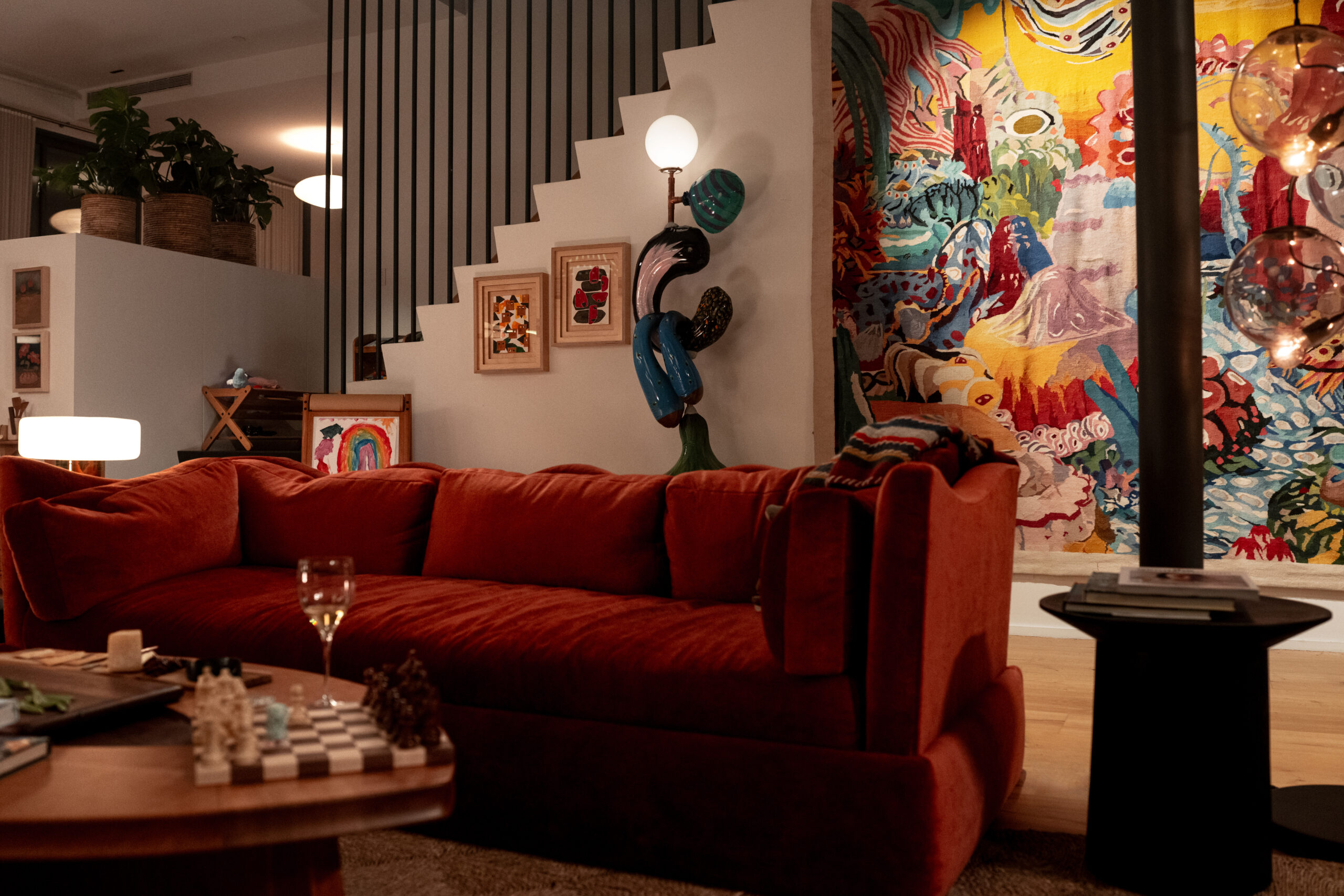
As an art advisor, Fanny Pereire has a very particular roster of clients: Logan Roy, Miranda Priestly, and Bobby Axelrod, to name a few. Instead of outfitting the Hamptons homes of the ultra-wealthy, Pereire spends her days filling the walls of film and TV characters. A large part of her job is to make the lives of the fictional elite look not just covetable, but believable. As stories about the upper crust of society (whether satirical like The Menu, sinister like Industry, or somewhere in between, like Succession) continue to dominate prestige TV and film, the art on a character’s walls can be as revealing about their personality and status as the quietly luxurious Loro Piana sweater wrapped around their shoulders.
The devil is in the details. In The Devil Wears Prada 2, on which Pereire served as a fine art coordinator, Miranda Priestly, the embodiment of impeccable and unrelenting taste, may have a preference (and the pocketbook) for the Pop Art-inflected confections of Wayne Thiebaud and Alex Katz. On the other hand, Lily (Tracie Thoms), a successful gallery director in Chelsea, might favor lesser-known contemporary figures rooted in diasporic traditions like Marco A. Castillo. Unlike your typical art advisor, Pereire almost always oversees the destruction of the art as soon as she’s finished filming (the pieces featured onscreen are almost always very good replicas).
On the heels of the release of The Devil Wears Prada 2, CULTURED called up Pereire to learn more about her process, her most difficult gig, and how she found herself advising for fictional characters.
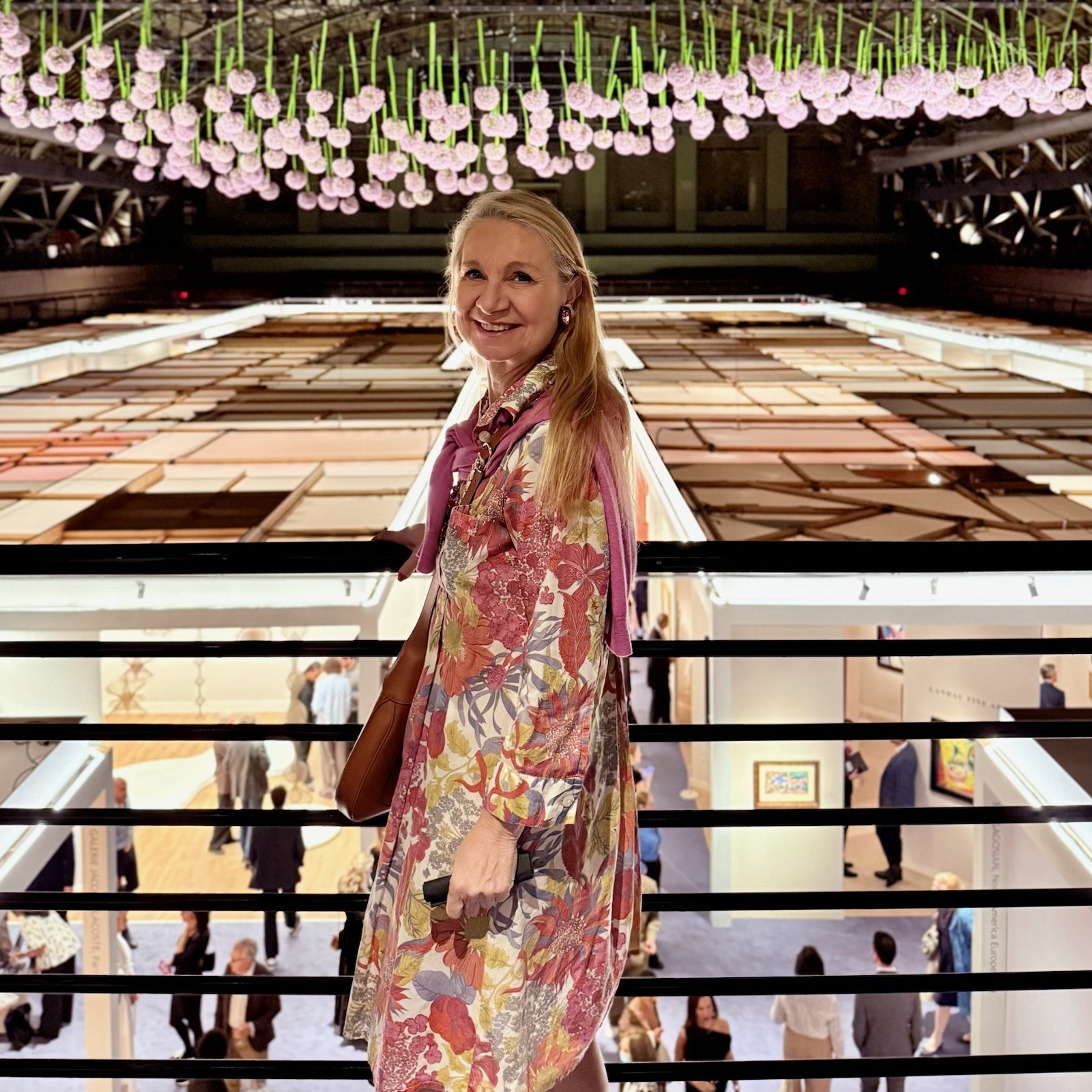
How would you describe your job?
I curate the offices and homes of people who don’t exist. People pay attention to the wealthy ones, but I do art for people who have no money too. I do the 5-year-old art that’s on the fridge. I will never put a $1 million painting in a house that’s worth $100,000. I could put in something that’s worth a lot of money if the character was old enough to have bought it when they were really young.
How did you get into this line of work?
In college, I studied architecture, custom design, and art history. Then I worked at Christie’s in the PR department. I was there the first time Barbra Streisand came in. She looked at the Tiffany lamps and then started collecting for decades. Then I got into art magazines, and then television production. But most of my friends were movie producers. And my position was created, basically, by Scott Rudin, who is himself a big art collector. I started doing it in 1999, and it’s a union position now.
Why did he create it?
It was around when they started enforcing copyrights for artworks. Scott’s idea was, if I’m gonna hire somebody to clear every artwork that’s gonna be on the walls, I want somebody who knows about art. Because everything that is one-of-a-kind and done by an artist has a copyright and has to be cleared—even a 5-year-old’s drawing, I have to have the parents clear it. And if the character has children that are 5 and 7, I will get drawings from a 5 and a 7-year-old.
But when it’s an expensive artwork, are you using the real thing?
I would say about 85 percent of the time we make official copies. So I get the copyright, we do a reproduction, and then I do the proof of destruction at the end of the film. With sculptures, I usually borrow or rent them. And if it’s something that’s inexpensive and it’s not worth the time to reproduce, we’ll just buy it.
Let’s talk about your work on The Devil Wears Prada 2. How did you go about sourcing the art for the movie?
It has two layers, because it [takes place] 20 years later. So some of the artwork that was used 20 years ago came back. We reused an Alex Katz that was in Miranda Priestly’s home and moved it to her beach house. We also reused a Wayne Thiebaud. Anne Hathaway’s character is in one house at the beginning of the story and another at the end, but some of her art goes with her. The most interesting character [in terms of art] is Lily, Andy Sachs’s best friend, who works for a gallery.
Yes, I remember her from the first movie. I’m glad she’s still in the mix.
She used to be an assistant in an art gallery, and now she’s a director at a major art gallery in Chelsea and lives in a loft in Tribeca. She has two Amy Sherald portraits and some work by a Cuban artist called Marco Castillo. It’s very colorful. They also go to a hotel in Milan, which has very edgy art furniture, like marble chairs from Enrico [Marone] Cinzano.
What are some other recent pieces you’ve reproduced?
I did a recent Law & Order episode where we created some antique Egyptian sculptures. They needed to be destroyed as part of the script. We shot in the Brooklyn Museum and we used some of the existing artwork, and then we substituted it with some of ours. It’s the magic of the scenic artists—I send them pictures, or videos. In Changing Lanes, the first movie I worked on, we reproduced an Antony Gormley sculpture. He was in London and I was shooting in Brooklyn and would call him for details. Then we sent him a video of the proof of destruction. Since it wasn’t destroyed during the filming, it had to be destroyed afterwards.
It must be weird to constantly be destroying artwork.
It’s hard because every piece of art that’s on a set, they’re like my children for the duration. And then you have to say goodbye. It’s like sending them off to college. I very often do it myself because it’s easier for me to do it than to watch somebody do it. I slash the canvas up and down. I cut them in pieces and I have a video taken of me doing it. Sometimes I send some of the pieces in an envelope. I’ve had some artists ask us to return them, and they like looking at their old work that has been sold or gone. Or they’ll just paint over it, since it’s a usable canvas.
How many people do this job full-time?
Not that many. But there are a couple younger versions of me. That’s why it became a union position. I love the research part. Sometimes wealthy characters are easiest because you pull from a list of what everyone expects them to have. But, for example, Succession and Billions were completely different. The characters were not of the same age. They had different backgrounds. Axe in Billions was on top of his game, and he was buying [art] at the same time. In Succession, you had the father who had wealth for a long time and the children who grew up with that. Then there was the new wife, who wanted to make her mark and would have more contemporary things.
Are there actors or filmmakers who have been especially interested in understanding the story behind the art?
Nancy Meyers, for instance, bought one of the artworks that we had on The Intern. A portrait of the dog in the kitchen of Anne Hathaway’s character’s house. Donald Sutherland wanted to buy one of the real Nicolas de Staël [paintings we used in The Undoing on HBO]. I actually tried to track it down for him. It was in a private collection, and I think the people would’ve only sold it for way more money than he wanted to spend.
Is there any artwork you feel is really overused in film and TV?
At one point it was Basquiat. Everyone had a Basquiat. I had one in Axe’s office in Billions and in Chris Rock’s movie Top Five. But because the Basquiat copyrights went over the top—it was crazy what they asked for—you are not going to see many Basquiats for a long time.
Have you ever had an experience where you had to go to the end of the earth to get a specific artwork for a scene?
Oh yeah. I remember we were doing Wall Street—my mistake was showing Oliver Stone Maurizio Cattelan’s ostrich with his head in the sand. He loved it. Marian Goodman [Cattelan’s gallerist] said they would do whatever they could. But Maurizio was in Sardinia or Sicily or something. It was the end of July—and there was no way he was going to make us one. He said, “We’ll ask the collector” [who owns the original]. I said, “No, I’m not borrowing this multimillion-dollar piece from someone, god forbid.” For the duration, Oliver would always look at me like, You didn’t get me that ostrich.
On the Devil Wears Prada 2, there’s a scene with a new character where we have a Thomas Struth [photograph]. I had to pick it up, and it weighed tons. We had to bring it in from a few hours away. I don’t even know if it’s in the edit. Very often, what you think is going to be your hero piece, you never see.
That must be hard, when you’ve busted your ass to get something and then it never shows up in the movie.
That’s the nature. On Ocean’s 8, we had a huge hero piece you never see. Warner Bros. wasn’t keen because [the work] had a cigarette butt in an ashtray.
What sort of selections have you made to tease out certain aspects of the characters?
I worked really closely with Donald Sutherland [on The Undoing]. He really believed it was important for him to know what was in there. So we had a very close dialogue about what was in his apartment. I got him a small Francis Bacon. And I don’t even know if we ever see it in the final cut. But that was not important. What was important is that he would see it when he was seated in his chair, in his living room, when he was having these conversations with his son-in-law and his daughter. We really had the same vision of who the character was.
I deal with [some] people who have no clue what’s on their walls; they don’t care. I just put it there and it’s fine. But for instance, Oliver Stone is very particular. He liked to have all the walls dressed [with art], even if there were walls that were never gonna be filmed. It’s just like the costume—when an actor puts on the costume, he gets his into a character. But what he looks at home or in his office tells you about who they are, too, if we do our work right.
More of our favorite stories from CULTURED
14 Books Our Editors Can’t Wait to Read This Summer
Inside the Closet of a Revered Stylist Who Has Only Worn Prada For Over 30 Years
Charles Melton Actually Has No Idea Where His Career Goes From Here
Introducing a Play For Every New Yorker Who’s Had More Bad Dates Than Good
7 Commandments for Rookie Collectors, From CULTURED’s Power Art Advisors
Sign up for our newsletter here to get these stories direct to your inbox.




 in your life?