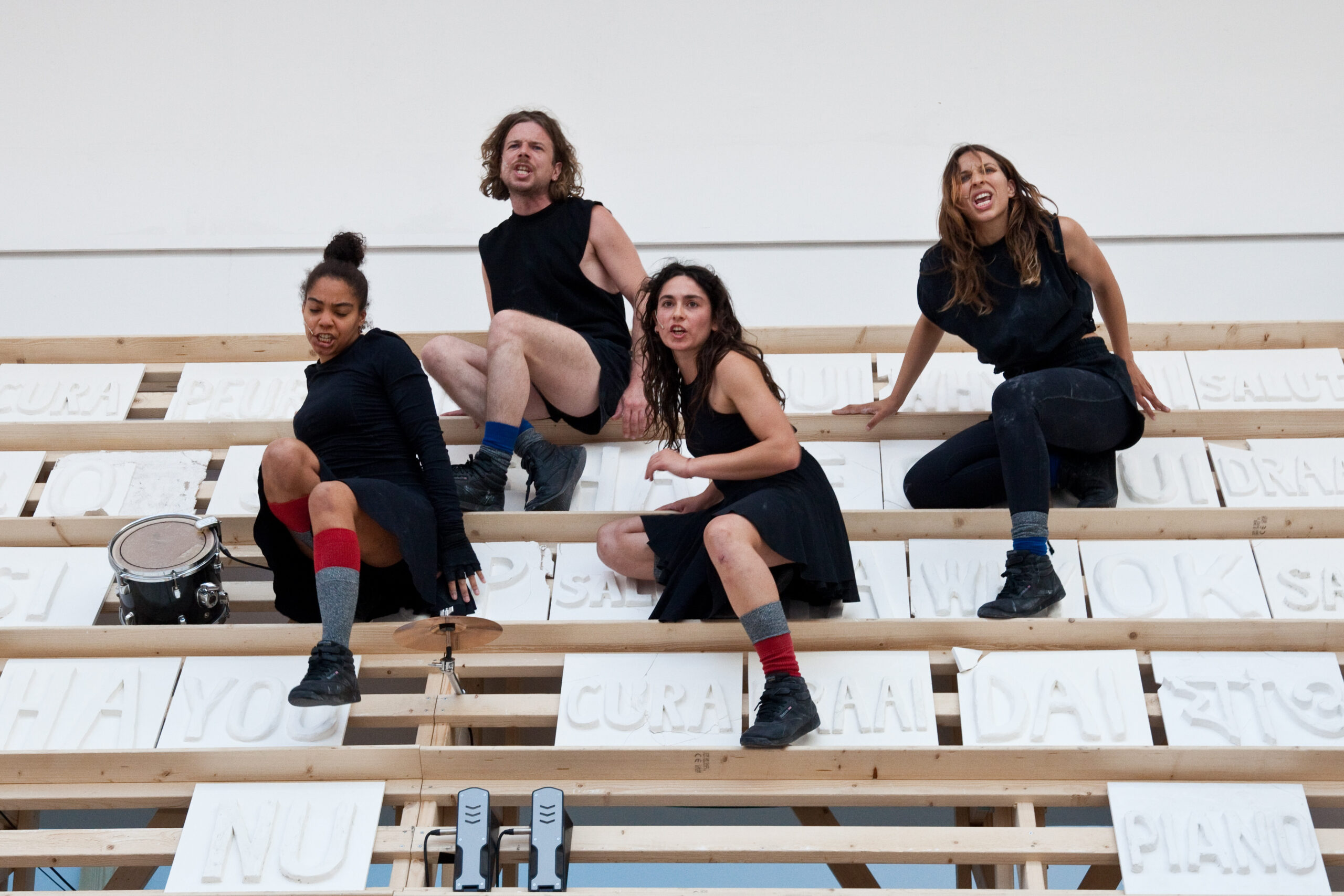
A group of performers clamber up a wooden structure that looks like a cross between bleachers and a slatted storage rack. Music blares; they bang drums affixed to the shelves. Plaster boards inscribed with words in a variety of languages line each row. In short: It’s a lot.
This sensory overload—an endless flow of words, performers playing the space like an instrument, and plaster pieces flying everywhere—is characteristic of the work of Miet Warlop, who is representing Belgium at this year’s Venice Biennale. Her project, titled IT NEVER SSST, references the onslaught of misunderstandings, noise, and disaster that defines contemporary life.
“It’s flooded like a head is flooded now with all the questions and barricades in life,” Warlop, 47, tells me of the pavilion, a few weeks before it opens. She is FaceTiming from the space, pacing the entire time, seemingly as unsettled as the performance she is preparing.
Over the past 20 years, Warlop has become a darling of avant-garde theater in Europe, having performed at venues including Hebbel am Ufer in Berlin, Bozar in Brussels, and La Villette in Paris. She is one of a number of artists prominently featured in this year’s Venice Biennale—including Florentina Holzinger, representing Austria, and Dries Verhoeven, from the Netherlands—whose work may be more familiar to performing arts and theater devotees than to the art world.
It’s a striking development for the Biennale, which maintains separate events for dance, visual arts, and theater. “You could ask the question, what happens when these biennials all get confused?” says Caroline Dumalin, the curator of the Belgian Pavilion. “It’s exciting when these figures like Miet come along and remind you that it’s a false separation.”
During the VIP preview, crowds packed into the pavilion, which looks like a sculptor’s studio meets high school gym. The space will be activated by the full cast for less than half the time the Biennale is open through November. But at least one sculptor will always be there, carving high reliefs based on photographs taken during the live performances and creating new words out of plaster to replace the ones that break during the action.
Every day, the cast will put the plaster words up on the slatted shelves and later take them down. In other words, the project is never done—it is made and unmade and remade over the course of the show.
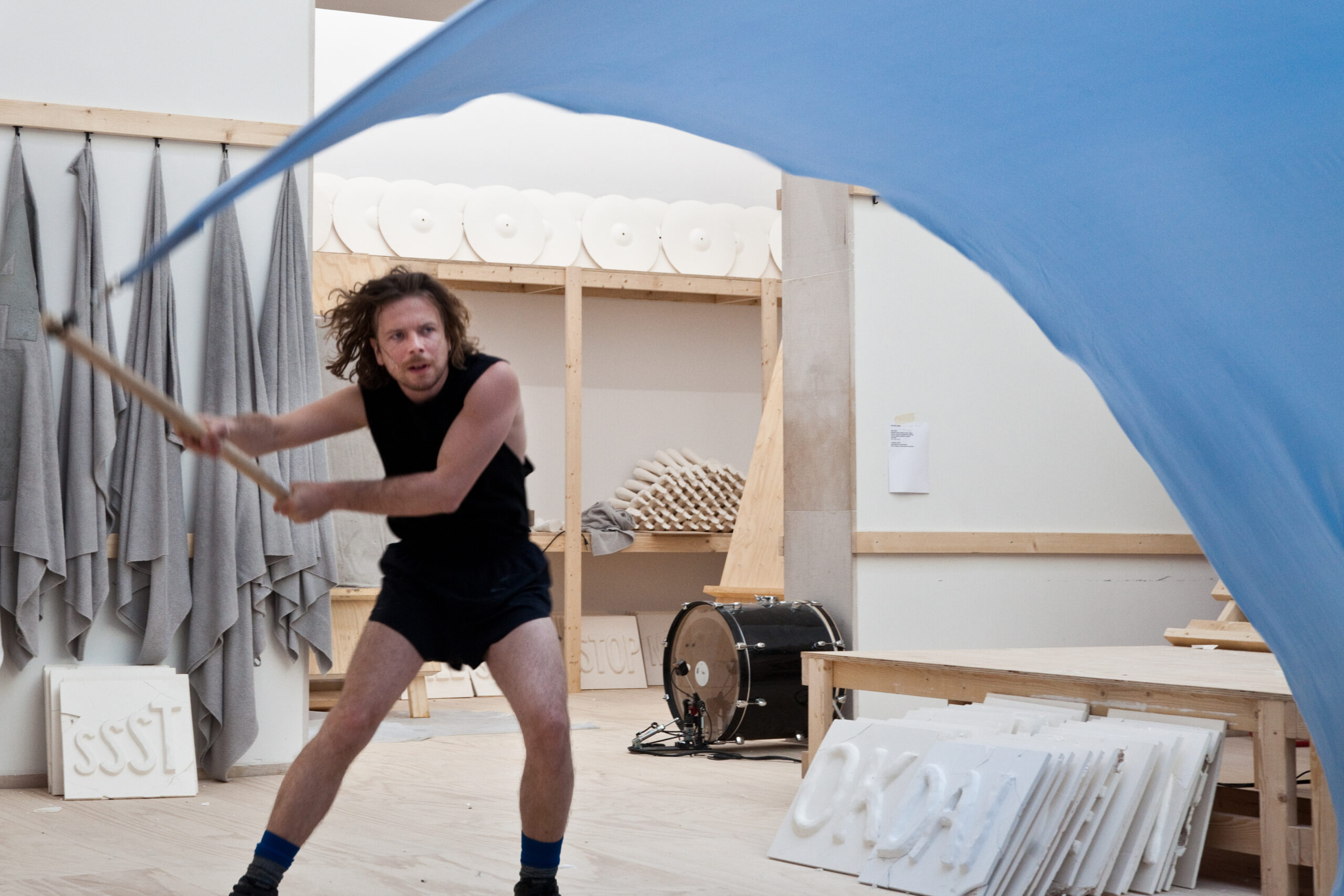
Although she was embraced by the theater world, Warlop has always pushed against its conceits. She rejects conventional narrative and embraces her materials, like plaster, as main characters—or, as she describes them, “drama queens.” In her recent project Inhale Delirium Exhale, performers danced with almost four miles of silk on stage. “I think my visual aspects are so prominent in my work that it’s a bit ridiculous to say that I’m a theater maker,” she says.
Yet the pavilion marks a departure for Warlop: It’s the first time she’s created a project that seeks to hold its own even when her frenetic choreography and music are not unfolding live. “It’s an interesting time to see how my performances stay vibrant,” she says.
Warlop grew up in Torhout, a small town in Flanders. Although she was always drawn to visual art, her family preferred more collaborative creative experiences. Her accountant father spent his free time doing amateur theater; her mother taught graphic design to students with developmental disabilities. “I think my family was, and still is, searching for expression,” Warlop says.
She attended art school at the Royal Academy of Fine Arts in Ghent—and there, too, her teachers encouraged her to experiment with performance and installation in lieu of painting and sculpture. For her graduate project, in 2003, she created six surreal tableaux vivants, including one of a woman crying into a mountain of tissues that nearly swallowed her up.
Warlop’s work possesses an athletic intensity that is louder, sweatier, and more raucous than the kind of Marina Abramović-style durational performance with which the art world is most familiar. In one of her most critically acclaimed pieces, One Song, musicians play a mournful song while running on treadmills, balancing on beams, and executing other see-it-to-believe-it physical feats. One critic described the performance—which is touring Germany and Belgium this summer—as “The Hunger Games for theater aficionados.”
For Warlop, the Biennale is an opportunity to reintroduce herself to the art world, which has held her at a certain remove. The field’s economics offer an appealing alternative to the touring theater model, according to Warlop. She likes the idea of selling her props and designs to support her projects. She applied to represent Belgium at the Venice Biennale in large part because “it was the only way to actually be able to fund my next work,” she says. “This is a reality that is not so visible, but it’s true.”
What does it mean that her gamble worked? Why might the art world be turning toward live art—a more collaborative, durational form than painting, sculpture, or even installation, the preferred medium of the biennale industrial complex? In our screen-addled era, “the taste is for more visceral contact between people and between bodies,” Dumalin, the Belgian pavilion curator, suggests. “The thing I come back to: these are the moments where we need beauty and to feel each other and to be together—rather than making or looking at static objects, we need to have an exchange of some kind.”
More of our favorite stories from CULTURED
14 Books Our Editors Can’t Wait to Read This Summer
Inside the Closet of a Revered Stylist Who Has Only Worn Prada For Over 30 Years
Charles Melton Actually Has No Idea Where His Career Goes From Here
Introducing a Play For Every New Yorker Who’s Had More Bad Dates Than Good
7 Commandments for Rookie Collectors, From CULTURED’s Power Art Advisors
Sign up for our newsletter here to get these stories direct to your inbox.



 in your life?