Venice is where Dale Chihuly studied the ancient art of Murano glassblowing in 1968, where he staged his career-making “Chihuly Over Venice” public art exhibition in 1996, and where a few months later, he and his now-wife Leslie Jackson Chihuly conceived their son, the photographer Jackson Chihuly.
The two were broken up at the time, but the late Seattle tech billionaire and art collector Paul Allen insisted they both come to a party in Venice. They ended up foregoing the use of one of the two rooms Allen booked, and starting their family, Leslie Jackson Chihuly confessed to a small group of art journalists over burrata and cured meats earlier this week. (Her interview-averse husband, who will turn 85 in September, was back in Seattle.) We were at a Venetian restaurant following the press preview for the glass artist’s triumphant return to the city with “Chihuly: Venice 2026.”
“Venice is [his] hometown,” Jackson Chihuly quipped.
Were it not for the city, Dale Chihuly may have never embraced glass as his chosen medium. In 1968, with a Fulbright in hand, Chihuly applied to study weaving at a workshop in Finland. They declined to host him. Chihuly had previously incorporated some glass elements in his weavings, and had become intrigued when he realized you could blow a bubble in molten glass. So next he sent out applications to seemingly every glass studio in Venice, winding up at Venini, a giant of the field that had never before hosted an American artist.
There Chihuly learned not only the art of glassmaking, but that the hot shop could be a hotbed of collaboration, artists working together around the furnace to execute a shared vision. The experience decidedly changed the direction of Chihuly’s career, while also setting a new glass art scene into motion back in the U.S., and Washington in particular. In 1971, Chihuly founded the Pilchuck Glass School in Stanford, Washington, which has gone on to educate generations of artists from around the world in a one-to-one student-to-teacher model.
“Dale is a revolutionary artist who just happens to use glass,” Donna Davies, the Pilchuck’s executive director said. “At the time the American studio glass movement was in its infancy, and he came in with such bold ideas, not about using glass as a decorative form, but using the material to really challenge ideas and to sculpt in three dimensions.”
The Pilchuck teamed up with the Frederik Meijer Gardens & Sculpture Park in Grand Rapids, Michigan, to put on this year’s Venice show. It celebrates the 30th anniversary of the 1996 project, which was an almost impossibly ambitious outing. Chihuly installed 14 glass chandeliers throughout the city, on bridges and courtyards, hanging above the canals. His team created these sculptures at glass facilities in Ireland, Finland, Mexico, and the U.S., documenting each step of the process. (In 2009, he would return to show work at the Venetian pavilion at that year’s Venice Biennale.)
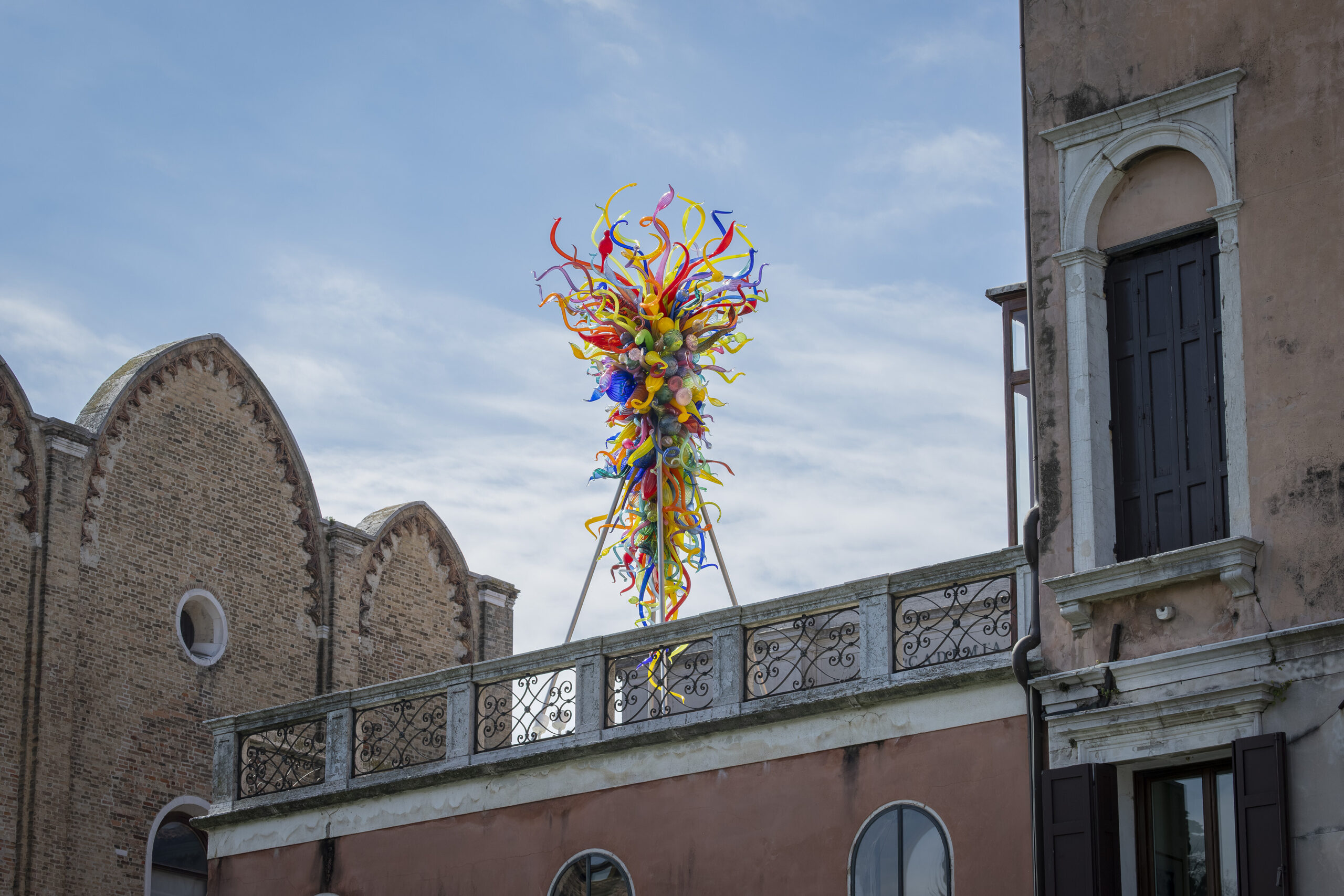
While “Chihuly Over Venice” was a rather renegade affair, self-funded and arranged informally, without formal permits or permissions, the 2026 sequel required months of research and site visits to arrange for just three large-scale sculptures to go on view along the Grand Canal, all viewable from the Accademia Bridge.
“We literally walked almost every inch of Venice looking at different sites,” Britt Cornett, the Chihuly Studio director of exhibitions, recalled. (That even included the hospital, on the city’s northern edge.) In the end, the team settled on the Palazzo Franchetti, Palazzo Querini alla Carità, and the Palazzo Balbi-Valier Sammartini, where a friend of the artist who had hosted a chandelier in 1996 was happy to take part once again.
The opening comes just a few weeks after a vandal, apparently suffering from a mental breakdown, smashed 12 glass sculptures at Chihuly Garden and Glass, a permanent exhibition in Seattle, causing $240,000 in damage.
“That was crazy,” Jackson Chihuly admitted. But while the destroyed works cannot be remade—they date to Chihuly’s time working in Finland—the display is large enough that it was easy to rearrange the remaining pieces without any noticeable difference. And the incident, while unfortunate, certainly added to the buzz around the Venice show, combined with serendipitous recent appearances as a clue in both the New York Times crossword puzzle and the Jeopardy! game show.
So it is with a sense of triumph that Chihuly’s newest show arrived in Venice, shipped with the greatest of care from his Seattle studio, a museum-like facility on Lake Union named the Boathouse after its long history as a boatbuilding workshop.
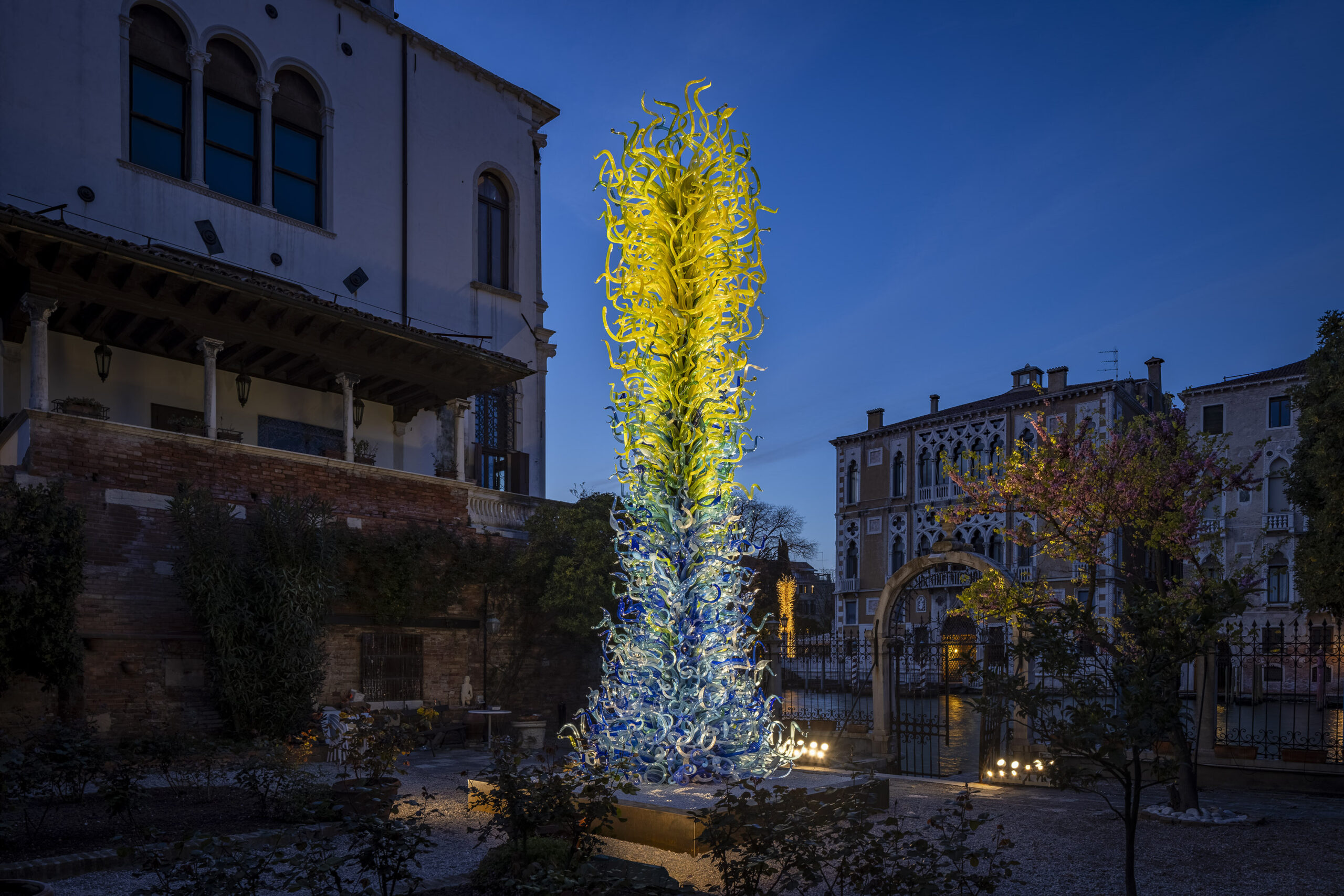
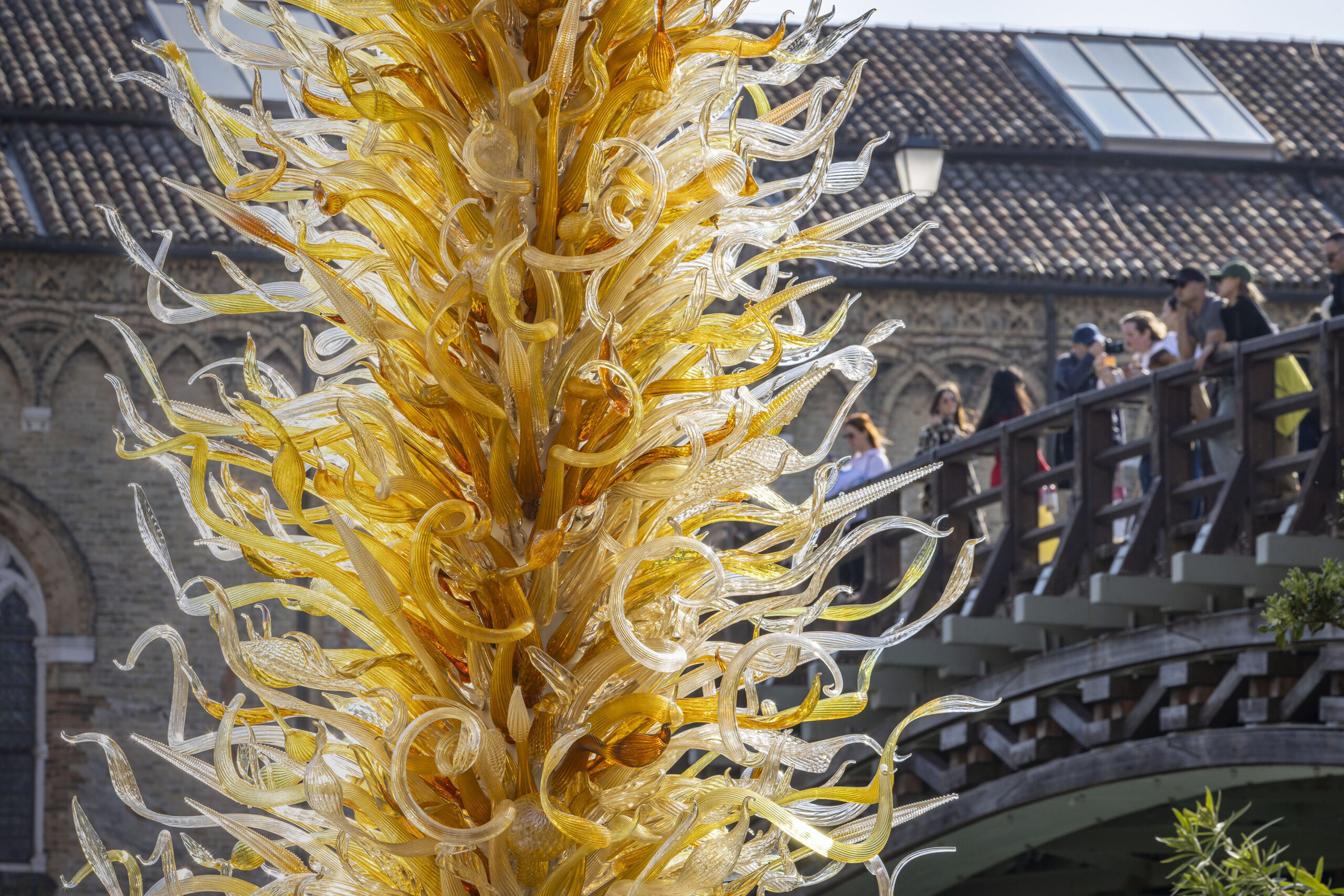
The full range of Chihuly’s mastery of color is apparent in the three installations (all made in 2025), with the amber translucence of the 31-foot-tall Gold Tower contrasting with the vibrant green-to-blue ombré of the curlicue baubles of Blue Green Tower, which measures 26.5 feet tall. The two works have some 1,600 and 1,400 handblown forms, respectively. And there’s a special nod to glassblowing tradition in the 16-foot-tall End of the Day Chandelier, which takes its name from the thrifty practice of reusing all the discarded scraps of glass to make one final work when a project is done. It features a bold mix of 350 leftover red, blue, yellow, and green glass coils, bulbs, and tendrils, swirling together in a carnival-esque, confetti-like display.
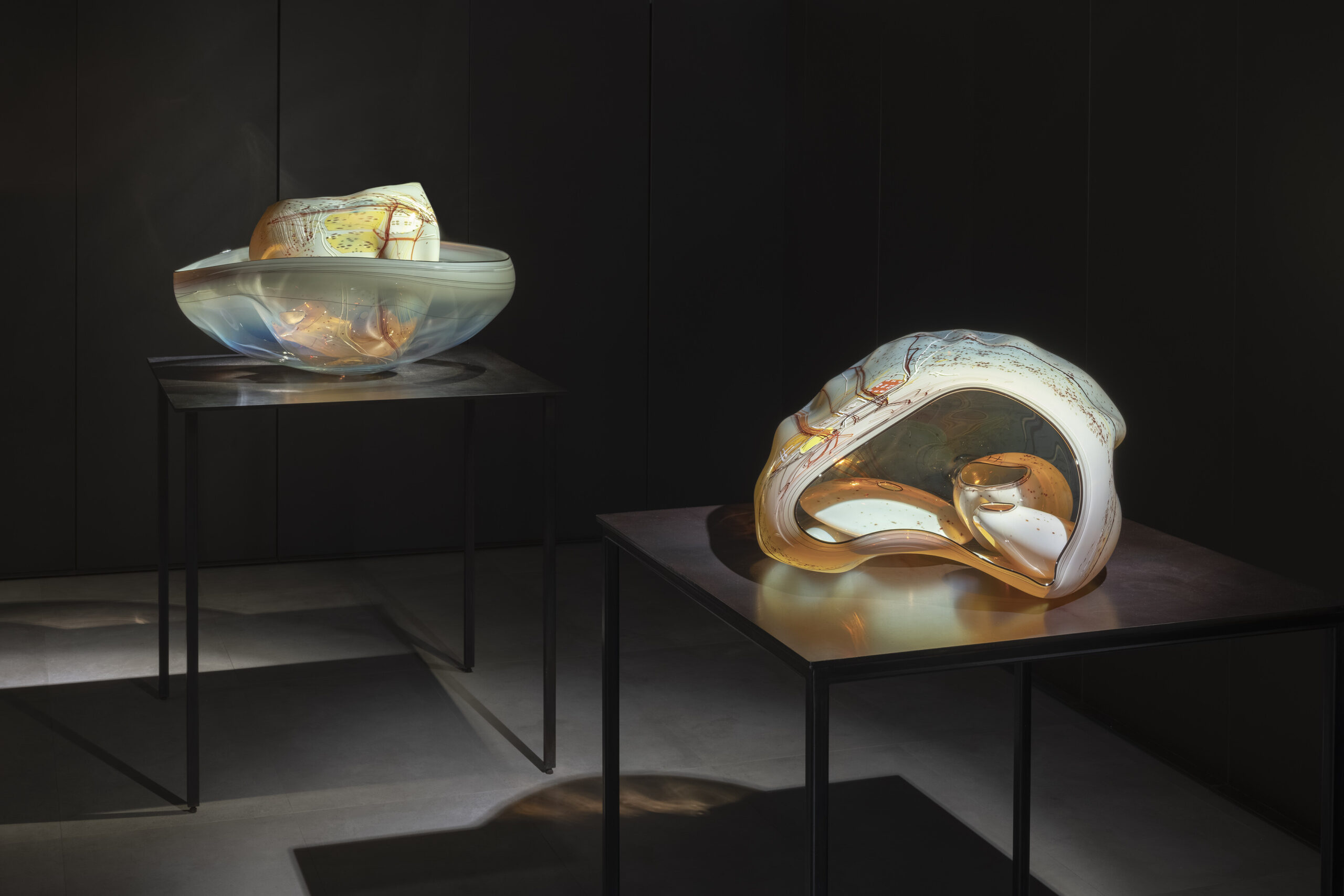
There’s also an accompanying gallery show curated by Suzanne Geiss at the Istituto Veneto di Scienze, Lettere ed Arti. On view are Chihuly’s faxed drawings and notes prepping for the 1996 show—a key element of his practice, as injuries have prevented him from blowing glass since 1979—as well as a gorgeous array of colored photographs documenting the exhibition. A second room presents Chihuly’s delicate, nested “Celadon Baskets,” a 2017 series inspired by Native American baskets and his early interest in weaving. Through years of experimentation, Chihuly embraced the natural slumping and asymmetry of blown molten glass, giving each work an almost organic quality.
Chihuly’s work has become so familiar that it’s easy to take for granted the technical and artistic innovation that make it all possible. Each towering sculpture is made from fragile, delicate glass, installed on a custom-designed metal armature system. The artist had to engineer all that for the 1996 Venice show.
“It’s hard to remember that that had never been done before,” Jackson Chihuly said. She is a fierce advocate for her husband’s work, pointing out that “there’s no living artist who has as many permanent collections, in as many places as far flung as he does.”
From his early years, Chihuly always made sure to fully document his work through photographs and videos—a practice that gave “Chihuly Over Venice” an influential second life, as the subject of a PBS film. The 90-minute documentary was the first HDTV film ever broadcast, but it wasn’t just a way to capture a short-lived exhibition for posterity. It brought the beauty of the work, the remarkable contrast of the colored glass against Venice’s blue-green waters and romantic palazzos, to the world. Now, there’s another chance to experience Chihuly’s gift to a new generation.
“Dale just says ‘I want to give people joy,'” Jackson Chihuly concluded. “He really wants to make people happy.”
More of our favorite stories from CULTURED
14 Books Our Editors Can’t Wait to Read This Summer
Inside the Closet of a Revered Stylist Who Has Only Worn Prada For Over 30 Years
Charles Melton Actually Has No Idea Where His Career Goes From Here
Introducing a Play For Every New Yorker Who’s Had More Bad Dates Than Good
7 Commandments for Rookie Collectors, From CULTURED’s Power Art Advisors
Sign up for our newsletter here to get these stories direct to your inbox.


 in your life?