
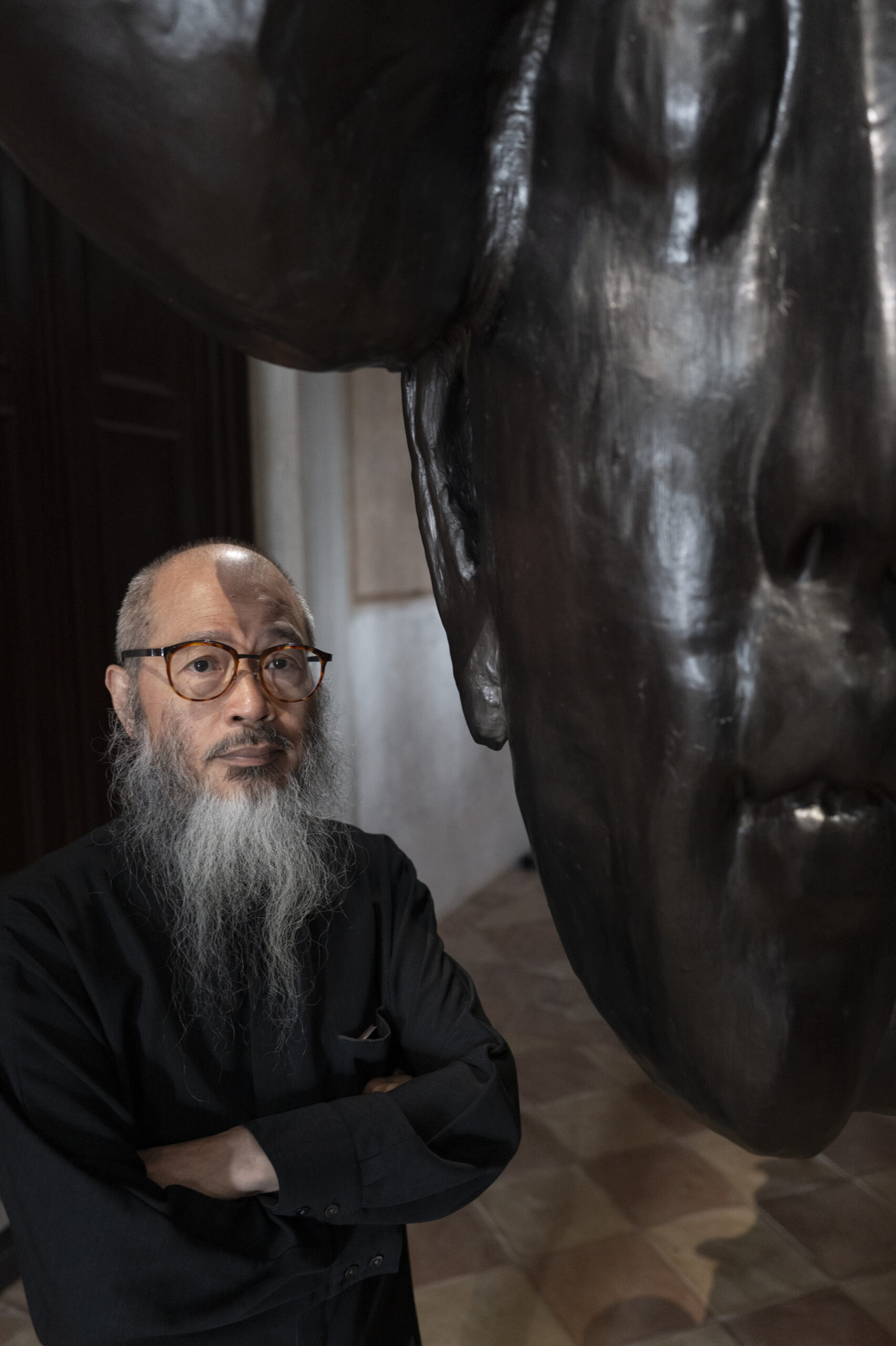
Wallace Chan once renounced the material world. Now he constructs it.
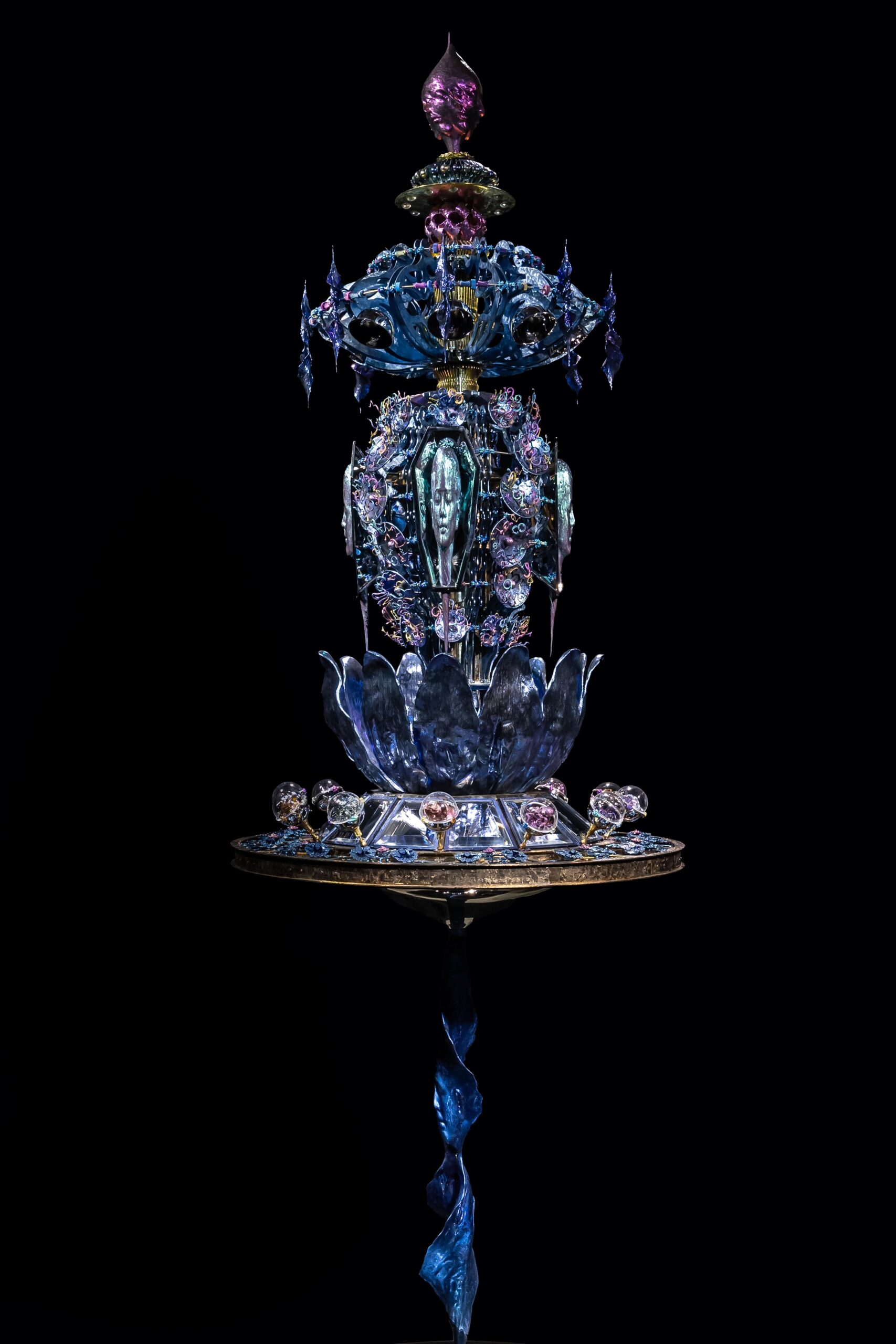
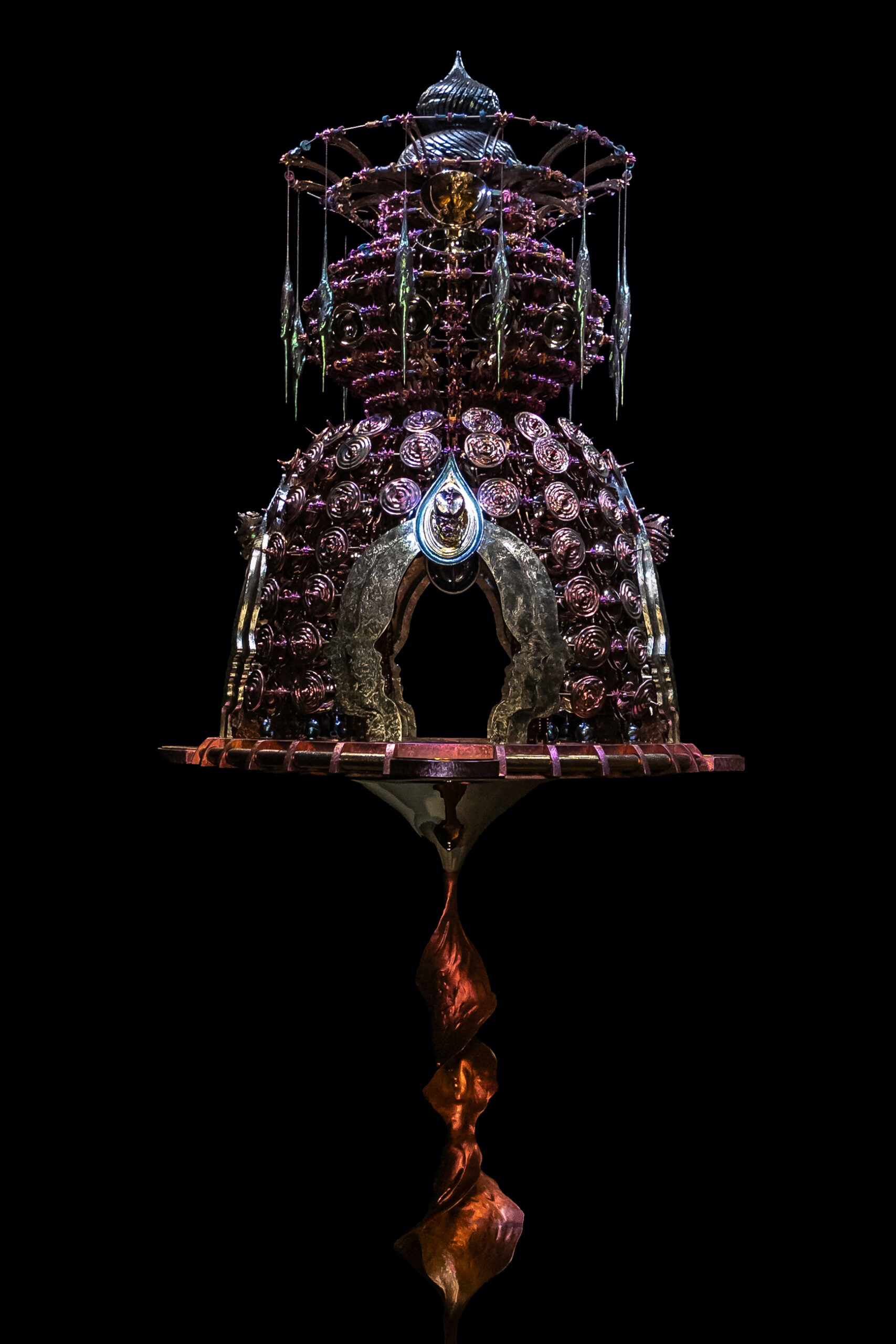
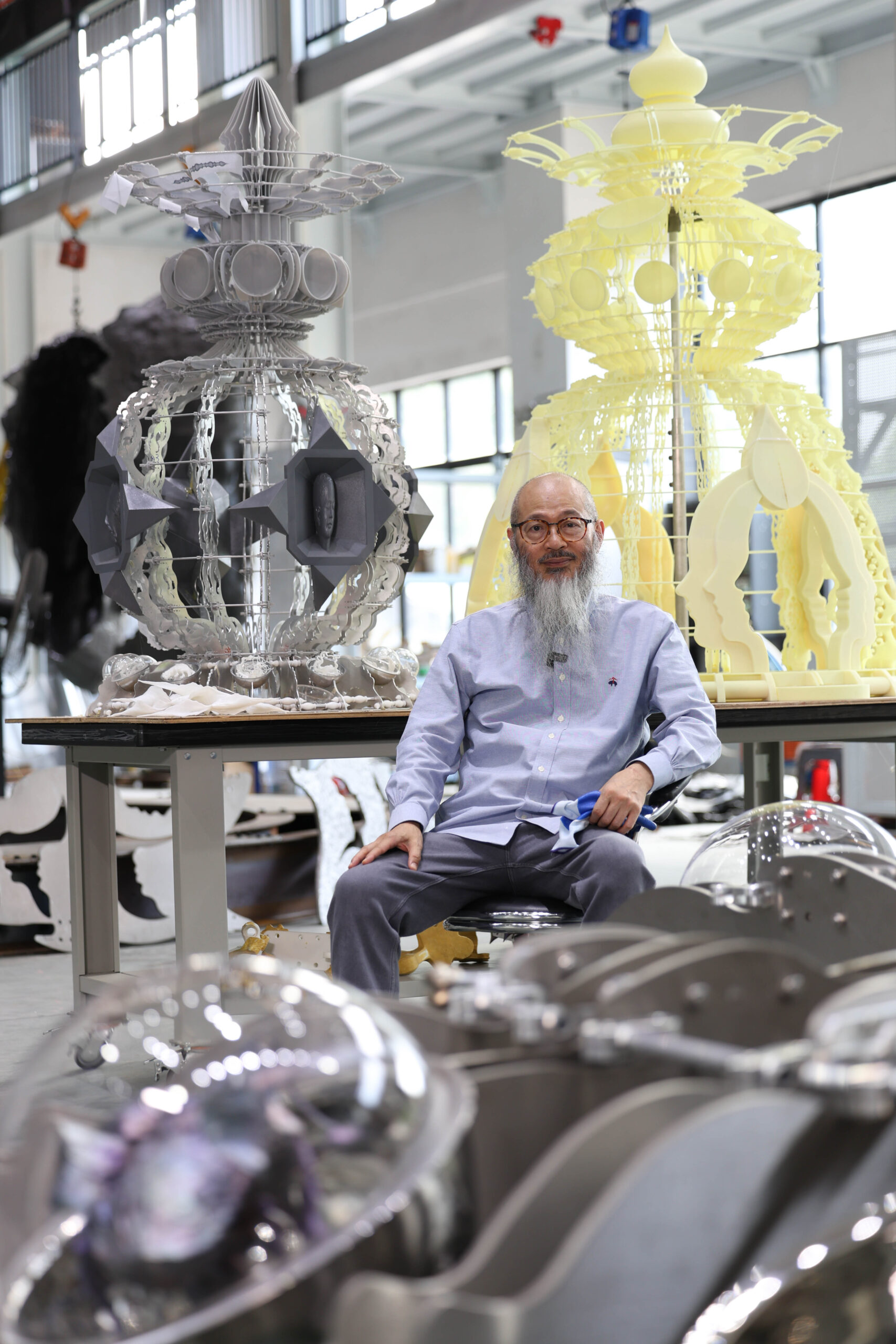
The artist and former monk’s latest exhibition, “Vessels of Other Worlds,” opening at the Chapel of Santa Maria della Pietà on May 8, coinciding with his 70th birthday, during the Venice Biennale and at Shanghai’s Long Museum on July 18, presents three titanium giants—towering at seven, eight, and 10 meters tall, evoking the oil vessels used in religious ceremonies.
The Hong Kong-born sculptor and jeweler himself spent years as a Buddhist monk before turning to titanium sculpting at a scale most foundries wouldn’t attempt. Five decades later, he’s built a practice where Eastern and Western philosophy and craft coexist, describing the time it takes to capture a moment in titanium as cyclical rather than linear. “Memory does not simply record the past. It reshapes it. It evolves as we evolve,” he explains. “It can take centuries to complete a single moment of being.”
The artist sat down with CULTURED to share a few of the memories embedded in his latest works, as well as his thoughts on the cultural distance between Venice and Hong Kong.
How were you first introduced to titanium as a material for use in sculpture?
There was never a single moment when I decided titanium could be used for sculpture. The turning point came when I realized titanium could become my artistic medium—capable of carrying whatever I wanted to create. Titanium is demanding. Its melting point is close to 1,700 degrees Celsius. It has strong memory and resists manipulation. You cannot dominate it. You have to understand it.
The three vessels to be shown at the Long Museum are physically heavy. They stand seven, eight, and 10 meters tall, and the seven-meter vessel alone weighs 4.6 tons. Titanium is lighter than many other structural metals, but there is nothing light about these works in physical terms. What it allows is structural precision at this scale. Thousands of components interlock and remain stable as one system.
For me, titanium is the material closest to eternity. It resists corrosion and survives extreme conditions. In “Vessels of Other Worlds,” it gives physical form to the cycle of birth, growth, and rebirth. Birth is constructed as an interdependent mechanism—gears and human figures embedded within the structure—suggesting that existence begins in movement and relationship. Growth expands in scale and spatial complexity, allowing the viewer to enter and experience the structure from within. Rebirth folds the cycle back into itself. It is not an ending, but a return. It allows me to approach the idea of continuity as a possibility.
What about the Chapel of Santa Maria della Pietà made you return for this year’s Venice Biennial, after exhibiting “Transcendence” there in 2024?
I felt that my dialogue with the space was not finished. The Chapel is long, narrow, and quiet. It is not monumental in scale, but it carries centuries of presence. It requires concentration rather than expansion. At the Long Museum, I explore monumentality through physical scale. In the Chapel, I explore monumentality through complexity and restraint. The architecture shapes the work. It asks the sculpture to respond, not to dominate. In Venice, the vessels exist in a state of becoming. The space encourages inward reflection. That condition is different from Shanghai, where the sculptures stand fully realized in open architectural volume. Returning to the Chapel allowed me to continue that conversation between space, material, and the cycle of life that the work embodies.
How do you see religion appearing in your work, considering your time as a Buddhist monk, and interest in the sculptures you’ve encountered in Christian cemeteries?
All religions are philosophies. They are questions and contemplations about existence. Across East and West, the language may differ, but the human impulse is the same. We continue to ask: Who am I? Why am I here? What lies beyond what we can see? In every culture, people turn to objects, rituals, and vessels to approach what cannot be fully explained. Religion, for me, is not doctrine. It is a method of inquiry, a way of moving from one state of understanding to another without insisting on a single answer. That spirit of inquiry continues in my work.
Of this body of work, you’ve said that “like water, they hold what cannot be held—moments, emotions, the passage of time.” What do you see as the connection between memory and water?
Water carries. It transforms. It takes the shape of whatever contains it. Memory behaves in a similar way. It has no fixed form, yet it shapes us, and we shape it. That reciprocity interests me. You shape me as I shape you. My work functions in the same way. I once believed I was sculpting the sculpture. Over time, I realized the sculpture was also sculpting me. Creation is not one direction. It is constant exchange, like memory, like water.
How did the three stages of life and Hieronymus Bosch’s The Garden of Earthly Delights become influences for these sculptures?
When I first encountered Bosch, I was struck by how contemporary his imagination felt. His vision moves beyond his own time. The density of imagery, the strange forms, the simultaneity of different states of being—everything feels in motion. The Garden of Earthly Delights is a triptych: three panels forming one continuum. Beginning, unfolding, transformation. In “Vessels of Other Worlds,” Birth, Growth, and Rebirth follow a similar rhythm. They are not separate chapters, but interdependent states within one cycle. Like Bosch’s garden, multiple conditions coexist at once. Nothing is fixed. Everything is becoming.
The exhibition coincides with your 70th birthday. How has your own understanding of memory and life stages changed, and how has that understanding shaped this body of work?
When I was younger, I might have understood life in a more linear way—moving forward, accumulating experience. Over time, I have come to see life as cyclical. Birth, Growth, and Rebirth are not distant stages. They overlap and exist within one another. Memory does not simply record the past. It reshapes it. It evolves as we evolve. This exhibition reflects that understanding. The three vessels are not separate narratives. They form one continuous rhythm—a cycle rather than a conclusion. It can take centuries to complete a single moment of being.
Your practice bridges Eastern and Western philosophies. How do you maintain specificity while allowing these traditions to coexist within the same piece?
I grew up in Hong Kong, where coexistence is ordinary. Next to a dim sum restaurant is an Italian bistro. In a local café, you can order macaroni in soup. In the same pharmacy, you can find Western medicine and traditional Chinese herbs. East and West are not theoretical positions there. They exist side by side in everyday life. I do not consciously merge philosophies. I live within that coexistence. Each tradition retains its specificity, but they share the same space. In my work, I am not trying to blend them into something uniform. I allow them to remain distinct while existing within the same structure.
Venice is a city defined by erosion and constant intervention. Did the city’s physical condition enter your thinking as you visualized this installation?
In Venice, material is always visible. Stone absorbs water. Surfaces erode. Buildings require constant reinforcement. That reality informs how one thinks about monumentality. Monumentality is not only about scale. It is about how a structure stands over time. It is about construction, support, and interdependence. That is why I arrived at the idea of complexity. Rather than making a single solid mass, I constructed systems—thousands of components working together. Monumentality, in this context, comes from the integrity of the structure.
When the exhibition closes and the works disperse, what do you hope the most impactful takeaway for guests will be?
Birth’s emptiness is potential. Death’s potential is emptiness.
More of our favorite stories from CULTURED
14 Books Our Editors Can’t Wait to Read This Summer
Inside the Closet of a Revered Stylist Who Has Only Worn Prada For Over 30 Years
Charles Melton Actually Has No Idea Where His Career Goes From Here
Introducing a Play For Every New Yorker Who’s Had More Bad Dates Than Good
7 Commandments for Rookie Collectors, From CULTURED’s Power Art Advisors
Sign up for our newsletter here to get these stories direct to your inbox.

 in your life?
