
For years, Harper Levine's success was tied to his outsider relationship with the art world. His cultish East Hampton bookstore evolved into a gallery almost by accident, and even as it became a buzzy destination for beach-bound New Yorkers, the spot never felt commercial or institutional. His was a gallery that embodied all the laid-back elegance of its East End location—and people loved it for that reason.
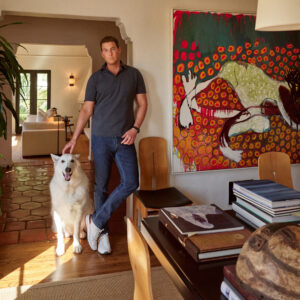
But Levine is no longer on the margins looking in. With five outposts in New York and one in Los Angeles, the dealer is now officially an art-world insider. It’s kind of freaking him out. “Honestly, it has completely changed,” says Levine when asked if the rapid maturation of his gallery has altered the way he feels about what he does. “I definitely feel like that outsider label, for better or worse, has been shed. I think that’s the central tension in what I’m doing now.”
As he speaks, Levine is sitting in an office in one of two galleries he owns on West 22nd Street in Manhattan. The 55-year-old sounds enthusiastic and energetic, which comes as a mild surprise, considering that he has just wrapped up back-to-back fairs on opposite sides of the world: Taipei Dangdai in Taiwan and NADA in New York.

It’s the new norm for the dealer, who has spent the last three years aggressively growing his once humble gallery. In 2020, 2021, and 2022, he opened locations in New York, Los Angeles, and then New York again, respectively. During that time his footprint tripled, his roster of artists increased to 21, and his staff ballooned to 16.
But more than the numbers, it was the speed of it all that proved to be the most surprising. Up to that point, Levine’s evolution had been slow and organic; it was part of his charm. In 2001, just a month after 9/11, Levine and his wife moved from Minneapolis, Minnesota, where he sold rare books online, to the Hamptons. In 2005 he moved Harper’s into the storefront where it exists today, sharing the site with another antiquarian; by 2010 he owned the location outright. During that time he went from specializing in literary first editions to photo books and, eventually, prints. His first exhibition, a presentation of work by photographer Matt Weber, came in 2007 and was only a modest financial success. It did, however, catch the attention of one important buyer: the artist Richard Prince.

Levine and Prince struck up a friendship that remains strong today. In Prince, Levine found his biggest fan. “Richard is basically responsible for my whole career,” says the dealer, still buoyed by the confidence the artist instilled in him 15 years ago. “If Richard Prince thought what I was doing was cool, then … it must’ve been cool,” he recalls thinking at the time.
But Prince provided the dealer with another pivotal element. In 2014, after an artist abruptly canceled plans to show at Harper’s, Levine was in dire need of a replacement. In came a one-word text from Prince: “Figgis." Levine’s friend was referring to Genieve Figgis, a then-unknown Irish painter whom Prince had discovered on Twitter. On a lark, Levine threw together an exhibition of Figgis’s mordant, neo-Rococo portraits. To his surprise, the show was a word-of-mouth hit. It sold out and launched the artist—who at that point was a full-time mom painting in her Dublin kitchen—into art world stardom. It also put Levine’s gallery on the map.

“That really changed the trajectory of how I was looked at and what I was doing,” he says. Soon after, business boomed, and by 2016 he opened Harper’s Apartment, a salon-style gallery space in a townhouse on Manhattan’s Upper East Side. When asked about his decision to further expand in 2020, when the pandemic deflated real estate prices and allowed him to scoop up discounted properties, Levine mentions his admiration for Prince, Figgis, and other artists associated with Harper’s. For him, the connection is not what these artists do for his business, but what they’ve taught him through their own success.
“The thing that makes a successful artist is acceptance of risk,” Levine explains. “Every good artist takes risks by definition. So I felt like I had to take a risk too. The risk-taking was, in a sense, the project for me." Levine recalls going on long runs through the East End in the spring and summer of 2020, that moment of existential alarm. “I had a lot of time and was thinking about my life and understanding that I wasn’t getting younger,” he says. “I realized that if I wanted to really make a dent as a gallerist, I was going to have to do it then.”


 in your life?