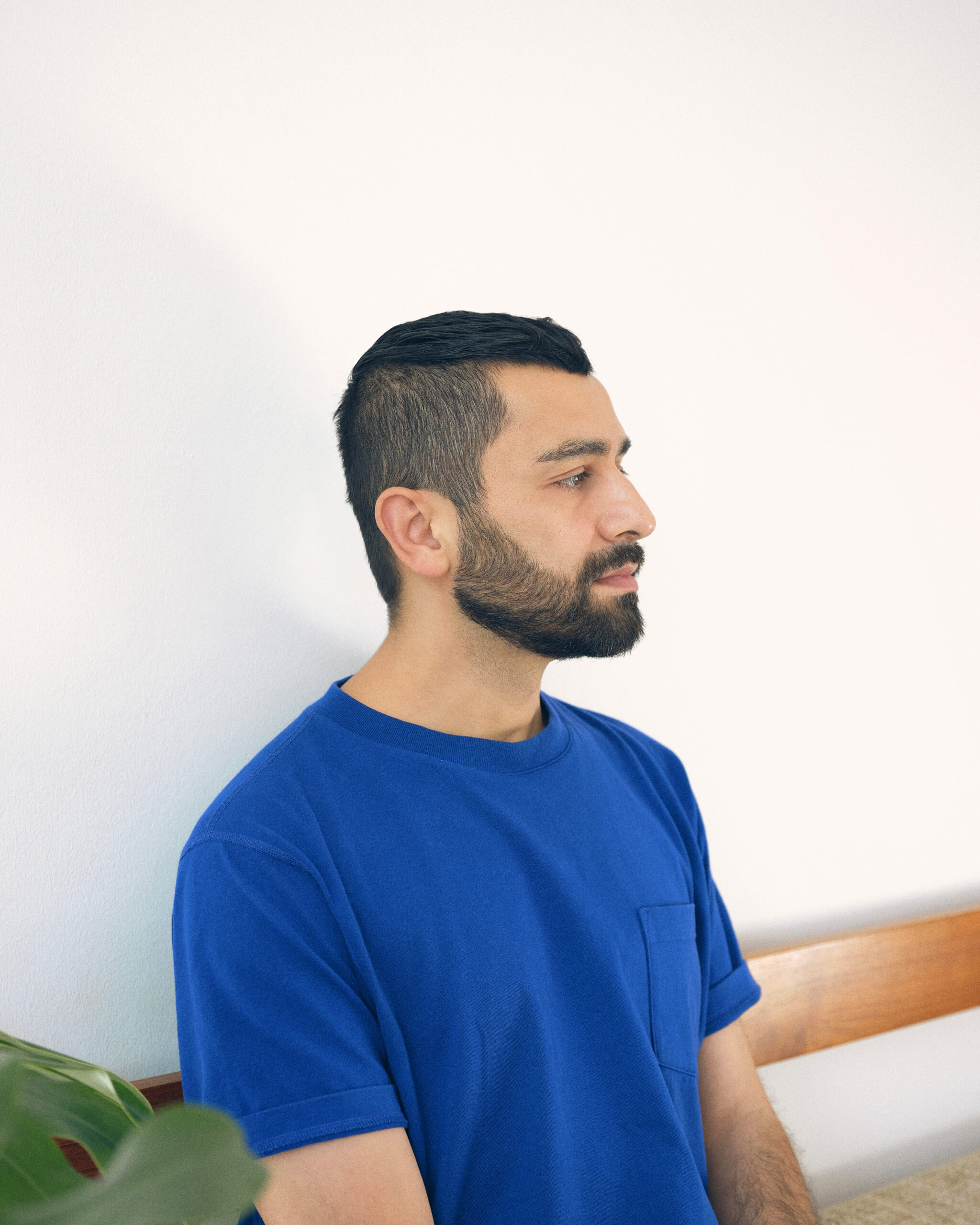
In turning Canada’s national pavilion at the Venice Biennale into a greenhouse, Abbas Akhavan has learned to let go of control. “At best, it’s humbling to be reminded that we’re at the mercy of nature,” the artist tells me. Akhavan, whose work is mostly site-specific, says the experience of installing in Venice has reminded him that much in the natural world cannot be controlled: “You’re not really the subject, you’re the custodian. You have to abide by its temperament, not your will.”
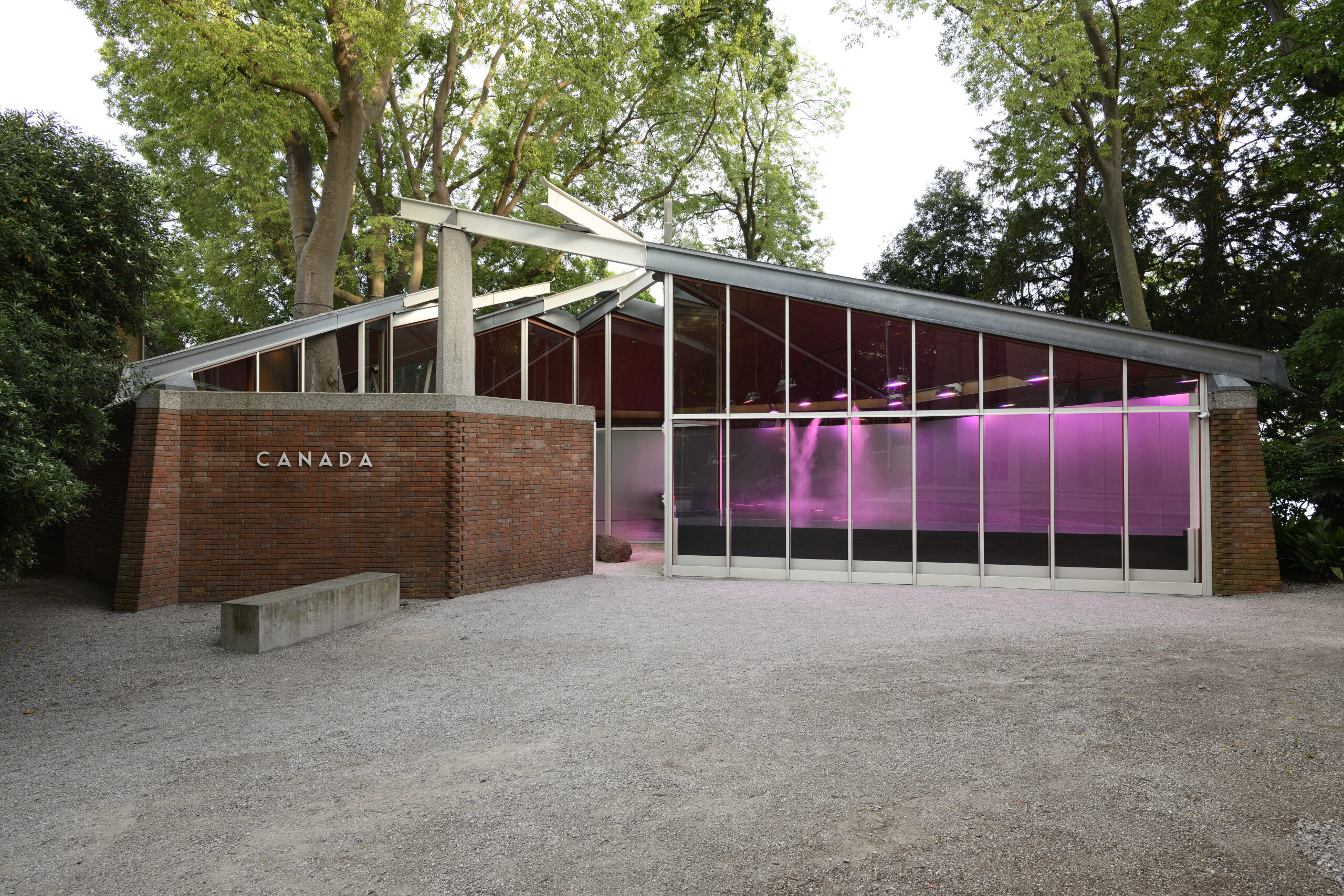
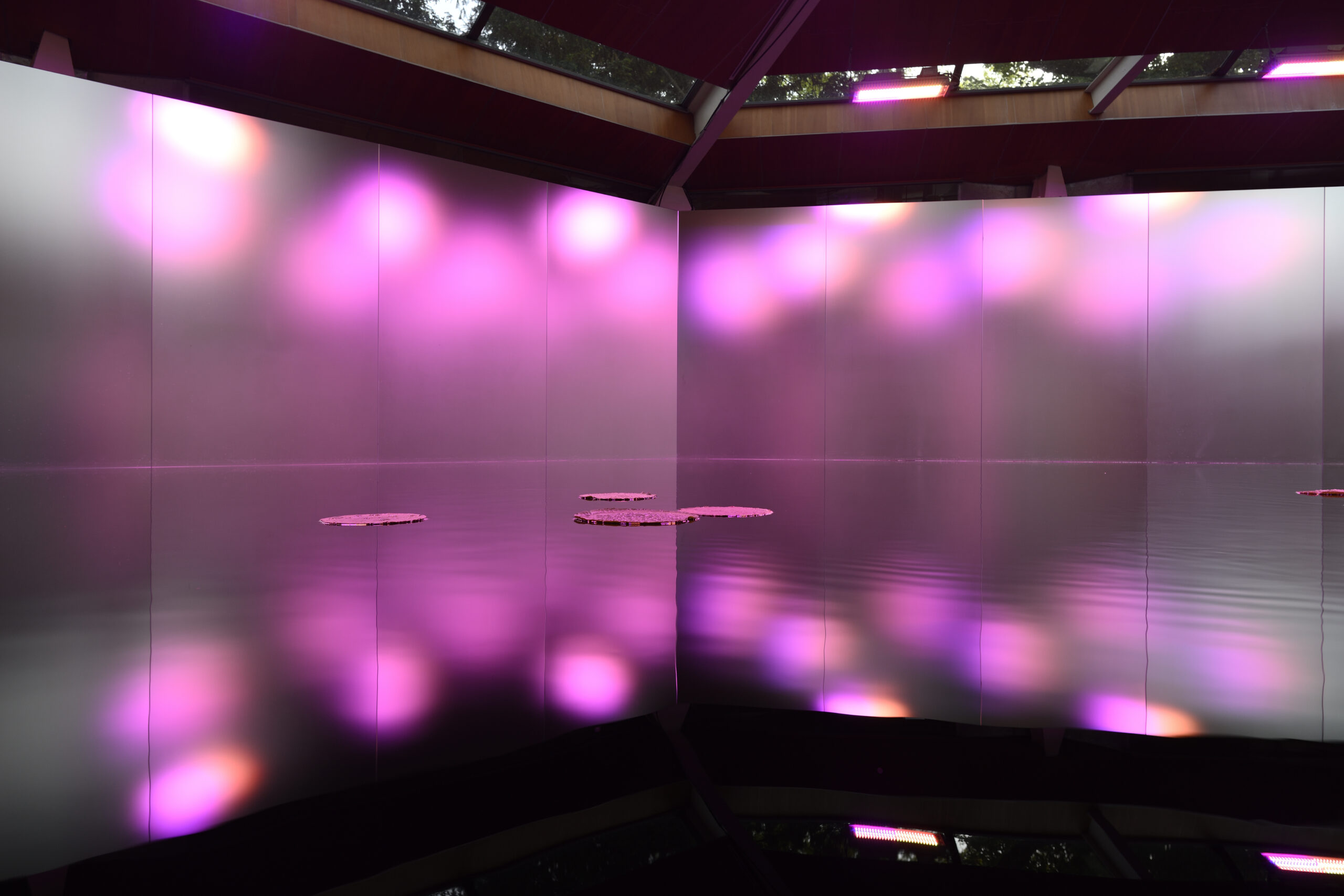
Visitors can expect a totally different pavilion this year. Curated by Kim Nguyen, director of programs at the Ruth Foundation for the Arts, commissioned by the National Gallery of Canada, and supported by the Canada Council for the Arts, the exhibition “Abbas Akhavan: Entre chien et loup” has seen the wooden panel doorway that usually guards the entrance completely removed. Instead, a vast expanse of glass affords a view onto a pond containing around half a meter of water within the gallery space—which will have a pinkish hue for the duration of the exhibition (on view through Nov. 22). The only light sources are sunlight and LED grow-lamps, which Akhavan says “are partial” to pink. Especially at twilight, the building will glow. “It feels like a bit of a spaceship,” he says.
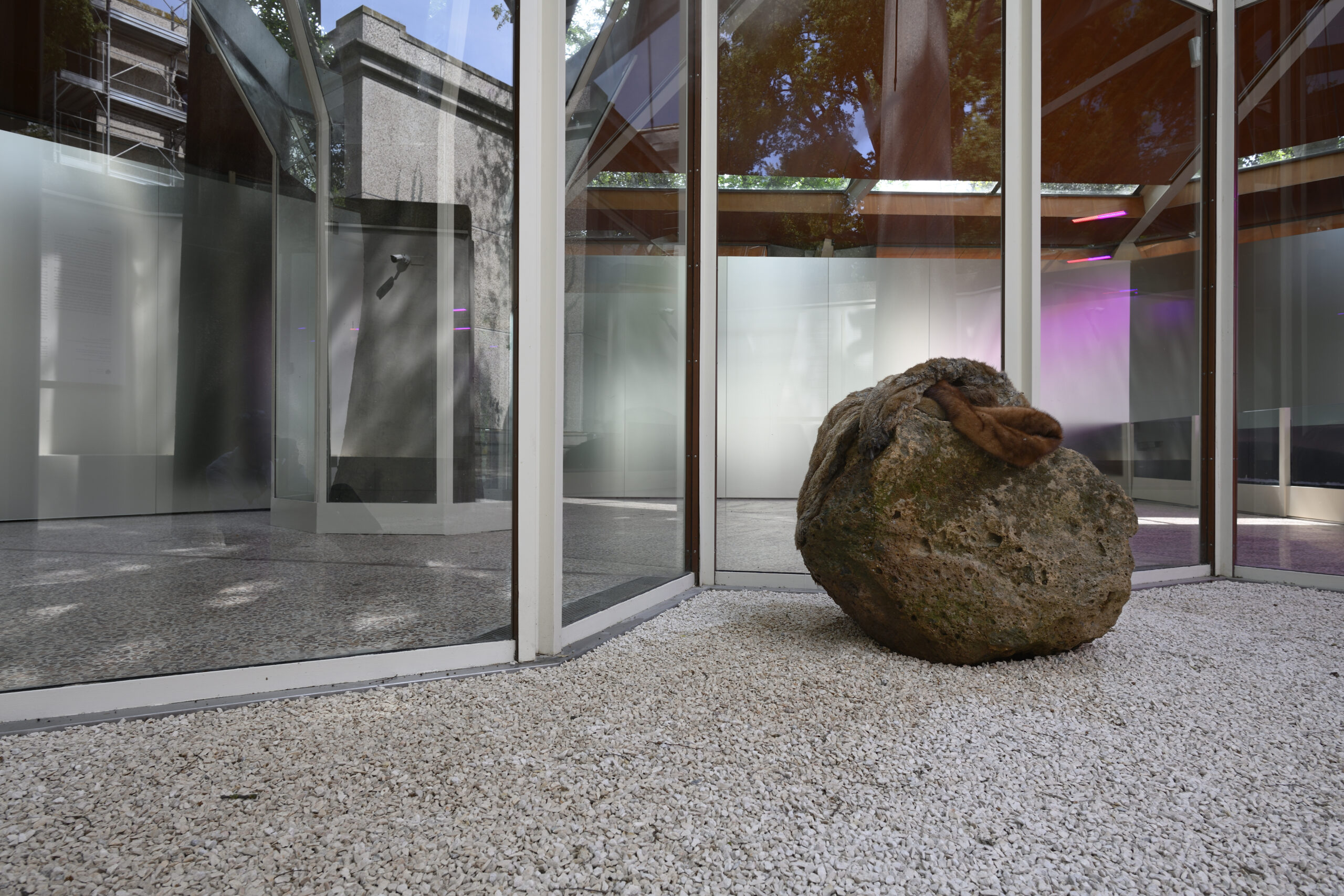
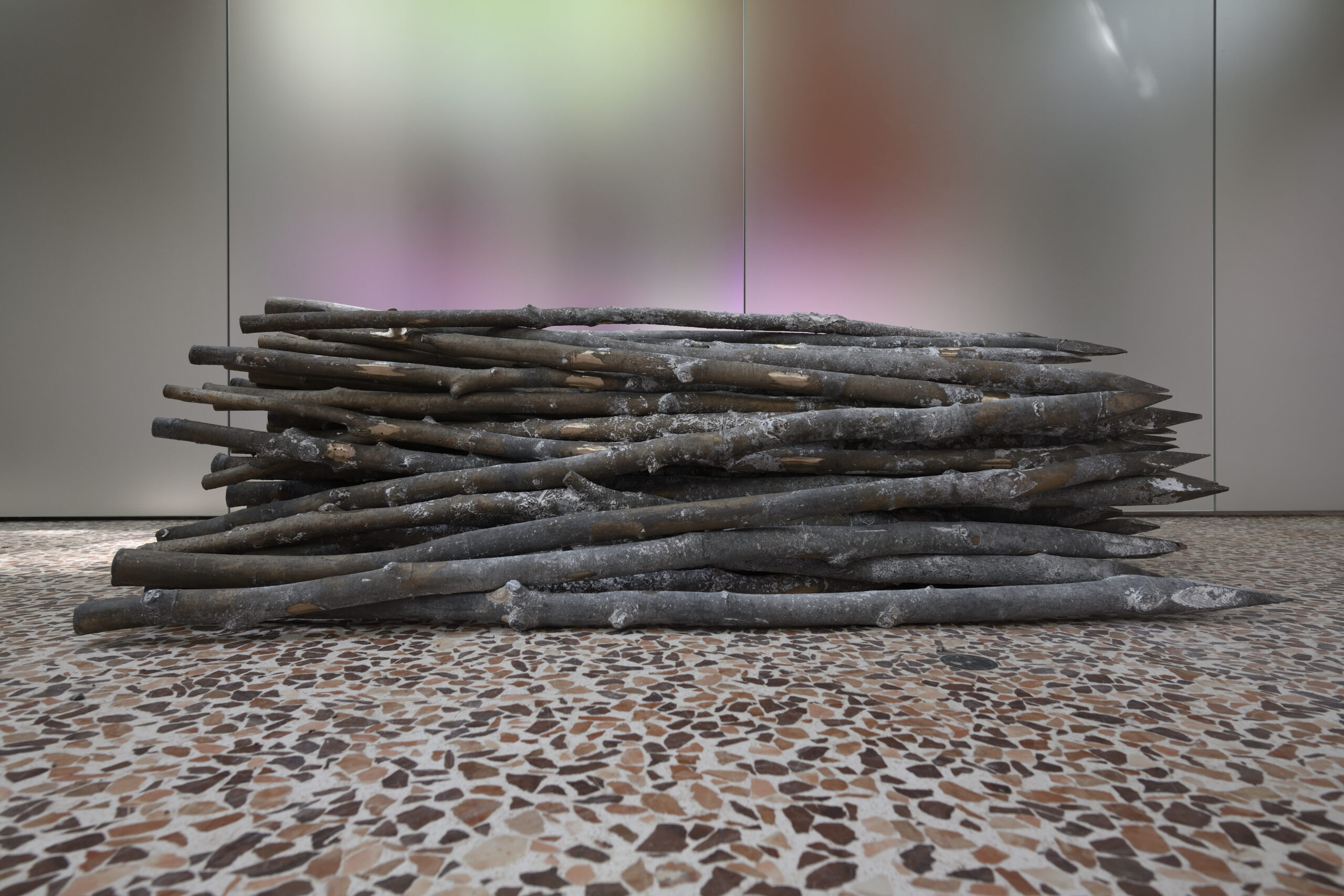
Before entering, visitors pass large, mossy boulders, one draped in a vintage fur coat retaining its animalistic presence (“I got one that had a bit of a wild, tattered look to it,” Akhavan says). Every so often, a mister will spray water above the coat, the excess running out of its sleeve. Not far are a stack of sharpened sticks, which resemble petrified branches but are actually unpatinated bronze.
Once inside the gallery, visitors are surrounded by mirrors, which Akhavan wanted to “deny or blur” the architecture, making it less like a gallery and more “jewel-looking.” He initially planned clear mirrors that would reflect the space but realized people would just take selfies, so instead installed custom frosted glass. “Now you don’t see your reflection, but you see luminosity,” he says. “Life isn’t a simulation on your telephone,” he says, adding: “At best, art makes you halt. Not to teach a lesson, but to create space for a thought you haven’t had before. Right now, most of our thoughts come from our phones. We don’t have self-reflexivity—we just reflect what we see there.”
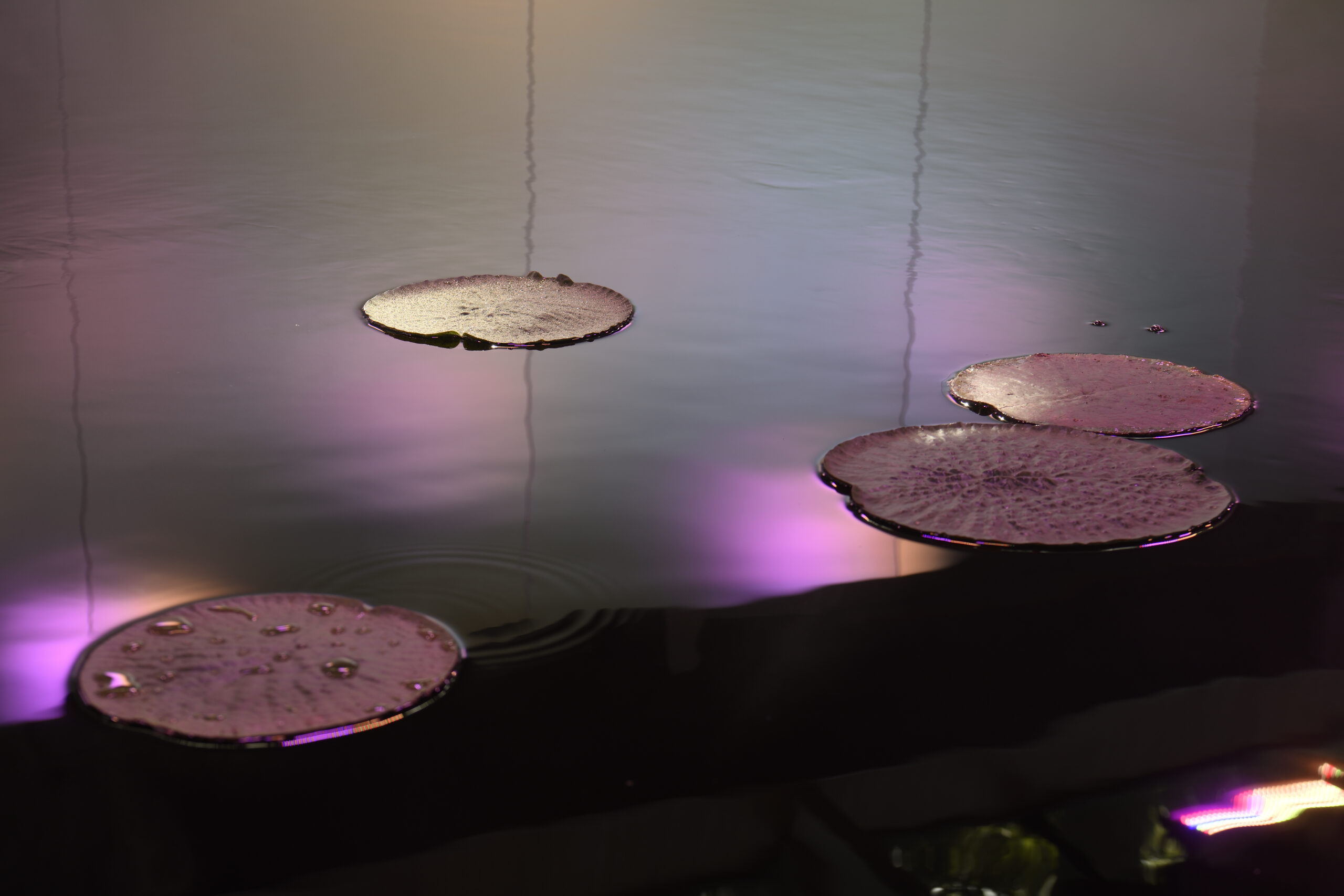
The light should bounce off the water where—at some point this summer—three giant Bolivian water lilies will steal the show. Normally grown at the Victoria Lily House at Kew Gardens in London, the seeds were sent to Padua for the project, where they have been raised to maturity before being transplanted to Venice. “Our pavilion is a kind of a custodian satellite space for these plants,” Akhavan says, noting that Kew’s Lily House is closed for renovations in 2026, and Padua gets a new plant species in exchange for its role in the process.
Akhavan thinks the plants “will peak in June—not at the opening. You can’t control it. You just have to listen to what it needs.” Their leaves should each unfurl to around a meter and a half in length, and each plant should have 20 or 30 leaves. “For the opening, they won’t be very big—it’ll look very sparse. But as time passes, they will take over the entire pond.”
Akhavan chose the plants because of their history: They featured prominently at the 1851 Great Exhibition in London, “essentially revealing them as a demonstration of England’s capacity to grow these plants from the Amazon in the great Crystal Palace. And so I thought, here’s a world fair again,” he says, referring to the Biennale.
He was interested in the migration and trade of the plants—especially in the context of Venice, a former hub of world commerce—and then discovered this species, the Victoria amazonica, was named after Queen Victoria. “And it was during her reign that Canada was established, essentially.” (Canada was confederated as a dominion of the British Empire in 1867.)
“But I wanted to actually talk about a deeper timeline,” Akhavan says. “The genus of these plants is 100 million years old—so this recent history of baptizing plants from the Amazon under the name of Victoria is a kind of short-sighted relationship considering what these plants come from,” he says. “These plants have an incredible will to thrive. They have a perseverance about them.”
Born in Tehran in 1977, Akhavan moved to Canada with his family during the Iran-Iraq war and settled for a long time in Montreal where he studied art history, a subject he was drawn to “because I realized that art is the only topic that touches on every single topic of the world. From astrology to science, to history, to materials, to health.”
Much of the work he has become known for relates to the destruction of culture or nature. His cast for a folly, 2019, takes as its point of departure a photograph from 2003 of the looted lobby of Baghdad’s National Museum of Iraq, while curtain call, variations on a folly, 2021, at Chisenhale Gallery in London used cob—a mixture of subsoil, water and straw—to evoke the colonnade that once approached Palmyra’s Arch of Triumph in the 2,000-year-old city destroyed by ISIS in 2015. But Akhavan says “everything I’ve made has to do with the defense of art.”
The work is not autobiographical. “So I happen to be from Iran. I’m not Iraqi. I’m not Syrian. But the Iraq war was the war of my generation,” he says. “All the works I’ve made about Iraq were coming from a time where, as a 20-something-year-old living in Montreal, a very politically active city, [it was seen as] an unjust, hyperbolic war,” he says. “It’s like you look at Americans, and so many of them are not Vietnamese, but they made art about the Vietnam War because that was their reality that they were dealing with, that was their political climate.” For him, “it’s never been about politics entirely. Inevitably, politics and these concerns come into talking about art, especially during wartime. But it was about watching the instrumentalization and manipulation and defacement and iconoclasm of art for political means.”
He says he would likely never have made anything about Palmyra if the then-London Mayor Boris Johnson had not unveiled a scaled-down printed replica in London in 2016 which he said was “in defiance of the barbarians.” Akhavan calls the gesture of articulating humanitarianism through powerful historical images a “cat’s paw; the artwork was being used against its will, essentially, to rewrite the history in the wrong narration.”
He adds: “We’re all an accumulation of our experiences, and that guides our way of seeing things, right? But I don’t think I’ve ever made work that is about me as a subject of the work. The world is a lot more interesting than the way I look at it, or the way I’m in it. I’m more interested in the way I look at it as a witness, let’s say.”
Akhavan is “wary of irony or cynicism as art, because those qualities are anxiety-driven. They don’t come from a place of generosity. And they’re not generous to the audience.” He dislikes exhibitions showing disasters or artifice about the world in which we live (“this kind of cynicism of digital technology”), saying: “I don’t find it productive. It taps into the lizard brain and gets at this sense of urgency, but it offers no space of contemplation. You can certainly deliver the gravity of the world’s complexities, but not through cynicism or irony. Those are ways to stay ahead of the audience, that you as an artist are outsmarting them somehow. And I think art has a different kind of responsibility.”
Representing Canada in Venice has prompted a moment of reflection for the artist, who also has a mid-career survey opening at the Walker Art Center in November. “Every artist hits Venice, and then they have a bit of a, What the hell am I doing with my life?” he says. “I’ve already been having that for a while, but I think I’m having a little bit more of it now.”
The instinct, he says, is to keep moving, to let the next thing carry you forward. He is somewhat resisting it. “It’s at these moments that we have to not go with the stream and just look back and be like, What am I actually doing? What part of this is me swimming forward, and what part of it is just me being streamlined or pushed forward by this current?“
More than anything, for him, it is a question of time.“Art’s selfish. At the end, I’m just doing what I want to do. I’m not of service to anyone. I really think there’s a point, especially in your late 40s, where you have to go: I have to be of service now. The world is giving me plenty. And I don’t mean financially, I just mean with my time. That’s what I’ve always invested in.”
He says the attention around the pavilion is something he is navigating with the words of artist Geoffrey Farmer in mind. “I was really young, and he was quite successful in Vancouver and there was a lot of derivative work. I asked him how do you negotiate all this? And he said, ‘We all grow like plants. We all have our own incremental temperance.’”
He is, he says, deeply grateful for what has come. But gratitude is not the same as continuation. “As time changes, our responsibilities have to change. That could also be just becoming a very modest studio-based artist. I don’t know what that means.” What he really wants, he says, is to work with animals. “To be frank with you, I would go into conservation work with animals, if I could do anything. For desire, for that vacuum of desire.” He describes a dream project—making parts of parks inaccessible to humans, so foxes in London could thrive in safe enclosures, animal bridges arching over highways. “In the name of art, you create these boundaries for animal life to thrive within urbanscapes.”
Venice is a peak for many artists, and he says sometimes “you reach something where you have to look in the mirror really hard.” As he says this, it is hard not to think of the opaque mirrored pavilion he has created, in which the glass is purposefully frosted so accurate reflection is impossible. When I say this, he laughs. “They’re blurry. You have to get really close, and then you see yourself, actually. When you come, you’ll see them.”
More of our favorite stories from CULTURED
14 Books Our Editors Can’t Wait to Read This Summer
Inside the Closet of a Revered Stylist Who Has Only Worn Prada For Over 30 Years
Charles Melton Actually Has No Idea Where His Career Goes From Here
Introducing a Play For Every New Yorker Who’s Had More Bad Dates Than Good
7 Commandments for Rookie Collectors, From CULTURED’s Power Art Advisors
Sign up for our newsletter here to get these stories direct to your inbox.

 in your life?