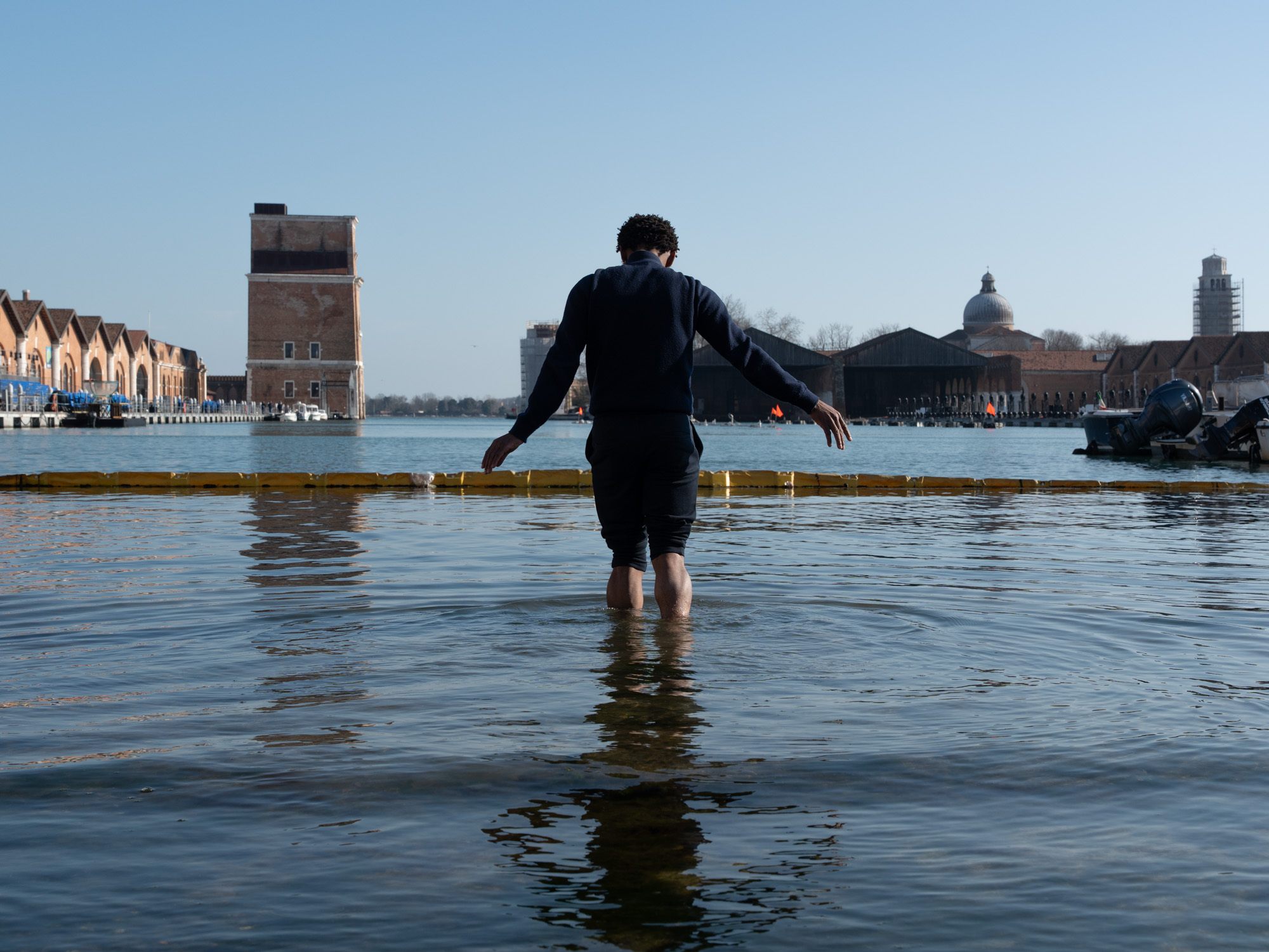
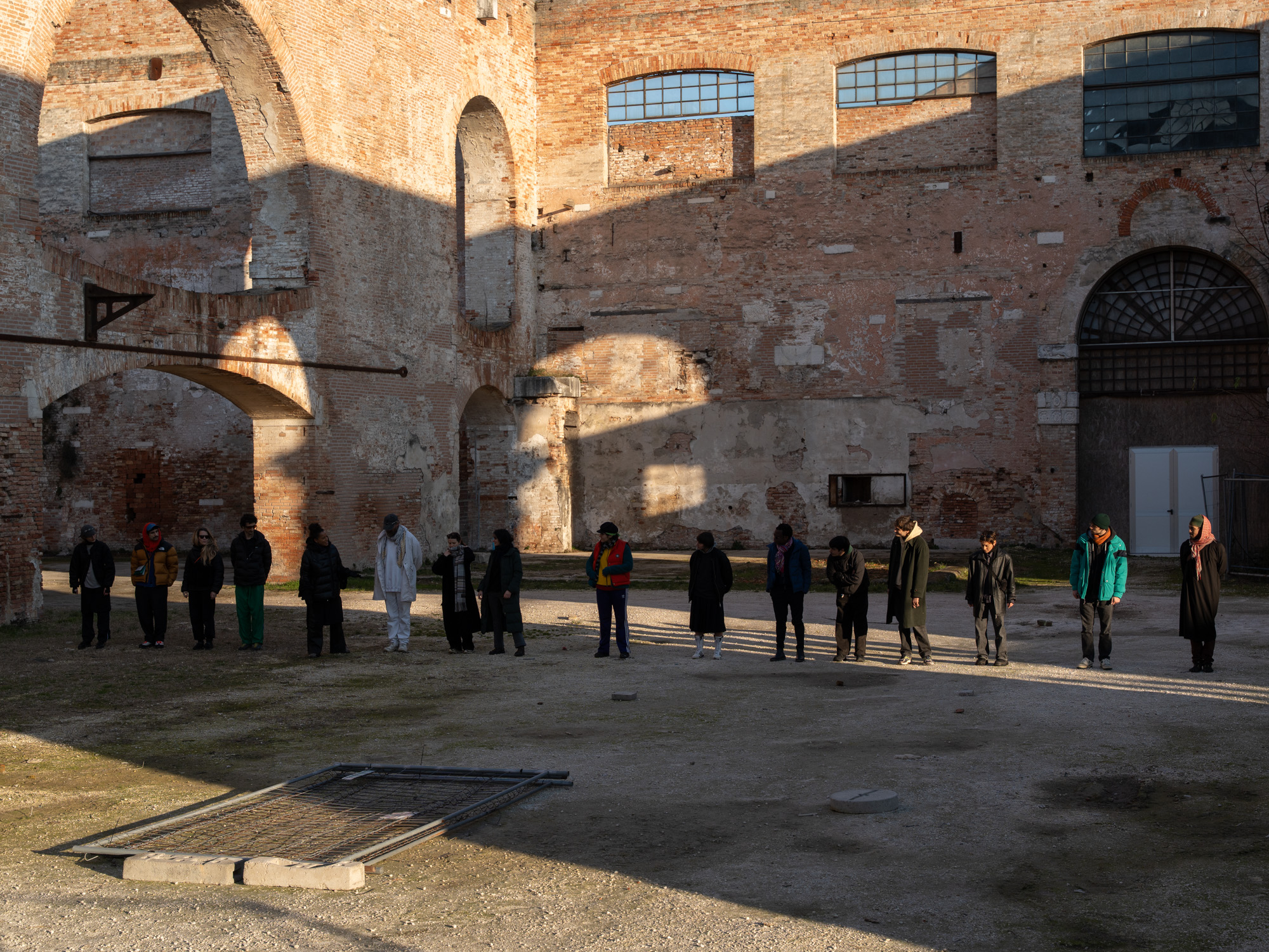
The Congolese choreographer Faustin Linyekula bends down and draws parallel lines into the gravel while a group of young people huddle around him. He looks like a football coach sketching out a play. “It’s like a big corridor,” Linyekula explains. They nod. There are two days until showtime.
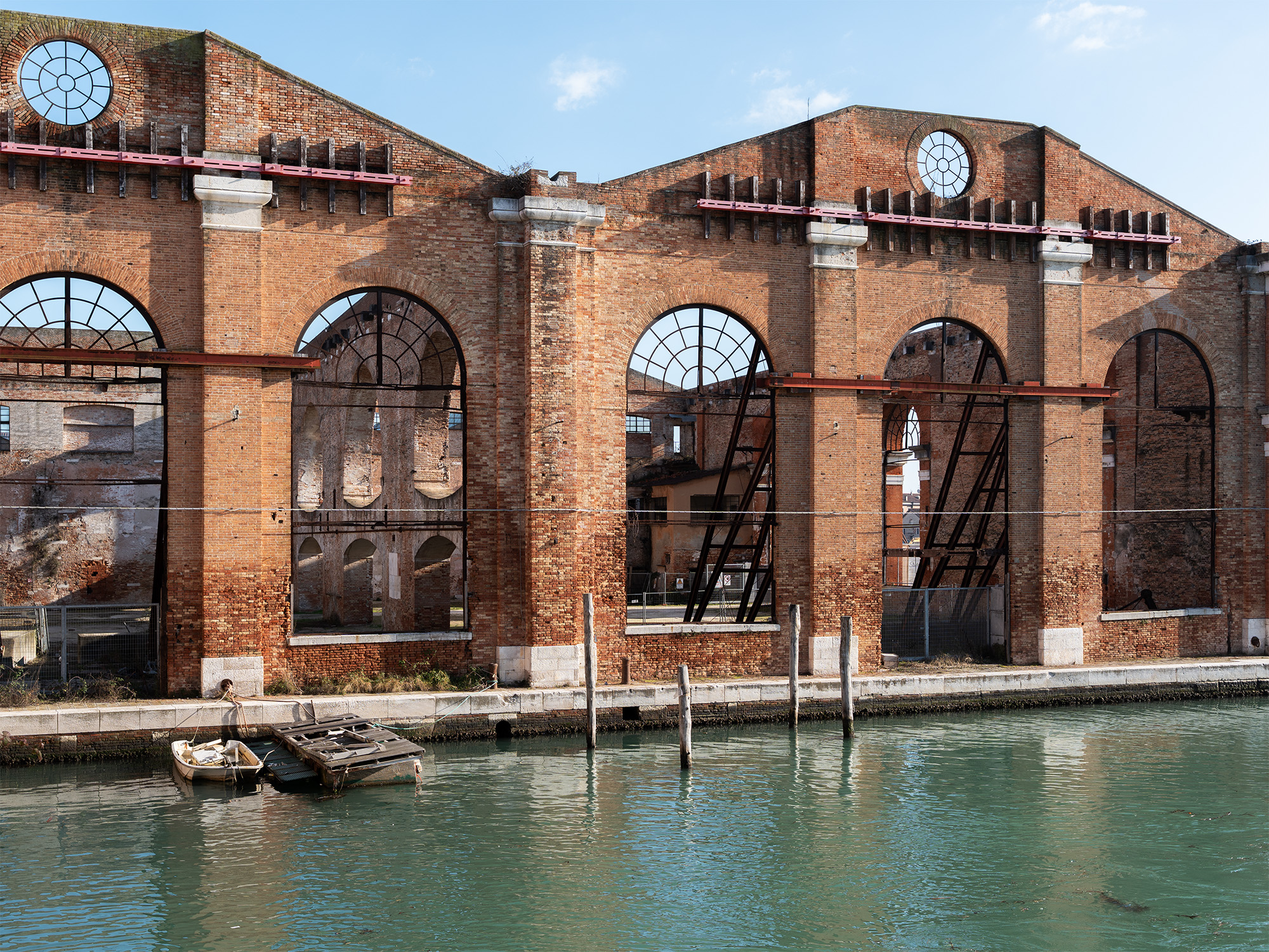
Linyekula and his cast are standing in the middle of the Galeazze, a 16th-century shipyard complex that has been inaccessible since World War II and has never been open to the public. They are preparing for a performance, commissioned by the Venice-based nonprofit Scuola Piccola Zattere (SPZ), that will bring up to 500 people into the 32,291-square-foot, open-air ruin for two nights only.
Eduardo Lazzeri, the project’s curator, is sitting nearby frantically checking the weather report. He’s worried about what rain will do to the acoustics, which are so good during that afternoon’s rehearsal that even he seems surprised. The production team is busy mounting spotlights on cherry pickers and setting up a sound booth on scaffolding. The space looks like a combination of a construction site and a secret garden, with overgrown plants winding around the giant brick arches. During rehearsal, performers sprint up and down mountains of gravel taller than door frames.
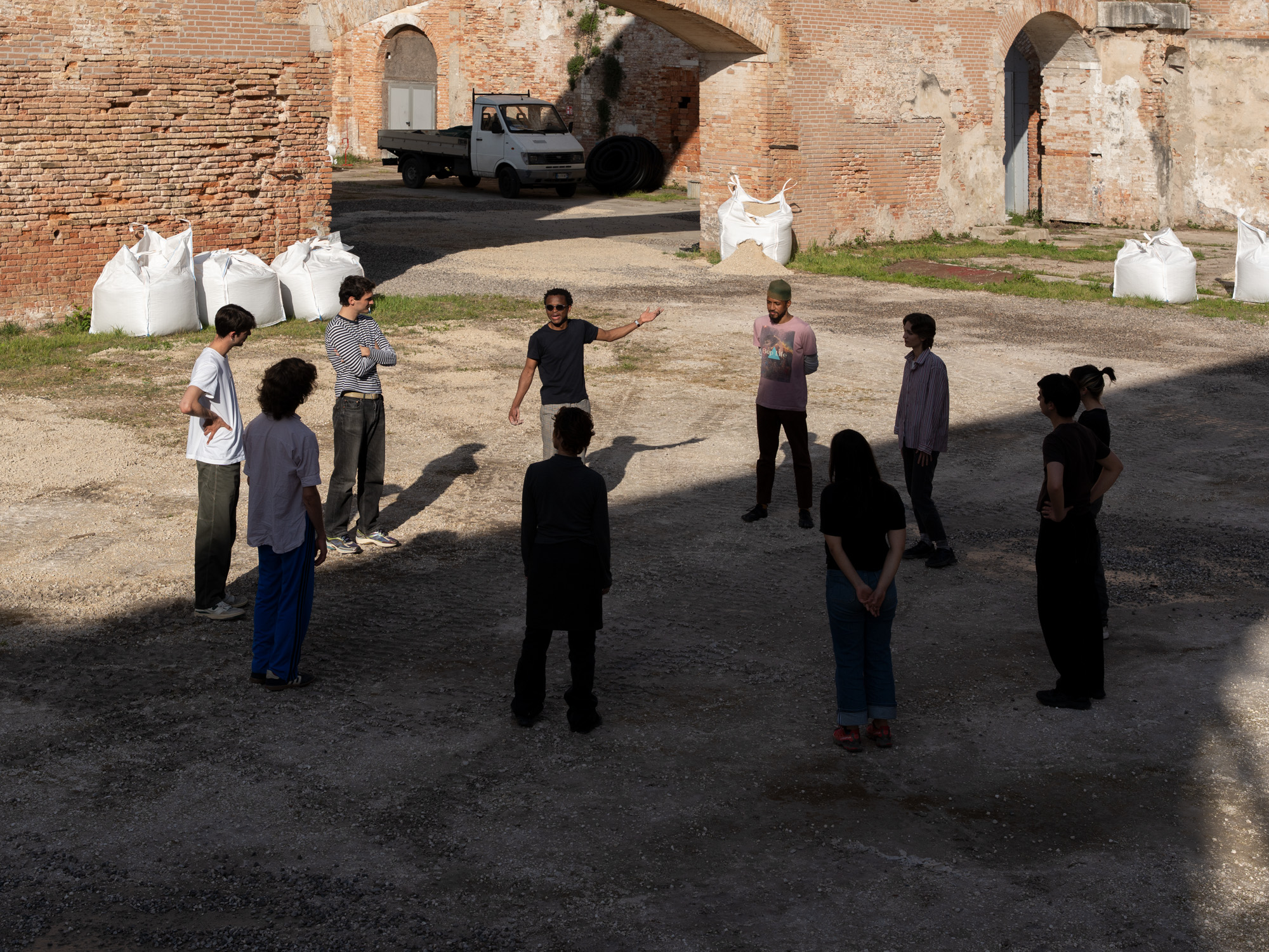
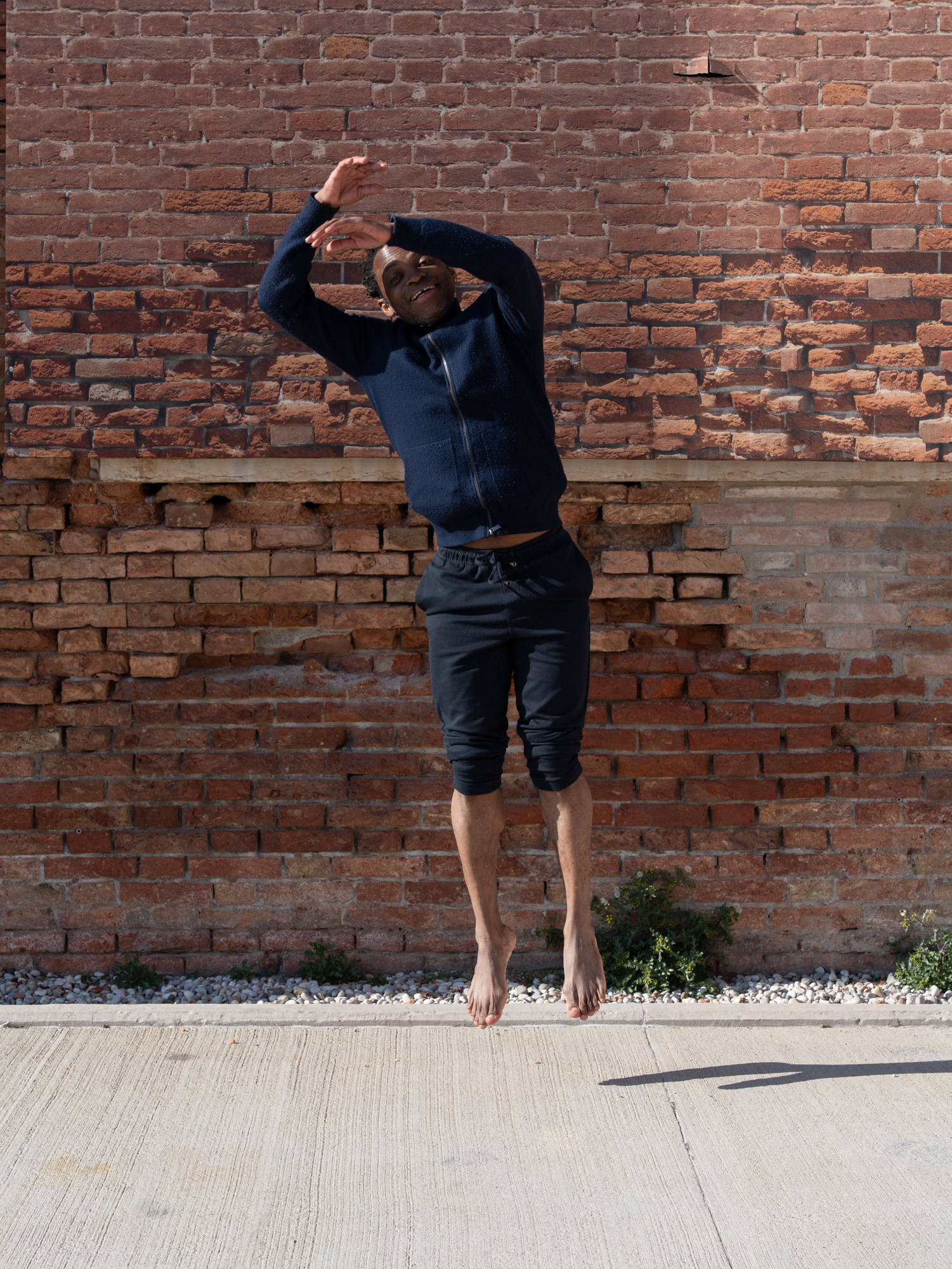
If Linyekula is preoccupied by the forecast, he isn’t showing it. The 52-year-old choreographer—who has performed at the Metropolitan Museum of Art in New York, Tate Modern in London, and the Sharjah Biennial—is laser focused on his dancers. They are paired off, one standing behind another. “It’s like marionette strings, and the torso lifts,” he says, demonstrating how to drive up a partner’s shoulders and propel them forward.
The Galeazze Project is one of dozens of official and unofficial collateral events staged in conjunction with the 2026 Venice Biennale, which opens to the public on May 9. It also represents a savvy move on the part of the city, which teamed up with a restoration nonprofit called the International Private Committees for the Safeguarding of Venice to help refurbish the Galeazze. The organization sought to recruit someone to stage a project in the dramatic space during the Biennale’s preview week and use the rental fee to stabilize and restore the floors. (The piles of gravel that serve as set pieces will be put to work after the performance ends.) SPZ, which opened a palazzo for exhibitions, research, and residencies in 2024, volunteered.
If the venue is a far cry from Venice’s typically opulent exhibition spaces, the performance is equally atypical. The Venice Biennale is widely recognized as a place where international art stars are born and art history is made. But Linyekula’s is one of several projects on the island this year that push against the notion of the artist as a lone-wolf genius. Instead, he proposes an alternative model: the artist as facilitator, convener, channeler, and coach.
Linyekula teamed up with students at the local performing arts academy, Venice-based professionals, as well as Cosmogram, a Venetian music label, which composed the haunting, trance-like soundtrack with Linyekula’s frequent collaborator, trumpet player Heru Shabaka-Ra. “The work develops through collaboration with local performers, musicians, and practitioners, building on knowledges already present in the site,” Lazzeri explains. “Authorship becomes shared and distributed.”
The Galeazze Project is a bit reminiscent of the German artist Anne Imhof’s DOOM, the much-discussed four-hour epic performance at the Park Avenue Armory last March. In both productions, bright-eyed, unjaded performers get the run of a raw and evocative space. Audience members can explore the decentralized action at their own pace. And a thread of earnestness runs through the whole thing.
But while DOOM was loosely inspired by Shakespeare’s Romeo and Juliet, the inspiration for The Galeazze Project is less legible, at least to a Western audience. Some movements clearly draw from African dance traditions. Others—jerking, shaking, whirling—are funky and less placeable. When a trio swings their right arms around in unison like a pitcher’s windup, it slips into goofy. “How I perceive the space becomes the frame,” Linyekula tells me. “But inside that frame, I’m inviting everyone to inhabit the space in their way.”
A similarly collective, generous spirit is expected to run through the Biennale’s central exhibition, “In Minor Keys.” The curator, Cameroonian-Swiss curator Koyo Kouoh, made the unorthodox decision to select six artist-led organizations to participate. Four of these groups—RAW Material Company in Senegal; Guest Artists Space (G.A.S) Foundation in Nigeria; and Nairobi Contemporary Art Institute in Kenya, blaxTARLINES KUMASI in Ghana—are based in Africa. (Kouoh finalized the list of participants before her sudden death, from cancer, almost one year ago; the show was completed by her curatorial team.) Since 2001, Linyekula has operated his own organization, Studios Kabako, in his home country. In addition to arts education and theatrical production, Studios Kabako also offers a water purification program for the surrounding area, which lacks drinking water.
Linyekula was born in Kisangani, a city in central Congo that is believed to be the inspiration for A Bend in the River, V.S. Naipaul’s famous 1979 novel of post-colonial chaos and destruction. After the country’s authoritarian regime shuttered all local universities, he moved to Kenya, where he fell into the theater scene. An encounter with Alphonse Tiérou, a choreographer from the Ivory Coast, during a workshop in Nairobi inspired him to pursue dance. But he isn’t particularly interested in distinguishing among art forms. “Theater is ultimately just poetry in context,” Linyekula says.
Over the next 20-plus years, Linyekula traveled the world creating performances that, he says, were designed to connect him to the history of his homeland. “I’m always searching for the Congo, which could be a senseless quest,” he says. Citing the French writer Éric Vuillard, he notes that the country itself was an invention, a fiction: 14 Western nations gathered in Berlin in 1884 to negotiate its borders.
While Linyekula’s previous performances were often inspired by interviews, archival research, and travel around the Democratic Republic of Congo, as well as his own speculative fictions, The Galeazze Project represents a new direction. In recent years, he has embraced the role of teacher—not only through his work at Studios Kabako but also at NYU Abu Dhabi, where he is a visiting professor of theater. (He has been teaching remotely since NYU sent students home for the semester following the outbreak of the Iran-U.S. war and Iran’s retaliatory attacks on the United Arab Emirates.)
Linyekula wants to transfer his method of channeling unwritten histories through movement to dancers who may not share his personal experiences. “For a long time, I thought my work only made sense when it was done with Congolese,” he says. “I’m beginning to see that this work can connect with many other people. Not because of some abstract universality, because that can be very problematic. But maybe it’s a way of carrying a certain experience of being alive.”
The Galeazze Project runs from 7 p.m. to 8:30 p.m. on May 5 and 6 inside the Arsenale Nord. Admission is free with registration.
More of our favorite stories from CULTURED
14 Books Our Editors Can’t Wait to Read This Summer
Inside the Closet of a Revered Stylist Who Has Only Worn Prada For Over 30 Years
Charles Melton Actually Has No Idea Where His Career Goes From Here
Introducing a Play For Every New Yorker Who’s Had More Bad Dates Than Good
7 Commandments for Rookie Collectors, From CULTURED’s Power Art Advisors

 in your life?