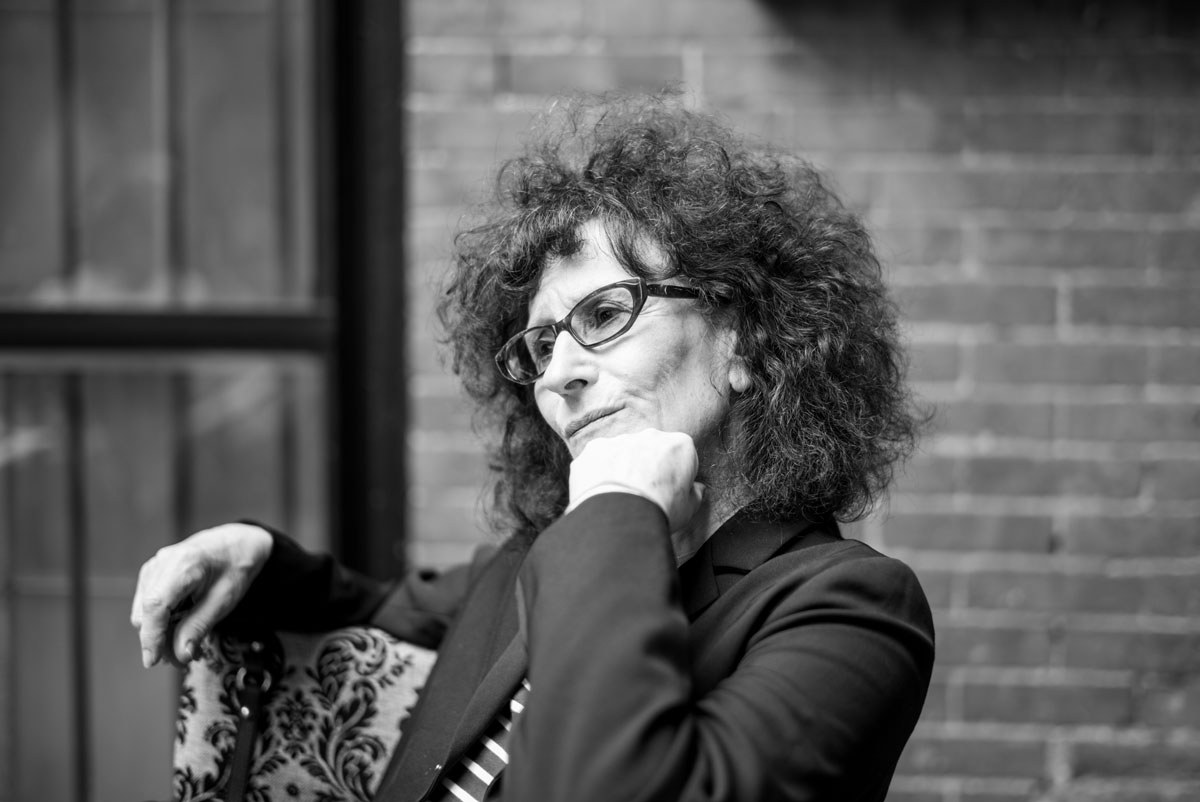
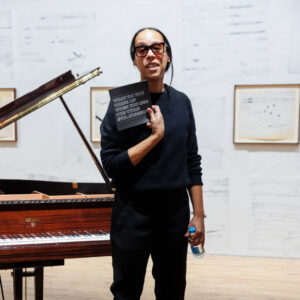
I can’t think of a more fitting way to inaugurate the Critics’ Table conversation series than by talking with my friend, the writer Lynne Tillman. Celebrating the publication of her new collection, Paying Attention: Essays on Art and Culture (from David Zwirner Books), at an intimate gathering high in the sky, hosted by Coco’s at Colette last week, we scratched the surface—just barely—of her more than four decades of criticism, broadly defined. Perhaps best known as a novelist and short story writer, Lynne is also famous (in certain circles, and certainly in my book) for her art writing, which is characterized by the same precision, openness, and lawless formal invention as her other literary work. I often open a volume of Lynne’s when I find myself backed into a corner of my own making as a writer. She’s a model of experimentation and freedom.
Her character, Madame Realism (the subject of another collection), was initially conceived of as a feminist riposte to Surrealism—which she imagined personified as an imperious Sir Realism—when she was asked to contribute to a magazine on the movement. (She declined.) Appropriately, our conversation about her approach to criticism and the state of reviewing ends with her recollection of another feminist counter to the patriarchal bent of that historic avant-garde: her visit to Méret Oppenheim’s Paris studio in 1973.
Lynne began by reading “Point of View,” a brilliant essay on Diane Arbus, first published in Frieze in 2011. Below is an excerpt of the transcript of the conversation that followed.
I wanted to start, since this audience may not be familiar with your history, with your origin story as a critic, because you come to art writing from a very particular and unusual place.
Well, I come to art writing as a fiction writer, though I do have some background in art. As a child, I was taken to museums. My mother was an amateur painter, my father a textile designer. And I watched television all the time, and of course I went to movies—I was interested in images. Then, when I was at Hunter College, I took all my electives in studio art. I worked with the painters Ron Gorchov and Doug Ohlson. I was never terribly good; I wasn’t an art major; I was an anomaly in the art department—but I think they liked me because of that. I didn’t come with any expectations. And then I got into filmmaking, everybody wants to make a film, right? At some point, we all want to be a director and control people.
I lived in Europe for quite a number of years, and, when I came back, I gravitated toward the art world, because, although I was always going to be a writer—I knew from the age of 8—I was very insecure. And I couldn’t bring myself to hang out with writers when I got back to New York.
So, art writing. I fell into it, because I met—through my friend Barbara Kruger—the brilliant art theorist and critic Craig Owens, who was senior editor at Art in America. One day, he called me up (this was 1985, ’86) and he said, “Lynne, we’re doing a symposium on Renoir in the magazine. There’s a big show in Boston and we’d like you to be part of it,” and he cited some art historians. Big names! Rosalind E. Krauss, Benjamin Buchloh, Douglas Crimp. I said, “Craig, I am not an art critic and I’m not an art historian.” And he said to me, “We know. You’re a fiction writer.” Right there, I gave myself license to write without trying to be something I wasn’t.
I’m not crazy about Renoir. But I thought, Renoir is Renoir. Who cares what I think? I went to the exhibition with a Sony Walkman, if you remember those. With my headphones on, I pretended that I was listening to the museum guide and I stood behind three different groups of people, eavesdropping. That became my second Madame Realism story, published in Art in America. (It infuriated some art historians, I was told, who wrote letters to the editor.) And from there, I continued to write Madame Realism stories, that was my character. I did quite a number of those pieces. By the end of the decade more and more people started to ask me to write for catalogues, or to contribute to art books. The majority of pieces, essays, in this book, are from the last 20 or so years, including this year.
Craig Owens died, sadly, of AIDS in 1990, and he had an idea that he articulated toward the end of his very short life—it was about writing alongside art, as a parallel activity. It wasn’t about being a judge, or a critic in the traditional sense; it was about recognizing yourself as part of the same world.
Well, you’ve led me right to my next question. We were talking about this in the cab on our way uptown together, too—about the idea of the critic as a judge, and where that leaves us if we reject that. There’s a debate these days, or rather, not just these days: it’s ongoing. In the discussion of the state of art criticism there’s a persistent complaint about lack of negative criticism. There’s a hunger for that particular kind of expert judgment, the discernment of quality, which becomes legible and credible when one writes something “negative.” There’s a complaint that critics are simply cheerleaders if they’re only picking artists and work that they like. In some ways, I see your writing as floating above that debate entirely.
It’s a real question—about writing negative reviews. One problem is that, first of all, there are far fewer reviews now. So, given that, do you choose to write about something you think is… not so good? I don’t even like using those words. What I mean is, do you write about something that you’re not interested in? That you can’t feel for or think for? With a lack of space for criticism, with fewer magazines publishing fewer reviews, other writers that I know don’t want to write about something that they think is not worthy of attention. They would rather be supportive of what might deserve attention.
An artwork is an idea, ideas. If there aren’t ideas in the work that appeal to me, if I can’t find anything, then I don’t want to write about it. So, that means I don’t really write negative things. But, in my pieces, I have arguments with myself about what it is that I’m saying. If you’re describing something, you’ll find that every word has a denotation or connotation. No matter what word you’re choosing, it has an attitude. You can’t get away from it. You cannot write completely neutrally. Writing is very complex in that way.
For one of the essays here, in Paying Attention, I wrote about Dana Schutz, who I think is a really interesting painter. I was asked to choose one of her paintings to write on for a monograph. I chose a painting called Boatman. I really got into it by describing everything that I could find in it, by trying to use what I thought were the correct adjectives, et cetera. It becomes a form of interpretation because the words carry so much more weight than you can imagine. Each word has an attitude.
That’s a wonderful piece, and it’s almost procedural in nature. As readers, we’re watching you sort it out on the page, this problem of interpretation. You go through the possibilities of what you’re seeing, which is profound. We don’t have much criticism like that at all. It reflects a kind of radical questioning that’s present throughout the book. You simultaneously get us to believe in your authority—you’re telling us something important and essential about the work—and you’re reserving your right to be wrong about it.
I think allowing yourself to be wrong, and to be seen as wrong, is not the worst thing in the world. What’s worse is pretending that you’re right. And also, that doesn’t really allow a reader into the text.
I remember, I went to a lecture Harold Bloom gave to a graduate center class. He spoke about—he dismantled, I would say—a poem. I think it was Keats. He said, “This stands for this, and this stands for this, and this stands for this,” and at the end of his dissection of it, he said, “There’s no other way to interpret this.” The poem just died. You know, why read that poem?
A very early piece in the book is on Méret Oppenheim, written in 1973. I’m fascinated by it because… well, because you met Méret Oppenheim! But I am fascinated by the form of the piece as well.
I was living in Amsterdam then, and she was in Paris, and the only thing I knew about her was her famous fur teacup. I knew very little. I was asked to write about her for an English art magazine that no longer exists. Really, I’d never done this before, and I was young and in awe of her. I studied up the way I still do when I talk to an artist or writer.
I didn’t even know what a feature was, really. So, I visited her, and asked her questions, and it turned out to be different from other articles.
It begins as a diary and ends as a questionnaire!
Yes, I did ask her the most embarrassing question I have ever asked anyone.
What was the question?
Well, I asked her, “What was it like to be alive in the ’20s and ’30s?” Can you imagine? You know, I had been reading all about the Surrealists and life in Paris, Gertrude Stein… Oppenheim was very kind to me, she just responded. She was an elegant, eloquent woman.
Well, this is why I ask myself, when I write, What would Lynne Tillman do? Because you invented this odd diary-questionnaire form, and it’s perfect.
Well, it’s like deep focus in Citizen Kane. It had never been done before. Orson Welles demanded it of Gregg Toland, the cinematographer, and so he did it. He figured it out. Necessity—or not knowing—is the mother of invention. I didn’t know what I was doing.
More of our favorite stories from CULTURED
14 Books Our Editors Can’t Wait to Read This Summer
Inside the Closet of a Revered Stylist Who Has Only Worn Prada For Over 30 Years
Charles Melton Actually Has No Idea Where His Career Goes From Here
Introducing a Play For Every New Yorker Who’s Had More Bad Dates Than Good
7 Commandments for Rookie Collectors, From CULTURED’s Power Art Advisors
Sign up for our newsletter here to get these stories direct to your inbox.

 in your life?