
Can the “Little Paris of the East” transform itself into a global arts player? Should it even aspire to?
These are the questions I’m interested in answering at the fourth edition of Romanian Art Dealers (RAD), an art fair in Bucharest that overwhelmingly programs Romanian galleries showcasing Romanian artists. It’s not trying to be yet another Frieze or Basel, which increasingly feel like vast warehouses stocked with global galleries and globalized artists, everything uncannily interchangeable. Indeed, from my home in LA, the prospect of a fair at the edge of the Balkans, featuring galleries and artists I’ve hardly heard of, gives RAD its electric charge. The work might be great and it might be terrible. The only way to know is to travel across the world and find out.
I land in Bucharest on Tuesday and head to the Hotel Caro, a compound of red brick buildings on the city’s north side. This is where I’ll spend the week—it’s where I’m staying and where the fair takes place. I miss the official welcome reception that night, but link up with RAD’s co-founder, the local dealer Catinca Tabacaru. Throughout the week, Catinca can almost always be found sipping white wine, simultaneously directing the fair and managing a vast army of gallerinas and assistants, acolytes, and sycophants, all while selling art, courting collectors, babysitting sponsors, and hosting talks with the Curatorial Summit, a cohort of 35 international curators flown in to immerse themselves in Romania’s art scene. Catinca is an undeniable force, and is in large part why I’m in Bucharest at all. When I expressed interest in visiting RAD, she wrangled the Romanian Cultural Institute in New York to cover my plane ticket. “RAD is where you can get a 360-degree view of the Romanian contemporary art scene,” Catinca tells me.
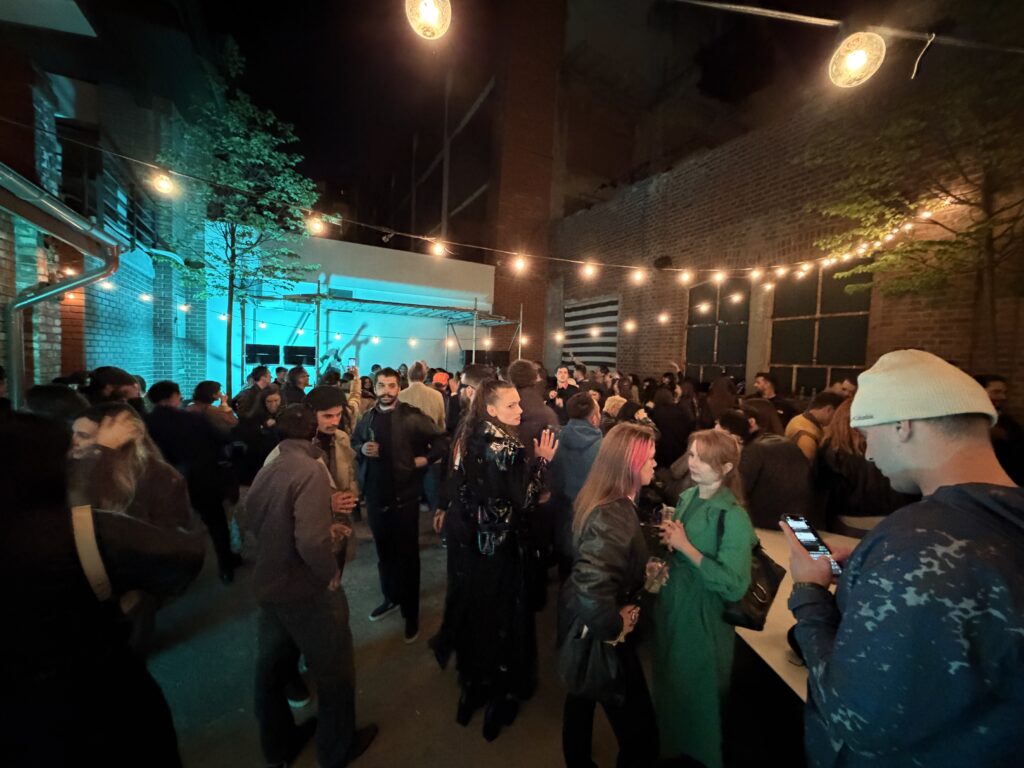
That night, she takes me to the 10-year anniversary party for Sandwich Gallery, which is owned by the fair’s other co-founder, artist-dealer Daniela Pălimariu. The party is at a restaurant called Balls, which everyone keeps telling me is funny because they sell meatballs or something. I’m disgusted by foodie culture in general, and especially by restaurants deploying sexual innuendo in their names (Egg Slut, etc.), but Balls is fun. The DJ, the dapper, boyish local collector Alexandru Rus, plays a schizophrenic set, swinging between smooth soul and hard electro, half of the crowd sitting down at each song change. I’m served a goblet of alcohol-free spritz and hang around outside with the glamorous Mihaela Nica, owner of Point, a restaurant with a theater upstairs and a gallery space downstairs. As Nica smokes skinny cigs, a Romanian artist with long blond hair joins us. The artist tells me her name, which I immediately forget. I feel drugged out of my mind from not sleeping on the flight from LA and now being awake for almost two full days. But I remember what she tells me because it’s a refrain I hear throughout my time in Romania: “In Bucharest, the art scene is one big family.”
What kind of family? Naturally, I’m thinking of the nightmarish Freudian variety, with dark Oedipal complexes, sexual rivalries, and petty grievances, because that’s at least what the art world’s like in its ruthless centers: LA, New York, London, and Paris. And that’s another question I’m trying to understand at RAD—what is Romania’s contemporary art scene all about?
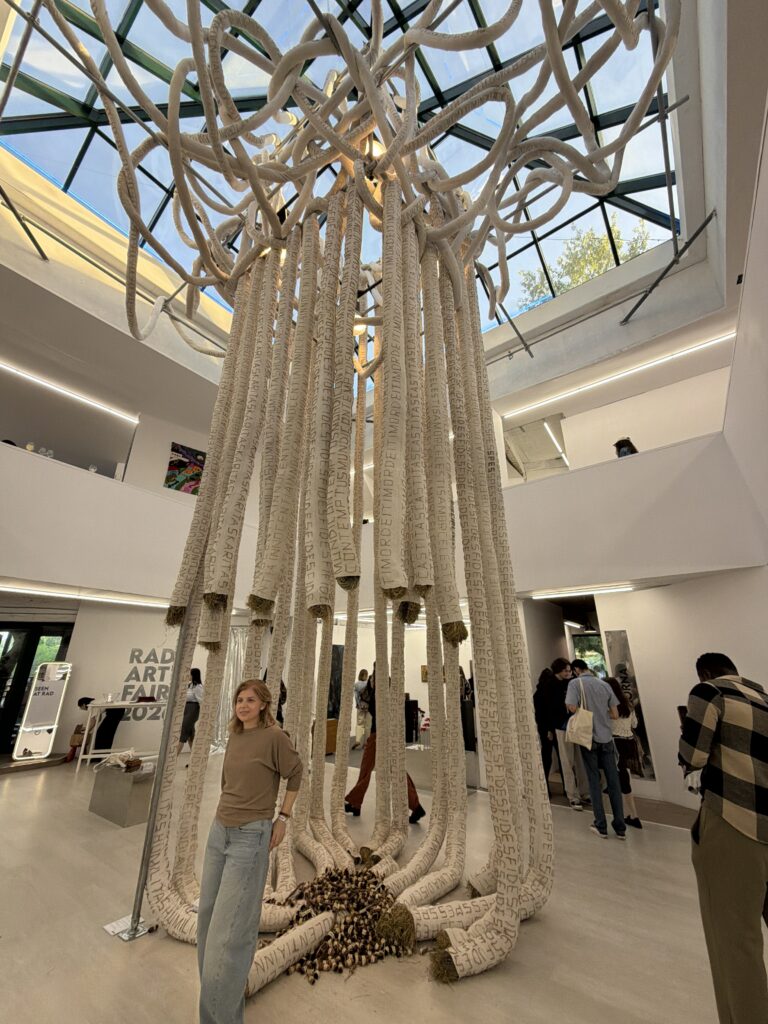
On Thursday, at the VIP preview, I wander through the main exhibition hall, a two-story rotunda behind the hotel. With just 31 booths, RAD is deliciously humane in scale. After an hour or two there, the dealers know my name, their assistants waving hello every time I meander past or take photos.
The fair’s central work is Donate a Word, 2025, by Romanian artist Victoria Zidaru. The octopus-like installation/performance features long tentacles of textiles stitched with biblical verses, stuffed with hay, and streaming out from under a skylight. At its base rests an altar of pine cones, sticks, and dried leaves, all glazed in beeswax and knotted with a strip of cloth. Beside the altar sits a journal and pen. Visitors take a souvenir from the altar, but must write a word in the notebook, which subsequently gets stitched onto the next altar. Steeped in Orthodox Christian mysticism, the piece comments on the spiritual power of traditional Romanian culture, crafts, and history. In a way, Zidaru’s installation doubles as RAD’s thesis: We don’t need to look outside for inspiration—we have plenty right here at home.
My second stop is Catinca Tabacaru Gallery’s booth, filled with abstract sculptures and objects, and of course, some paintings too. In the middle, atop a bed of cinder blocks, lies Nona Inescu’s Introverts, 2025, a series of fat river rocks cuffed with steel collars and leashed to metal chains with luxurious leather handles. Inescu’s sculptures simultaneously look like pets, medieval weapons, and BDSM toys. Coming from the U.S., where paintings dominate, it’s encouraging to find a gallerist taking risks on other practices. Part of RAD’s magic must be that its stakes are somewhat lower than those of a typical international fair, most of which increasingly feel like casinos—meaning, the house always wins. Galleries here can risk presenting a program that’s at least trying to say something.
Around the corner is a booth by Relicvar (translation: reliquary), a gallery from Cluj, the capital of Transylvania, founded by a 30-something painter Andrei Ispas and older Orthodox priest Vasile Istrate. The two met at art school and opened their gallery inside the basement of Istrate’s church. Their program features paintings and sculptures by Cluj-based artists, all but one of whom are long dead. Their one living artist is the reclusive 86-year-old Ana Lupaș. “It’s a big deal that we even have a Lupaș for sale,” explains Andrei. “Lupaș almost never shows with Romanian galleries.” One work on view, Identity shirt, first generation, 1969, is a series of sketches for Solemn Process 1964-2008, an installation of 21 steel sculptures reflecting on Romania’s changing society that the Tate exhibited in 2015.
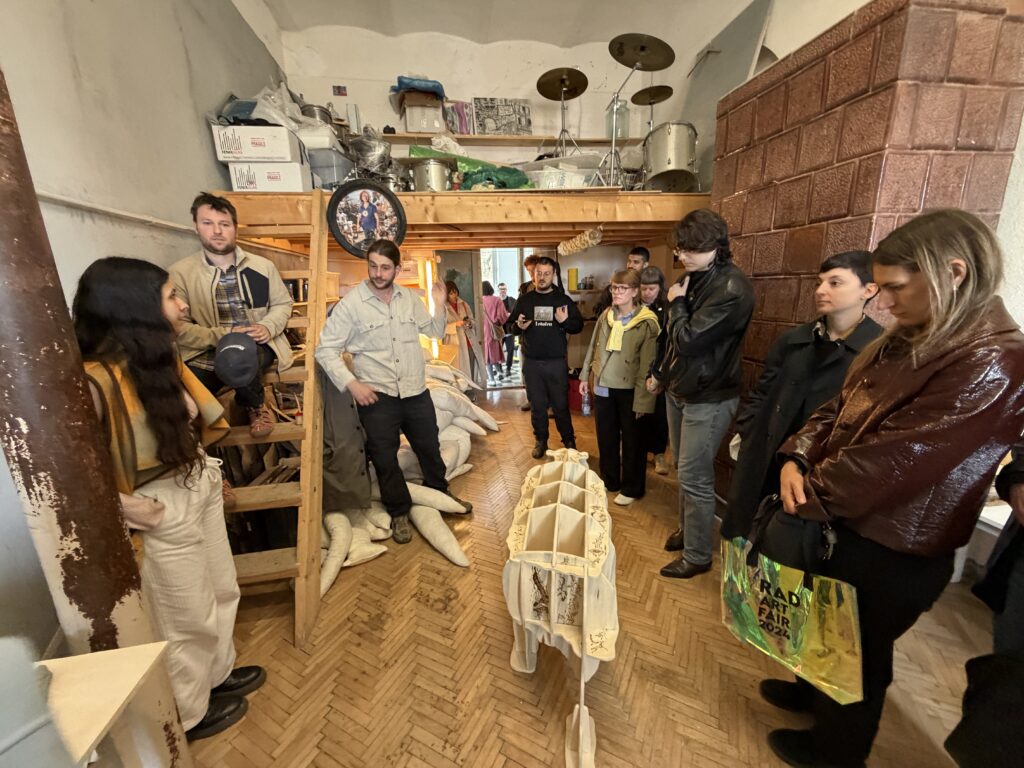
Romania’s fraught history—long in the crosshairs of competing empires and ideologies—percolates through many works on view at RAD. At Plan B, Cluj-based sculptor Ciprian Mureşan wrestles with Romania’s Soviet era. His glazed ceramic busts of Lenin are both comedic and grotesque. Lenin’s face, in the past portrayed with epic heroism, in Mureşan’s hands collapses from its own weight. The sculptures are political to be sure, but seem equally interested in ambiguity and poetry, weighing how the passage of time and memory reverberate in the present.
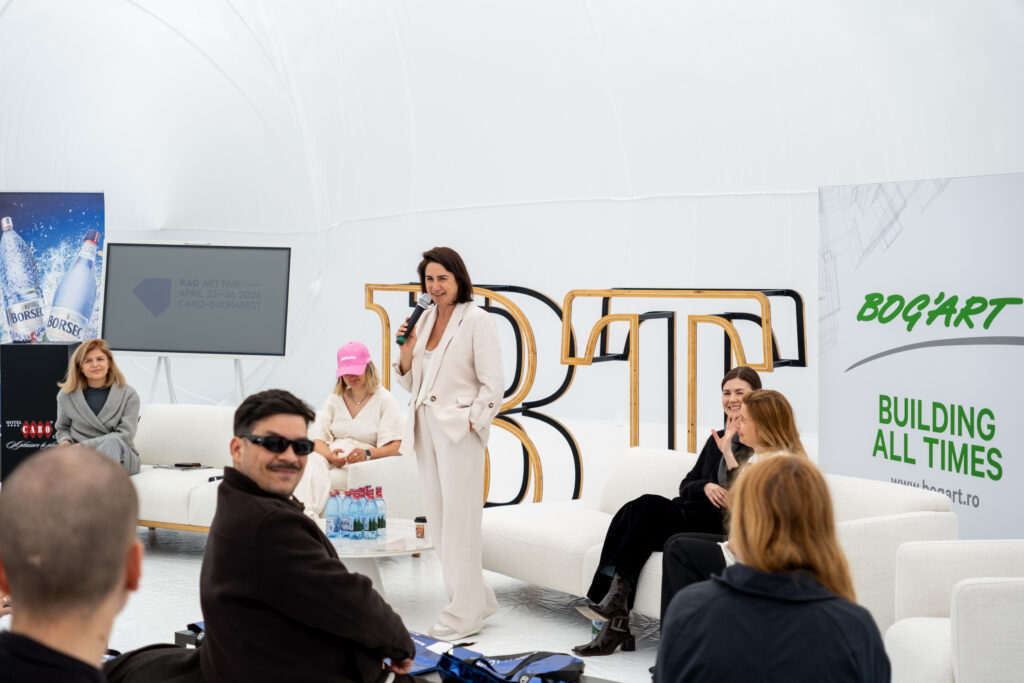
That afternoon at one of the curator talks held before a big white orb, I meet a young man wearing a dapper suit. “I hate communists,” he tells me out of nowhere. Another night, a glamorous gallerina tells me the same. It’s a sentiment I hear often in Bucharest. In a couple of days, I watch a major collector point to a painting of a communist being shot and joke, “This is the only correct thing to do with communists—shoot them.” Most Romanians I meet loathe the repressive communist regime that ruled the country from 1947 until its overthrow in 1989. Those are the “communists” they are referring to—not Bernie, AOC, Zohran, or LA’s DSA mayoral hopeful Nithya Raman, all of whom in Europe would be mainstream center-left politicians.
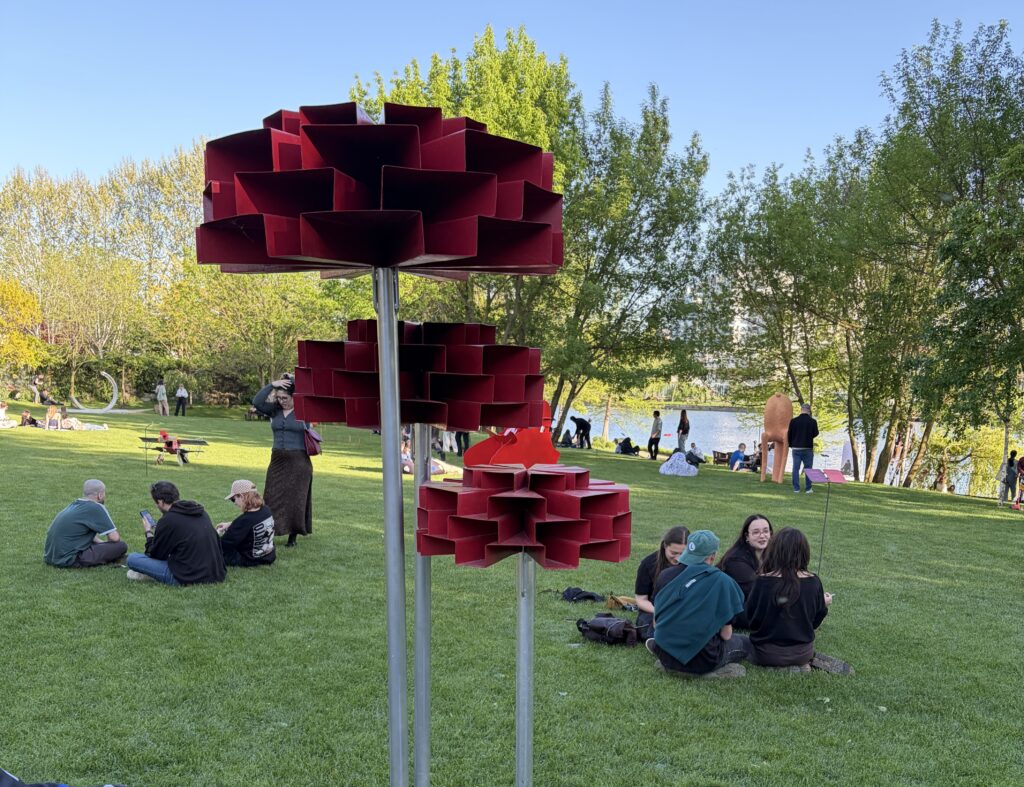
Artist Andreea Ilie’s Triada Maya (May Triad), 2026, blossoms out front of Jecza Gallery’s booth. The three steel-and-glazed ceramic sculptures—editions of a larger sculpture, outside in RAD’s sculpture garden—show geometric renderings of red carnations, the flower representing the Bolshevik Revolution, famously pinned to Lenin’s chest in many images. They’re on view beside bouquets of real carnations. The work is Ilie’s take on a massive monument to Soviet sacrifice found in a playground in Sosnovy Bor, a city near St. Petersburg. Her work may trade in nostalgia, but for the younger generation of Romanian artists, born into a sclerotic E.U., a nod to the leftover brutalist architecture that still dots Bucharest and the former Soviet Union maybe isn’t so surprising.
Of course, not all the art at RAD so consciously struggles with the nation’s political fortunes. Across from the sculpture garden, there’s an emerging gallery section. I walk over to check out Bucharest’s youngest gallery, S.L.S.R.L., featuring work by conceptual photographer Anca Țintea. The artist shoots images of her daily life, then prints them on found paper, transforming the photos into something else entirely. Cracked some eggs on this whole wide world, 2025, at first glance looks like a lush painting of the cosmos, but gallerist Stefany Lazar points out that it’s actually a picture of a cast-iron pan with two eggs, printed on a vintage French map of the world.
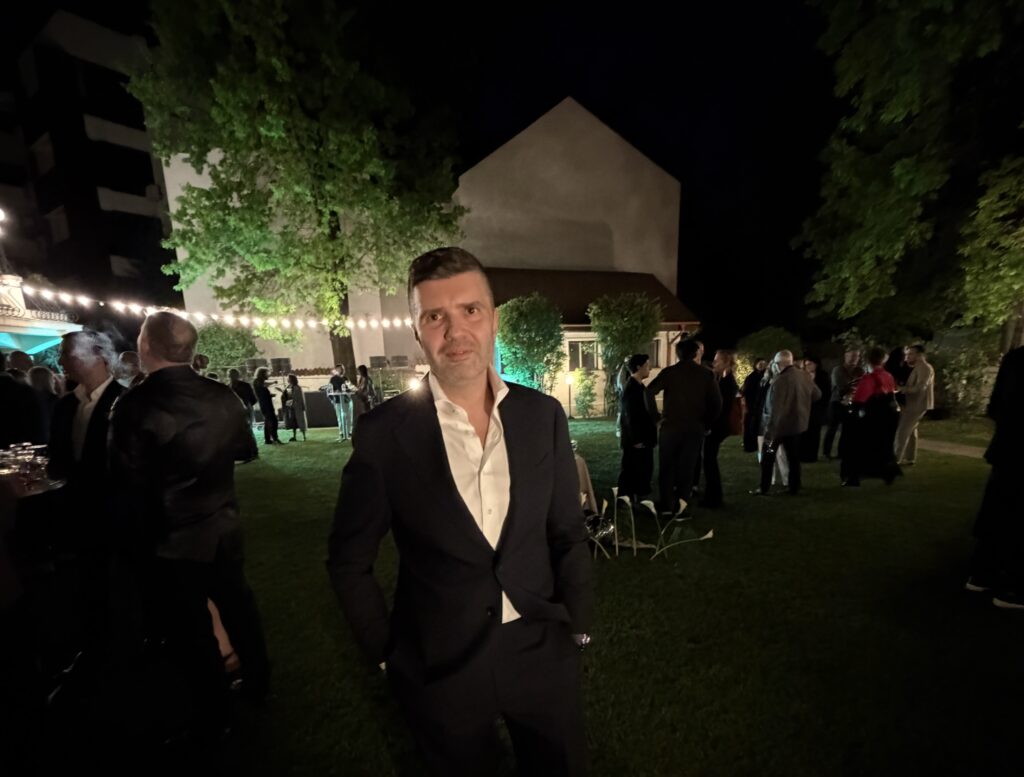
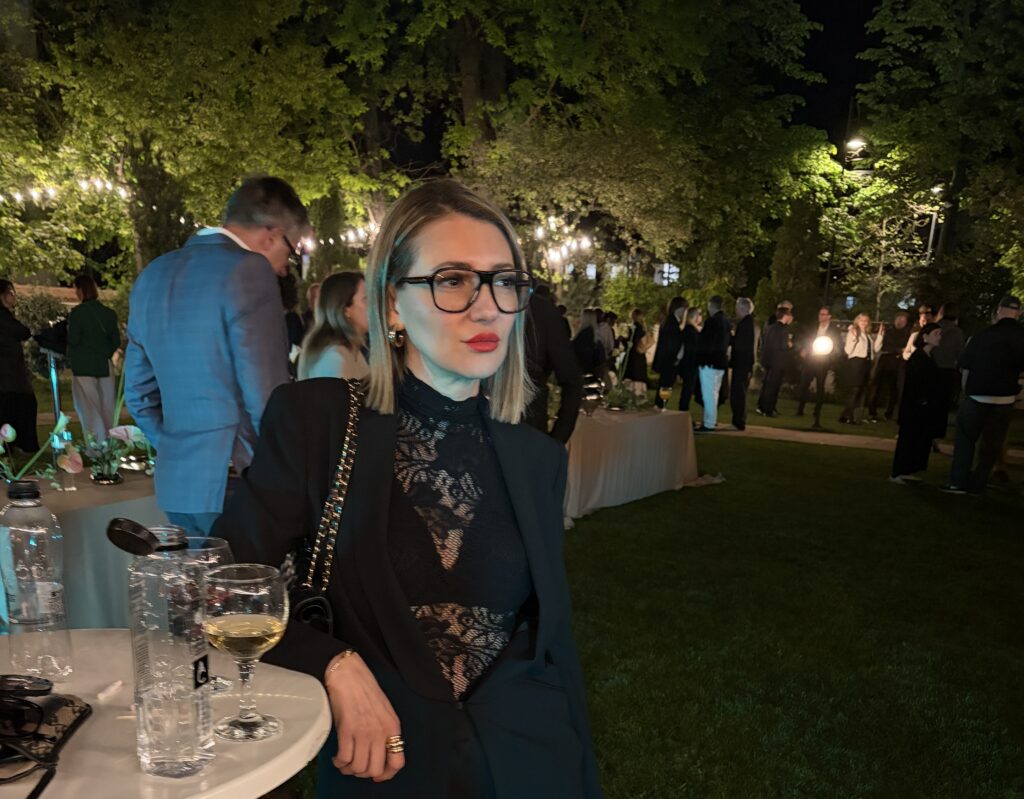
Friday night, I head to a dinner at the official residence of the British Ambassador of Romania, a mansion on a quiet, tree-lined street guarded by soldiers with machine guns. In the coatroom hang photos of King Charles III and his mother, Elizabeth II. Everyone mingles in a large garden: dealers, socialites, the clique of curators from the U.S. and Europe, and other faces I’ve seen at the fair. Maybe it’s just all the free Prosecco, but there’s a palpable enthusiasm about the future of Romania’s art scene. “Bucharest feels like Miami Basel from the early 2000s,” Romanian-American advisor Luana Hildebrandt tells me. “Fortunately, these days, there are many wealthy people in Romania. I’m trying to advise them to skip a second sports car and instead buy art—the ultimate luxury.”
Similarly to the “big family” and the “I hate communists” lines, “Romania only has three or four collectors” also gets repeated often. It’s tempting to assume that they would the nepo babies of post-communist oligarchs, but, in fact, most are somewhat self-made and work unsexy day jobs, even if they’re from well-connected families. It seems that Eastern European billionaires are not so dissimilar from their American counterparts—they have terrible taste and don’t buy much art. Hildebrandt introduces me to Avi Cicirean, the founder of a branding agency, who explains to me with visible pride that his collection is 99% Romanian. “I’m a VIP at all the art fairs in the world,” Cicirean adds. “And seeing what they display, and knowing all the Romanian artists, I think we have huge potential—we just need the right PR to organize the scene.”
The following afternoon, I order an Uber to see Geanina and Tudor Grecu’s private collection of over 600 pieces, housed at the tax auditing firm KPMG’s corporate offices. I head there with Parisian critic and curator Simon Njami and ask him for his take on the fair. Njami rarely minces words: “Romanian artists haven’t been polluted by the market yet, so their work is still interested in ideas.”
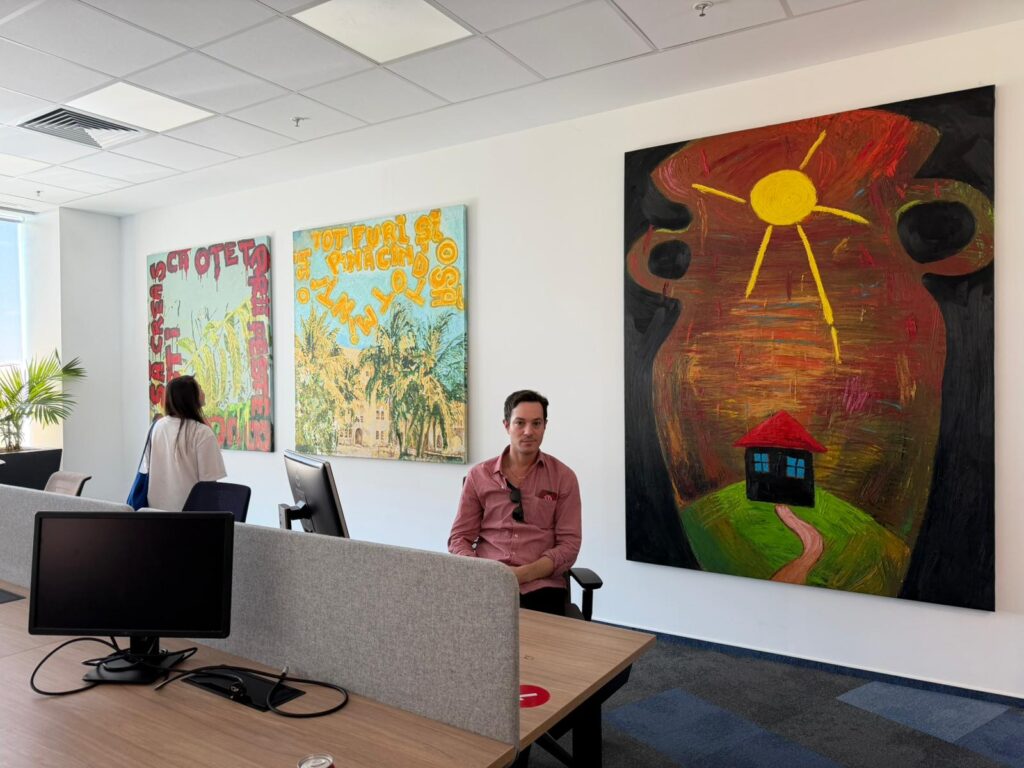
We drive past an IKEA and the Uber drops us in front of the charmless suburban glass KPMG headquarters. I idiotically assume the collection is simply housed on the first floor of the building, but as Tudor Grecu begins the tour inside, he boasts to the crowd: “We have the most visited collection in all of Romania. Every day, 300 to 400 people see these works. Of course, it’s the same 300 to 400 people,” he cracks, “but still.” I don’t get it, at first. As the tour files upstairs into the actual KPMG offices, it clicks. The Grecu’s impressive collection decorates every office, hallway, conference room, kitchen, and lobby, across four floors of KPMG’s corporate offices. The 300 to 400 “visitors” are KPMG employees (Tudor Grecu heads KPMG’s consultancy business). “Originally, we hung the pieces in my office,” Tudor says. “It grew from there.”
Saturday, I’m invited to dinner at Jecza Gallery’s newest space, recently opened in one of Bucharest’s poshest neighborhoods. After checking out the group show, I’m led through a back hallway into a storefront space next door, which Jecza’s developing into a restaurant. There, I catch up with Romanian artist Radu Oreian. He lives in France and shows at 1969 Gallery in New York, but, like so many people I speak with, he says he also feels like Romania’s at the cusp of something great. “In the U.S. and Europe, things are kind of bleak,” he says. “But Romania is buzzing.”
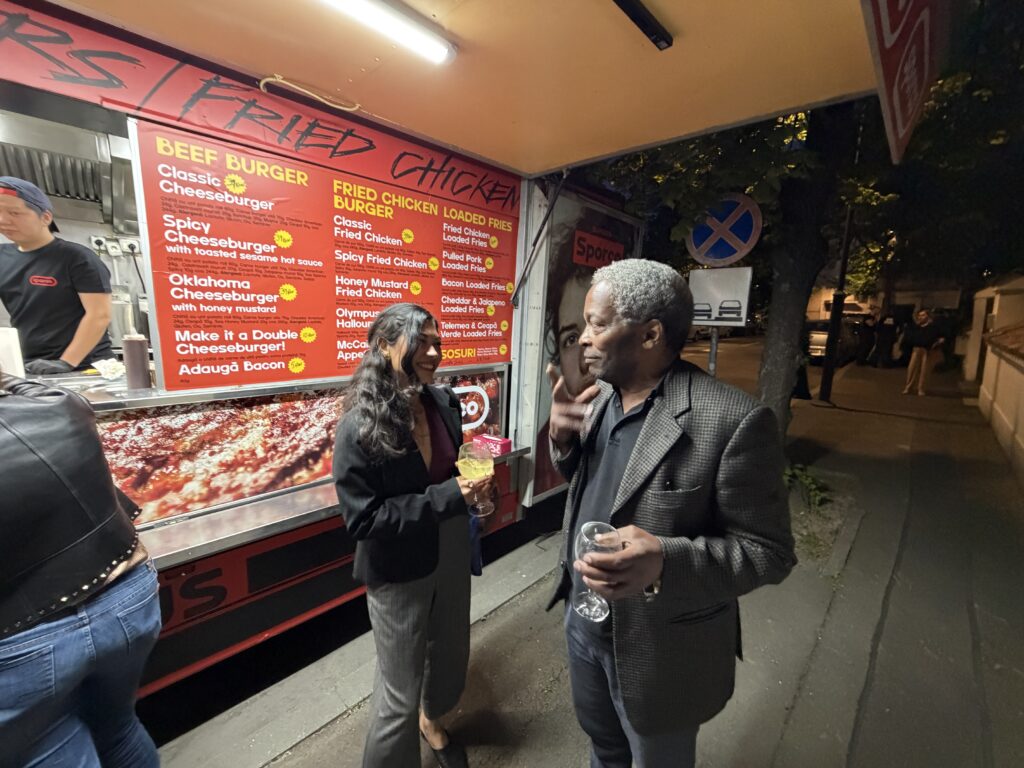
An hour later, I migrate back over to the gallery side and watch Andrei Jecza, the gallery’s owner, pick a small painting of a nude woman off the wall and hand it to a smiling Avi Cicirean, the collector I’d spoken with the night before at the British Ambassador’s residence. It’s 11 p.m.—Jecza’s made his final sale for the day.
Even with all the local hype, though, it’s unclear if Romania’s big moment will ever arrive. Few people in LA or New York could name a single Romanian gallery, other than maybe Nicodim, whose absence from the fair must mean something, though I’m not quite sure what. I ask people why Romania’s most famous dealer didn’t show, but no one seems to know or wants to tell me. My guess is that for a gallerist like Nicodim, with spaces in LA and New York (as well as in Bucharest), a smaller fair, visited by only a handful of potential collectors, may not make a whole lot of sense.
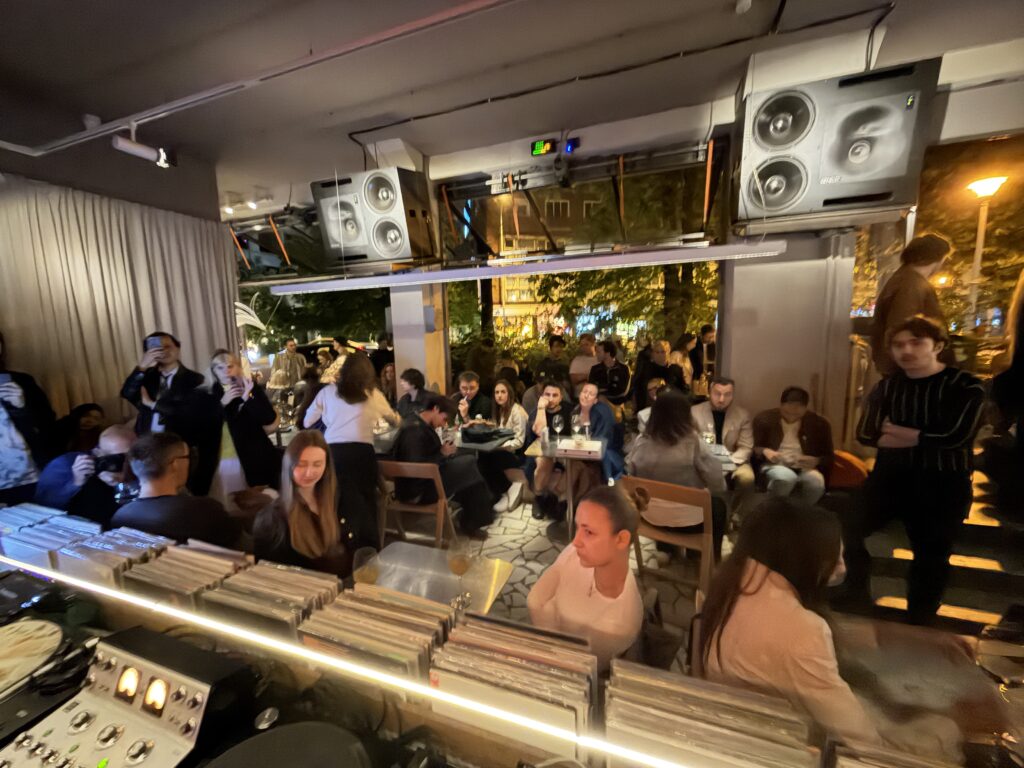
The last night of the fair, I host a reading with some local poets at Bar Ton, a hip “listening bar” in the city center with natty wines and a clientele straight out of LA’s El Prado or Manhattan’s Clandestino. Post-reading, I hang with Bogdan Bǎlan, a local critic who I’ve been crossing paths with throughout the week. Bǎlan’s sassy, always dishing hot takes while sucking down cigs. The venue couldn’t be less like RAD, in a sense, even though it attracts an almost identical crowd. While it’s lovely, there are versions of this bar in Tokyo, LA, NYC, London, and Berlin. It’s sameness brings to the fore the tension I’ve sensed throughout my week. The less “provincial” and more global Romania’s art scene becomes, the more it risks becoming like everything else.
Bǎlan, the critic, agrees, but doesn’t think being provincial is all that bad, not for a nation, city, or even an up-and-coming art scene. “The good thing about being in a provincial place,” he muses, “is that there are far fewer sociopaths.”

 in your life?
