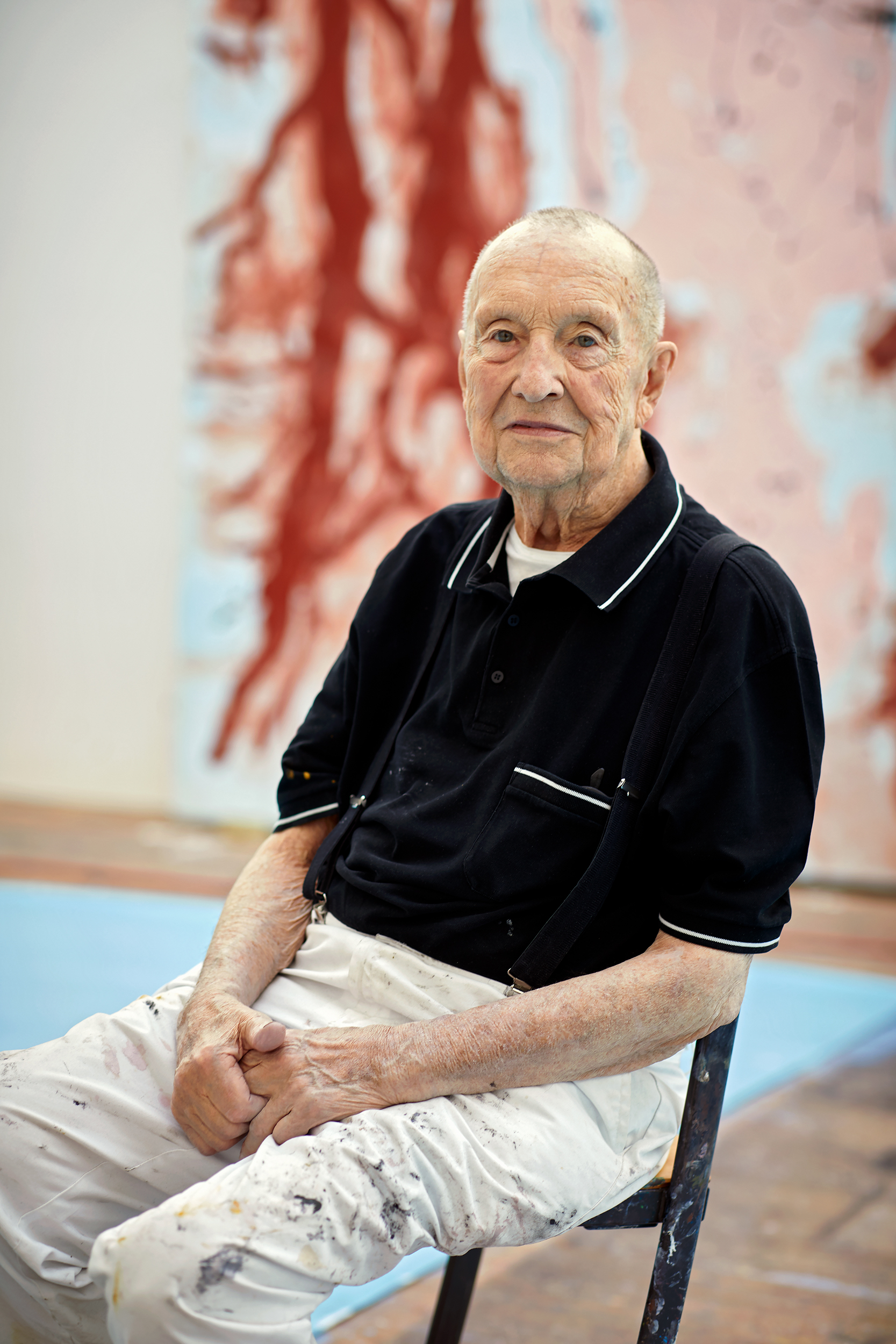
“I’m sure that the Cini paintings will be the last ones I’ve made,” Georg Baselitz told me a few weeks ago, while sitting in his Munich office. Those words now ring eerily prophetic. Our conversation was the final spoken interview the legendary artist would give. Baselitz passed away on April 30; he was 88.
“Georg Baselitz, the Saxon-born artist who defined German visual art for a generation, profoundly influencing artists around and after him and the international world of art, has died peacefully,” stated an obituary by Robert Isaf, shared by his longtime gallery Thaddaeus Ropac. Known for his inverted, or upside-down, paintings, Baselitz eschewed artistic movements and trends despite often being associated with post-war Neo-Expressionism. He remained an outsider in many respects until the end.
“I tried to belong to a circle in Berlin and beyond—but I never succeeded. Maybe I didn’t try hard enough,” he admitted while sitting in a wheelchair across from me in mid April, a black fedora cocked jauntily to the side, as he slowly sipped a hot rum and tea grog. “When I turned the paintings upside down, I thought others would follow. But they didn’t,” he remembered.
Baselitz spoke to me in German through a translator (though he seemed to understand everything that was said in English) ahead of a new exhibition titled “Eroi d’Oro [Heroes of Gold]” at the Fondazione Giorgio Cini in Venice, opening May 6. He had just gotten over a rough virus, I was told, and he looked drawn and frail. Occasionally, he closed his eyes in concentration, as though mustering the strength to speak. By force of will, he found it for the next 45 minutes.
For what we now know is his final show, Baselitz painted inverted, inky black portraits of himself and his wife, Elke—a favorite subject—on monumental-scale, gold-primed canvases. In these works, the 88-year-old artist and his wife appear nude, withered further by age, and laid bare like delicate, celestial specimens—webs of gangly limbs and flesh twisted or held to the side. Painted on uniformly flat, metallic gold surfaces, one thinks of Orthodox icons or Sienese Renaissance paintings. Yet, these are no saints.
“It’s about the nude, the Elke nude, and my own nude in a rather bleak way. The paintings are not very euphoric,” he told me. “The whole thing is a summary of many things I’ve done. I didn’t want to make concessions to anyone,” he said of the gilded paintings, which together form a “key image” that encompasses a long career of genre-disruption. “What’s interesting is that there’s nothing behind [these new works] except art history.” For centuries, artists have been using “the same frame, same size, meant to hang above a sofa. This kind of art is related to decoration in a room,” he continued. “The paintings I have made here are so outrageously large that they don’t fit into a room at all.”
Baselitz’s consensus-disturbing, curious language of self-described “ugly paintings,” between abstraction and figuration, which speak to the trauma and guilt of postwar Germany, have been causing a stir almost from the start of his professional life. His The Big Night Down the Drain, 1963, of a stunted and dejected male figure masturbating ended in a trial for obscenity, and his monumental series of morally ambiguous, bloody, bloated “Hero” paintings skewered prevalent notions of heroic male imagery. He explored the grotesque in fractured, torn limbs as well as “wounded landscapes,” depicting German forests. “They weren’t things people wanted to see,” he said. “I simply didn’t make it easy for people. But I also delivered a great deal, and the hour of truth is still to come.”
He was born in 1938 in Deutschbaselitz, as Hans-Georg Bruno Kern, to parents who were both schoolteachers. (His father, a civil servant, was a member of the Nazi Party.) He adopted the name Baselitz in 1961 to commemorate the bucolic village of his birth. But that natural beauty would contrast with a youth spent under the doomed Nazi and then the East German communist GDR regimes. In response, Baselitz soon developed an instinctive distaste for “so-called order.” He was expelled for “sociopolitical immaturity” from East Berlin’s Academy of Fine and Applied Arts, where he enrolled at age 18, and moved to West Berlin’s Hochschule der Künste, where he met his wife, Elke Kretzschmar.
He soon developed a practice that reclaimed a form of figurative expressionism that veered toward abstraction, partly in reaction to communist East Germany, which thought it a product of Western capitalism but also in opposition to what he saw more broadly as postwar artistic orthodoxies in Germany.
That thirst for disruption, and an ambition to make entirely new kinds of raw images, often in opposition to Minimalism, fueled the artist’s groundbreaking practice. “Architecture, space for image—none of that ever interested me. That aesthetic, prominent since the 1960s—just an empty space with a dead cat in the corner—never interested me. I always wanted to show everything I do on paper or canvas. I even tried to abandon orientation—up, down, left, right— to leave these conventions,” he said. This was almost never done without controversy.
“There are artists who are ‘well-behaved’—they paint polite pictures from the start, or none at all, because they’re too well-behaved. Others make a big show, shout, ‘Abolish museums!’ etc… I have done all sorts of nonsense,” he said.
Baselitz drew international attention at the 1980 Venice Biennale, where he debuted his sculptural practice alongside paintings by Anselm Kiefer in the German Pavilion; viewers mistook the wooden figure, inspired by African sculptural traditions, for a man making a Nazi salute. In more recent decades, he’s been criticized for his opposition to identity politics, particularly within the arts. He also famously made comments disparaging the abilities of women painters, and has since tried to correct that stance by pointing to the many women artists that he does admire. Eleven years ago, Baselitz once again turned heads for arguing that viewing and making art through an overwhelmingly sociopolitical prism is “fascist.”
I asked how he saw the same issue now. “Today it’s much worse,” he said. “If an artist makes art to find identity and then finds it in a political party—Hamas, communists, whatever—then I say: ‘My God, you’re idiots. Because that is precisely the most important thing that has to be excluded from the outset. You have to go into the studio without a party card.”
To help break free from his own potentially limiting ideological thinking, Baselitz said he had always kept financial pressure out of his practice. “When you really have no money to live and work, to feed your children, etc… then you have a difficulty … I always decided not to let that flow into painting pictures,” he said, remembering the years he and his wife worked for a company that produced coffee cups to sustain their family. Knowing he had artistic talent, which he could have used to make people-pleasing, easily selling works, such as “a beautiful picture of Stalin,” he offers by way of example, had always hung over him. Resisting that direction came with a price, however, and “with quite a bit of aggression,” he explained.
After we spoke, I traveled without Baselitz to his towering, natural-light-filled studio beside a grand, modernist home designed by Herzog & de Meuron, overlooking a sloping green clearing of wooded land and Lake Ammersee in Upper Bavaria. The artist had to stay behind in Munich, but he generously gave me permission to poke around his studio. His absence, however, made the exercise feel strangely like gathering memories for a life that was nearing its end.
Cans of paint and long-handled wooden brushes sat waiting beside several recent, golden-background paintings that had not been stretched yet. They were made just a few weeks prior, I was told, offering false hope that there might be more to come after all. Other, enormous paintings depicted powerful, insect-like Hindu goddesses painted earlier, with gold on black canvas. There were stacks of books—his own catalogs, but also art historical references—pencil sketches, and a shelf of string instruments gathering dust beside boxes of CDs.
Baselitz had been painting less in recent weeks, but when he did he still preferred working larger-scale and on the ground, where he was forced into primal, close proximity with the canvas. This created a freeing spontaneity to his gestures, which had become second nature. “Children can paint huge things on the floor, and so can I,” he told me.
Of the Venice paintings, Baselitz explained that the long history of gold in painting was critical to the works, including “variations” on the art historic “standard” a gold background represents, such as icon or mummy portraits. “Black is the beginning of an aesthetic intention, gold is the end of that process — because you know there’s no further experimental principle beyond it.”.
After years of experiments in opposition to the harmonious artworks he has called “bourgeois,” had Baselitz decided to make beautiful paintings? Could the viewer be forgiven for thinking so?
“Don’t rely on the viewer,” he said. “At openings, people say the usual nonsense: ‘Your paintings are so powerful. Where do you get the strength?’ Or ‘your colors are so strong.’ It’s all nonsense, but what else can one say about paintings?”
Baselitz is survived by his wife, Elke Baselitz, and his sons, Daniel Blau and Anton Kern. In his memory, Thaddaeus Ropac will present a selection of Baselitz’s “most significant ‘Hero’ paintings” in their London space this October, coinciding with Frieze.
More of our favorite stories from CULTURED
14 Books Our Editors Can’t Wait to Read This Summer
Inside the Closet of a Revered Stylist Who Has Only Worn Prada For Over 30 Years
Charles Melton Actually Has No Idea Where His Career Goes From Here
Introducing a Play For Every New Yorker Who’s Had More Bad Dates Than Good
7 Commandments for Rookie Collectors, From CULTURED’s Power Art Advisors
Sign up for our newsletter here to get these stories direct to your inbox.


 in your life?