At the beginning of our conversation about Carlos Vega’s current show at Jack Shainman, the artist leans forward conspiratorially. “Should I go open heart with you? Should I tell you everything? I don’t wanna sound like a freak.”
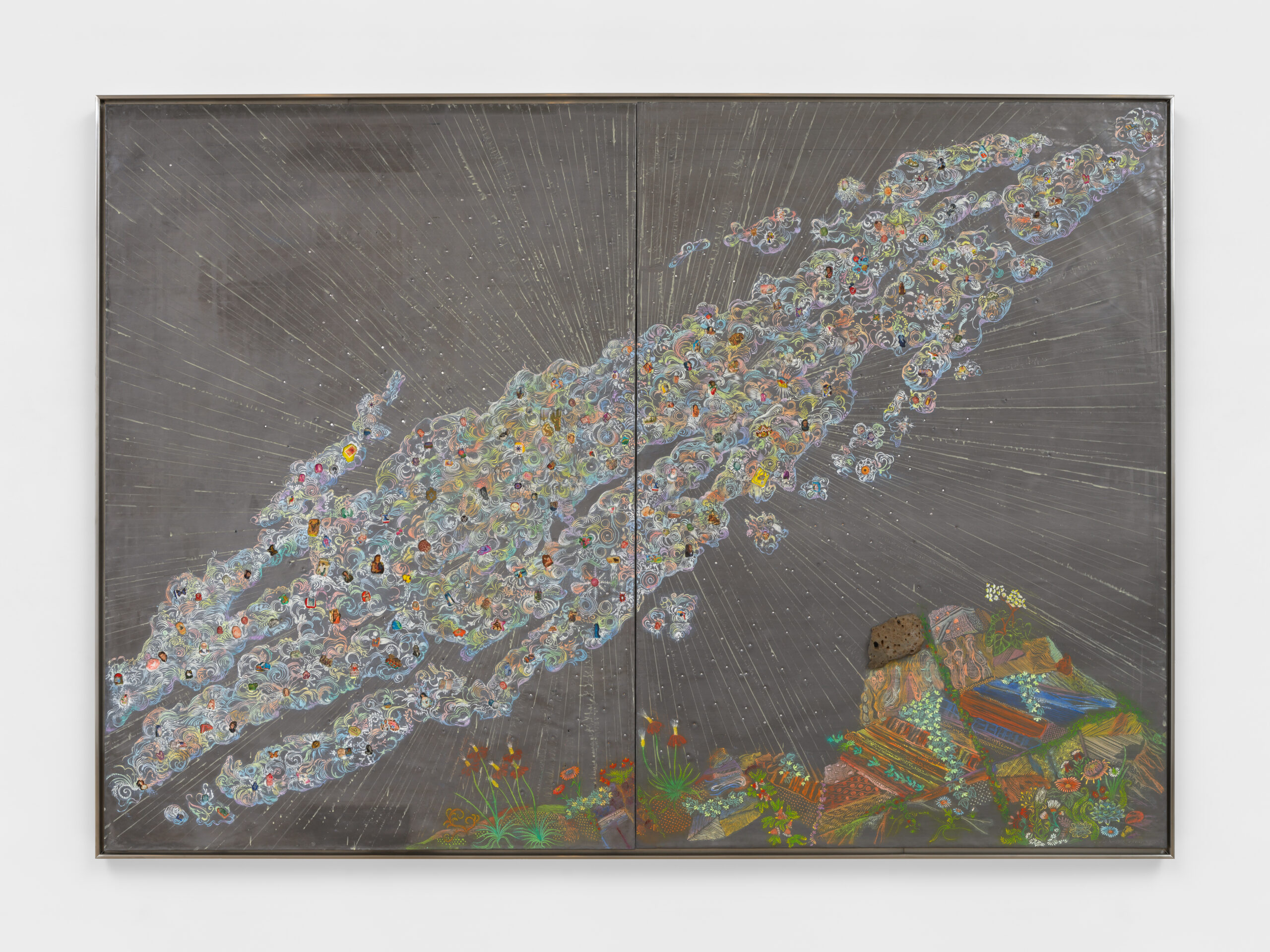
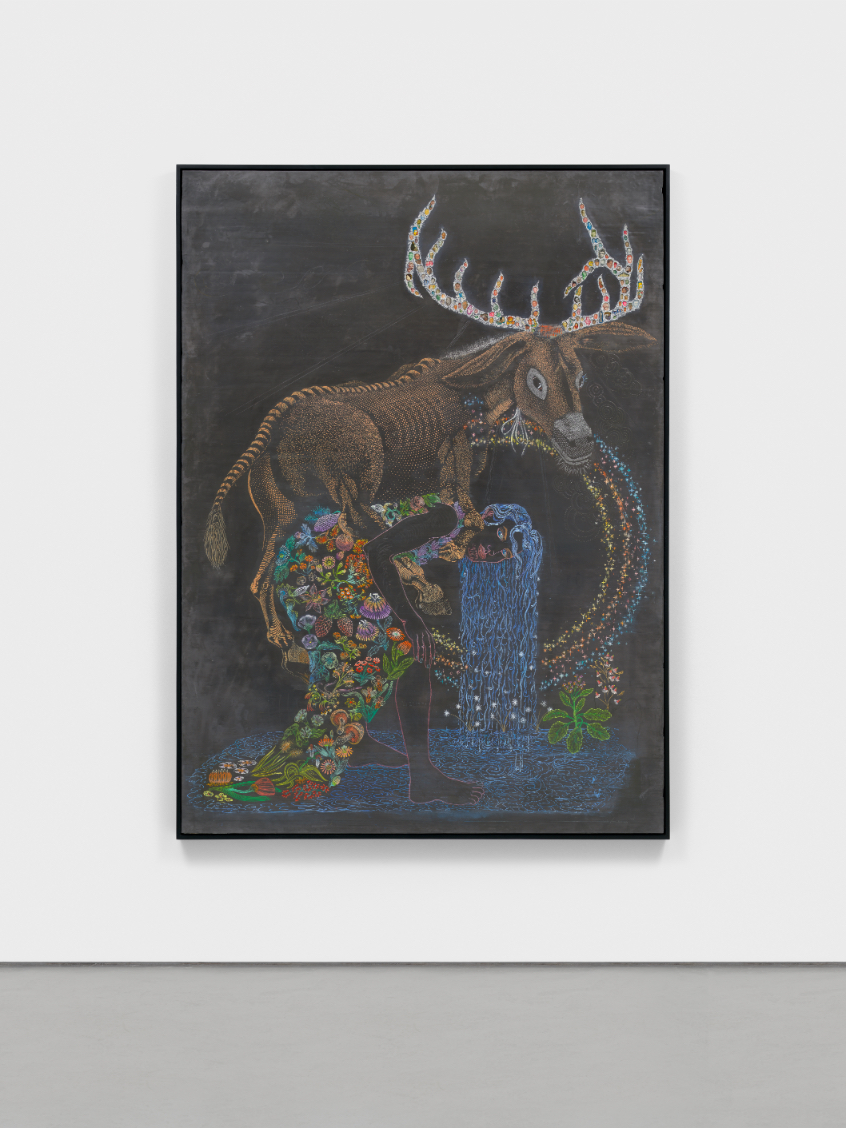
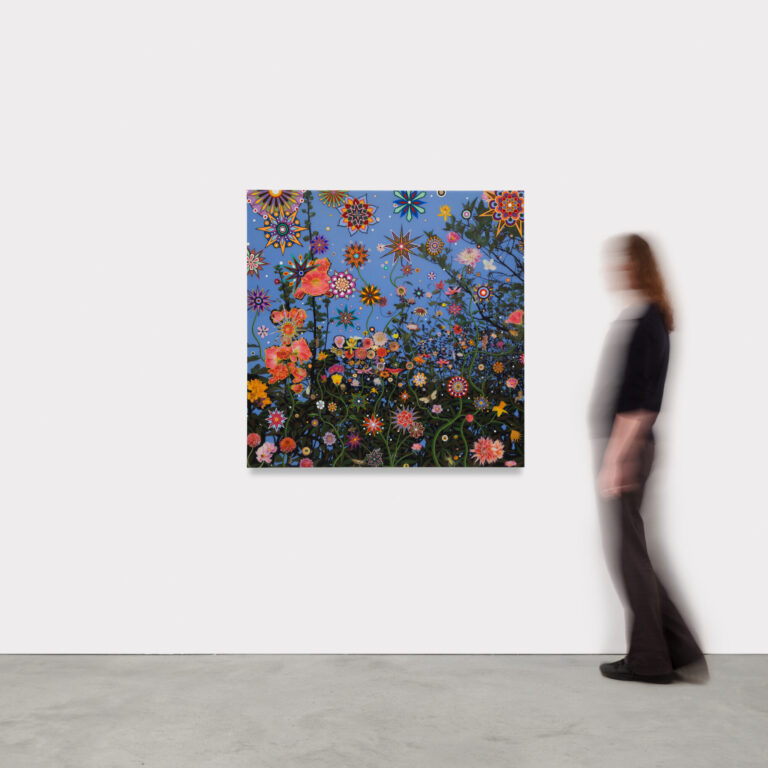
Open-hearted seems to be the dominant mode for the 63-year-old artist (who is also Shainman’s husband). His vast paintings on lead substrate evoke an Edenic image of the universe most often found in ’60s psychedelia. A nymph with a waterfall for hair and foliage for a dress carries a young stag on her back. Extraterrestrial flora sprout tendrils, buds, and roots from a placid face in repose. Galaxies swirl. Portals yawn. Mother Nature is there, a haloed odalisque.
Vega isn’t afraid to come across as a bit woo-woo. For him, art isn’t about the expression of his individual identity, but rather universal truths about the soul, consciousness, and death. The show’s title, Anima Mundi, is rooted in ancient Greek philosophy and refers to the interconnectedness of all animate and inanimate things. There’s something alchemical about Vega’s works, all imploding stars and mutant botany, as the artist attempts to push beyond the rational and discrete and towards the intuitive and interconnected.
As he gets older, Vega says, all other artistic questions converge into one: what happens to consciousness after death? The subject is especially potent for Vega, who was born and raised in the small, autonomous Spanish town of Melilla in northern Morocco. His grandfather was assassinated during the Spanish Civil War, leaving his father orphaned. This awareness of life’s precarity, paired with his proximity to the vibrant natural beauty of the Mediterranean, drove a young Vega to classical art with a spiritual overtone. He studied painting at the Royal Academy of Fine Arts in Spain, where he spent hours copying still lifes and nudes. “Anima Mundi” has its own nods to this classical training: all the frames featured are Renaissance antiques.
“Anima Mundi” is on view at Jack Shainman until April 18. CULTURED called up Vega to go deep on metaphysics, saints, and how COVID changed the spiritual landscape of America.
Can you tell me about the inception of the show?
I’m an artist that invests a lot of time in the studio, meaning hundreds of hours of labor for each piece. It takes me a couple of years to resolve some of them.
I’ve been doing art since I was 17 or 18. When you’re that young, there are all kinds of crises you haven’t gone through yet. Back then, the ultimate question we go through is one of identity: who am I? How has my past affected me? But at a certain point, the ultimate question is whether consciousness can survive death or not. It is the most important question that humanity has placed on the table because it’s something that we all confront sooner or later.
Until 150, 200 years ago when encyclopedias and science came full force, art was a vehicle to talk about the world of the invisible. The world of the invisible is dreams, premonition, intuitions, connections with a benevolent higher force, all those things that have propelled art to be what it came to be in the 18th century. Most of all, it was about finding images that guided you through life. Then, being intelligent and rational beings, we began only accepting things that are measurable and tangible.
Conversations about the nature of consciousness—the nature of the soul, the silent voice that we all feel at night in bed, asking, Why are we here? What’s the future going to bring?—became secondary to static expressions of society, of the self.
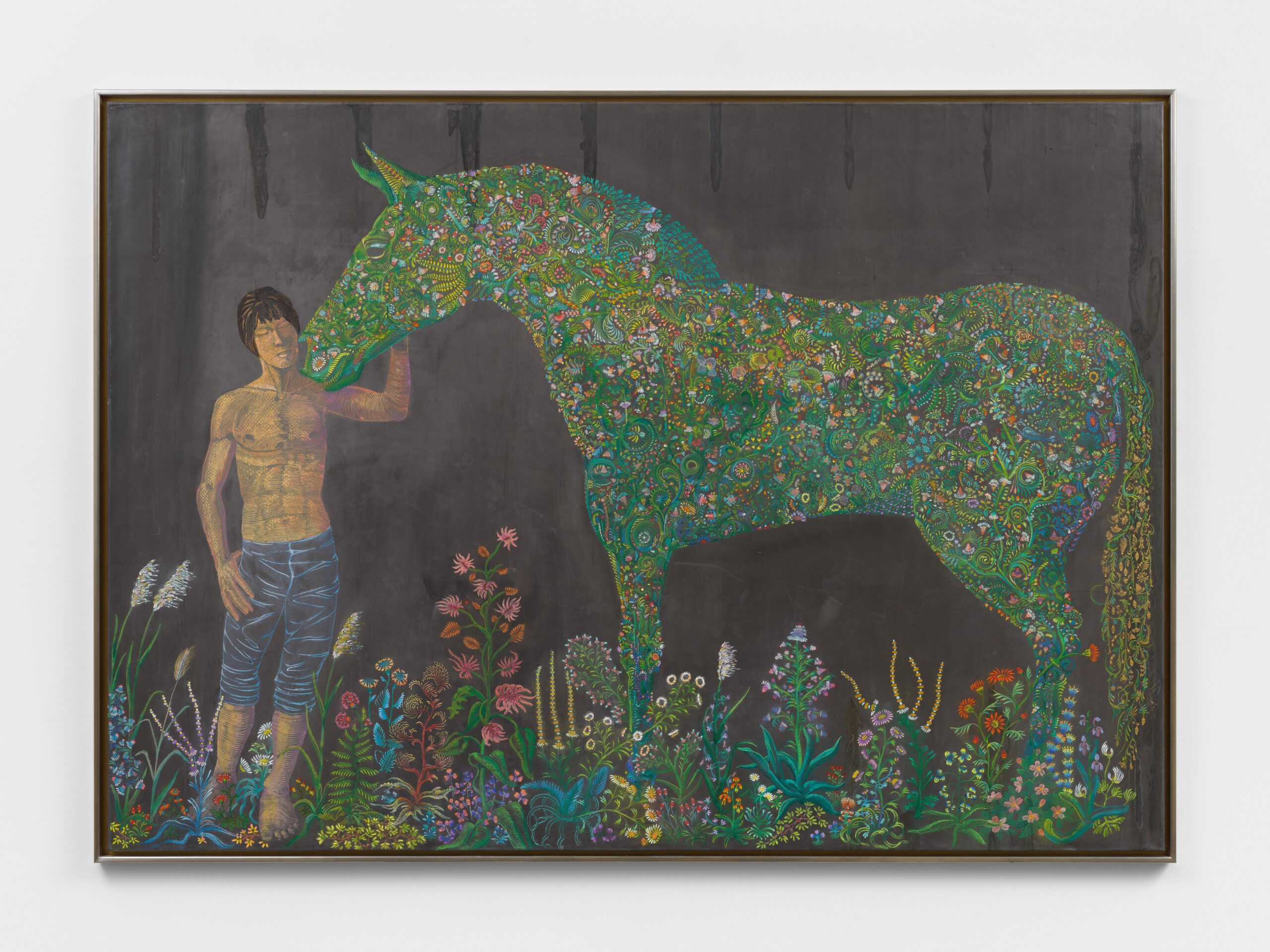
Artwork represents identity, but I’ve been dealing more with the concept of the soul and the journey of life. What inspires me in this show is not only the soul but also lived experience. For example, there’s a work, Levi, involving a horse and a moment I witnessed when he was adopted. He understood that something had changed, and I saw this moment of love between two species, human and animal. I’m sure you’ve experienced something similar with your pets or things you love. That’s what motivates me.
Were you always interested in these metaphysical questions, or were there particular experiences that led you there?
I was always a bit quirky. I’m gay, which wasn’t easy. Then, over the past 20 years, I decided my work had to hold something powerful and immense. I also come from a European tradition where the main function of art is to remind you of something important.
There’s something visually compelling about art that pushes you to think about what the triviality of life takes away. Years ago, I did a whole series based on people’s diaries, portraying how an individual life can become a representation for all of us. For example, I think you and I have both experienced the highest and lowest points. Nobody is safe from feeling like they’re drowning in life. That’s where I like to go. I like artwork that asks questions, not with a hermetic answer, but something you can relate to. These are not abstract gestures. They are tangible experiences we all recognize.
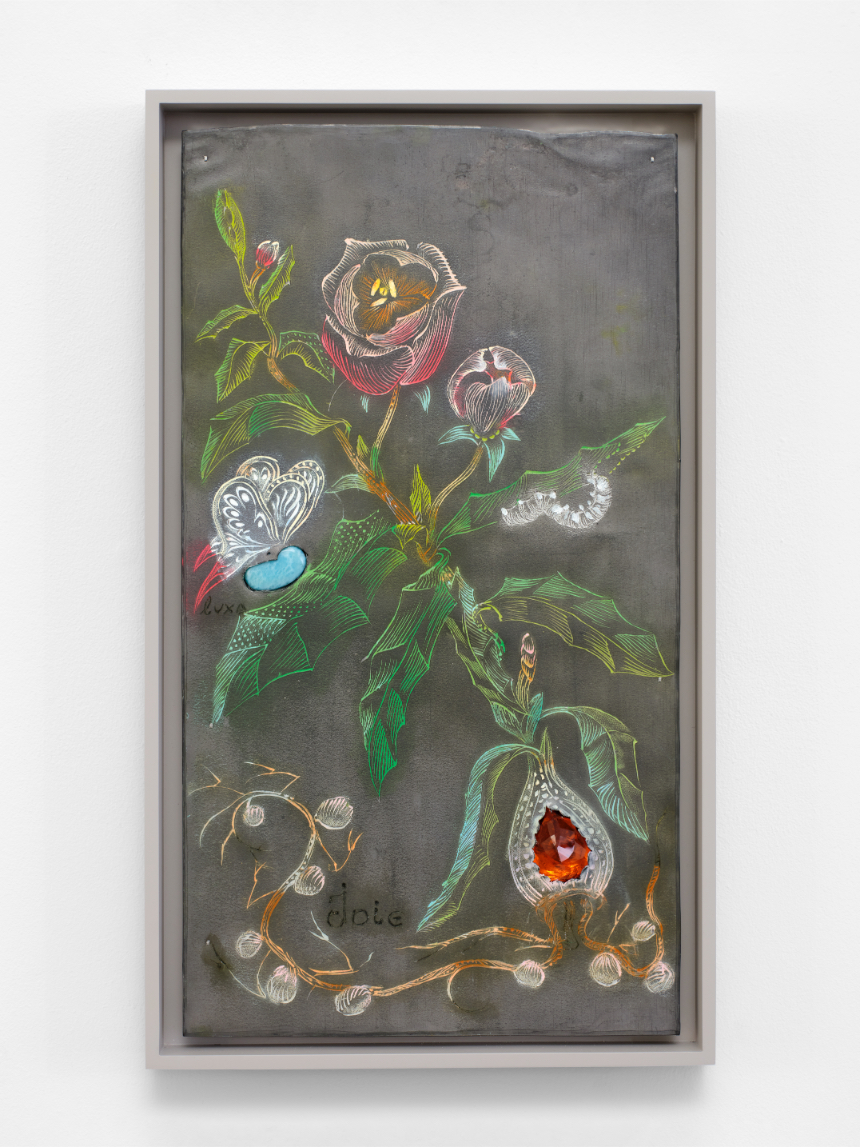
So much of your work has visual references to alchemy as well as medieval and Renaissance art. I would love to hear how you sourced your Renaissance art frames.
I wanted to create a sense of power. I believe that as an artist, you charge the artwork. When I paint, it’s like cooking: you start with a base, but every gesture, every cut, every decision adds meaning. All the accessory elements carry energy.
I wanted to create objects of reverence, like when you go to the Metropolitan Museum and see a Madonna. You might be Jewish, Hindu, or anything else, but you still feel that sense of divinity or tenderness.
For this exhibition, I also purchased many semi-precious stones, and I was fortunate to acquire frames from an auction house connected to the Metropolitan Museum’s acquisition funds. I specifically chose tabernacle frames—those with columns and a pediment—because they elevate the artwork. I want to reach the same level of power as Raphael or Leonardo. When you’re alone in the studio, the inner call is always to be as good as the masters you admire.
The frames help emphasize works related to divinity. I believe in synchronicities, in a kind of guardian presence or universal intelligence that loves each of us as if we were the only ones on Earth.
That comes through in your depictions of nature, especially plant life. I was even thinking of something like the Voynich manuscript. What draws you to those forms?
Sometimes I fantasize that in the afterlife I’d have a job designing plants and flowers. I’d love to be a biological engineer, creating new forms that could evolve, fall in love, produce new variations. The older I get, the more I enjoy dwelling in that kooky, imaginative space.
The exhibition’s title, “Anima Mundi,” really ties into that, this idea of a spiritual connection with nature beyond religion.
Yes. When I talk about spirituality, I mean something completely separate from dogma. I’m not interested in religion as a system. I want to speak about something universal, something not tied to any one belief.
You live in New York now but do you have another home outside of the city? Do you spend a lot of time in nature?
I grew up in North Africa, in a Spanish city on the Moroccan coast. The woman who raised me, a Moroccan Muslim nanny, taught me how to eat, how to behave. From her I learned compassion and love, and from very early on I understood that we are all fundamentally the same.
I later had a very traditional European education at the Royal Academy of Fine Arts in Spain—six hours a day for five years drawing from nudes from life. That training made me sensitive to the visible power of things, including nature.
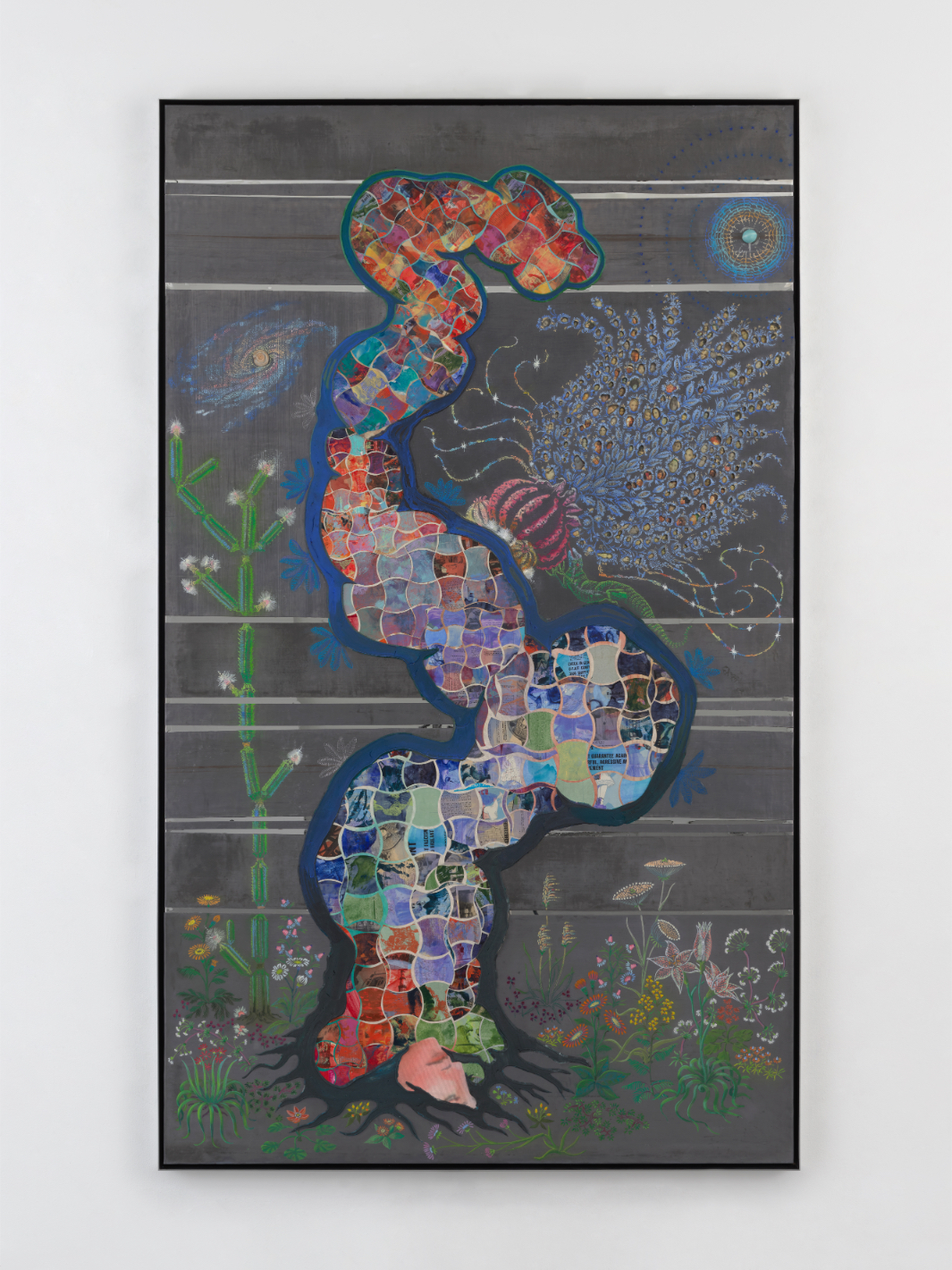
I see magic in nature all the time, in works like Gea (Gaia), or Don’t Tell Me You Can’t, or the cactus piece where humanity emerges from its trunk. There’s always something symbolic, something alive.
Your landscapes feel especially lush, reflecting your positive outlook for humanity. The environment in your work feels almost idealized, like a kind of Garden of Eden.
I think that’s my own therapy. I can be a bit depressed, so I create a world that is as loving and beautiful as possible.
Your last solo show was in 2019. What’s changed since then?
That show was very different. It focused on female saints, broadly speaking. I’ve always loved women—the way they think, the emotional intelligence I’ve experienced from my nanny, my mother, my sister, my friends.
What’s changed now is the intensity of effort, especially working with lead. Painting allows for correction, but with lead, every mark is permanent. You can’t erase it. That rigidity forces intention. Nothing is accidental. It’s all by subtraction.
Even now, I’m still working on the large triptych for the show. So I go back to the studio at night. The process almost becomes trance-like because there’s no room for error.
Do you think the pandemic influenced that shift?
Yes. COVID also brought an awareness of spirituality. I don’t think I’m unusual in asking these questions. In times of confusion, noise, and online distraction, people begin to wonder what lies beyond the immediate. COVID made people realize we are not simple beings. We contain something greater, something connected.
I was curious about your use of postcards in Red Giant. I recognized some of the faces: Jane Fonda, John Wayne. Where did those come from?
I’ve used different media. In one work, I used U.S. postal stamps because they reflect 140 years of cultural history, moving from emperors to artists, thinkers, and environmental imagery.
For the piece Red Giant, I used images of famous actors and actresses from the ’60s and ’70s. Most people today don’t recognize them. That’s the point. I wanted to use those popular figures to represent how we are conditioned to others’ perception of us—what if I’m misunderstood? What will they think of me? But we have to pay no attention to how people perceive us. Life is an opportunity to bring forward what is best inside of you. It could be like a game of discovery, but it goes beyond that. It’s to acknowledge that there are two aspects of life: one is the context of the people surrounding us and how they perceive us. And the second is the cosmic meaning of your life.
More of our favorite stories from CULTURED
How Blue Ribbon Survived a Mob Run-in and Transformed Late-Night Dining
Why Cookbooks Are the Next Frontier for Narrative Writing
You’ve Heard About the New Museum’s New Building. The New Show Is Even Better.
Everyone Was Afraid to Touch Nadav Lapid’s Satire of Israeli Artists. Now, It’s Being Released.
Where 27 Artists Are Hanging Out in New York Right Now
Sign up for our newsletter here to get these stories direct to your inbox.

 in your life?