In 2014, Kara Walker’s monumentally scaled sugar sphinx, A Subtlety, ushered in a new era of monuments that tell the stories of those who have not historically seen themselves represented in the form. The resulting projects also raised an important question at the intersection of aesthetics and politics in the U.S.: What is the role of monuments in contemporary culture?
“MONUMENTS,” a major undertaking co-sponsored by the Brick and the Museum of Contemporary Art, Los Angeles, and curated by Hamza Walker, Bennett Simpson, and Walker herself (no relation to Hamza), may provide an answer. The exhibition is on view across MOCA’s Geffen Contemporary and the Brick through May 6.
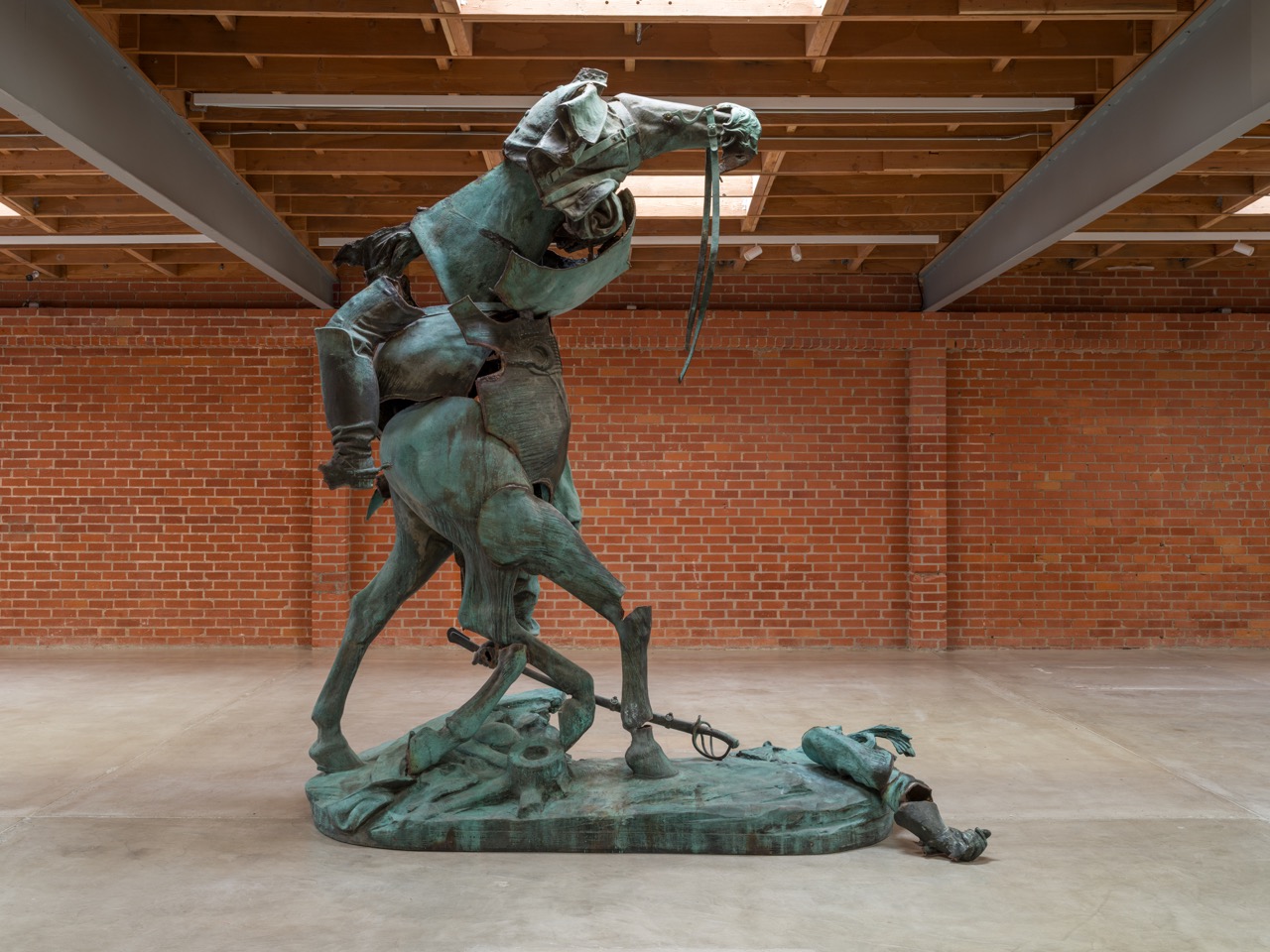
Bringing nearly a dozen Confederate memorials—each altered in some way from its original form—together with contemporary works in other media, the show seems to suggest that monuments are crucial to the project of describing what Hamza Walker calls “the relationship between present day grievances and historical injustices.” Kara Walker’s reworking of the Stonewall Jackson monument from Charlottesville, Virginia is perhaps the most masterful among a profoundly powerful collection of objects that make the inseparable relationship material: Jackson is beheaded, his horse butchered, and the constituent parts of the original monument are recombined into a poetics that explicates the ideologies that made the Confederacy possible and whose tendrils are still branching and unfurling in the present.
“MONUMENTS” was eight years in the making, an eternity even by curatorial planning standards. Calls for the removal of Confederate monuments, longstanding in Black communities in the U.S., burst into broader public discourse in the wake of the 2015 anti-Black murder of nine parishioners during a Bible study group at Mother Emanuel AME Church in Charleston, South Carolina. Two years later, the Unite the Right Rally—a white supremacist rally in response to those efforts that led, among other violences, to the murder of a counterprotestor—spurred a quick succession of removals. “The cities showed us that these monuments were moveable,” Simpson said. This physical destabilization created the conditions for a conceptual intervention facilitated by the relocation of the works into the indoor, white-walled context of the museum.
Given that much of the power of monuments derives from their publicness, a show of them across two private institutions could be seen as a harbinger of what is to come, with more interventionist monuments mounted in private while public spaces return to their status as sites for conventional statues, including both the reinstallation of Confederate monuments and new initiatives like President Trump’s Garden of Heroes. But, as Walker and Simpson point out, there are few places where the speciousness of the distinction between public and private space is more evident than monuments and museums. Museums make private collections public, and monuments on public land are often underwritten by powerful private interest initiatives, including the United Daughters of the Confederacy, who raised the funds to erect hundreds of Confederate monuments in public space across the U.S. at the turn of the last century.
Kara Walker recently said that the “provocation” for the show was “to say, can we be people here for a minute?” This incitement rhymes not with the public discourse conventional monuments are supposed to invite, but rather with the kinds of private dialogue often only possible on a smaller scale, where issues seem more personal, comprehensible, or operable. This echoes an important moment half a century ago when a number of artists whose practices were maturing during the social upheavals of the 1960s and early 1970s—like Adrian Piper and Vito Acconci—saw the limits of mass protest movements to effectuate change. Turning from the Minimalist vernacular they had been using, they made their own bodies the medium to address their audiences directly and propose a different route to common ground. As I argue in a new book on the shifting role of monuments in U.S. culture, Monumental: How a New Generation of Artists Is Shaping the Memorial Landscape, this aesthetic innovation laid the representational groundwork that enabled A Subtlety and the generation of monuments that followed to come into being.
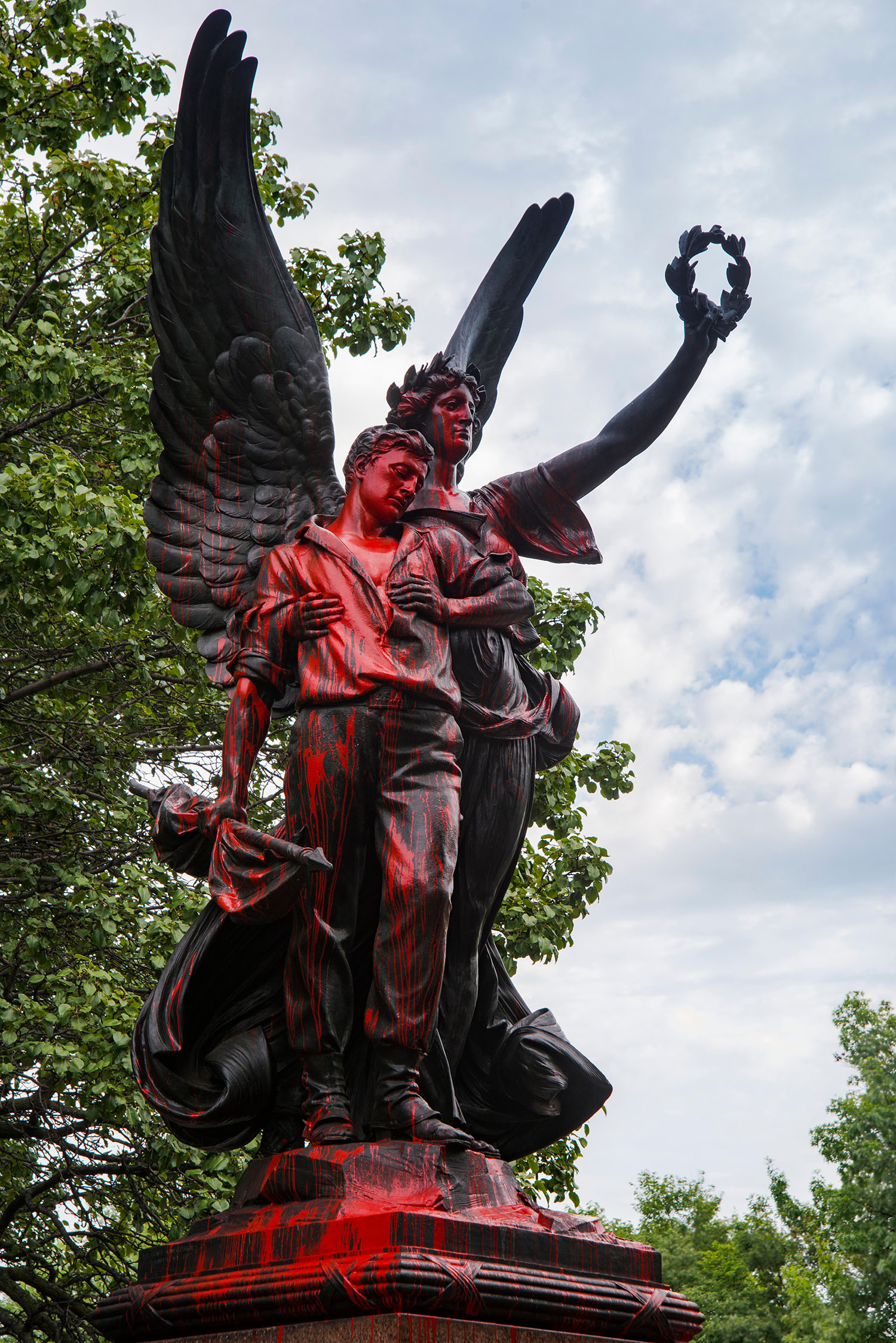
Despite their new contexts, the monuments in the show retain an aura of publicness that derives from their original form—a tension that affords the works a measure of pathos previously not accessible through them. Walker and Simpson note that this opens up questions about the ethics of aesthetics that arise from racist or censored objects that have been altered in both form and context. The show also suggests that questions regarding what to do when a monument is removed and who gets to make such calls are less interesting than investigations into the conditions surrounding their installation and persistence.
This distinction is borne out by a series of larger-than-life photographs of Klan hoods by Andres Serrano that become legible in this context as close-ups of Confederate monuments on a grand scale. Stripped of their military garb and Lost Cause rhetoric, they reveal monuments like the ones that form the source material for the show as the paeans to white supremacy they have always been. “MONUMENTS” opens in a different political climate than the one in which it was conceived, and at a moment that bears striking resemblance to the push at the turn of the previous century to rewrite history to naturalize and normalize white supremacist values in U.S. culture, when the majority of Confederate monuments went up. The show offers a potent reminder not only of this precedent but also of the ways in which the values that motivated Atlantic Slavery and the Confederacy may have shifted shape, but have never truly gone away. Inviting its visitors to make those connections, “MONUMENTS” looks past the exceptional conditions of the monumental form to see the far more ordinary ways that power is scaffolded, difference is marked, and new ways of being in community with and relating to one another can arise.



 in your life?