On April 9, 1917, the day before the opening of the Society of Independent Artists’ first annual exhibition in New York, Marcel Duchamp, a director of the Society, entered his work into the unjuried show. Thousands attended the opening of what was then the biggest-ever art exhibition in New York, featuring more than 2,500 paintings and sculptures. Every submitted work was to be exhibited, yet Duchamp’s entry was ultimately withdrawn following the objections of his peers. Was his submission—the porcelain urinal he purchased from a shop selling plumbing supplies, signed with the pseudonym R. Mutt, and named Fountain—even a work of art? This question changed the world of art forever.
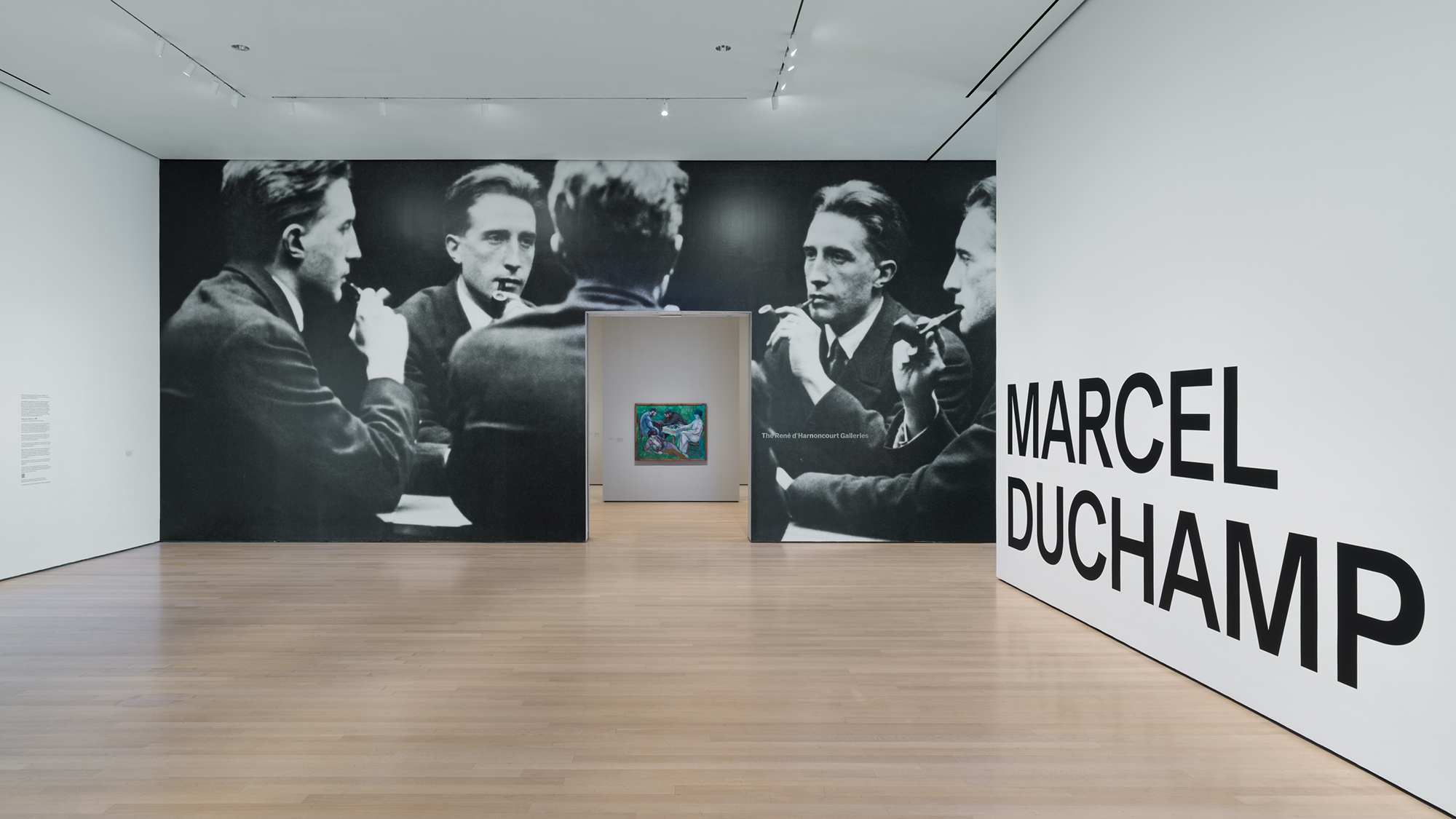
“Marcel Duchamp” at the Museum of Modern Art is the late artist’s first retrospective on this continent in over 50 years. Curated by Ann Temkin, Michelle Kuo, and Matthew Affron, it’s a brilliant and appropriately bewildering exhibition—shaped both by bold choices, especially its strict chronological organization, and a few conspicuous missed opportunities.
The most fascinating—and disorienting—aspect of this revelatory exhibition is how, and when, Duchamp’s artworks appear in its chronology. Many of his most famous works are seen at the right time only in photographic reproduction (like Alfred Stieglitz’s iconic photograph of Fountain published in May 1917) and then they reappear—often again and again—as refabricated copies or miniatures. The show is rife with replicas.
This is particularly true for the most revolutionary of Duchamp’s works: the “readymades” of 1913-17. Take the earliest, Bicycle Wheel, 1913, which doesn’t appear at the right time at all. (Mentioned in a letter to his sister, the first version was left in France and discarded while he was abroad.) Instead, the second version of the sculpture appears within the exhibition in a circa 1917-18 photograph by Henri-Pierre Roché of Duchamp’s studio at 33 West 67th Street. Bicycle Wheel appears as a sculpture in the center of the room, much later in the exhibition, with Duchamp’s third version from 1951. This is followed by two more editions in later rooms from 1964 and 1960/76. The 1913 original exists only as a ghost of an idea.
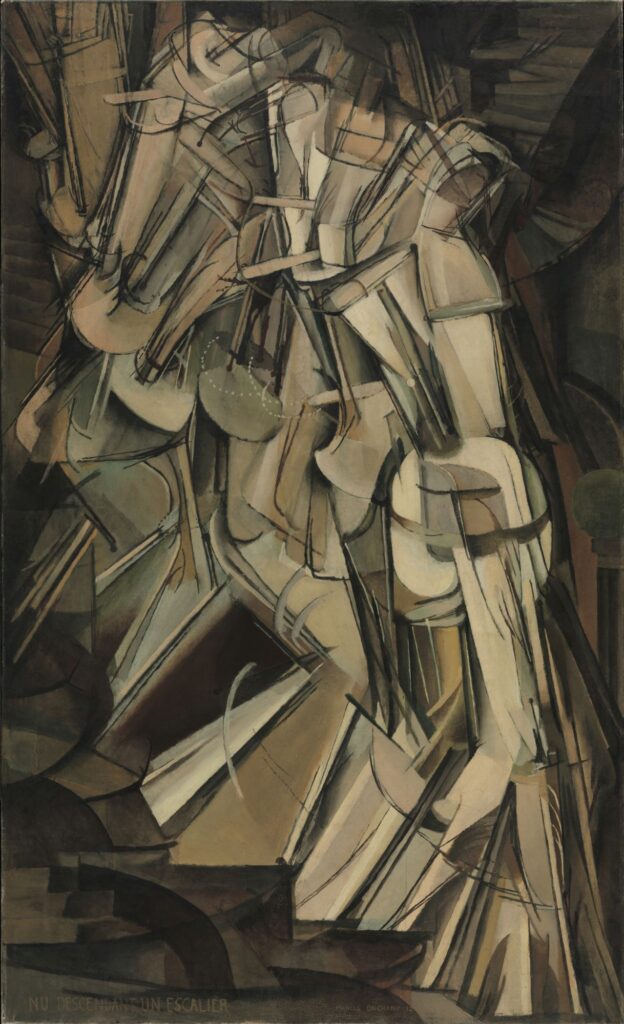
Before we get to the dematerialization of the art object, there are paintings, from teenage oil renderings of chapels, gardens, and churches, to illustrations Duchamp made for newspapers, which share dark outlines found in early paintings heavily influenced by Paul Cézanne. Duchamp’s greatest achievement in the medium comes when he fuses the Futurists’ obsession with speed with Cubist techniques to illustrate motion in Nude Descending a Staircase (No. 2), 1912, in oil on canvas.
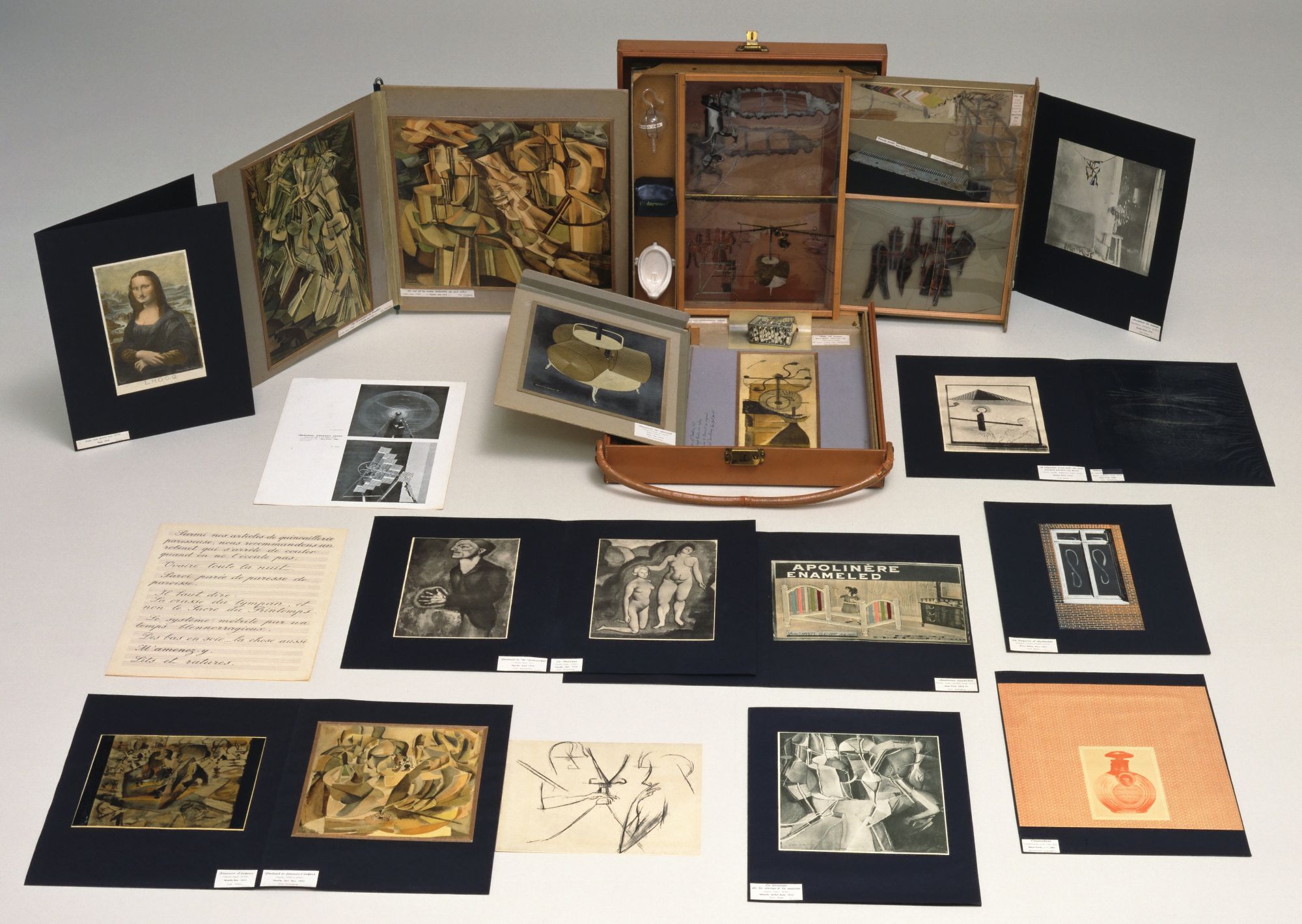
The very first Duchamp retrospectives were made by Duchamp himself. The MoMA show includes a great number of his Box in a Valise contraptions, initiated in the 1930s and allowing for Duchamp to create his own greatest hits collections in miniature, as well as to collect various notes in facsimile. In the galleries, this creates an overwhelming presentation of stuff, much of it repetitive, exploded in clusters across the space. It’s a radical departure from what museums usually do, undermining the very idea of an original. Let’s not forget, Duchamp’s proto-meme intervention: L.H.O.O.Q., from 1919, which consists of a postcard of the Mona Lisa, with added facial hair in pencil. (It’s title, read aloud, translates approximately to the phrase “She has a hot ass” or “She’s a hot piece of ass” in French.)
There’s another approach to a Duchamp retrospective that played through my mind as I walked through the galleries, one that would chart his influence on later artists. But that influence is so great that this could spin off in a thousand directions. Fitting for Duchamp—who was greatly suspicious of what he termed “retinal” art—this is an exhibition more important to think about than to see, better to daydream within than to preserve and catalog the excess of detail. (My pairings would differ from yours. I pictured Greer Lankton’s dolls next to Raoul Ubac’s photograph of Marcel Duchamp’s Mannequin Rrose Sélavy from 1938; Dayanita Singh’s Museum of Chance, 2013, her modular photo boxes beside a Duchamp, Box in the Valise; Matthew Barney’s The Cremaster Cycle films, 1994-2002, playing beside the 1924 Man Ray photos of Duchamp’s face lathered in shaving cream that uncannily anticipate Barney’s character.)
Duchamp’s final work, Étant donnés, which he worked on over 20 years until his death, appears here only in photographs, as it’s permanently installed at the Philadelphia Museum of Art, where this show will travel next. Looking at the photos of the supine female body, I immediately cycled through remembered images from the work of Ana Mendieta. The more than 300 objects in the exhibition should forever overthrow the myth (born partly from Duchamp himself) that for many years he quit art to play chess or do nothing.
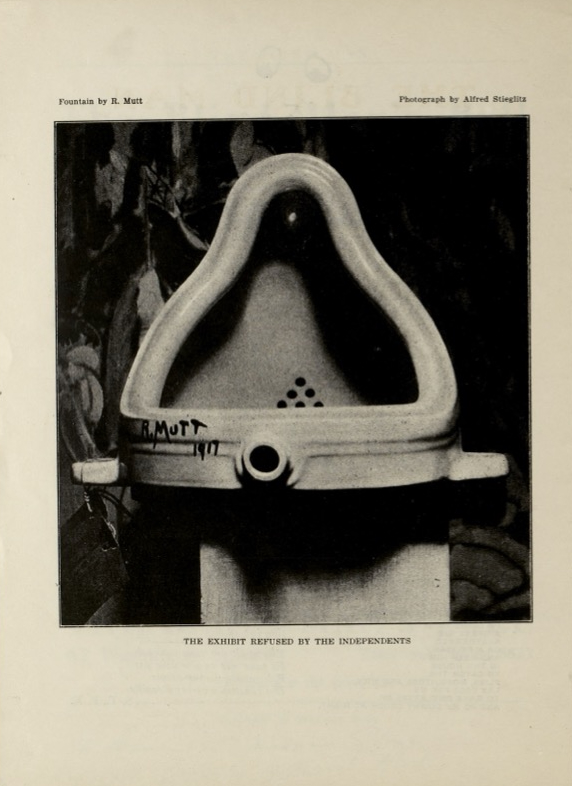
One of the exhibition’s oversights relates back to Fountain. While the curators tell the history of Fountain being withdrawn and how it was subsequently photographed by Alfred Stieglitz and published alongside a defense of the work in the Dada journal, The Blind Man, they leave out crucial context. Duchamp chose to submit Fountain at the last minute before the April 10 opening. This follows shortly after the Congressional declaration of war on Germany, made on April 6, 1917, thus entering the U.S. into World War I—a spectacle of technology and violence never before seen, resulting in an estimated 15 to 22 million people killed.
It’s against this backdrop of accelerating war that Duchamp radically rejects aesthetics and the centrality of beauty. His call for a new kind of art—an art of ideas—needn’t be seen as inherently political. But it is philosophical: What is the value in good taste in a time of mass capitulation to violence and death? “Taste is the enemy of art,” Duchamp would later exclaim.
Seeing a propeller at a 1912 aeronautical show outside Paris with Fernand Léger and Constantin Brâncusi, Duchamp announced, “Painting is washed up.” He wondered whether any painter could make something more consequential. Duchamp, then, was something like an artist, now, trying to anticipate the impact of A.I. on art and society.
Born a Frenchman, he died a New Yorker. With a pissoir, he provided conceptualism’s elegant proof.
More of our favorite stories from CULTURED
14 Books Our Editors Can’t Wait to Read This Summer
Inside the Closet of a Revered Stylist Who Has Only Worn Prada For Over 30 Years
Charles Melton Actually Has No Idea Where His Career Goes From Here
Introducing a Play For Every New Yorker Who’s Had More Bad Dates Than Good
7 Commandments for Rookie Collectors, From CULTURED’s Power Art Advisors
Sign up for our newsletter here to get these stories direct to your inbox.

 in your life?