

I recently learned about the Thematic Apperception Test, a 1930s projective analytical tool devised by Henry Murray and Christiana Morgan, a pair of lovers who co-directed the Harvard Psychological Clinic during the frontier years of hybridized psychoanalyses. Both Morgan and Murray believed that the literary mind is directly linked to the unconscious mind, and that fiction is born from a subconscious impulse to reconcile the present with the past.
The test they invented together sought to simulate this tendency through a relatively simple methodology: a subject would observe a series of images and explain what they saw, giving form to thoughts or drives that might otherwise evade language.

I think quite frequently about the work of writer Emma Cline, whose fiction always seems to reveal the quiet tectonic shifts that occur just beyond the frame of disaster. Her almost wholesome California-girl beauty belies an imagination devoted to the dark corners of the American psyche, as though to silently reiterate that we can never know what’s going on in another person’s mind.
I sat down with Cline—whose third novel, Switzy, will be released this fall—to talk about doubles and repetitions, about what it means when we find ourselves in someone else’s work, about why writers return to the irresolution of the past again and again. We began our conversation with an exercise in Thematic Apperception, testing Murray and Morgan’s theory that the quiet rumblings of our unconscious minds realize their most legible form when fixed, however provisionally, by the model of the story.
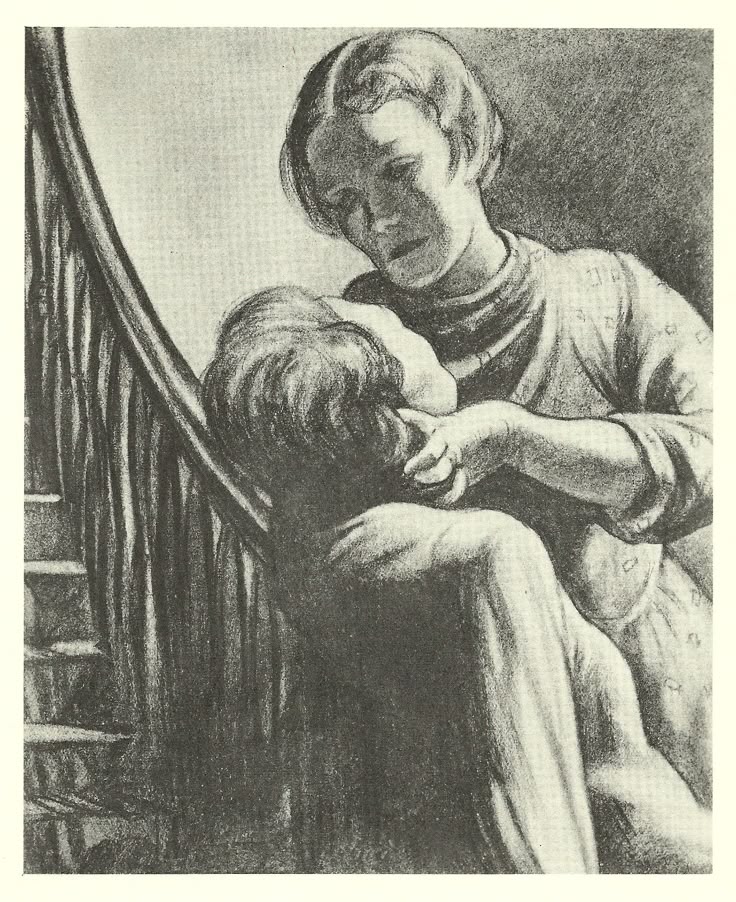
Alissa Bennett: What’s happening in this picture?
Emma Cline: My first impression was that we were looking at an image of a woman carrying another person up the stairs, but then something shifted. They’re wearing the same outfit and they have the same hair, but I think that only one of them is alive. She seems to have gotten ahold of some slightly out-of-order version of herself—a dummy or a doll—and she’s dragging it back upstairs.
Bennett: What led to this moment?
Cline: The dummy was used, whatever that means. It did its job, and she’s finished with it for now. It served its purpose.

Bennett: How does she feel?
Cline: Her dispassionate gaze makes me think that whatever happened is over. We’re witnessing a transitional moment.
Bennett: How do you think it ends?
Cline: She goes upstairs and puts the devil away.
Bennett: And then she takes it out when she needs it again. I can’t believe you consented to this, by the way. Thank you for taking part in my amateur psychological evaluation!
Cline: When I heard it was you doing the interview, I just decided to trust.
Bennett: We’ve never had a conversation in real life, but I have written to you with questions about characters and details in your books. I asked you about a painting that gets defaced in The Guest, because it reminded me of a recurrent fantasy I used to have about vandalizing a specific artwork. I wonder if people regularly react to your writing with that kind of over-identification.
Cline: Sometimes, but it’s so rare that there’s a satisfying one-to-one answer; it’s usually some kind of kernel or flicker that leads me to something else. The idea of that painting comes from a time in my 20s when I dated a guy whose parents were collectors. We were at their house alone, and he was showing me their art, and I remember looking at a painting and wondering if they would notice if there was suddenly some minor interruption to its surface. I thought there were two ways that could go, and the more interesting one was the possibility that no one would even register that something had happened.
“The incidents I am drawn to are always shaped by confusion.” —Emma Cline
Bennett: I read that you’re interested in true crime, and I think the tendency some of us have to over-identify with a work of fiction is borne from a similar mechanism. If you’re really honest with yourself, true crime is only compelling when you subconsciously identify with either the victim or the perpetrator.
Cline: I’ve been reading about the Donner Party a lot, most recently a book called The Indifferent Stars Above. There’s a part where a young woman’s husband dies, and the others immediately rush in to ask if they can eat him. She says, “You can’t hurt him now,” then they all sit around the campfire while someone roasts his heart on a branch. I’m interested in understanding moments of extremism. What could possibly be going through a person’s head while this is happening? How do people actually manage to live through these things?
Bennett: There are a lot of extreme events occurring in your fiction that you choose not to narrativize. You’re very good at showing how we sublimate, which often means not addressing the big threat.
“I’m interested in understanding moments of extremism.” —Emma Cline
Cline: I guess I return to this over and over—almost helplessly—because I’m preoccupied by the idea of the thing that no one can quite look at straight on. That’s a big part of the work.
Bennett: Which returns us to the argument that fiction writers are dealing with a series of pre-set narratives that have imprinted themselves on the unconscious mind, and that writing is an attempt to find meaning or resolution in the repetitions.
Cline: It’s the dream of someday reaching coherence, finding that it’s always out of reach. The incidents I am drawn to are always shaped by confusion.
Bennett: A lot of your characters are suspended in liminal states. You write about aging men who are on the verge of losing something, and you write about young women whose vulnerability has begun to tip towards cruelty. You describe the brutal economy that arises when one of those groups confronts the other.
Cline: I often notice that the way I describe a particular situation—sometimes it’s granular, maybe on the sentence level—is clearly triggered by a sense memory. I find myself writing about certain things repeatedly in the same way, but each time, it’s as if I’m finding it anew. There’s something comforting about that. It makes me feel like there’s an organizing principle, even if I’m not aware of it. It’s like Freud said: “The ego is not the master of the house.” Something else is at work. We like to think we’re the master, but we’re not.
Makeup by Kendell Cotta
Hair by Richard Verrett
Set Design by Taylor Venegas
Lighting Design by Saúl Barrera
Photography Assistance by Alizabeth Bean
Order your copy of the CULT100 issue here.
More CULT100 Cover Stories
Salman Rushdie Tells Laurie Anderson the Truth Behind His New Ghost Stories
Lena Dunham Checked Out of the Hype Machine. Is She Glad to Be Back?
Meet David Jonsson: the Actor Frank Ocean, Colman Domingo, and A24 Can’t Get Enough Of
Why Naomi Watts Is Embracing Camp
Vinnie Hacker, the 23-Year-Old Michelangelo of Thirst Traps, Plots a Life After Influencing
Sign up for our newsletter here to get these stories direct to your inbox.






 in your life?