
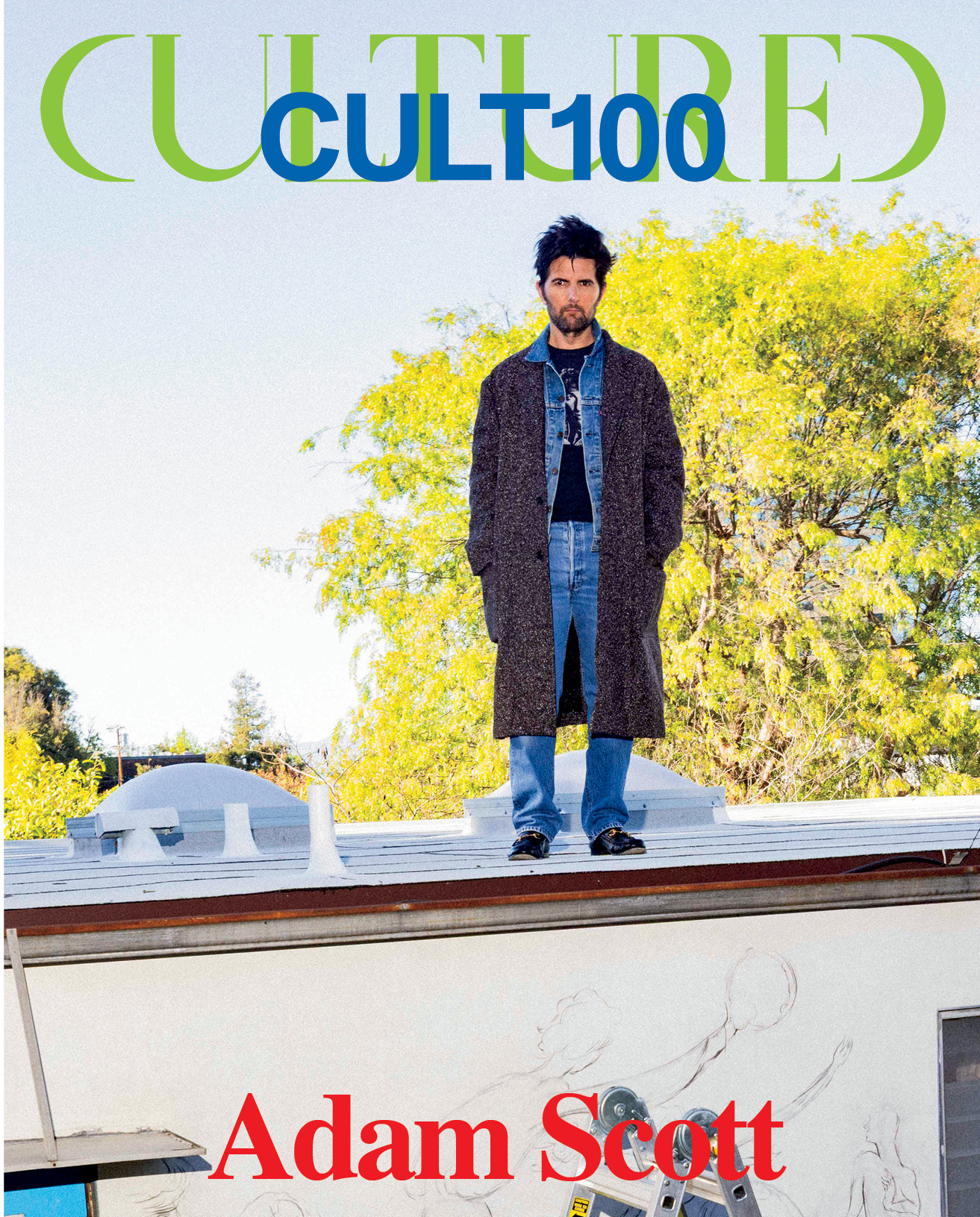
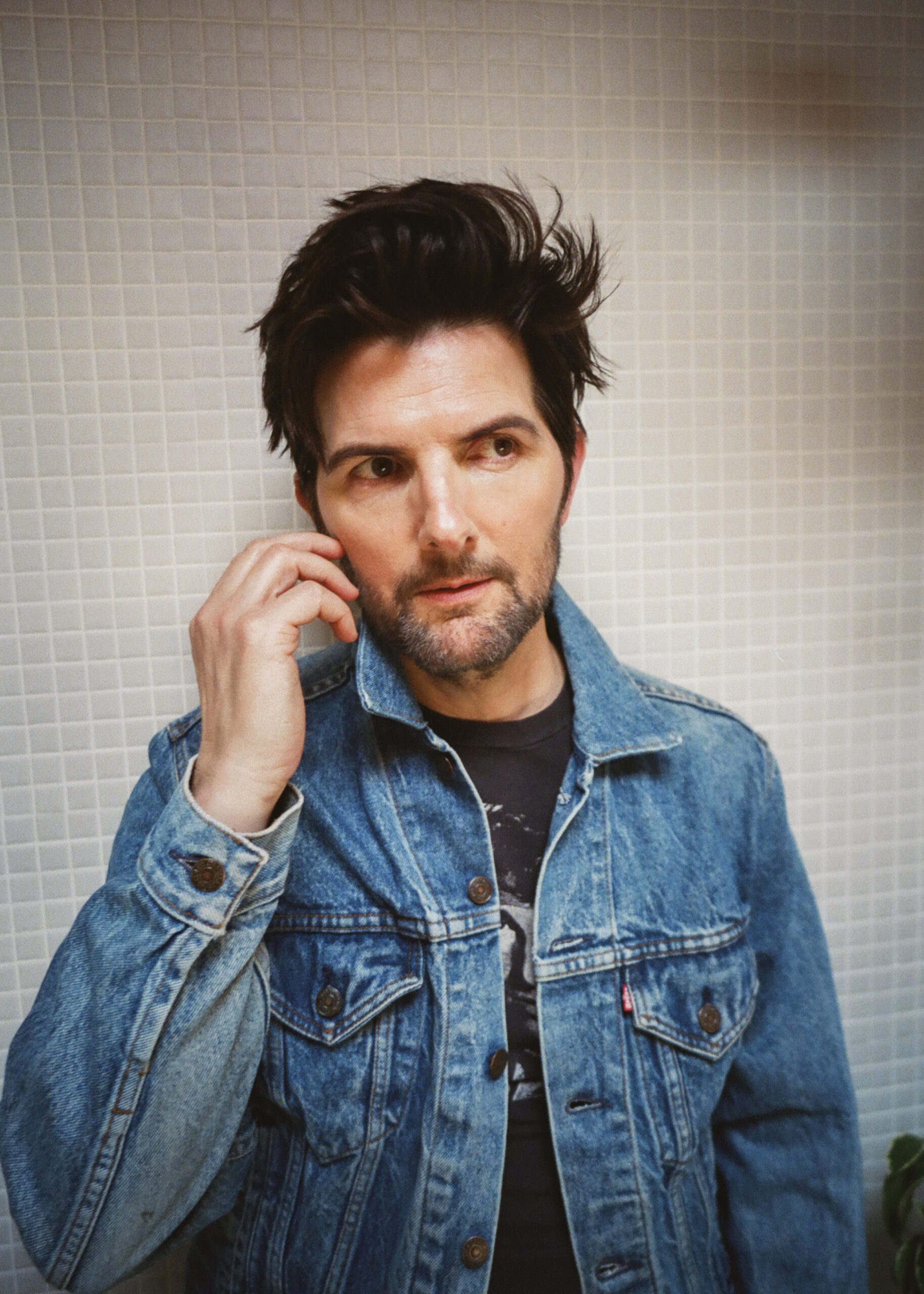
“I am always in the mindset of the out-of-work actor who no one is interested in hiring,” Adam Scott confesses to François Arnaud.
Neither attained household-name status right out of the gate (the pair have 50 years’ worth of acting credits between them), but the admission still comes as a surprise. Scott is so firmly cemented in the popular imagination as the quintessential “straight man” of millennial comedy that it’s hard to imagine the last three decades of television without him.
The 52-year-old actor’s deadpan shrugs and faintly mousy demeanor made his flannel-clad, R.E.M.-loving government bureaucrat in Parks and Recreation a cult character. But his onscreen reputation as the mild-mannered everyman was taken to its furthest extreme in Severance, Apple TV+’s record-breaker of a show, in which he plays a stiffly coiffed office drone who’s cleaved his at-work persona from his grief-stricken real-world self through sci-fi means.
Offscreen, he’s further commanded ownership over his projects by dipping into podcasting and producing, launching Great Scott with his wife, Naomi. The production company is now the operator behind the much-streamed Severance Podcast and the thriller The Saviors—about a couple, played by Scott and Danielle Deadwyler, renting their garage to mysterious inhabitants—along with his still-cooking directorial debut. His streak of paranoid, unsettled characters continues with this May’s Hokum, in which he plays a horror writer trapped in a haunted Irish inn, and Netflix’s adaptation of Alex North’s The Whisper Man, where he also incarnates a writer, this time a widowed one picking up the pieces after the abduction of his son.
Ahead of another sojourn on the set of Severance, he called up his new friend Arnaud to talk about overpreparing, big breaks, and what try-hards have over everyone else. –CULTURED
François Arnaud: What’s your go-to snack order at the movies?
Adam Scott: I like peanut M&Ms.
Arnaud: Do you put ’em in the popcorn?
Scott: Amy Poehler taught me that. I do like that. It’s kind of a fucking mess.
Arnaud: You have a few movies coming out—Hokum and The Saviors, which you also produced.
Scott: Yeah, with Great Scott. It was called Gettin’ Rad for years. Then Naomi and I were like, The name of our company sucks.
Arnaud: I love it. It’s aspirational.
Scott: We’re going to get rad at some point.
Arnaud: Between Severance and those two projects, you’ve cornered the market for characters prone to conspiracy theories, whether it’s true or not. Is that something that occupies your thoughts on the daily? Are you channeling something there?
Scott: I have found myself—a few times in my life, or more than a few times—going against the grain a little bit if I have an opinion and I’m outnumbered. I don’t like how that feels, but once I’m through it, I’m always proud that I stuck with it. If I feel a certain way, I’m not going to peel off just because I’m outnumbered. I think it’s important to stand up for yourself, whether it’s a note in a movie or if it’s something political.
But to answer your question, I’ve always gravitated towards the ’70s thrillers like The Parallax View and all the Alan Pakula movies of that era.
Arnaud: How do you feel about genre? Are you a big horror fan?
Scott: I like horror movies, but not graphic violence for the sake of it.
Arnaud: Did you know [Hokum director] Damien McCarthy before this?
Scott: I saw Oddity, yes, and loved it. I didn’t know Damien before. We met over this Zoom call and it was a lovely conversation, but we’re both such mild-mannered, reserved white dudes that, by the end of it, we both thought that the other wasn’t interested in it. Neither of us wanted to feel like we were pushing ourselves on the other. Do you know what I mean? We were being too nice.
Arnaud: I feel like that’s the case in so many of these meetings, right? You’re wondering, Do you really want to do this?
Scott: I know that you’ve been around for a while. Then Heated Rivalry happens, and suddenly your career is really solidifying. That’s a great feeling. It took me so long to get everything together that I am always in the mindset of an out-of-work actor. That’s always my default setting. Do you still hold onto that feeling?
Arnaud: I did a TV comedy called The Moodys a few years ago that not a lot of people watched, but it was a cast of basically all comedians: Denis Leary, Elizabeth Perkins, Jay Baruchel, and Chelsea Frei. I had to play the straight man among them. I was a bit terrified, but then I thought of you in Party Down. I was like, This will be my North Star. It really carried me.
Scott: That’s very kind of you to say and really flattering. When I was going to do Party Down, I was thinking of Jason Bateman or even more of Ted Danson, because the character’s a bartender. I had to figure out how to be the person that everyone is coming to with all of their problems. You have to be neutral, but you don’t want to be boring.
Arnaud: It’s a lot harder than it seems.
Scott: Ted Danson makes it look really easy.
Arnaud: Is that a lot of instinct?
Scott: It could be. With a horror movie or a thriller, I think it’s maybe less so. There’s this whole section of Hokum where I’m alone in a room, and we’re just going from one set piece to another. It’s not a lot of dialogue. I remember when we were making it, we shot a bunch of the movie, and then I looked at the schedule and I had three weeks of not saying a word, just being in this room by myself. I was like, Oh, shit.
The one thing that horror and comedy have in common is that the thing you’re going for—audience response—is something you have no control over.
Arnaud: You shot [Hokum] in Ireland? Had you been before?
Scott: I had been to Dublin. I was in a movie called Leap Year with Amy Adams. [For Hokum,] we were way down at the bottom of Ireland in West Cork, which is out in the countryside. Have you been?
Arnaud: I’ve only been to Dublin. But I’ve worked with a lot of Irish people who I love. I feel a real kinship with the Irish sensibility. I also think it’s the most beautiful accent of the English language. I could listen to it all day long. Do you get contaminated by other people’s accents? By take five did you sound Irish?
Scott: I wish I could absorb dialects like that. If I were to try to put on an Irish brogue, I would need to dive in for like eight hours a day for six weeks to even come close to it. Can you do that?
Arnaud: I think I can. French is my first language, and then I learned English at a young age, and then Spanish. It helps to learn a language or accent when your brain isn’t fully formed yet. I just did a movie in Spanish for the first time [called Abril].
Scott: Wow.
Arnaud: A friend of mine trusted me with it. He had actually written the part for a native speaker. I’ve spoken Spanish fluently for a long time, but when I’m not immersed in it, I get a bit rusty, and I was nervous‚ so I really overprepared. But by the time I got there, it was just so liberating, the freest I’ve ever felt on set.
Scott: Why do you think it was liberating?
Arnaud: With accent work or a different language, you’re automatically someone else. Your rhythm is different. Your sense of humor is different. Your sensibilities are just different.
Scott: It’s like Aaron Sorkin or Shakespeare. You’re in their rhythm.
Arnaud: I feel like so many people try to look like they’re not trying. I really like how much you care and how much you work. Maybe as a teenager, I thought it was cool not to have to try, but it’s completely changed now. Effort is fucking sexy.
Scott: Absolutely.
Arnaud: In everything—not just work, but in life and love—do you still feel you have to work as hard as you used to, or can you relax?
Scott: I’ve tried both. I found that overpreparation and overwork is when I’m at my best. My mantra is “get caught trying.” It’s what I live by, particularly with acting. When I grew up, it was all about, like, Brando didn’t care. He was so great because he didn’t care.
Arnaud: I don’t buy that at all.
Scott: You see how hard he worked on making that Godfather character. That’s hard, man. I got to work with Robert De Niro [on The Whisper Man] last year, and I got to watch him working. He still gives a shit and is there to make it as great as it possibly can be. If you want it to be great, do everything you can to get it there.
Arnaud: What led you to want to produce now? Is it to have more creative control over the performance or the material? Or do you want to surrender to someone else’s vision and just not think about it?
Scott: I guess it depends. I love producing. After being around for a long time, I found that you have so much time to kill when you’re acting. And I remember the first time when Naomi and I made these Adult Swim specials where we recreated opening credit sequences to old ’80s TV shows. We made these mini mock documentaries around them directed by me and my friend Lance. I found when we were doing that, I didn’t have a minute all day to kill. I was just busy all day. I loved it. I loved hitting the pillow at night, just dead tired knowing that there wasn’t a moment where I wasn’t busy. I feel like the more of my day I can fill is less time I have to kill in my trailer.
Grooming by Kristen Shaw
Photography Assistance by Amber Maalouf
Styling Assistance by Adrian Gilliland
Order your copy of the CULT100 issue here.
More CULT100 Cover Stories
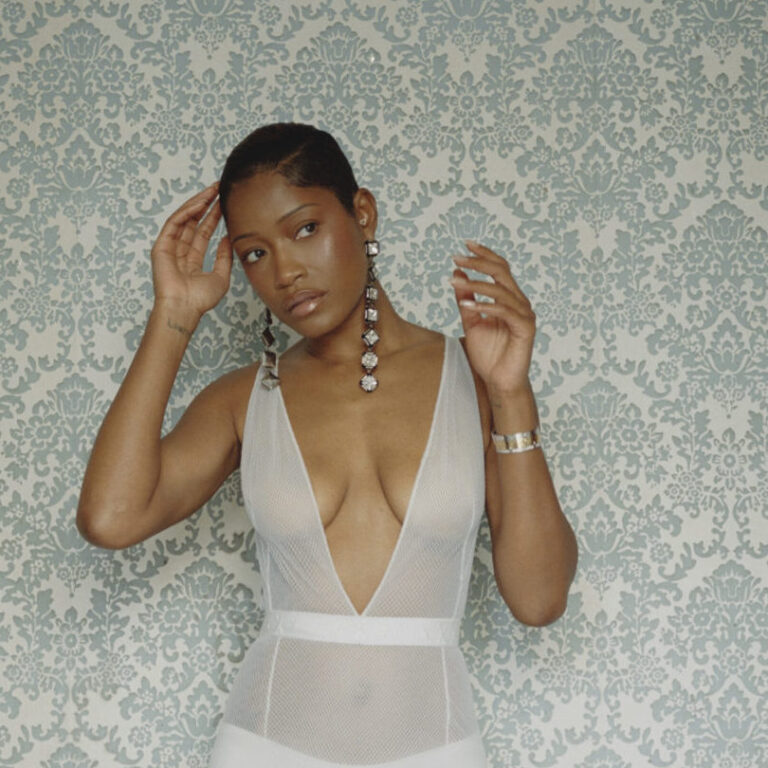
Keke Palmer Never Got to Play the Boss, So She Became One
Lena Dunham Checked Out of the Hype Machine. Is She Glad to Be Back?
How Sombr Emerged From Dimes Square Fully Formed as a Pop Star Heartthrob
Marcello Hernández, SNL’s Youngest Cast Member, Turns to Jamie Foxx for Advice
Salman Rushdie Tells Laurie Anderson the Truth Behind His New Ghost Stories
Sign up for our newsletter here to get these stories direct to your inbox.





 in your life?