As always, to map our picks and plan your route, enter the Critic’s Table hashtag #TCT in the search bar of the See Saw app. Easy!
A year ago I was complaining about an art world that felt as if it were retreating into pretty, safe, and very often boring painting (especially at the mid-tier galleries of Tribeca and elsewhere downtown). Comely decoration in acrylic or oil was on offer rather than work that might challenge, surprise, or even confuse.
Conditions have changed. Painting is out. Sculpture, installation, and sculptural environments of conceptual work are in. This year’s Whitney Biennial neatly embodies this trend, which can also be seen throughout New York, from the sprawling Carol Bove survey at the Guggenheim Museum to Michael Heizer‘s largest indoor “Negative Sculpture” to date at Gagosian 21st Street, where his voids move beyond simple geometric forms recessed in the floor (like the examples long on view at Dia Beacon) to a more expressive mode that suggests both a supersized looping line drawing and, if you could jump in, a maze.
Two shows, one in Midtown and the other in Tribeca, bring into view neglected aspects of the German artist Isa Genzken’s work. Galerie Buchholz, now located just north of, and across the street from, MoMA focuses on her “Projects for Outside,” which includes architectural works and public sculpture. Downtown, at the newly christened Zwirner Tribeca, formerly known as 52 Walker (R.I.P.), the show includes a set of four of Genzken’s “world receivers,” her radio-shaped concrete blocks with metal antennae extending from their tops. It’s curated by 52’s Ebony L. Haynes, now in her role as global head of curatorial projects. (Aki Onda’s homage to José Maceda’s 1974 composition, Ugnayan, at this year’s Whitney Biennial reminded me of Genzken’s “receivers,” as an array of 20 radios and boomboxes played Maceda’s piece—my favorite work in the Biennial that didn’t make it in my review.) Add to this list of stellar shows, Paul Chan’s new set of “breathers”—his kinetic, windsock-like figurative sculptures—in “Automa Mon Amour” now at Greene Naftali.
As I’ve come down from my Biennial high, three exhibitions in particular strike me as standouts that, in different ways, match or outdo the best of what is on offer at the Whitney: Robert Gober at Matthew Marks, Felix Beaudry at Situations, and the pairing of Hans Haacke and Louise Lawler at Maxwell Graham. Consider my short-list above, and these three exceptional shows, as your go-to pairing of what to see alongside the current Biennial. (Yes, Lawler has a back-to-back appearance in the Critics’ Table—add Johanna’s pick at Emmelines too.)
Last week, Robert Gober’s “Plein Air,” confirmed my belief that great artists can push the experience of confusion into a state of wonder. My desire for transcendence—or, if that’s too much, at least mystery—finds a match in the devotional practice of Gober’s latent Catholicism juxtaposed with his concern for the signs and symbols of quotidian of the American nuclear family (with dashes of queer desire and catastrophe). I have been moved by every Robert Gober show I’ve seen in my 20 or so years of seriously looking at art, but I also can’t say that I’ve ever understood a Gober show in a sufficiently rational and articulable way.
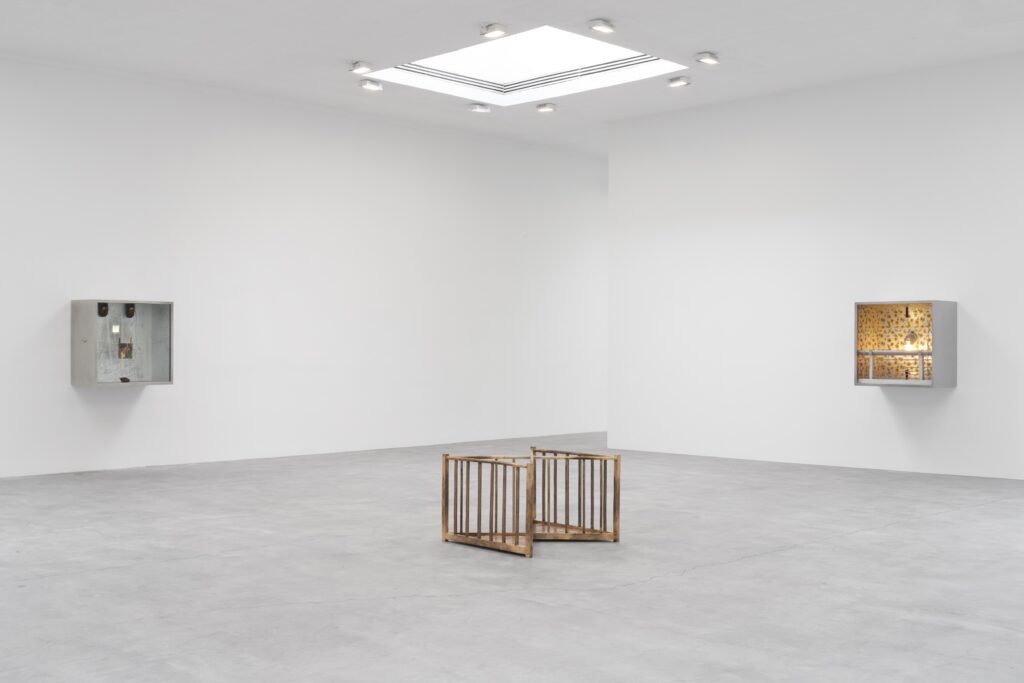
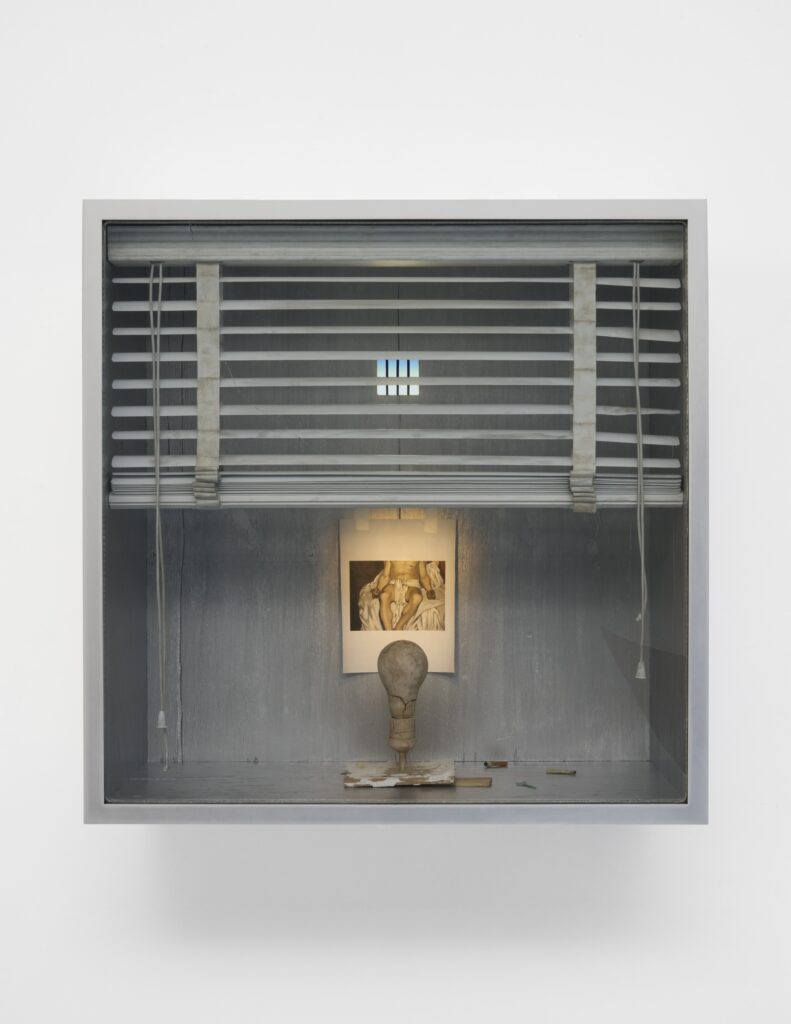
At Matthew Marks last week, I finally feel like I got hold of Gober, in part, because in the presentation his mystery has been diminished, even if just slightly. His uncannily realistic legs emerging from walls, candles, running water in sinks and drains, always transform space in a profound manner. Here, Gober’s works—diorama-like cells—hang like paintings, a characteristic strain of his later work. Most are fronted with glass, sometimes cracked. Two have miniblinds, making clear that their faces are windows of a sort. Classic Gober details are here, fragments of men’s shoes or, in one, a leather belt; four of the boxes show, on their “walls,” the barred windows of prison cells. Most reproduce other artworks or iconic images within. Untitled, 1990-2025, contains a postcard-sized detail of Manet’s Dead Christ with Angels,1864, bringing our attention to his torso and the white drapery of simple cloth partly covering it. This image of Christ with his wounds is taped in the background of a sculpted broken lightbulb, two cigarette butts and a mint-green plastic tooth flosser rest on the cell’s floor to the right—a difficult set of symbols to read beyond an immediate recognition that this is a work by Robert Gober.
While cryptic, it’s also contained and portable, presented like a durable good for sale among others. The X-shaped crib in Untitled, 2013-16, which closely resembles Gober’s life-size, painted wood X Playpen, from 1987, is similarly reduced in power by being cast here in bronze—divorcing it from the classic hand-hewn Gober quality. (The artist slept in a crib in his parent’s bedroom until he was five years old.) Even in these formats, Gober remains a deeply affecting, and still, deliciously perplexing artist.
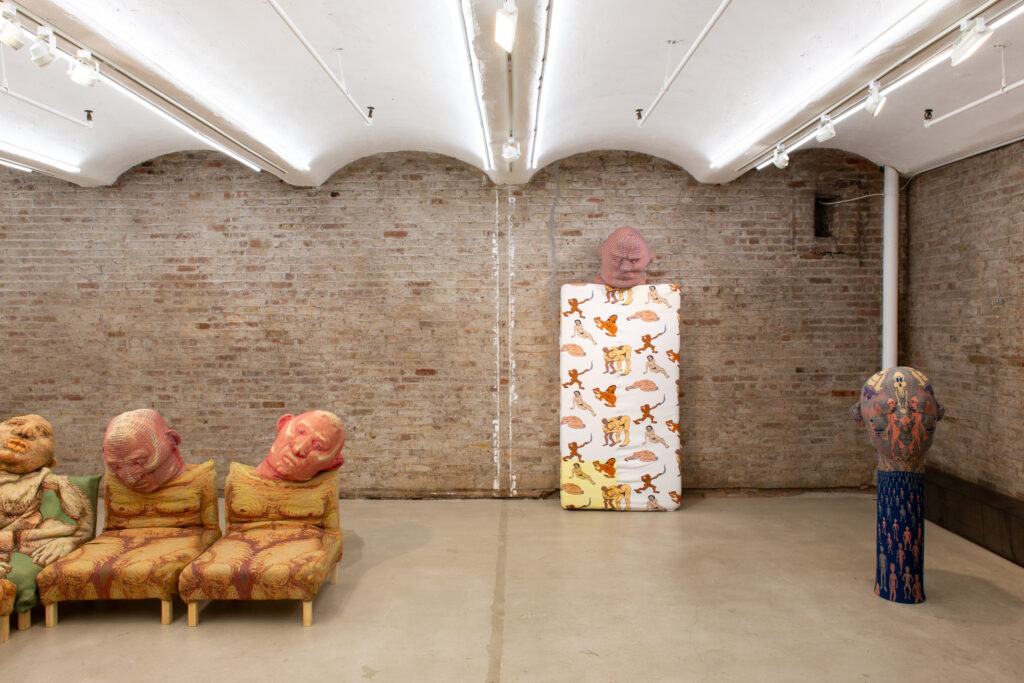
A couple of blocks south, in the 3rd floor gallery Situations, also in Chelsea, you can rest for a moment in the weird, plush environment created by the Kingston, New York-based sculptor and textile artist Felix Beaudry. Sit on the sectional sofa, if you don’t mind also sitting in the gnarly lap of one the show’s titular “Malleable Young Men,” with their heads looking over your shoulder. Beaudry’s fabrics are produced on a computer-assisted knitting machine to make his figures that are at once charming and delightfully freakish. Drone, 2026, is a disembodied purple head atop the rolling base of an office chair. Slumber Paddy, 2026, features a head atop a mattress, leaned against the wall, with a knit cover, mimicking a child’s print. Some of Beaudry’s knitted heads telescope from the wall on articulated pneumatic arms.
Beaudry is an artist of systems and processes. He’s inspired by the complicated networks of ropes and masts on the galleon ships of the 16th to 18th centuries. He utilizes A.I., the press materials tell me, to help render complex designs in yarn—combining elements of drawing in multiple colors of thread to make his sculptures. A.I. is too often used merely as a buzzword or deployed superficially, but here, in his complex, soft sculptures, Beaudry is clearly using it effectively as a problem-solving tool to push his knitting-based practice into an imaginative and complex direction, rendering objects unlike any others I’ve seen before. It’s not fetishistically futuristic. It’s very now.
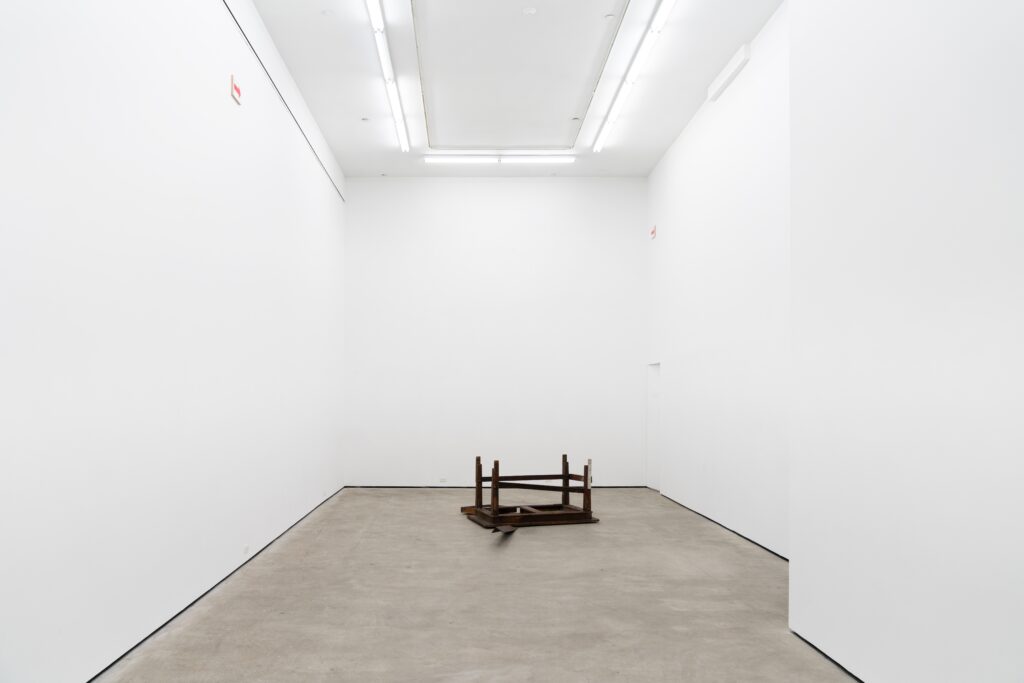
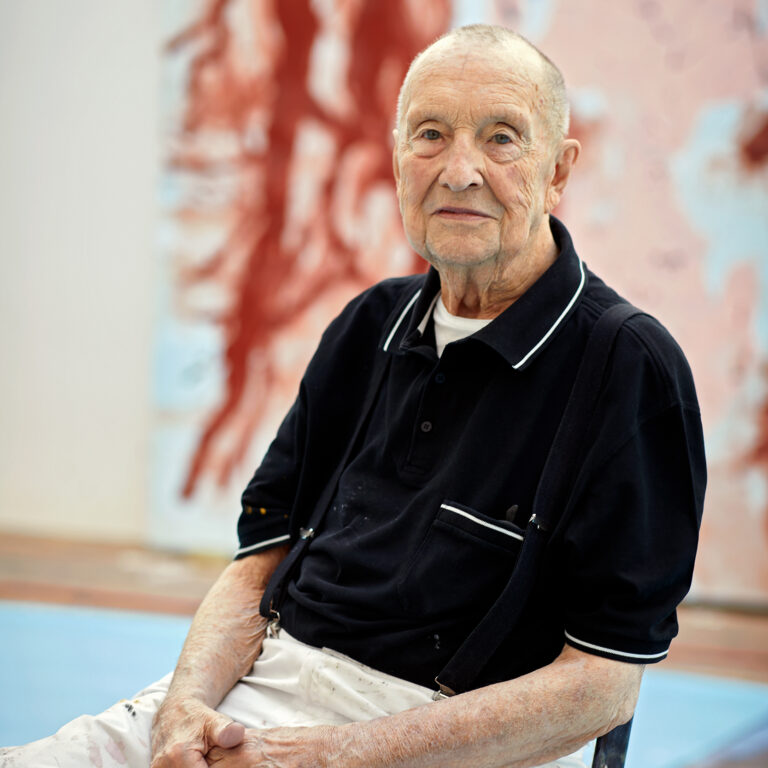
Across town, on the Lower East Side, at Maxwell Graham, I found myself in a temple of humanism and reflection. It’s a startlingly sparse two-person show. Hans Haacke, soon to turn 90, and Louise Lawler, nearly 80, together offer one of the most politically responsive exhibitions currently on view, though not didactically so. At the center of the main, lower gallery space, lies the overturned wooden desk of Haacke’s Untitled #1, 2005, shown here for only the second time after debuting in “State of the Union,” at Paula Cooper, in a 2005 solo show in which the artist reflected on the aftermath of September 11. A desk drawer contains a small American flag lapel pin and broken lightbulbs. Throughout the space are five red arrows, by Lawler, multiple versions of Alizarin (Terrorists are made, not born), 2023, first shown at Sprüth Magers in Los Angeles shortly after the events of October 7 that year. Read that parenthetical in the title again. Alizarin is the first pigment, a bold red, to be made synthetically. Lawler also shows her new piece Before/During/After (Green), 2024/25, a large dye-sublimation print of an iPhone photo she took, blurred from motion, of The Death of Marat, 1793, a portrait of an assassinated revolutionary in the bath by Jacques-Louis David, the artist who would go on to become Napoleon’s brilliant propagandist.
What does this all add up to? The time when an artwork is made and the time when it is exhibited is important—or so says Maxwell Graham’s press release epigrammatically. The show ventures that artists can speak to history and respond in a fraught political epoch. I’d call it polemical, but it remains too opaque, too resisting of an easy reading to be so. The pairing proposes an art of ideas that isn’t subsumed by commerce. I left grateful for a New York that still shows art like this. Such thrilling quixotism compels me to write in praise of difficult art.
More of our favorite stories from CULTURED
Our Critic’s Favorite Show This Month Is Hidden in a Subway Station
James Cahill Saw the Best and Worst of the Art World. His Latest Novel Exposes It All.
If We’re in the Golden Age of Documentaries, Why Are All These Documentarians So Worried?
Sign up for our newsletter here to get these stories direct to your inbox.



 in your life?