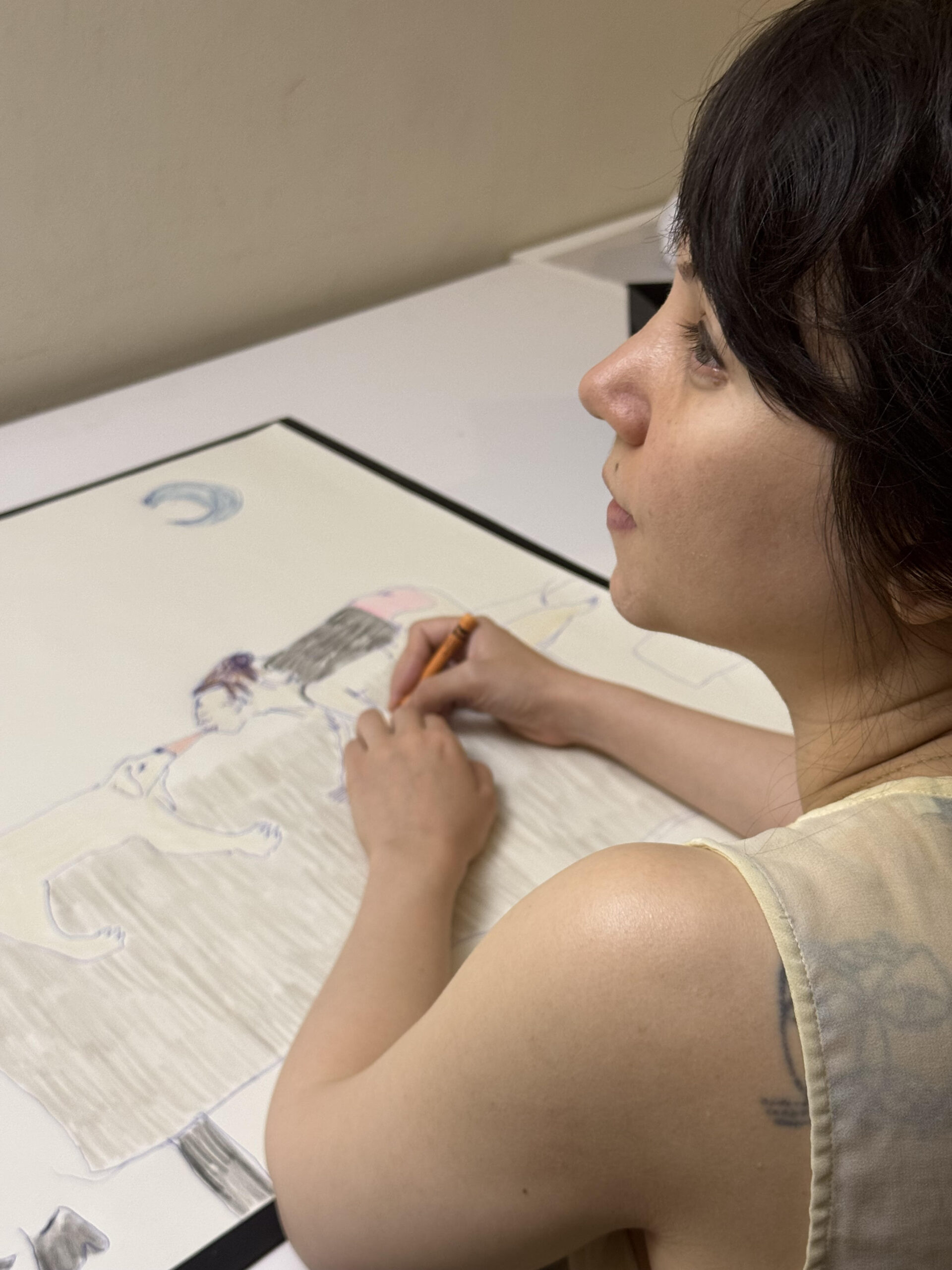
For years, the artist Emilie Louise Gossiaux has paid tribute to their guide dog, London, through ebullient drawing and sculpture. After losing their sight in their early 20s, Gossiaux developed a close bond with their beloved golden Labrador. As the two grew enmeshed through mutual care, the typical hierarchy between human and animal dissolved.
Gossiaux began to explore the private world they shared—buzzing with tattoos, magical forests, doppelgängers, alligator-humans—with frenetic, riot grrl energy. In pen and crayon, ceramic and papier-mâché, London takes action: eating peanut butter, licking faces, dancing the Maypole (which happens to double as a giant white cane).
Gossiaux sculpts and draws by touch, feeling lines and shapes as they make them. In the process, they tap into dreams, myths, and the felt knowledge that comes from living interdependently.
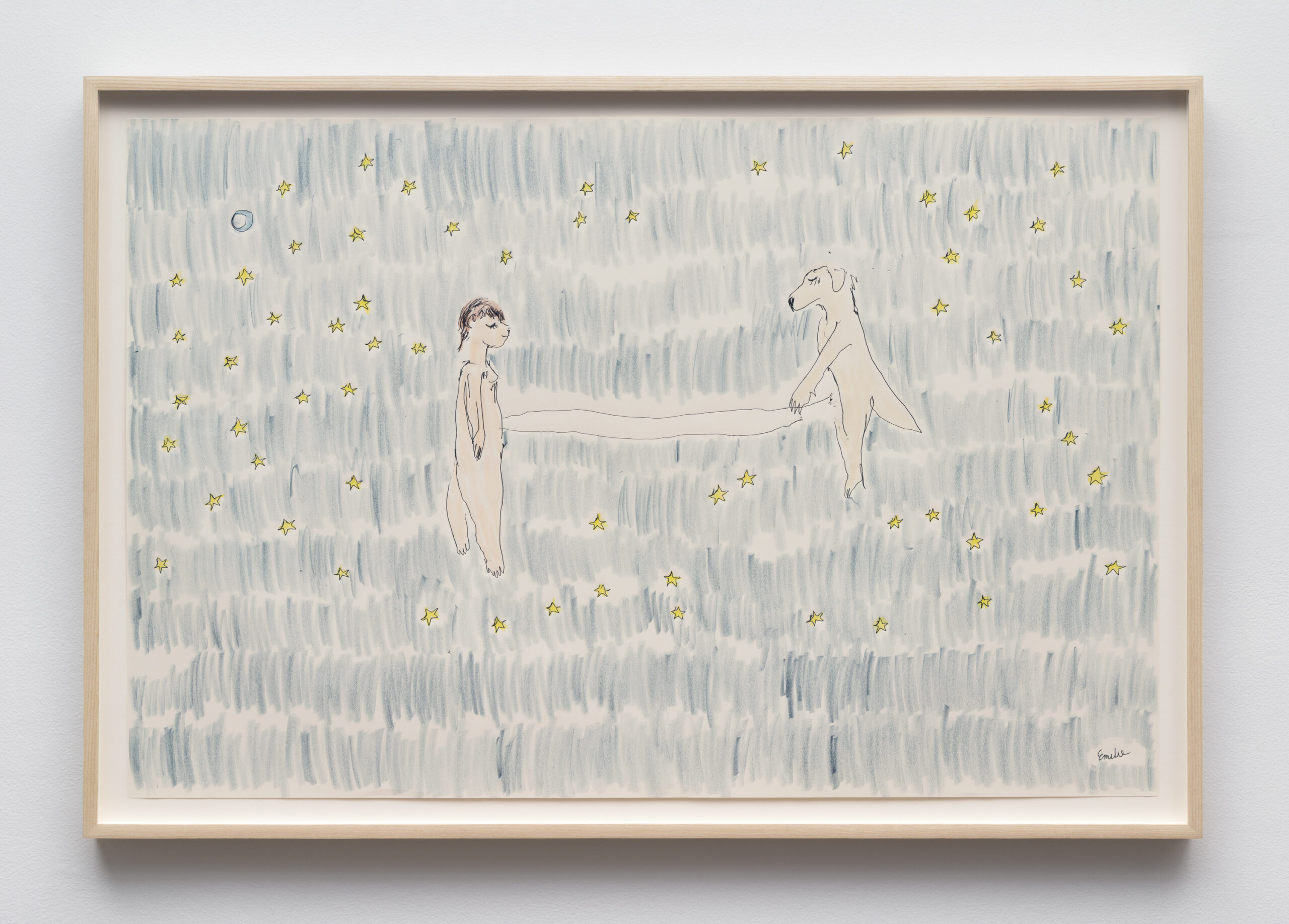
After London’s death in 2025, Gossiaux took this year’s Whitney Biennial as an opportunity to imagine heaven from a dog’s perspective. In drawings, they capture themself floating through the sky with their canine companion; in sculpture, they present a colorful menagerie of Kong toys. As the art critic Alex Greenberger wrote in a review of the biennial, “I’ve been hard on this show, but I’m not made of stone: Gossiaux’s drawings made me tear up. These works also spurred me to reconsider my relationship to animals more generally—and to want to be a better companion to them.”
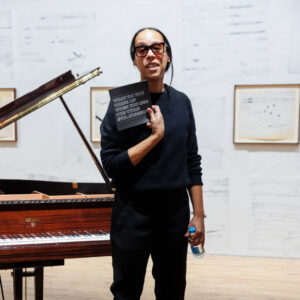
On a snowy day in late February, Emilie joined me from their Manhattan home studio to discuss how the Whitney work came together, the creative potential of chew toys, and making art through grief.
Emilie, congratulations on your inclusion in this year’s Whitney Biennial. How did you approach working toward such a high-profile show?
A lot of my work is centered around my guide dog, London, and she passed away last year, one year after I started to work on Kong Play, the piece selected for the biennial. So that work evolved after her passing into this wonderful paradise for London in heaven, where she’s surrounded by her favorite chew toy that you stuff with peanut butter, called a Kong. I imagined filling a room with these colorful objects; they’d be close to the floor, at dog level. I was playing with an idea of pleasure both from a human’s perspective and a dog’s perspective, but mostly from a dog’s perspective.
The drawings that I was making towards the end of London’s life were exploring the afterlife, and also about what it was like to care for London. The weight of it and the sadness of it. Saying goodbye to such an important person and reflecting on the connection we have. She came into my life and completely changed it for the better.
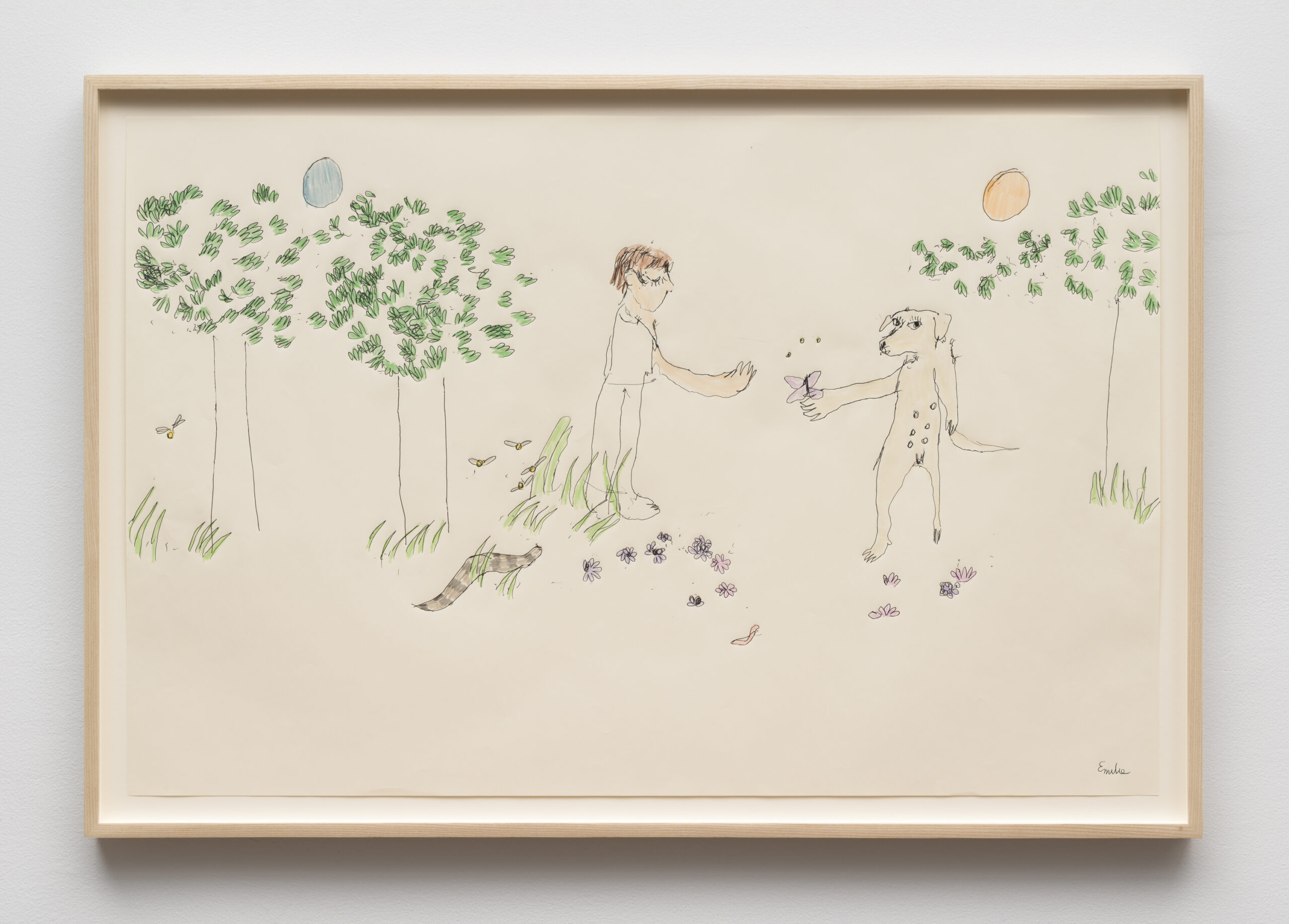
The drawings feature spiritual ideas of London and me being connected through an umbilical cord. One drawing is called In Dreams We’ll See Again: London is standing before me as a hybrid animal, like a goddess, and she’s holding out a butterfly to me in her open paw, and I’m reaching out to grasp it from her. It’s also about liberation and freedom.
Do you feel freedom is the gift that London gave to you?
Yes, and it’s something that I wanted for her when she retired from being a guide dog and also for her second life in the world beyond.
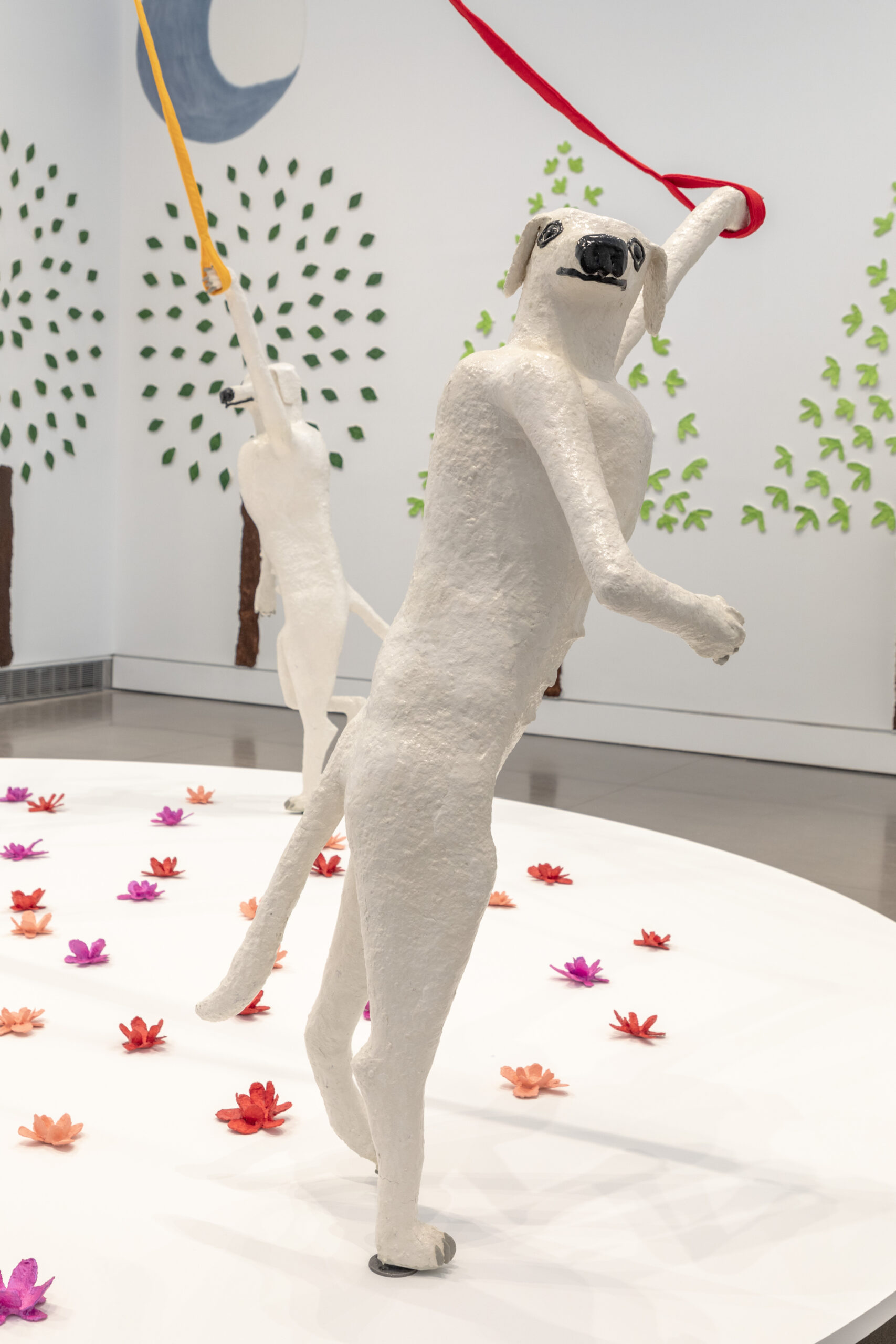
In your recent exhibition at David Peter Francis, you sculpted some butterfly dogs. Were you preparing for London’s metamorphosis?
I was, but I didn’t know when it would happen. I asked her, Is it time? And I knew that she would let me know when it was time. A lot of my drawings and sculptures were preparation, a way for me to cope and be able to eventually let go.
Grief can take on many different shapes and forms. Part of my remembering of London is the happiness and pleasure that she brought to me. Her pleasure, too—watching her lick peanut butter off of my fingers. That kind of shared intimacy that we had, like sitting in her bed and feeding her scraps of chicken. But also when you laugh, you cry sometimes.
You’re holding space for pleasure and grief at the same time. Even though you center joy in your work, you always bring complexity to that feeling. I see different ways to approach the dog Kongs as well. They look like chew toys to dog owners, but they might be butt plugs to the uninitiated. Are you open to alternate readings?
I enjoy that ambiguity. It’s like, Why is this making me feel weird and also making me feel really happy? I have a drawing where one London is mounting another London, and they’re trying to reach with their tongues to lick Kongs that are levitating in front of them. It’s playful, sexually charged, with a double meaning. Are they playing, or are they doing more?
At the Whitney, the Kongs will be on low circular plinths. I think about heaven and about the song by the Talking Heads: “Heaven is a place where nothing ever happens.”
Another moment of contrasting feelings—bliss and monotony. Okay, back to nuts and bolts. What is a typical day in the studio like for you?
I’ve started to go to bed early, like at 10. I wake up around 7. I work from home, so it’s easy. I can eat breakfast with my partner, Kirby. We’ve been working together for a really long time now. So we start working around 11 a.m., and we stop around 5 to clean up and eat dinner. It’s just a little bit every day.
I appreciate Kirby because he is very much a perfectionist, and I am a perfectionist, too. But in my work, I also embrace the imperfections. I call myself an imperfect perfectionist. Kirby is really good at getting the details done. My approach is always just do it and see what happens. I’ll start rolling up paper together and using tape to force it to connect to another piece of paper. But he’s really structural. I feel like our opposite approaches work well for us.
Right now, the studio is very messy. There’s a lot of foam cutting and PVC parts flying around everywhere. It’s looking like a bit of a construction site.
If your art practice were a musical artist, who would it be?
Charli XCX. She really gets me moving.
Not what I expected! In terms of your studio process, where do your ideas and images come from?
The imagery that I hold in my mind starts with a meditation, then I draw that idea down, and then I draw the idea again. It evolves or morphs, and that’s when materials start to come in. I start thinking, What kind of material would this object or this piece feel good in? What kind of colors do I want to use? That helps me decide if I want to work with clay or work with paper mache or something else.
Lately, I’ve been making a wall with ceramic tiles. Each one will have a drawing illustrating the idea of traveling through the underworld. I’ve been reading Greek mythology about Orpheus and Eurydice, and also Hecate, the goddess of the crossroads between the living and the dead. Her companion was always a dog. Then in pre-Columbian Mexican culture, there was the Xoloitzcuintle dog. They were hairless, and they would lead people through the underworld. There’s the same reverence for dogs in Tibet, because dogs were known to be guides through the afterlife there, too. So I’m also getting ideas by reading about ancient myths.
Drawings usually come first?
They do. It helps when I’m working on a project with Kirby because I can show him—this is what the idea is. I want my sculpture to have that same character, that same movement, as my drawings do. [I’m] like London, when she was younger had so much energy—like a little child jumping up and down, going around in circles, poking me, like, Hey, what’s up?
I love picturing her as a puppy, and then you channeling her puppy energy. As you make work from your own reality, do you also feel a weight of responsibility to represent the disability community?
The work that I do is for my community, the disabled community, and I don’t feel like there’s any weight or gravity that goes along with that. When I’m making my work, I think, How can I make this accessible for my community to experience? That’s why I like to lead touch tours and invite my blind friends. At the Queens Museum [where the artist had a solo show in 2024], for example, that was really my favorite part. My favorite people to engage with are always going to be the blind and disabled community.
We’re scheduling a touch tour this summer at the Whitney. There will also be a touch graphic of one of my drawings in the gallery where my work is being shown.
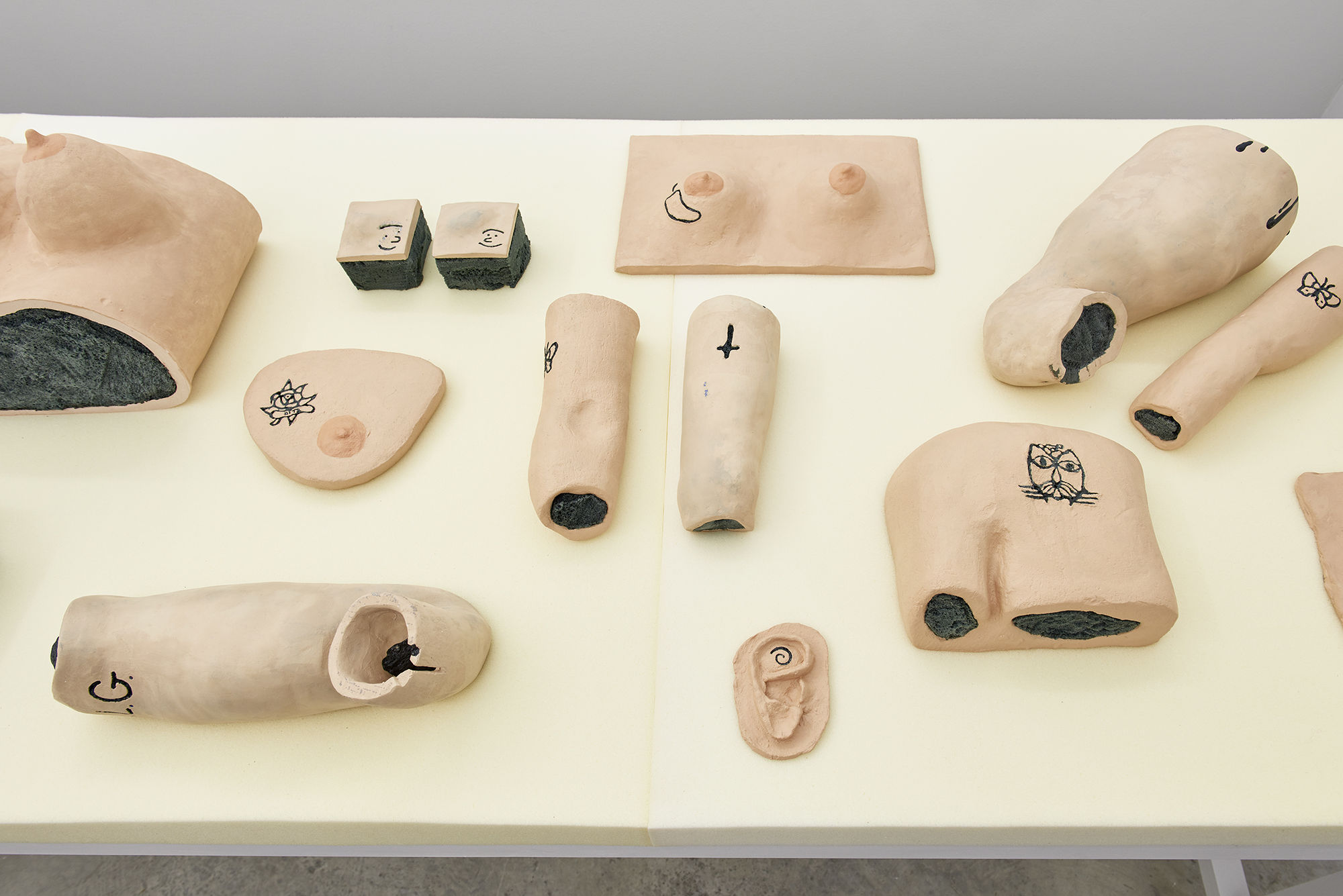
I’d love to touch your work, especially your Kongs and your sculpted bodies in fragments—a hand, an elbow, London’s tongue. Are there different times when you turn to either wholeness or to fragmentation?
I started a project called “E.L.G. Familial Archives,” my tattoo body part series that was shown at SculptureCenter in 2020. Those were recalling memories of the different tattoos that were on my body, my dad’s body, and my sister’s body. I think of them as relics, a physical archive that was tactile for me.
The fragments that involved London were meant to zoom in on physical and emotional feelings—of a dog licking a hand or a dog’s paw stepping on top of your foot. Ways that humans and dogs show affection to each other. I wanted to make that feeling heightened for viewers: if they see it, they might also get to feel it.
When I make my whole body sculptures, like with the Queens Museum installation, I think more about world building, like [imagining] this other world where dogs are dancing on their hind legs.
It’s making me think that things in this world are fragmented, and things in the other world are whole.
Yes, totally! The way I experience the world, I see with my two hands. Touching London is kind of fragmented. My hand is on her tongue, and my other hand is on her ear. So I have that physical memory of the size and the shape of London’s head and her ears and her tongue and her face. That’s my reality. The more fantastical, whole sculptures are like the world that I want to live in.
More of our favorite stories from CULTURED
The Substack Stars: 21 Newsletters That Your Favorite Writers Can’t Get Enough Of
In Wayne Koestenbaum’s First Novel in Two Decades, Gay Lust Incarnate Is a Rabbi With a Dad Bod
Eva Victor Made the Breakout Indie of the Year. Now, They Have to Do It All Over Again.
What Is It Really Like to Work at a Black Art Institution Right Now?
In Paris for Fashion Week? Catch These 11 Must-See Exhibitions While You’re There
Sign up for our newsletter here to get these stories direct to your inbox.

 in your life?