You’ll be up to your eyeballs in fair coverage soon enough, so we asked Juliana Halpert to return to the Critics’ Table with a distinctly local perspective on LA’s busy February. Her account of four very different exhibitions—by Tanya Brodsky, the Julia Stoschek Foundation, Amanda Ross-Ho, and Rita McBride—each in a unique venue, shows us four facets of the city she loves all year round.
“When he enters the territory of which Eutropia is the capital, the traveler sees not one city but many, of equal size and not unlike one another,” explains Marco Polo in Italo Calvino’s 1972 postmodern novel Invisible Cities. The work reanimates the famed 13th-century explorer and merchant, who is tasked with regaling the Mongol emperor Kublai Khan with stories of the many municipalities that fall under his rule. In Eutropia, as Polo tells it, inhabitants cycle through a series of sub-metropoli. Whenever the going gets stale in one, they pack up and move on to the next: “only one is inhabited at a time, the others are empty; and this process is carried out in rotation.” People get a much-needed change of scenery, but otherwise “the inhabitants repeat the same scenes, with the actors changed; they repeat the same speeches with variously combined accents; they open alternate mouths in identical yawns. Alone, among all the cities of the empire, Eutropia remains always the same.”
Is it just me, or does Eutropia sound a whole lot like the contemporary art-fair circuit, as the rough beasts of Art Basel and Frieze trundle from London to Paris to New York to Basel to Hong Kong to Seoul to Qatar and beyond, pitching camp in the same booths under the same tents, repeating the same speeches with variously combined accents? Perhaps I was too primed by the imminence of what we now call LA Art Week, the superbloom of art fairs and events that orbit around Frieze Los Angeles, dragging a horde of global citizens in its wake. With our galleries saving their snazziest shows for then, and a recent spate of heavy rains, the city, in early and mid-February, has felt a bit quiet, almost empty—at least, to someone whose social life largely revolves around lurching across the jammed 101 North to Hollywood or down the 110 to Chinatown to loiter among bone-white walls and under fluorescent lighting to sip watery white wine. Those neighborhoods, each home to clusters of galleries, have been recently, abhorrently redubbed “Melrose Hill” and—less officially—“Triste Corridor,” respectively. But the routine remains mostly the same.
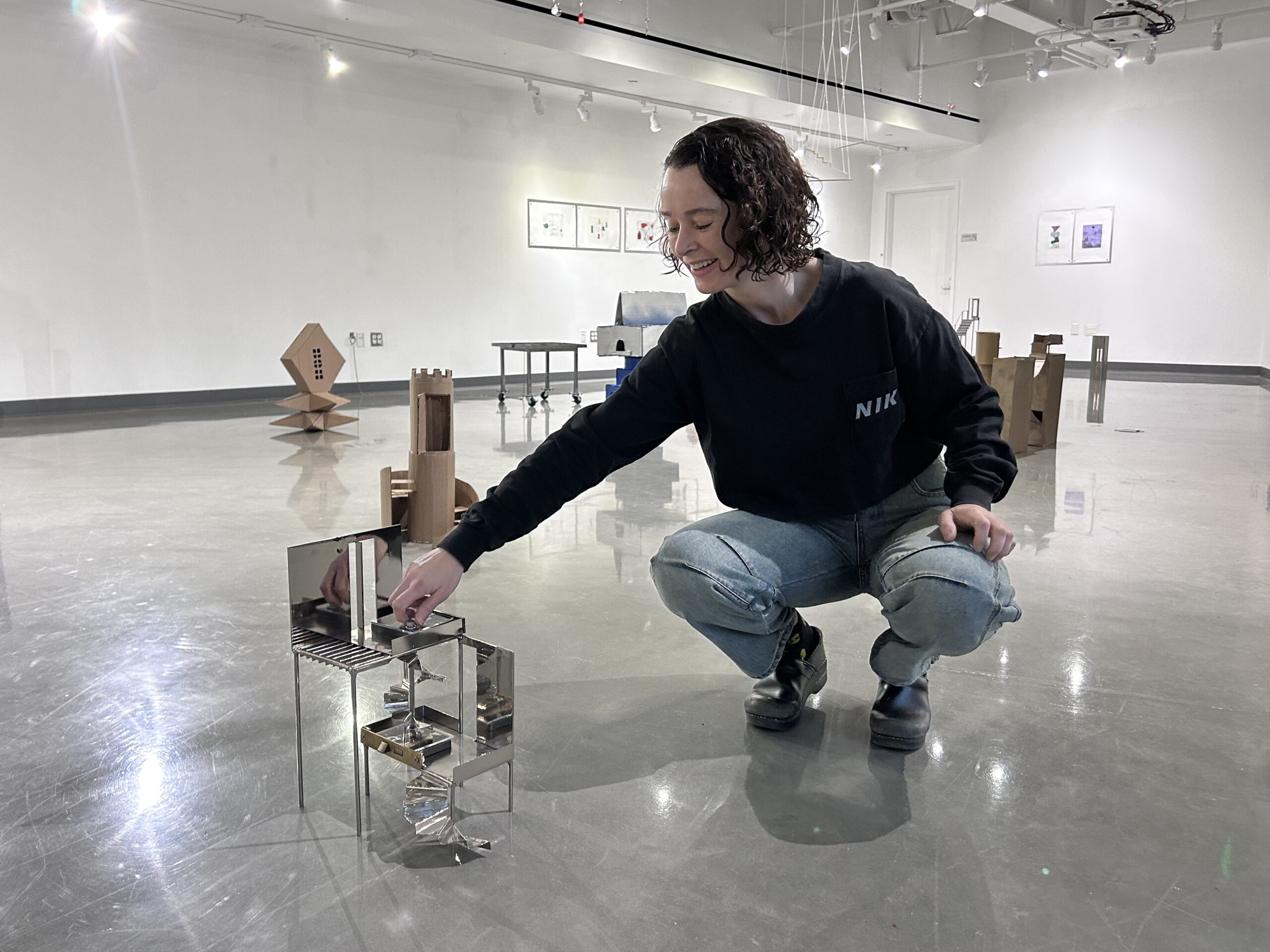
Calvino’s experimental novel provided the template for “Stories of the City,” a recent exhibition by the artist Tanya Brodsky, up at Campbell Hall school in Studio City. A change of scenery was one among several reasons why, on a sunny Sunday, I ventured up to that historic little “Jewel of the Valley” to meet Brodsky for a tour. A few months earlier, we had been chatting at another—also stellar—show of hers, staged at the pocket-sized gallery Gene’s Dispensary in Chinatown, and she teased the upcoming project she was mounting at a K–12 school. I pictured Brodsky’s small, shiny, metal maquette sculptures among the cinder block walls, drop ceilings, and drab colorways of an underfunded public school, and was sufficiently intrigued. But the doors of the elevator from Campbell Hall’s parking garage opened instead onto a sun-filled atrium, surrounded by modern, raw-concrete classroom buildings and elegant landscaping. I eyed a few stacks of shiny drums piled outside the Disney Family Music Center and scanned the sprawling donor wall on the side of the Spielberg Family Arts and Education Center. Ah, private school…
Brodsky badged us into the CH gallery, the school’s dedicated exhibition space, and flicked on the lights. Dozens of small, freestanding sculptures were scattered across the glossy cement floor. I recognized the intricate, polished-steel works, whose MC Escher-like configurations of miniature stairs and platforms become delightful maquettes of Modernist idioms, as Brodsky’s own. But the charming little cardboard structures scattered in between? “The students made those!” she exclaimed, emphatically.
A seasoned teacher, Brodsky had conducted a workshop with a group of Campbell Hall’s students in conjunction with the show. “I gave each of them one story from Invisible Cities,” she added. “They had to base their maquettes on Calvino’s descriptions.” With spiral staircases, turreted towers, Corbusier-esque cutout windows, and sloping skybridges, the students’ creations are no less fantastical than the Italian author’s own. “I wish I could have gone to this school,” I quipped, somewhat bitterly. Brodsky flashed a smile. Having moved to the U.S. from Kyiv when she was 10, the artist spent her first decade living in a concrete-panel Krushchevka apartment building and attending Soviet-era schools. “Me too,” she whispered.
It’s not exactly a revelation that certain pleasures and privileges are only afforded to an affluent few. (You can’t say the Soviets didn’t take a stab at this problem!) The following Friday, I fought evening traffic to take a rare drive downtown, eager to sharpen my writerly blade against a certain member of the global billionaire class. The German collector Julia Stoschek, who has amassed one of the world’s largest stockpiles of video art, had recently alighted in LA.
Her eponymous foundation, based in Berlin and Düsseldorf, was debuting its first collection presentation on the West Coast. Titled “What a Wonderful World: An Audiovisual Poem,” the exhibition, open through March 20, is “edited” by veteran curator Udo Kittelmann, formerly of the Nationalgalerie and Museum für Moderne Kunst. I had never been to the venue, the Variety Arts Theater—a 1920s women’s club turned movie palace turned underground punk and metal venue turned (almost) megachurch turned vacant property. It’s right on Figueroa, a stone’s throw from the Staples Center turned Crypto.com arena. Go figure.
I walked into the Venetian-style lobby with one question in mind: Why LA? In recent years, Stoschek has come under greater scrutiny in her home country for the source of her family’s immense wealth, an automotive-parts company founded by her great-grandfather Max Brose—a Wehrwirtschaftsführer for the Nazi party—and the company’s use of slave labor during the war. Various acknowledgments and reparations have been made; the heiress insists that the company’s fortune was built after 1945. For what it’s worth, Stoschek also has a child with the billionaire Mathias Döpfner, head of the “unabashedly arch-conservative” media company Axel Springer. A German friend of mine alerted me to rumors that Stoschek wants to relocate to LA with her son. “In Germany everybody knows about all this,” he wrote me on WhatsApp, the day before the opening. “But I’m not sure any of this info has made it across the pond.”
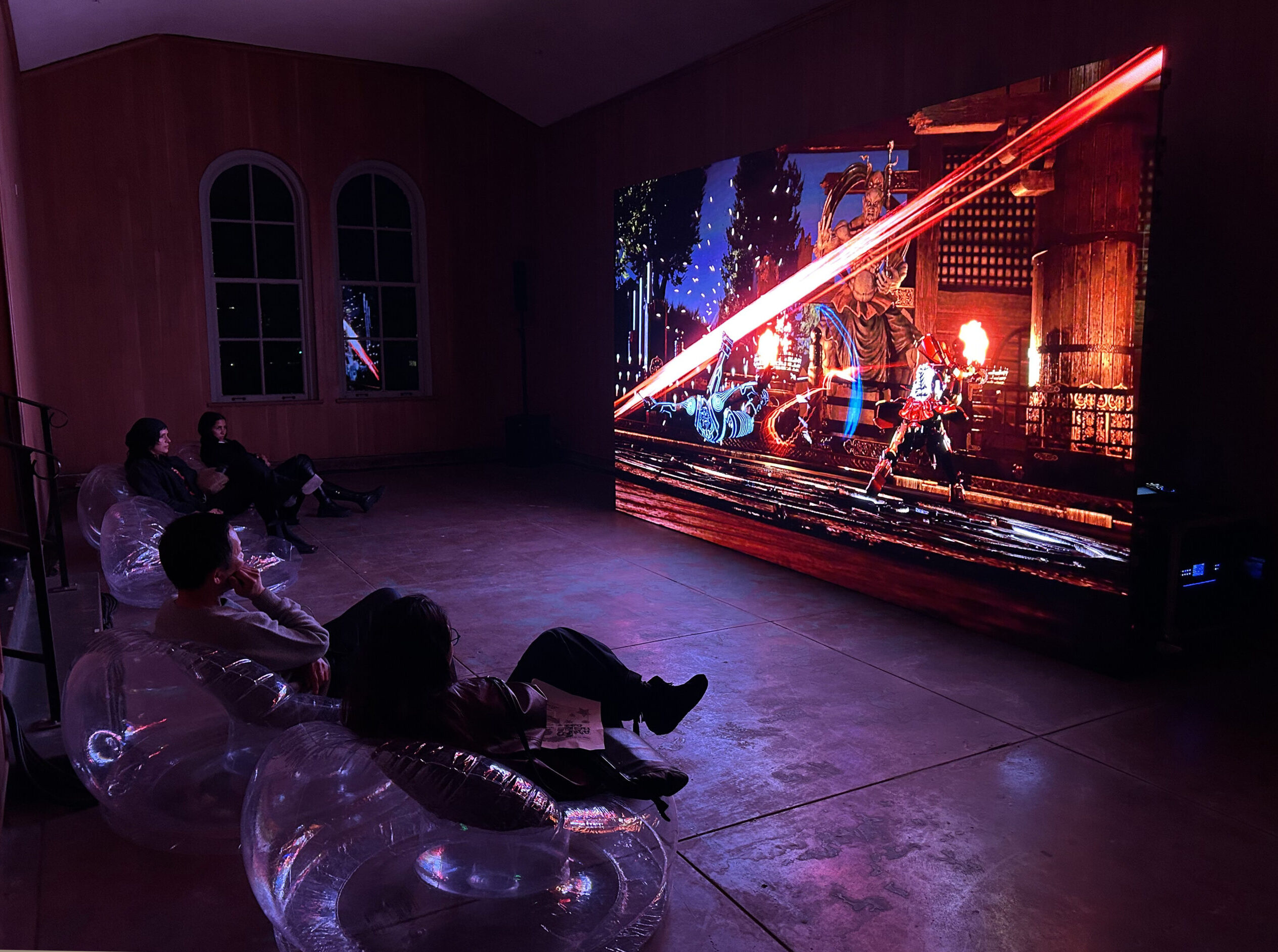
That seems to be the case. At the evening press preview and VIP opening, my comrades weren’t so interested in my background briefings. Nazi familial histories don’t quite scandalize the way they used to. Everyone was keener to wander the theater’s five floors, sample the fresh-popped popcorn, and install themself on the couches, bubble chairs, and theater seats placed before many of the 45 works on view. (You know what’s truly evil? No seating in a video-art show.) Gossip and intel become secondary only when a show is that damn exciting.
And I must admit that it is: The venue is a veritable labyrinth, straight out of Calvino or Borges, and Stoschek and Kittelmann have worked the space expertly. The countless hallways and rooms and balconies and mezzanines have been kept in their original states, conjuring a haunted, squatter-like spirit. Walls are shoddy, pockmarked, and patchworked with paint; wooden café chairs are piled up in corners; a few defunct chandeliers dangle from the ceiling. When accents were added, such as the wall of luscious red curtains that encircle Travers Vale and George Cowl’s 1917 film Betsy Ross, they only boost the whole ghostly, old-Hollywoodness of it all. Ditto the full-Regency-glam, full-service bar in the basement.
Every single screening method—whether monitor or projection-based—was duly considered and faithful to the work presented. The videos themselves—predominantly from the last 30 years or so, with a few ’70s classics by Chris Burden, Ulysses Jenkins, Ana Mendieta, Paul McCarthy, and Dara Birnbaum thrown in—are almost incidental. Any work could flourish under such care, but they are bangers, nonetheless. In a city throttled by painting shows, it’s a rare gift to see the greatest hits of Arthur Jafa, Wu Tsang, Sturtevant, Precious Okoyomon, Bunny Rogers, Anne Imhof, Cyprien Gaillard, Mark Leckey, Lu Yang, P. Staff, and more, under a single roof.
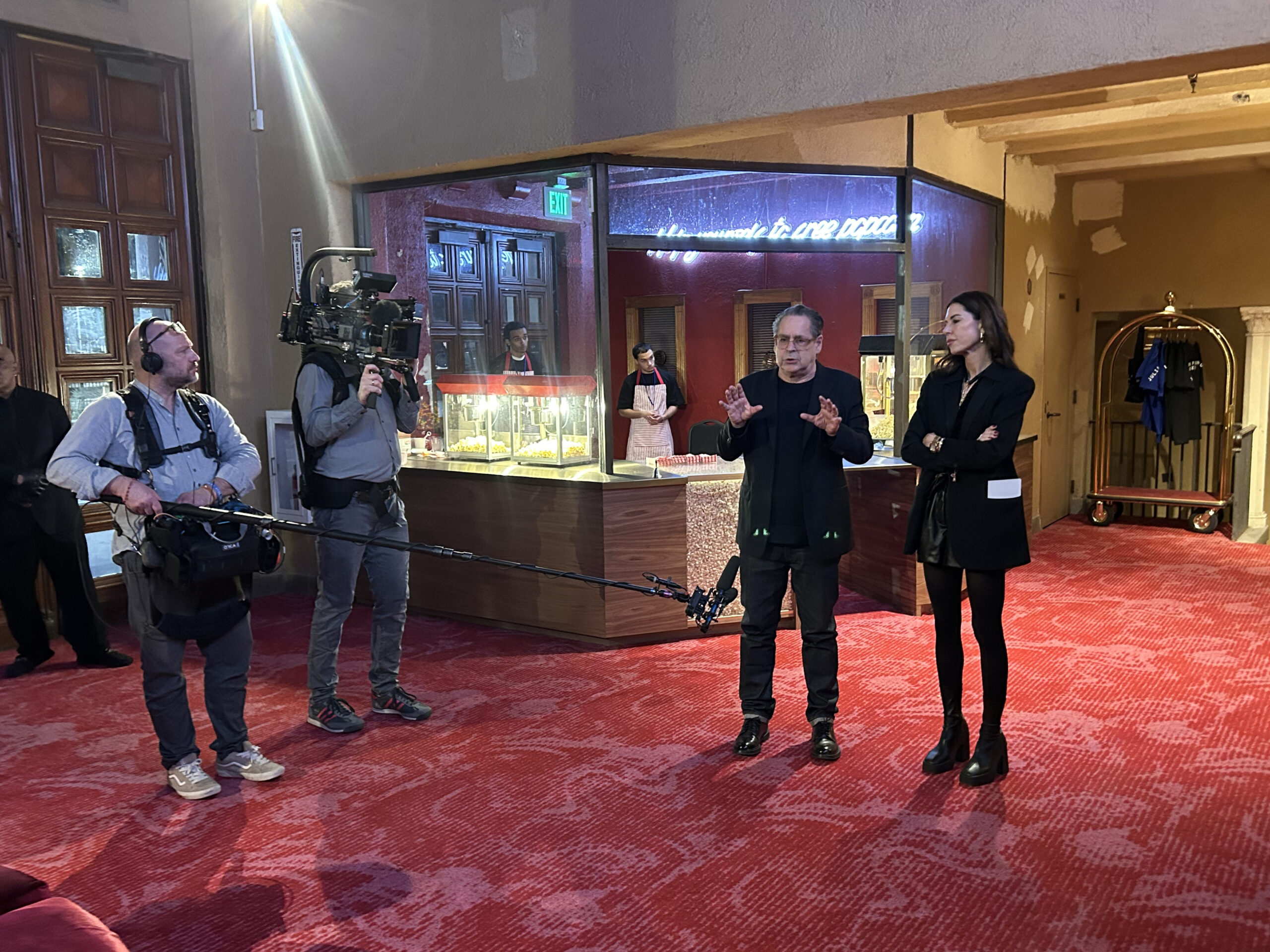
After an hour or so, I reluctantly pried myself away, venturing back to the lobby for Stoschek and Kittelmann’s opening remarks, where I huddled with fellow Angeleno critics Hannah Tishkoff, Andrew Berardini, and Claudia Ross. Photographers and videographers swarmed the room, mostly fixated on Stoschek. In her early 50s, the tall collector wore black boots, black tights, and a black blazer, and looks almost half her age. She fits right in with the upper echelon of this city, in other words. Kittelmann also donned the official Kunst uniform, wearing black jeans, T-shirt, and blazer, with his gray hair slicked back. Their respective, blanket statements covered their veneration of LA’s filmic legacy, their excitement about contextualizing video art in Hollywood’s backyard, and all that. To back up these claims, the show also includes several classics from the silent-film era, such as Georges Méliès’s Le voyage dans le Lune, 1902, Walt Disney’s The Skeleton Dance,1929, as well as Betsy Ross—easy grabs from the public domain. I thought that this would amount to a cheap gimmick, but these films’ quiet, silvery flickering adds to the spectral allure of the show.
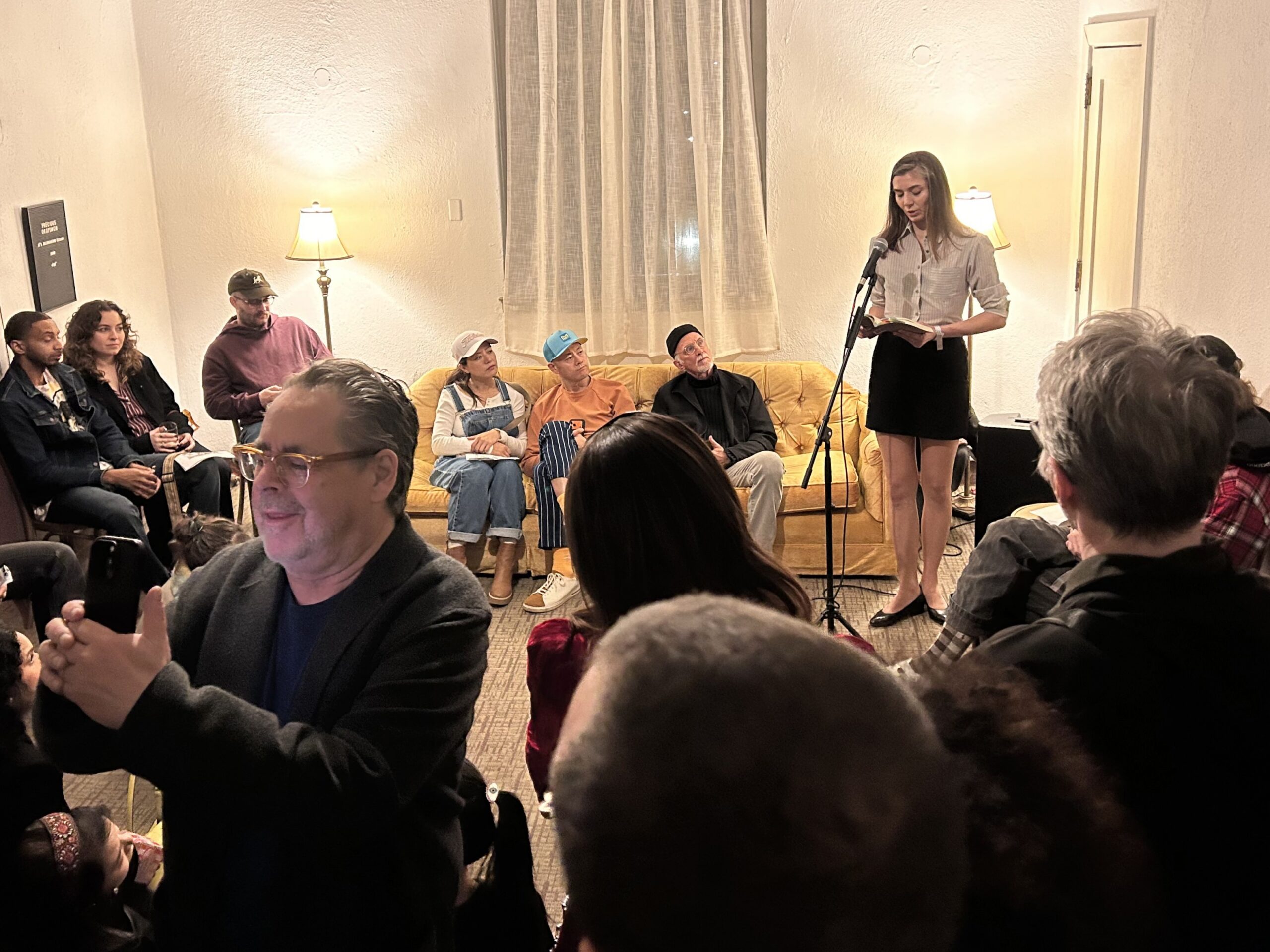
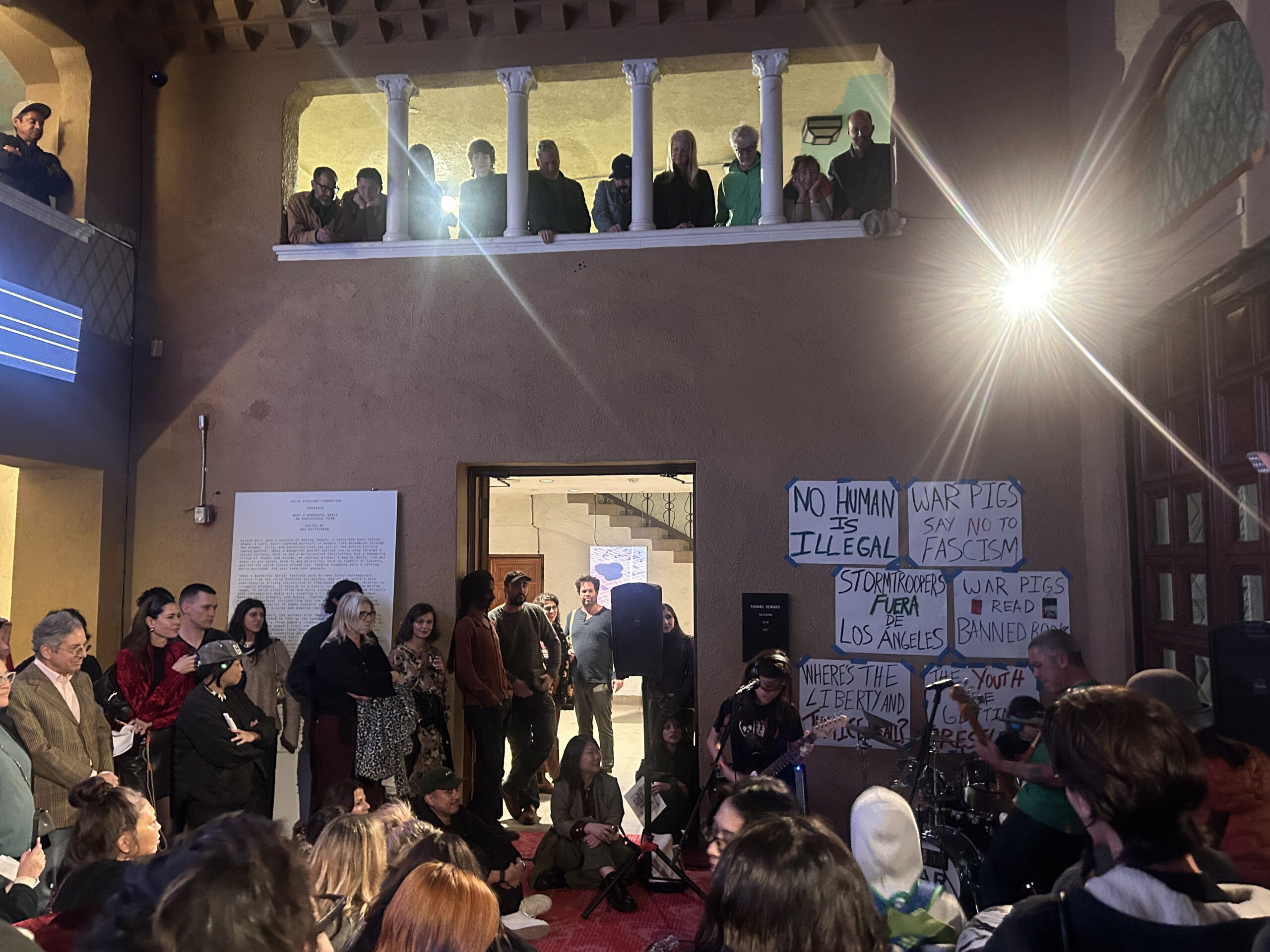
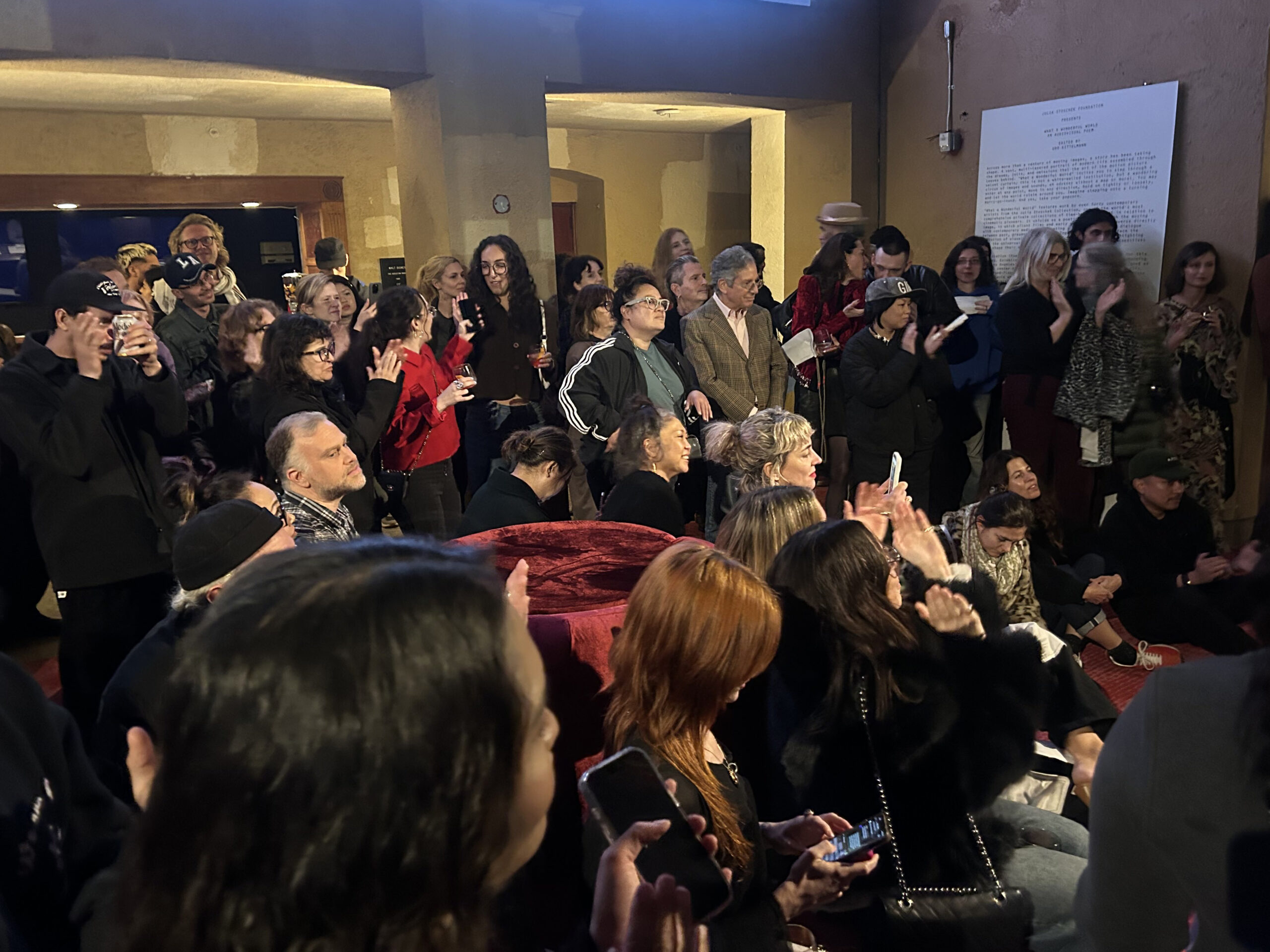
“What a Wonderful World” has also lined up a star-studded series of programming. Arthur Jafa and Doug Aitken already put in appearances to debut new works; next month, Gideon Jacobs, Dean Kissick, and David Rudnick will deliver a lecture on the “end of images.” A week after the show’s opening, I swung by the space again to absorb a series of performances arranged by Hard to Read, a “literary social practice” founded by the writer Fiona Duncan. Bunny Rogers, Patty Chang, Alicia Novella Vasquez, Harmony Holiday, and “LA’s tiniest punk band” War Pigs were all on the bill. The dormant teenage Tumblr girl inside me was particularly curious to catch Rogers in the flesh. She was big for young me! Had she disappeared over the last decade, or had I just grown up?
Before everything started, I was wandering the third floor, finding rooms I’d missed the first time around. And there she was, walking the show alone in a ballet-pink and white collared shirt, black mini, and ballet flats. “Hi—Bunny!” I accosted her, commencing the most bumbling interview of my life. She answered my fawning questions in her classic doe-eyed, dreamy manner. “What will you be reading tonight?” I asked. “Poems from my new book Sadly Glass,” she intoned. “When did you, um, get to LA?” I stammered. “Last night,” she responded. “So—are you in New York still?” I persisted. “Yeah,” she said. I couldn’t think of anything more to say, so I thanked her and scurried away. The bijou poems she read in the fourth-floor vestibule half an hour later were no less succinct or aloof, and maybe a little twee. But Bunny remains squarely on her own Bunny-shaped planet, and we were all happy to be in her orbit.
The following evening, I was already watching TV in bed when I got a text from the artist Olivia Mole, who had been palling around with the Troy-based curator Dena Beard. “We’re going to Leroy’s later this eve,” she told me. I had entirely forgotten about that night’s open hours for Amanda Ross-Ho’s exhibition “Untitled Damages (Room Divider)” (open through March 1) at the artist-run Chinatown space, located in a former Vietnamese restaurant. I threw on some jeans and a sweatshirt and zipped down there in a quick 15. I was grateful for a more casual affair among friends and fellow thousandaires. Inside, Ian James, who runs the space, was tending bar, chatting with Olivia and Dena; Amanda was standing nearby with the artist Stanya Kahn. Ian poured me a stiff tequila soda and we all exchanged embraces. This place might be the closest thing I have to a local bar. Sometimes, the usual isn’t so bad.
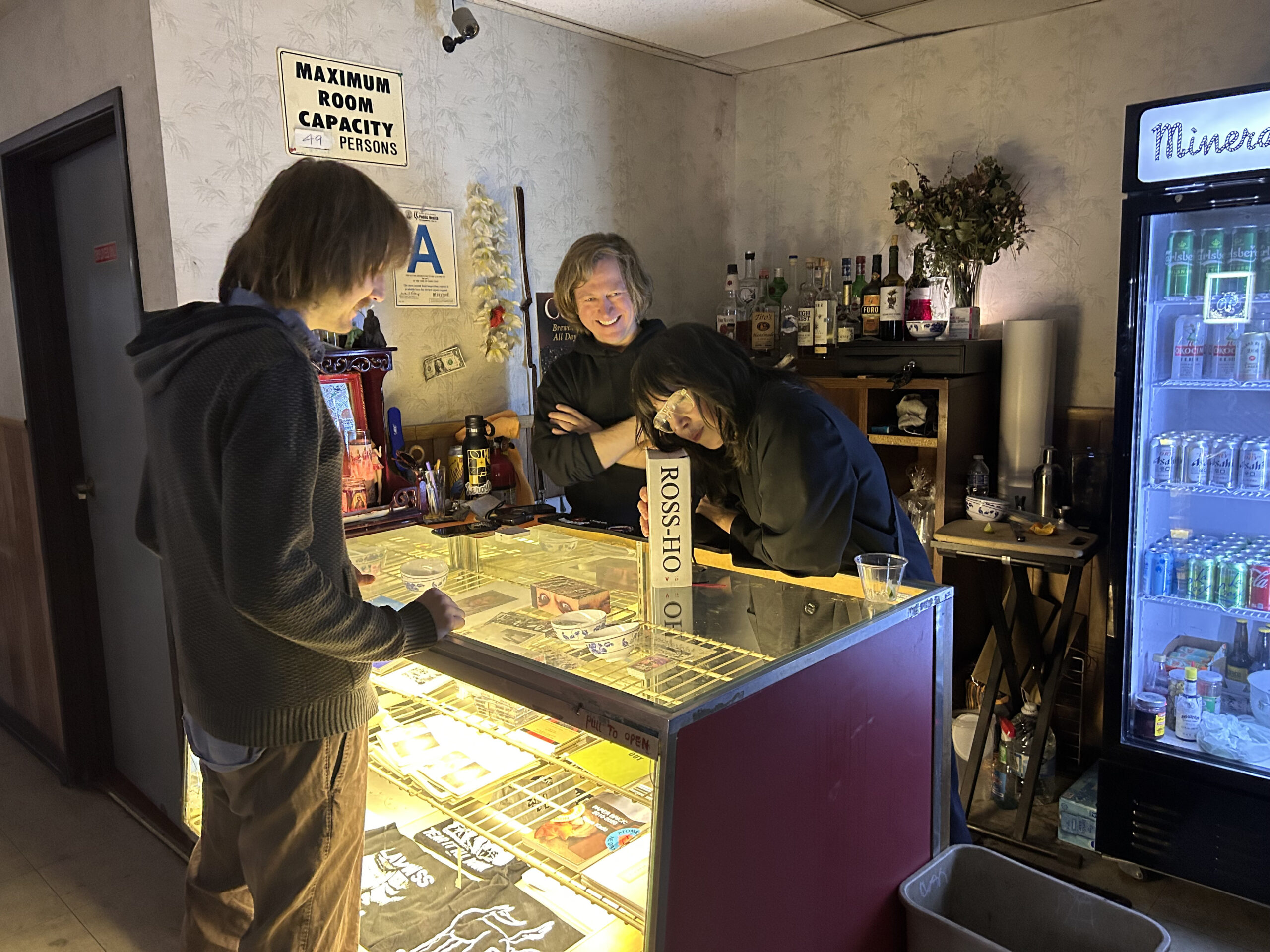
Much like the Germans, Ian accepted his venue as-is and has preserved its condition. The kitchen still has most of its stainless-steel fixtures, with stockpots and woks stacked on shelves above the commercial sinks. Bamboo-print wallpaper and dark-stained wainscoting still line the large, linoleum-floored dining area. It’s a refreshingly specific space, although Ian ensures it doesn’t subsume the works in each show.
That evening, it was especially dark in both rooms, save for the tungsten glow from a deli display case, which now houses artists’ books and stickers and acts as a bar top. A series of small, wall-mounted lightboxes also shone a shockingly bright white against the space’s beige and brown trimmings. On their surfaces, Ross-Ho has mounted five-by-seven-inch color transparencies of images shot by her father decades ago when he had a gig as a product photographer for Sears. A white Schwinn stationary bike gleams against a black studio backdrop; a polychrome set of Fiestaware mugs, bowls, and ashtrays is arranged on a table next to wicker baskets and some wooden spoons. Cowboy boots, porcelain sets, desk furniture, printing calculators—these are mostly the same, squarely middle-class commodities of our day, although mailed catalogues have been wiped out by Amazon, primary colors have faded into millennial grey, and nobody shoots film anymore. Except for artists, of course.
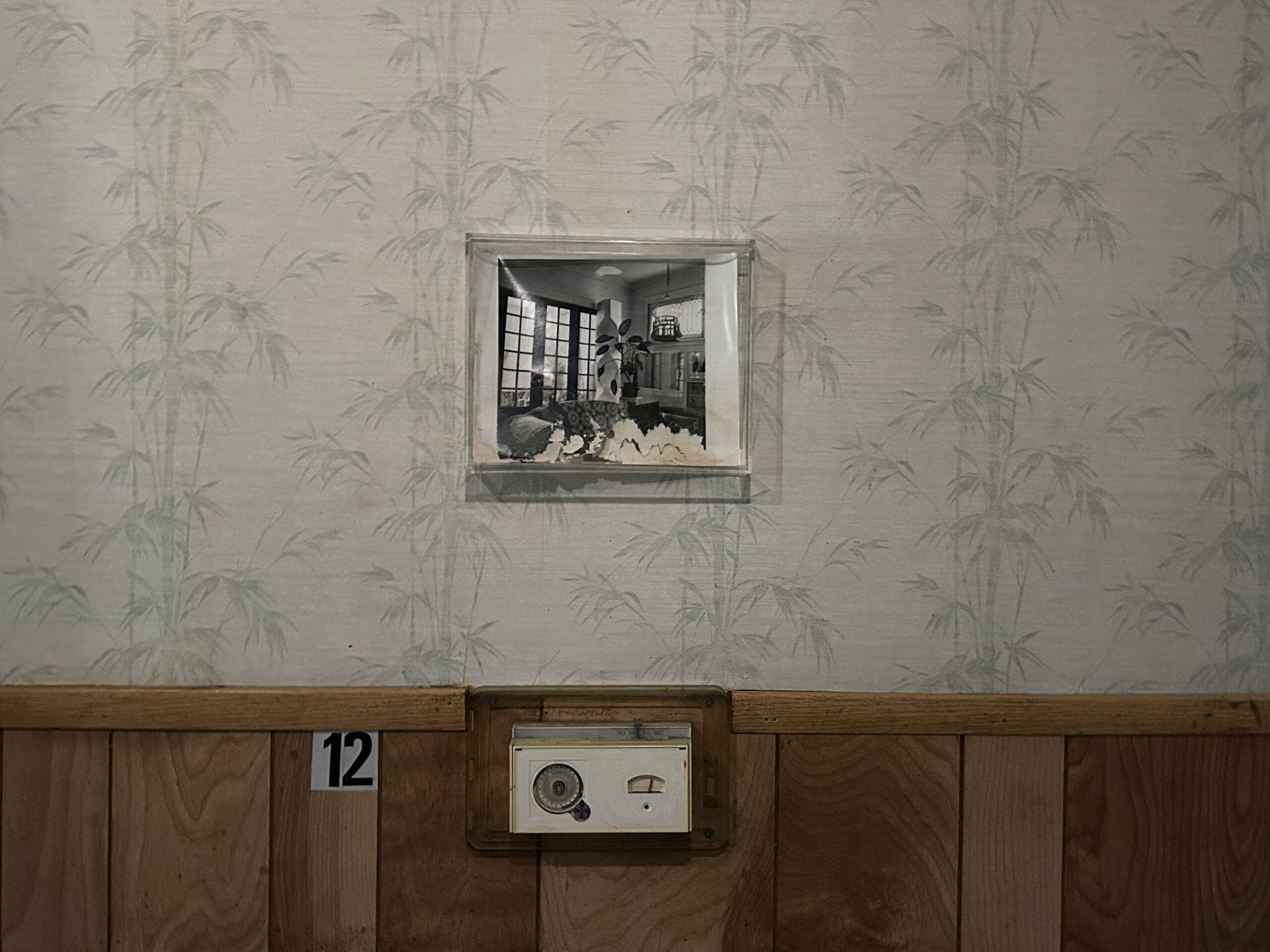
“Untitled Damages (Room Divider)” also features several worn, warping 8-by-10 inch photographs, shot by Ross-Ho’s mother inside the family’s home, an old six-bedroom building that was previously occupied by a commune. Simple yet incredibly striking interior shots show ornately patterned wallpaper, metal pans hanging from a rack—installed in the Leroy’s kitchen, naturally—an unmade bed, a bathroom, a potted pothos plant hanging in a window. These prints, and the transparencies, have once fallen victim to a flood; the water damage creeps onto the paper and plastic from their edges, and rather beautifully at that, adding the stamp of another point in time. I said something of the sort to Ross-Ho, who nodded. “I wanted to pile on these past, present, and psychic spaces that are all slipping around,” she explained. “It needed that extra layer from the restaurant. I literally made this work for Leroy’s. I don’t think I would have ever shown these prints otherwise.”
After chatting a bit more, I glanced at my watch, and realized it was already 11:30. “That’s late for LA!,” I joked. “The first group show I did here back in 2018, people stayed until 6 a.m.,” Ian told me. “I thought it was going to be a one-off, but people were like, ‘No! Please! We really like hanging out here.’”
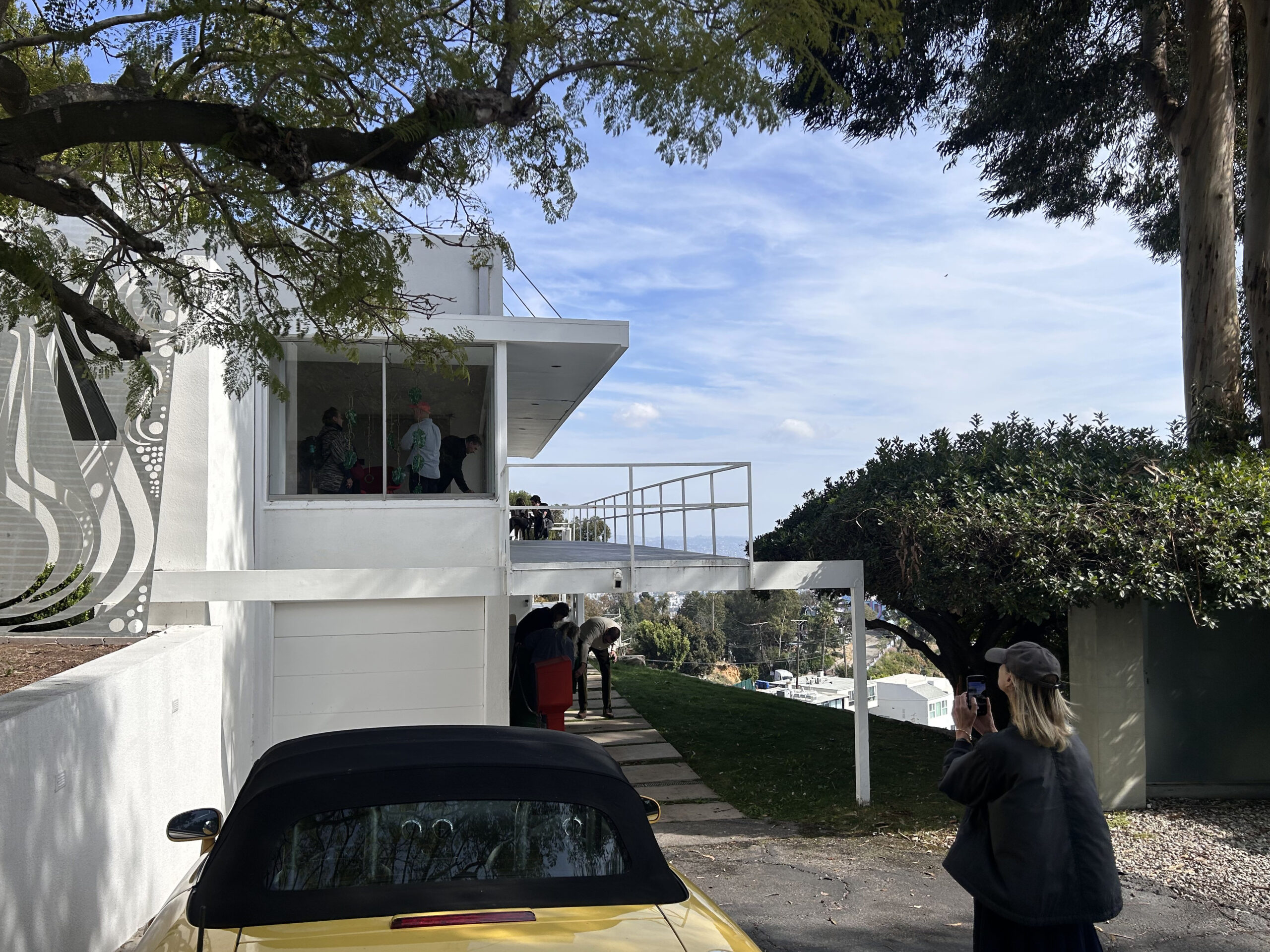
The next weekend, on Valentine’s Day, I had an appointment to view one last show at one last hyper-specific locale. I’d received word of an exhibition by Rita McBride in a Richard Neutra house up in the Hollywood Hills that hadn’t been open to the public for 80 years. Both the artist and the location would be plenty enticing on their own; together, a visit was imperative. My excitement mounted as my GPS told me to turn on Lookout Mountain Avenue, up in Laurel Canyon. I’d only been there once, ages ago, back when the artists Shahryar Nashat and Adam Linder had a house on the road. (After texting me his street address, Shahryar tacked on the famous Joni Mitchell quote, “Ask anyone in Laurel Canyon where the craziest people live and they’ll say Lookout Mountain. So I bought a house on Lookout Mountain.”) As I climbed the hills in my modest little Mazda, the road narrowed and the houses expanded. I nearly sideswiped a racing-red Ferrari as I rounded a bend, suddenly remembering why I love this city so much.
Up here, it’s a mix of luxury real estate, dug-in hippies, wild empty hillsides, and gardeners’ pick-up trucks perched precariously on the road’s edge. After parking in a similar fashion, I walked up the rest of the hill to 1880 Blue Heights Drive. Through the large windows, I spotted Tyler Murphy, the director of Okey Dokey Konrad Fischer’s LA location, in a sky-blue collared shirt and fluorescent orange cap, talking with McBride and the creative consultant Emma Reeves. You’d be hard-pressed to find a gallerist in LA who possesses keener judgment or wit than Tyler, and I had a feeling this show was largely his doing. He’d never say, but he escorted me around the house-cum-gallery, studiously relaying its history and that of McBride’s works within it. I, meanwhile, struggled not to simply gawk at the view, which unfurled the city in its seemingly infinite sprawl, from downtown to Culver City to Catalina Island and beyond, as if rendering it all in miniature.
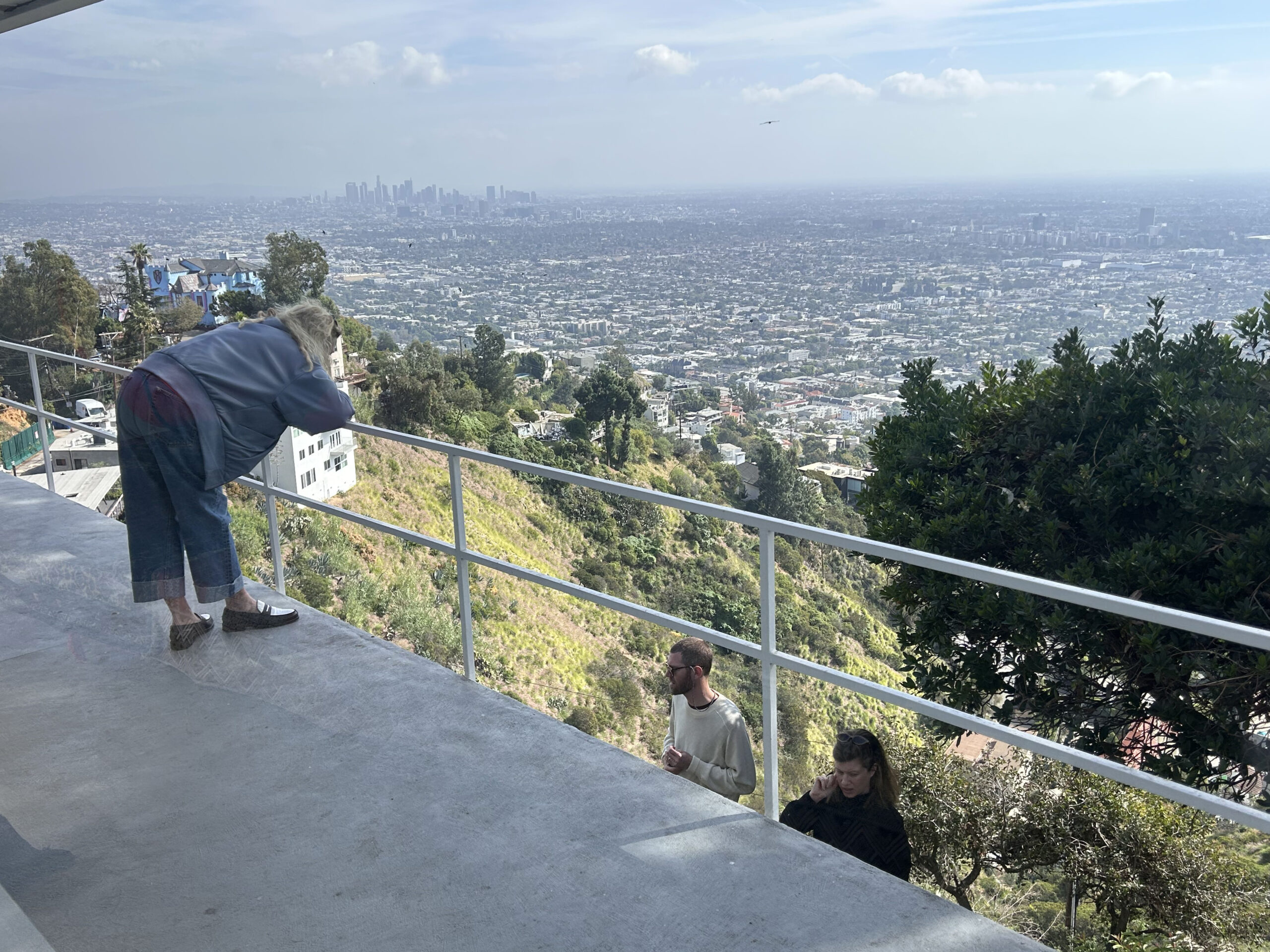
Richard Neutra built the house in 1935 for the German-Jewish art dealer and collector Galka Scheyer, known for founding the “Blue Four” artist group, made up of Wassily Kandinsky, Paul Klee, Alexej von Jawlensky, and Lyonel Feininger. Scheyer wanted her new home, the first to be built on that hill, to be half-gallery, half-abode. Neutra abided, and the house became a hot spot for events and exhibitions.
After Scheyer died in 1945, the house was turned into a private residence, and remained so until last year, when it went back on the market. The German collector Max Grimminger quickly scooped it up. He plans to restore the structure to original Neutra specs and convert it to a residency and exhibition space called Blue Heights Arts & Culture. The artist Beatriz Cortez, who lost her home to the Eaton Fire last January, was its first unofficial resident; Rita McBride’s exhibition “wunderkammer” is the second, and last, program before the big renovation.
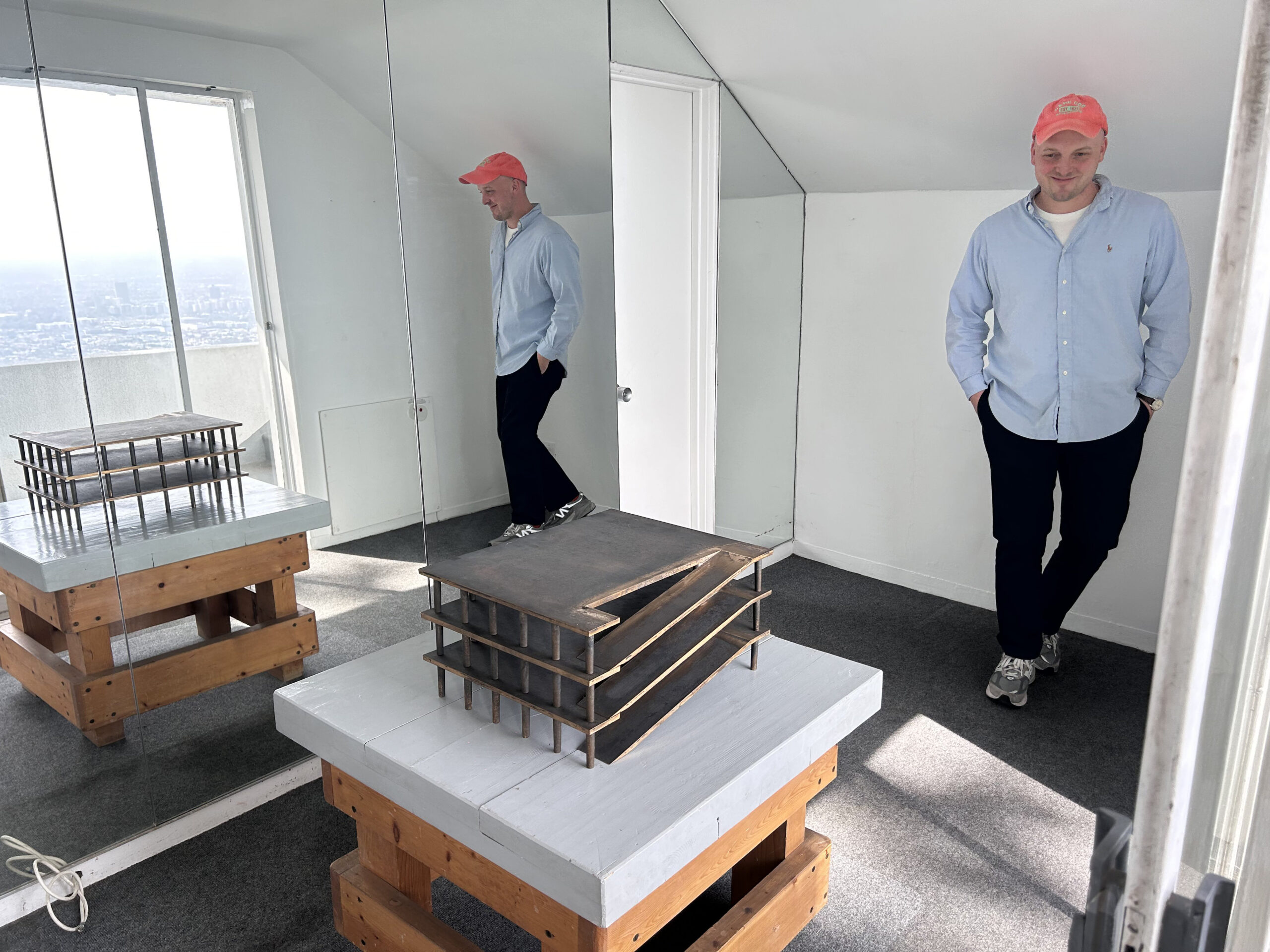
The show, as Tyler told me, assembles a range of McBride’s work from her storied career, dating from the mid-’90s to this year. An artist based in LA and Düsseldorf, her sculpture practice straddles the sensibilities of the two cities, equal parts spectacular and stark. The Year of Darkness (Sunset), 2026, reprises a 1987 installation, featuring a red Saarinen chair placed atop Moroccan and Persian rugs, an original movie poster for The Terminator, some studio lights, and a backdrop. Her four Secession Posters, 2000, arranged in a row on the rear wall, each feature a rendering of a different tower, with the title’s building in Vienna placed on top. For the occasion of her show at Secession, “these posters were pasted all over the city,” Tyler added. “People freaked out, thinking they were proposals for actual developments.” Between these interventions, her large-scale public works, and her abstractions of news racks and mailboxes, McBride’s medium seems most often to be civic life itself.
For A-Frame Allee, 2026, a personal favorite, the artist fabricated 12, 12-inch-tall A-frame houses out of rattan. In “wunderkammer,” they’re arranged in a tidy row across some built-in wooden cabinets at the back of a small office, off to the side of the main room. So concisely, the folkish edifices conjure yet another fanciful village, again in miniature, straight out of Calvino’s stories. They seem to wait calmly, in that dark room, ready for the moment their future residents set their sights on an altogether new city, far from old, rotten histories and tiresome routines alike.
More of our favorite stories from CULTURED
A Movie Deal Is a Writer’s Dream—or Is It? 5 Authors Get Real About the IP Machine
Shrinking Actors Sherry Cola and Jessica Williams Talk Therapy (On Screen and Off)
The Pitt’s Shawn Hatosy Is an Emmy Winner, a TikTok Star, and a Secret Literature Nerd
Why Are Artists So Interested in Making Playgrounds?
Sign up for our newsletter here to get these stories direct to your inbox.


 in your life?