
For her Critics’ Table debut, Juliana Halpert (whose show “Civil Commitment,” with Chris Kraus at Bel Ami, just closed last week) finds intimations of the macabre everywhere. From standout solo presentations by locals Stanya Kahn and Calvin Marcus, to the Hammer’s latest, lackluster “Made in L.A.” biennial (as well as its scrappier “Made in HelLA” counterpart), Halpert has the on-the-ground report. Tip: to map Halpert’s picks and plan your route, enter the Critic’s Table hashtag #TCT in the search bar of the See Saw app.
On a recent Monday evening, after a restless few weeks of shuttling between advance previews and openings and after-parties and regular gallery hours, I was finally back to the old routine. I hadn’t left my fortress of solitude (studio apartment) in northeast Los Angeles all day; I was gaping at a blank Word document; I was letting my attention drift over to Instagram. The artist Anthony Discenza, who runs the residency and project space lower_cavity in Holyoke, Massachusetts, had messaged me: He was coming to town in a few days and wanted to make plans. “We should go to the haunted hayride!!” I responded, referring to the Halloween spectacle that takes over a portion of Griffith Park every October. “Is that what they’re calling ‘Made in L.A.’ this year?” Tony quipped, with a winking emoji.
It was all too apropos. Is the LA art world always this on-theme in October? I can’t remember, but the insides of galleries are looking a hell of a lot like the outsides of the houses in my neighborhood this season. In the past three weeks, I’ve seen witches, skulls, fountains of fake blood, grim reapers, dollhouses shellacked black, and paintings of green grass so seemingly innocuous that they quickly turn sinister. Not unlike the front lawns that blanket charming little super-segregated South Pasadena, just five minutes north of me—where, it just so happens, Halloween was shot. Or the smiling, plastic skeletons for sale at my local Home Depot, oblivious to the people getting snatched from the parking lot.
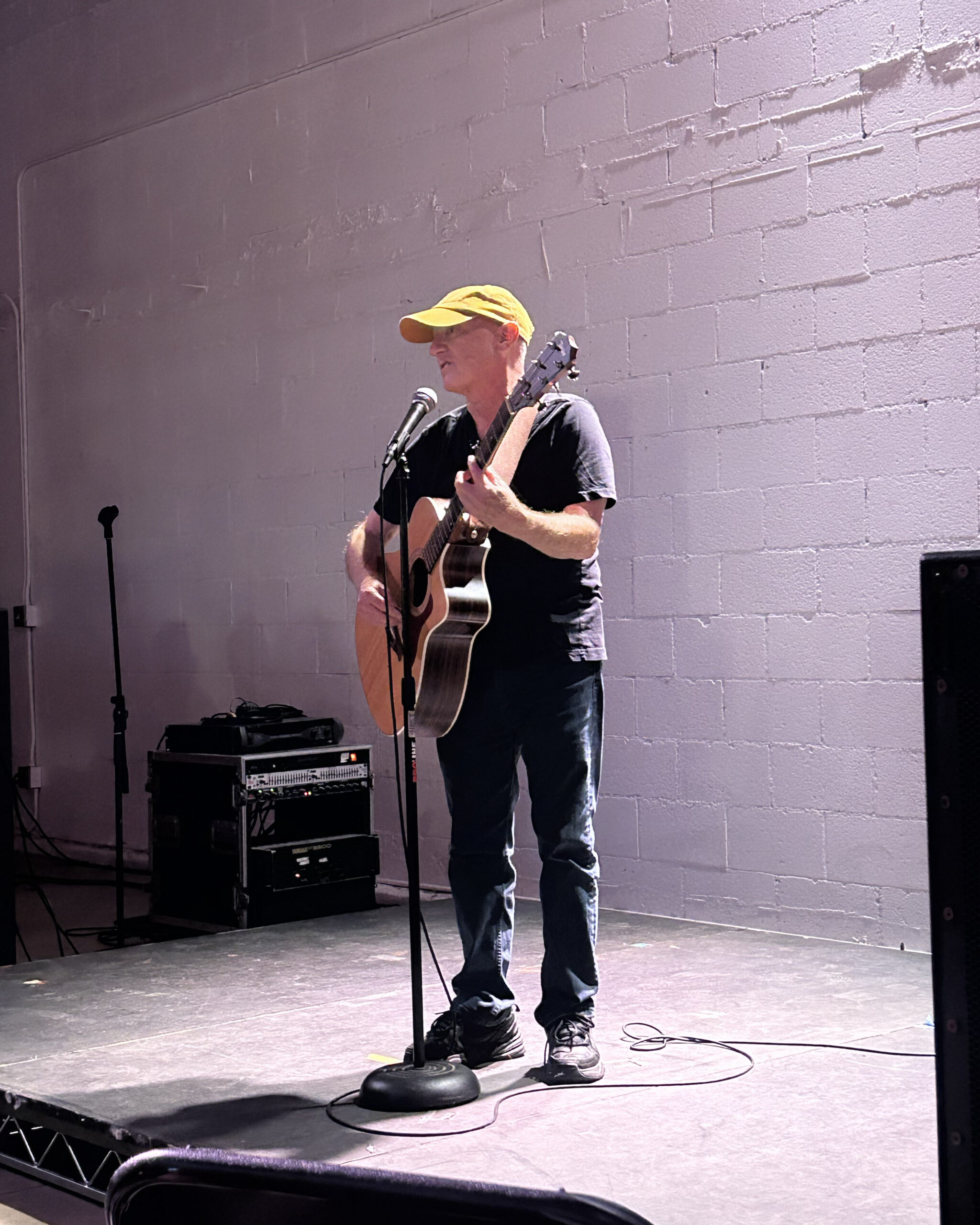
“Problems, problems, everybody’s got ’em,” sang the author and musician Jack Skelley, strumming an acoustic guitar on stage at 2220 Arts + Archives on a late-September Saturday. “But—not me! I look around from a hole in the ground!” he continued. Skelley was closing out a marathon reading, with a roster running 50 deep, for the occasion of the Poetic Research Bureau’s 25th anniversary. “I see the sun coming up and the moon going down, everybody’s worried ‘bout the sky turning brown,” he crooned, campfire-style, goading us to sing along. “But—not me! I’m dead! I’m dead! And it’s fun to be dead, fun to be dead.”
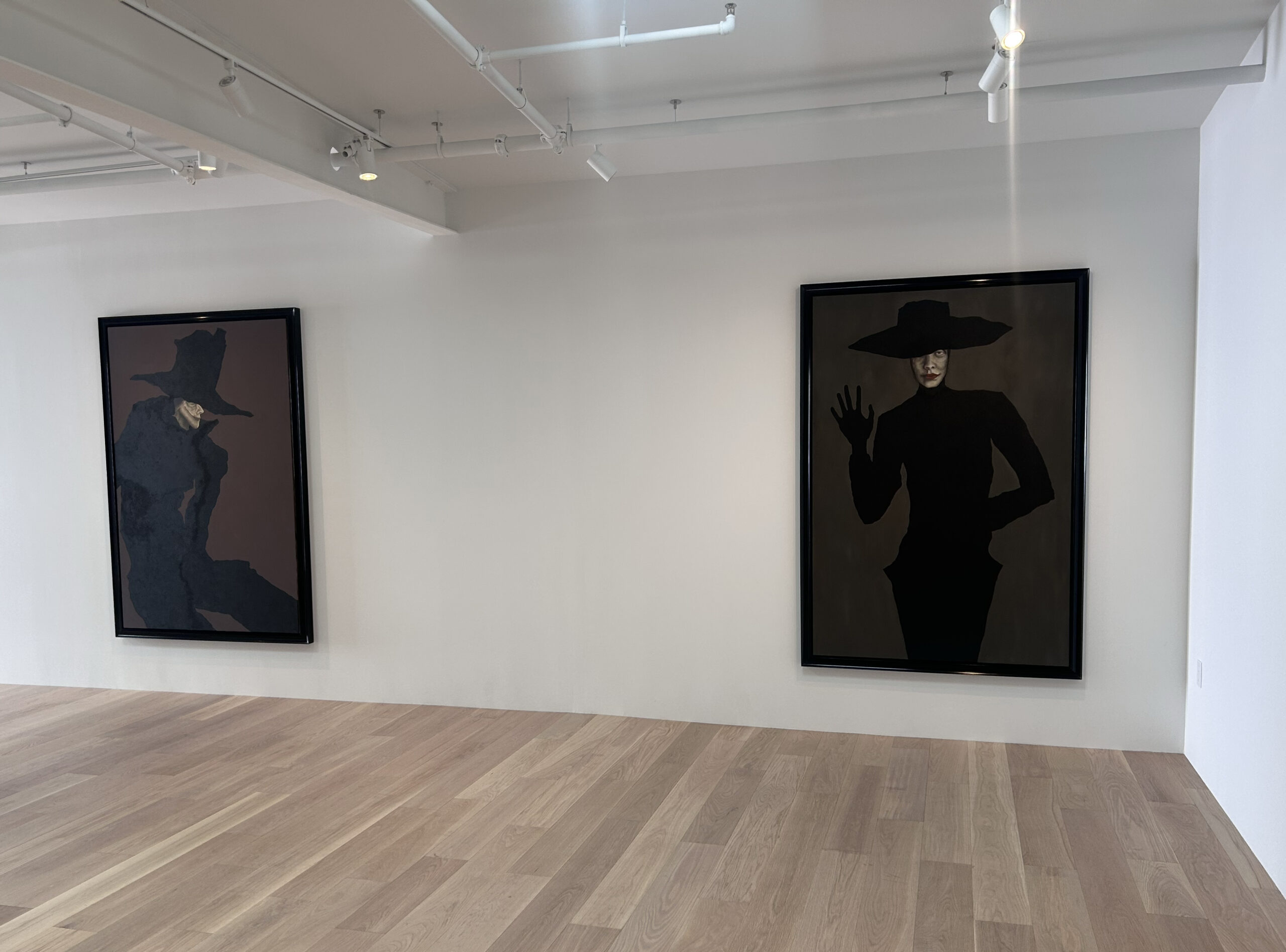
Is the contemporary dying? It seems like every show of fresh work brushes against death in one way or another. (Even my own recent show was mostly about murder.) Some artists, such as Josh Smith, deal with it detachedly. At David Zwirner, he unveiled a new suite of paintings depicting grim reapers biking around New York. Affectively, they match a teenage boy at a horror movie, pretending not to be scared. Other shows strained a bit too hard for depth. Over at Hoffman Donahue’s Beverly Hills location, Adam Alessi’s paintings of grey and ghoulish figures, cloaked in swathes of flat black, reached for an Egon Schiele-y eeriness, occasionally making contact, though I could have done without the artist statement’s canned contemplation of mortality.
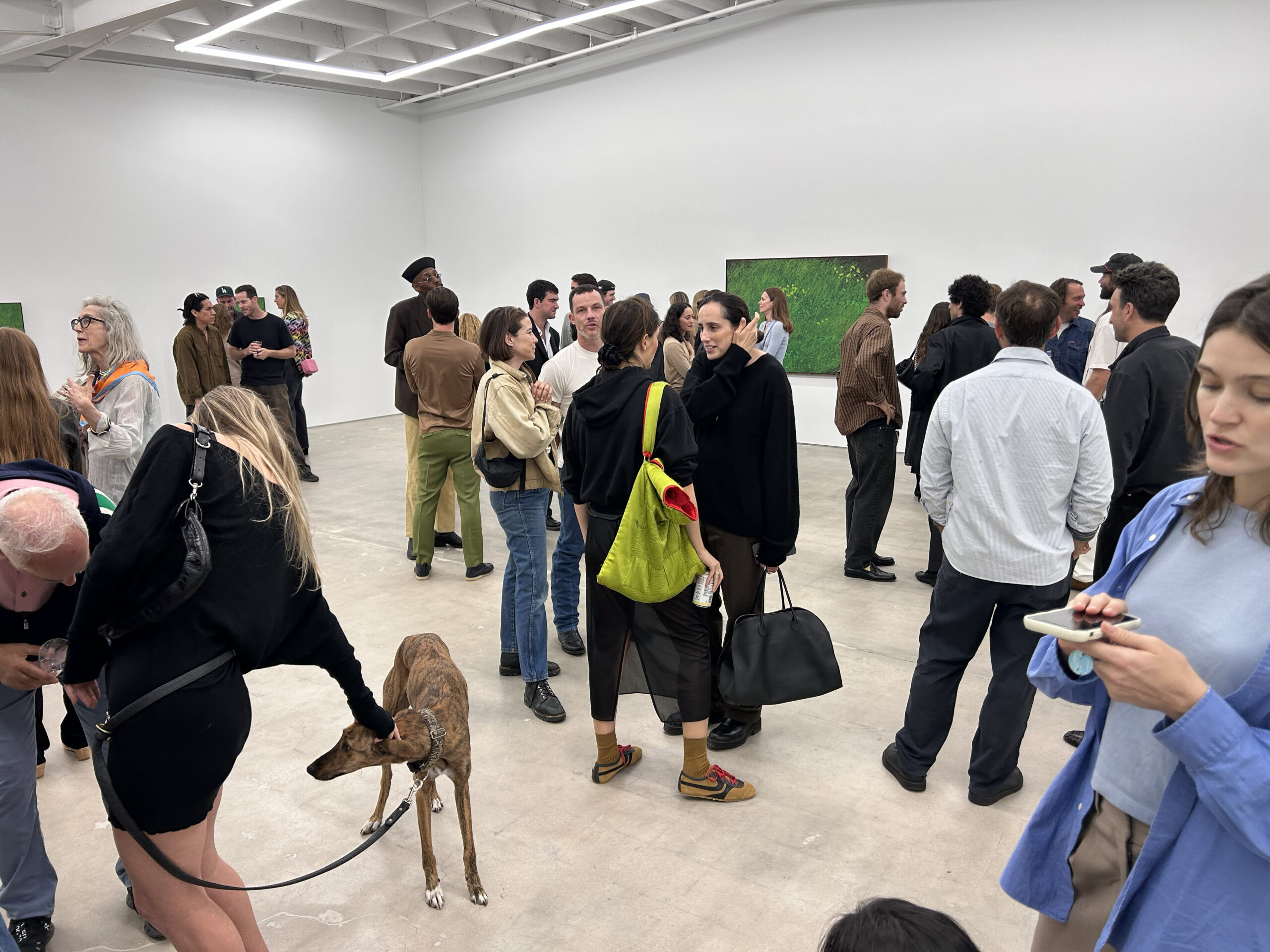
After the Poetic Research Bureau party, I zipped over to Hollywood for Calvin Marcus’s opening at Karma. It was a fashionable affair, far from worries about brown skies. I exchanged greetings with the painter Lauren Quin and her fiancé, dealer Anthony Salvador, easily the best-dressed art-world couple out here. I hugged the writer Christie Hayden, always chic and smiling, and caught up with the actress Elise Duffy, the statuesque partner of gallerist Ace Ehrlich. And I spotted the artist from afar, getting pulled in every direction. Marcus is the spitting image of a young Ed Ruscha, with the vintage Porsche and model girlfriends to boot. He mirrors that “modest, soft-spoken, and handsome” manner that Peter Schjeldahl ascribed to Ed back in 1985, and I would argue that his best work squats at the same “intersection of mind and tongue where meaning and laughter blend.”
Local commentators like Diva Corp and Grant Edward Tyler, who runs the Substack Camel, later shrugged off Marcus’s new “grass paintings” as substance-less. I disagree, and I am happy to die on this hill. The works, mostly medium-sized, are like little clippings from his earlier “dead soldier” paintings, which portray men in uniform, splayed out in fields, tongues drooping out. The soldiers slip into expiry as Marcus’s little blades of grass verge into simple, Twombly-esque abstraction. Absence is substance. One day, we’ll all be mulch! “I think you’re just under Calvin’s spell,” someone who wishes to remain off-record told me. It’s possible.
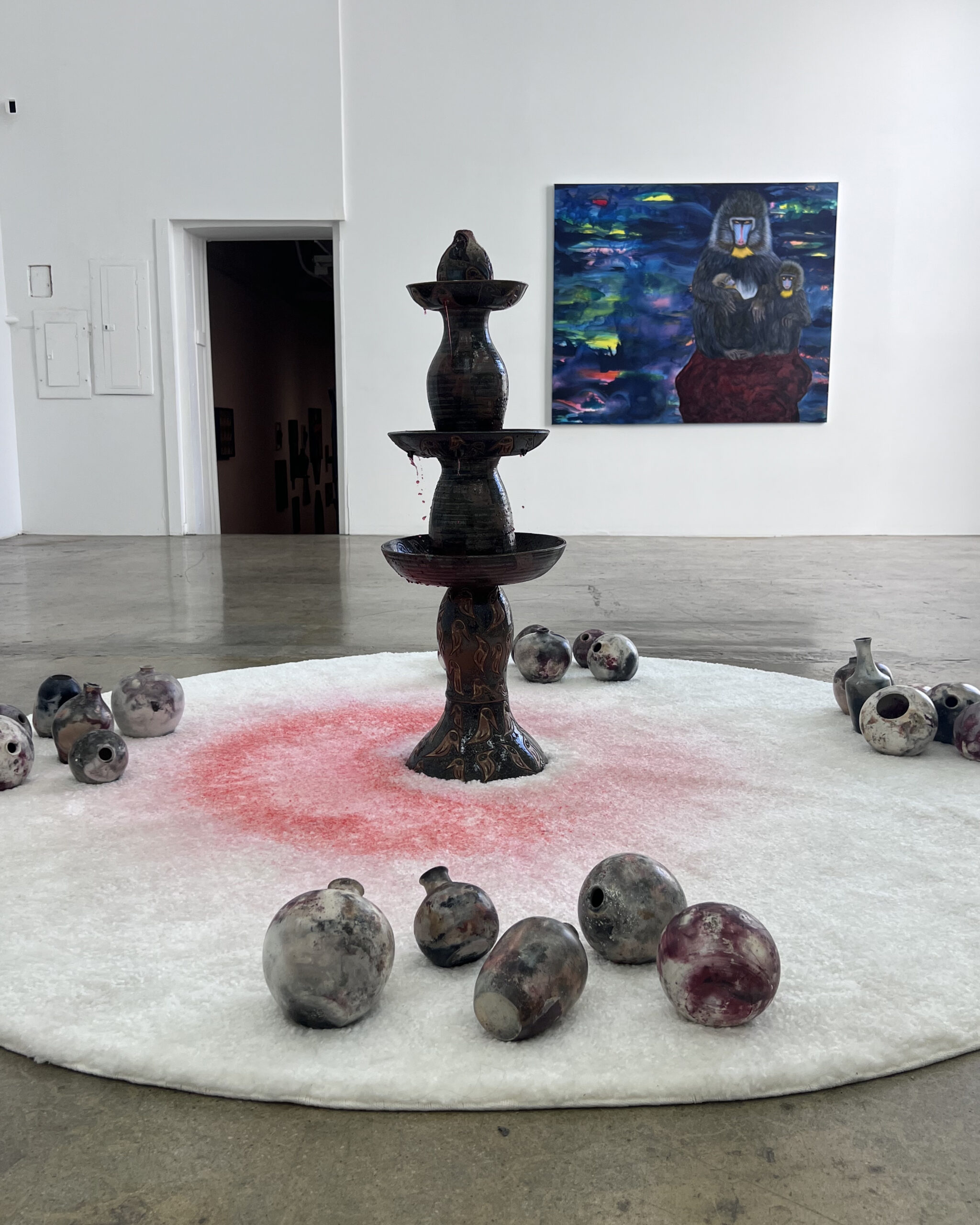
The following Saturday, I took a break from the painter bros to swing by Stanya Kahn’s exhibition at Gattopardo, up in the north reaches of Glendale. Kahn has shown to have true staying power as an artist, and has been the most vocal and vociferous among us on the genocide in Gaza. There wasn’t a shred of ironic detachment here. In the middle of the main gallery, a tiered fountain filled with red liquid sits atop a white carpet, which was slowly becoming stained from the spray. “Is it…supposed to do that?” I asked Alex Nazari, my dear friend and former classmate, who runs the gallery with her partner Chris Hanke. “Oh, definitely,” she nodded. Elsewhere, skulls and animal motifs pepper ceramic-tiled works, vases, paintings, and a new animated video. “The end form, or gift, is an installation site as respite, repository, funerary parlor, incantation, altar,” Kahn penned in the press release. I scrawled FREE PALESTINE next to my name in the guest book, a meager gesture by comparison.
A week later, I was chatting with the gallerist Sebastian Gladstone outside his Beachwood Canyon home. “I bought the platinum passes!” he boasted, peering under the hood of his cardinal-red 1967 Mercury Cougar, the sleeves of his striped Husbands Paris collared shirt rolled to his elbows. He had taken a friend to the Haunted Hayride just the night before. “We skipped all the lines,” he added. At my request, we were taking the Cougar to this month’s main attraction: the opening of “Made in L.A.” at the Hammer Museum, way over in Westwood. It was a year to the day since he and I had done a show together, at his former space on the Lower East Side. It feels like a century ago.

Sebastian closed the hood and ushered me into the wide passenger’s seat. Once he turned the ignition, the V8 sounded like it was about to burst from its cage. We peeled out onto Beachwood Drive. It was wonderful to be in a car that isn’t all computer screens, that doesn’t temper its evil emissions. Will we ever get out from under the shadow of the glorious ’60s?
Across the city, shows that haven’t been busy eulogizing the present have all been conjuring the past. Also at Karma, concurrent with Marcus’s show, the writer, editor, and curator Negar Azimi assembled 35 abstract paintings, all made in the 1950s and ’60s, by the late New York School painter and poet Manoucher Yektai. Downstairs from Hoffman Donahue, Michael Werner mounted “Natures Mortes,” a show of paintings by Per Kirkeby. They were made in the late aughts, about 10 years before he passed, but their ardent, gestural abstraction is undeniably mid-century. In one of the season’s smartest shows, Okey Dokey Konrad Fischer, the LA outpost of the storied Düsseldorf gallery, bolstered a grid of actor portraits by right-now artists Calla Henkel and Max Pitegoff with some early Bernd and Hilla Becher photographs and a 1972 video by Allan Sekula. Sebastian’s eponymous gallery, which just moved into the Santa Monica space vacated by Reena Spaulings (RIP), hosted a dozen paintings by the late Herman Cherry for its inaugural show. The cartoonish, polychrome compositions, made in the early to mid-’60s, are striking, curious artifacts of the moment, in which AbEx’s ailing body was possessed by the demons of Pop.
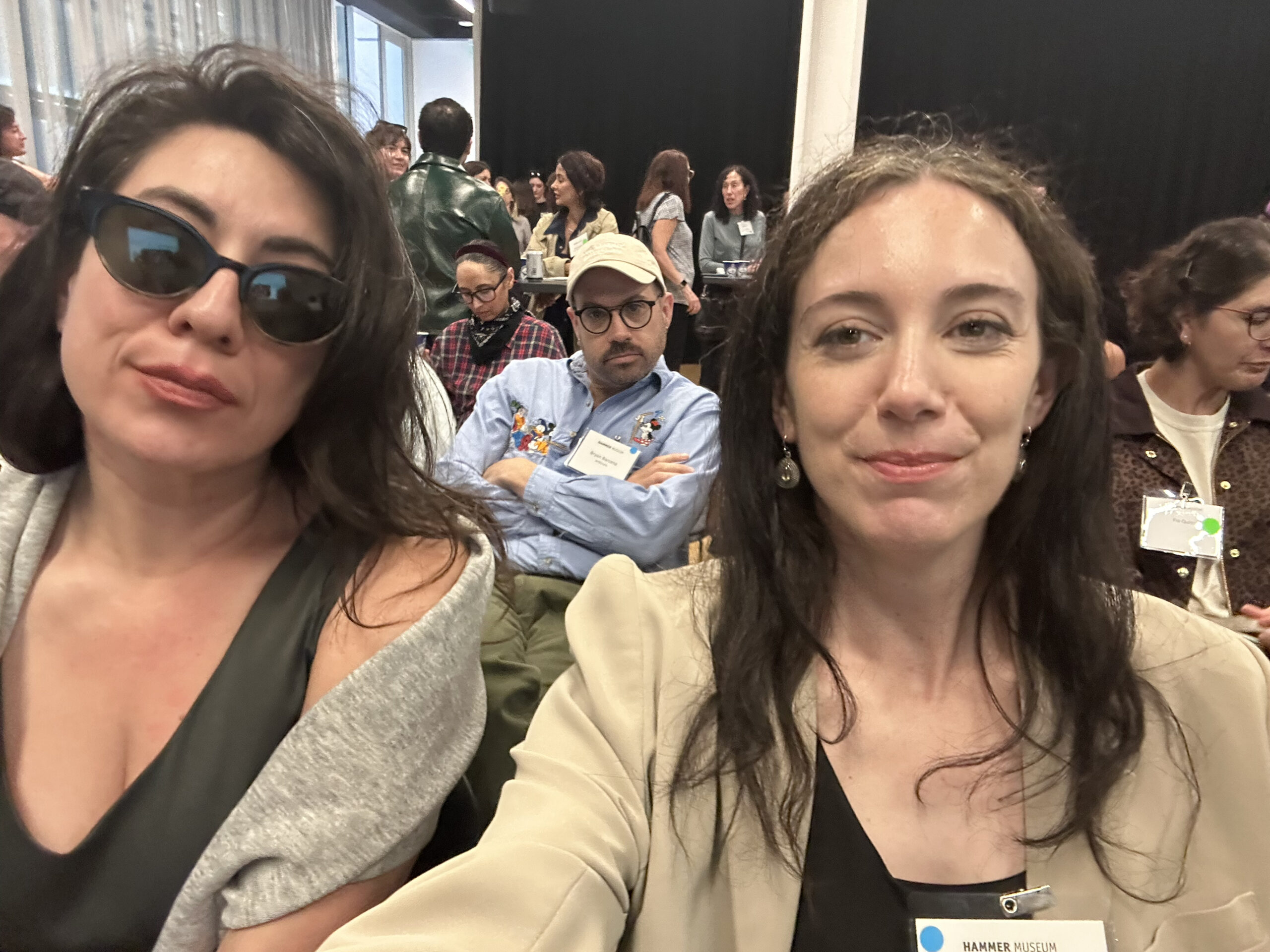
Platinum access is one of arts writing’s few perks, and I had already seen this year’s “Made in L.A.” at its press preview the morning before. At the prefatory presentation, I sat with the writer and comedian Christina Catherine Martinez, who always livens things up. After we talked shop and took selfies with Artforum editor Bryan Barcena, Christina slumped back into her chair, sunglasses still on. “I’m tired,” she announced. “I think I’d rather do, like, two sex works than write this review.”
After that remark, nothing about the whole affair could scare me straight. I tried to stop giggling about nothing with Christina through Zoe Ryan’s antiseptic introduction. (As the Hammer’s new director, Ryan has unenviably large shoes to fill, following Anne Philbin’s retirement in late 2024 after 25 years adroitly running the place.) This year’s curators, Essence Harden and Paulina Pobocha, were next up to the podium. Pobocha, who was a curator at the Hammer for just over a year before moving on to the Art Institute of Chicago in late 2024, did most of the talking. “Essence and I began this project nearly two years ago,” she explained, “and we deliberately came to it with no ideas. We had truly no ideas.” Uh oh, I whispered out loud.
I suppose another way to contend with the present is to simply say nothing about it. Harden and Pobocha are clearly perspicacious curators, but they assembled a biennial so meatless that I’m wondering whether it’s even worth biting into. “Made in L.A.” needs active curation like a novel needs a protagonist. What would The Big Sleep have been without Philip Marlowe? This year, the show seems as voiceless as a corporate handbook, and prevaricates at every turn. The curators opted to go without a title, and the show’s visuals could hardly have less flavor.
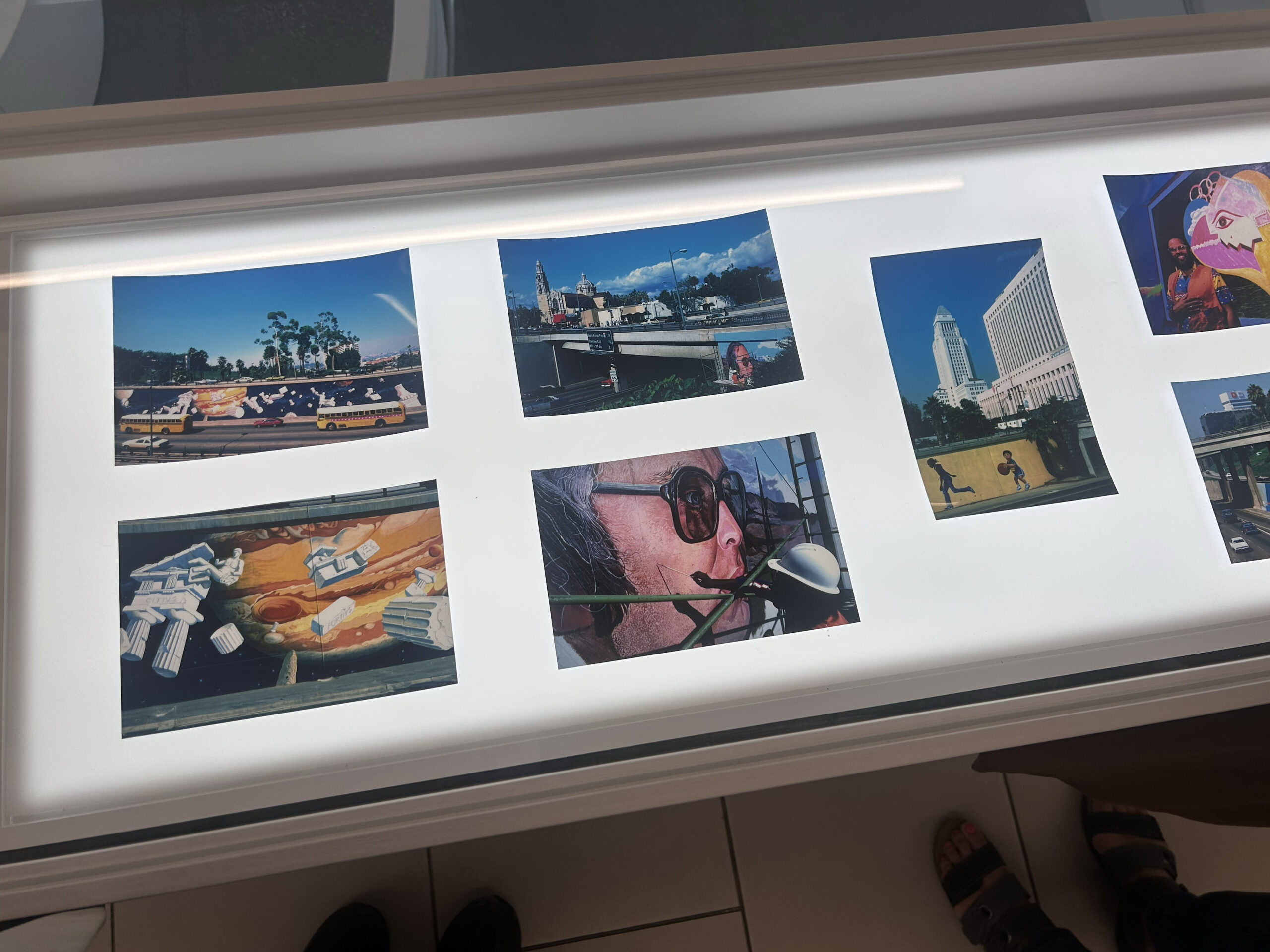
There is wonderful work in the show, though, and its roster is, thankfully, much less white than gallery shows across the city. Video works by Na Mira and Bruce Yonemoto/Eder Santo, and an installation by Black House Radio, were given the spacious, stately presentations they deserve. Ditto the painter Hanna Hur, whose five large, beige canvases were sequestered in a room of their own, the curatorial treatment their contemplative quietude craves. Alonzo Davis’s striking, offbeat ultramarine mural, which spans adjacent walls at the museum’s entrance, deserves that prime real estate and more. Nearby, a vitrine displays old photos of the murals he painted around the city in the 1970s and ’80s. Christina posted a pic of one of them on Instagram: “Drove by this mural ALL THE TIME when I was a kid—was right before the exit to my grandma’s house in Boyle Heights!” she wrote. Now that’s history.
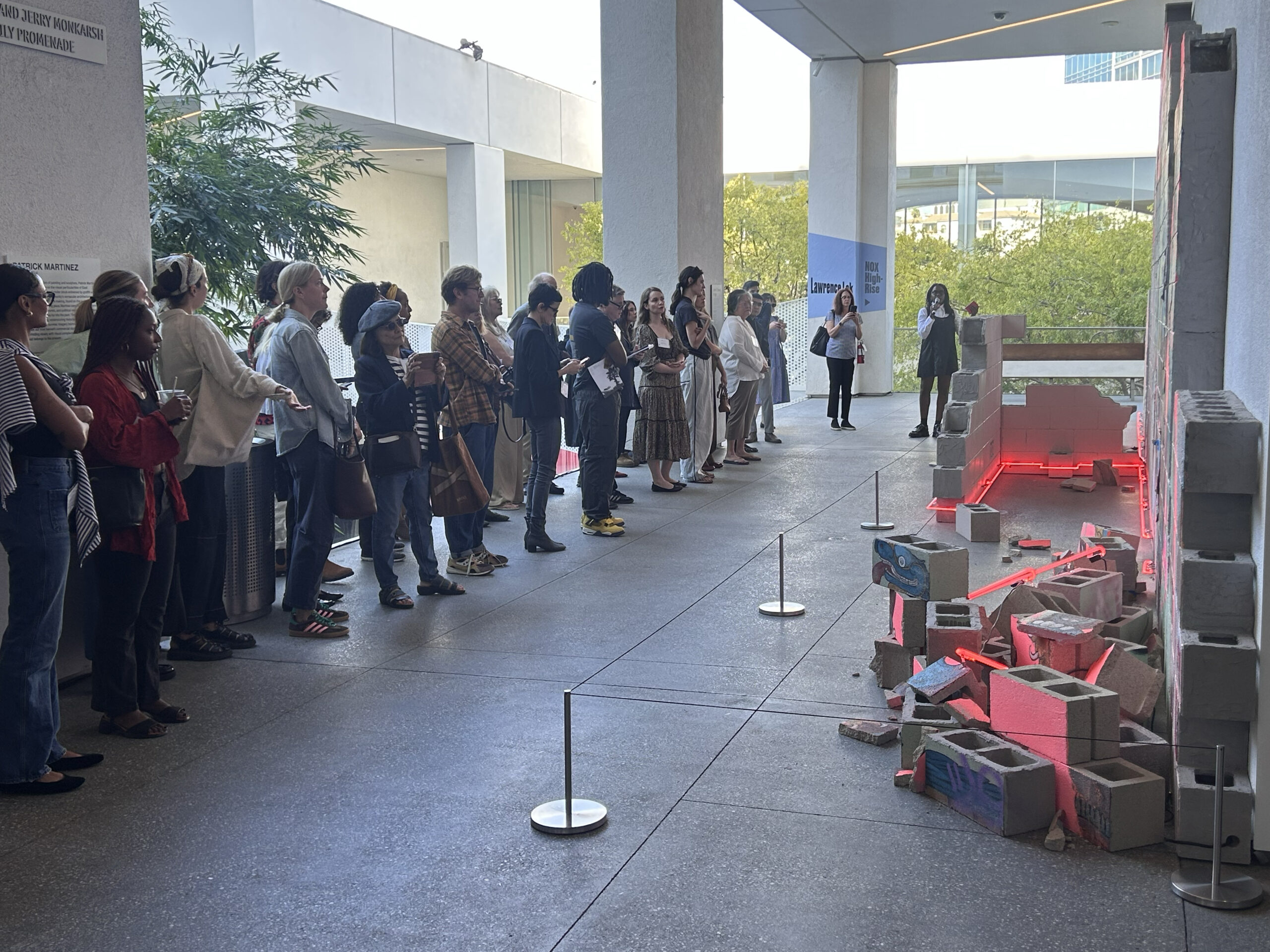
Elsewhere, much of the work felt dated and stale. The show is overrun with babyish cartoon characters—in clay figurines, on wall works, as a giant inflatable outside the museum—by the young artist Alake Shilling. Lumpy, jewel-toned vessels by Brian Rochefort take up a ton of floor space nearby. If I never see another show of gloopy ceramics in Los Angeles, it will, frankly, be too soon. Ditto political statements rendered in neon tubing, such as Hold the Ice by Patrick Martinez, the show’s only acknowledgment of you-know-what. Behind Rochefort’s works, Greg Breda’s portraits of Black figures are spry and striking, but they’re a tad underbaked and overfamiliar.
The crowds at the opening swarmed through the show, hungry and curious. But every time I bumped into an acquaintance, we telepathized our bewilderment. Harrison Glazier, a director at Château Shatto, and Adrianna Cole, ibid at Hoffman Donahue, wisely kept their mouths shut—we giggled over light gossip instead. Nearby, Athena Denos, who left David Zwirner to become director at Matthew Brown, chatted intently with the artist Artem Nanushyan. Later, I saw Lee Foley, who runs the show at Bel Ami, toasting the artist Peter Tomka, the subject of their next exhibition. Tomka is also in “Made in L.A.” Six of his stunning, black-and-white mural prints, made in his makeshift apartment darkroom, hung nearby.
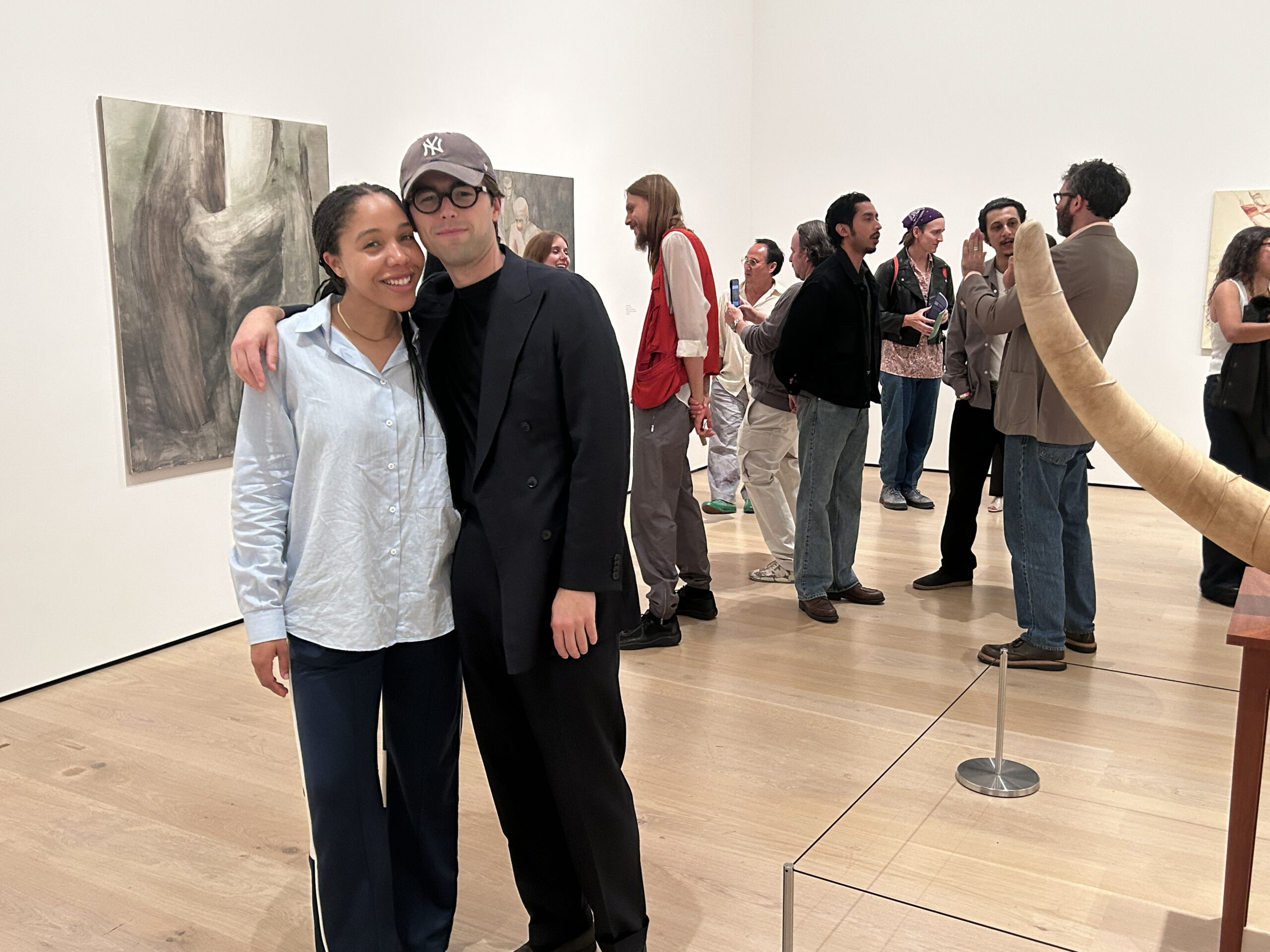
On the way out, I finally found the works by Nicole-Antonia Spagnola, one of my favorite artists working in LA today. Her silent 8mm film 1-2-3: Apartment Gallery, 2025, plays on two small monitors, hanging in the box-office windows outside the museum’s Billy Wilder theater. With a cast of friends who all run apartment galleries in the city, Spagnola’s film crafts noirish plots of murder and intrigue. I watched her boyfriend, the equally deft artist Bedros Yeretzian, crumple to the floor after being shot. He holds his hand to the pretend bullet hole in his chest as he shuts his eyes, approaching death. I turned around, searching for the exit, and spotted him standing with a group of friends nearby. Arms crossed over his denim jacket, he looked a bit aimless and bored, even more agnostic about the present and the rites of the art world than the rest of us. But he was still living and breathing nonetheless.
After a pit-stop for some Persian food with the artists Nick Angelo and Michelle Sauer, Sebastian and I peeled off to drive back east, to the evening’s pièce de résistance, over by MacArthur Park. Sammy Loren, the city’s emergent sorcerer of scene, who runs the reading series Casual Encountersz and the newsprint tabloid On the Rag, had assembled his own “biennial,” which he cheekily dubbed “Made in HelLA.” For 24 straight hours, a string of panels, readings, talks, performances, and an exhibition materialized at the gallery O-Town House, populated by the city’s old guard and young aspirants alike. I fought through the throngs of Gen Z-ers and dense cigarette smoke, trying not to feel aged.
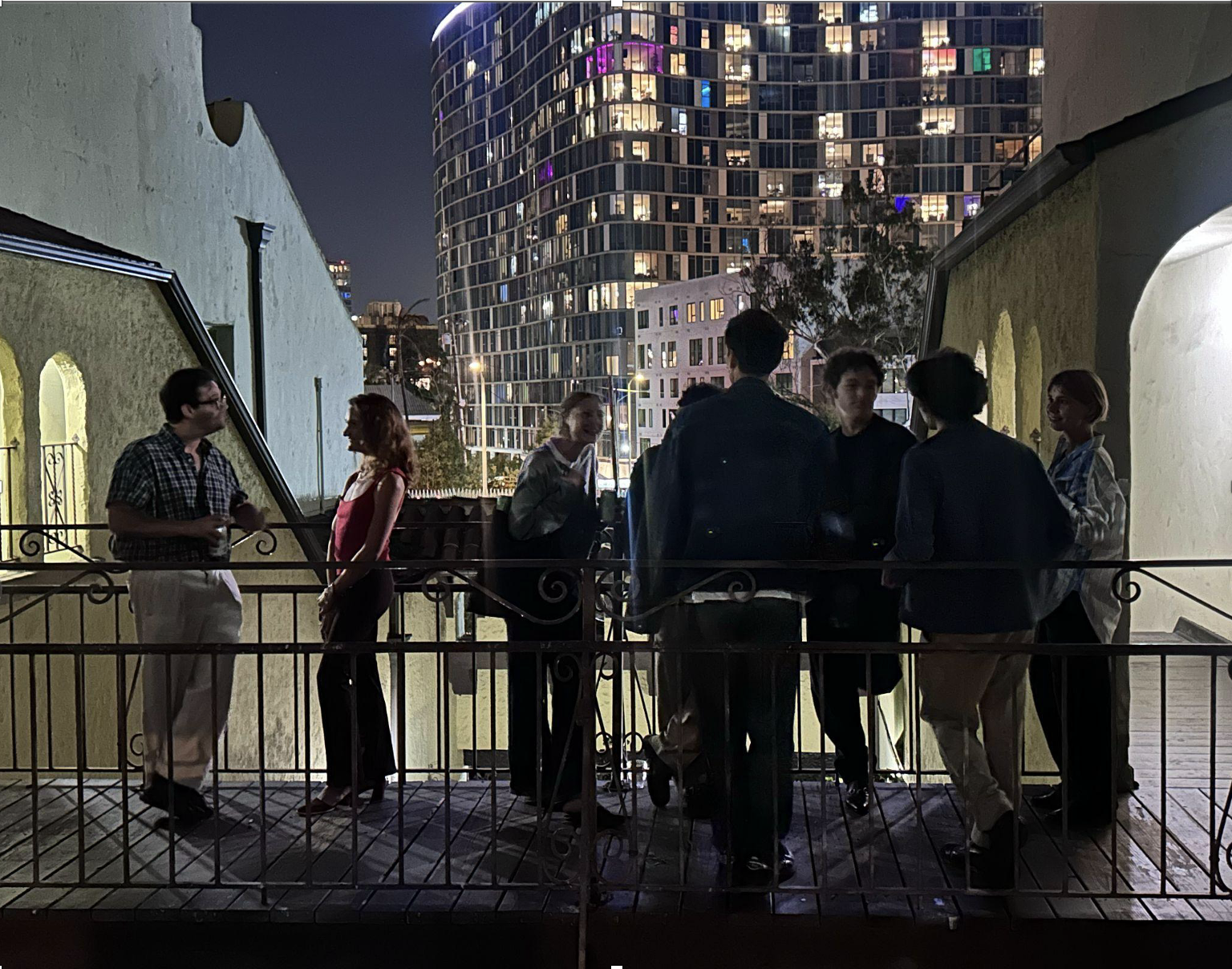
Sophie Appel waved hello and told me about the pancake breakfast she was slotted to serve at 2 a.m., using maple syrup from trees on Bernadette Mayer’s property in upstate New York. Then I collided with Nichole Fitch, whose large painting of a dagger hung on the wall behind her. “It was my mother’s,” she explained, somehow still looking fresh in a vintage Dolce & Gabbana pantsuit. “She used it ritualistically in her weird pagan practices!” Witchy. I finally flagged down Sammy, who had been whirling around, a bit bedraggled. “It’s electric, isn’t it?” he asked, eyes wide. I nodded. “I just wanted to see what I could do with just myself, some 19-year-old ‘interns’ I met on the street, and all the weird artists I’ve gotten to know in the last 15 years,” he explained. To Hell with institutions, I thought. The whole thing would be over in a matter of hours, but who cared? I could tell a new tradition had been born, and would summon us again at this time in two years.

 in your life?
