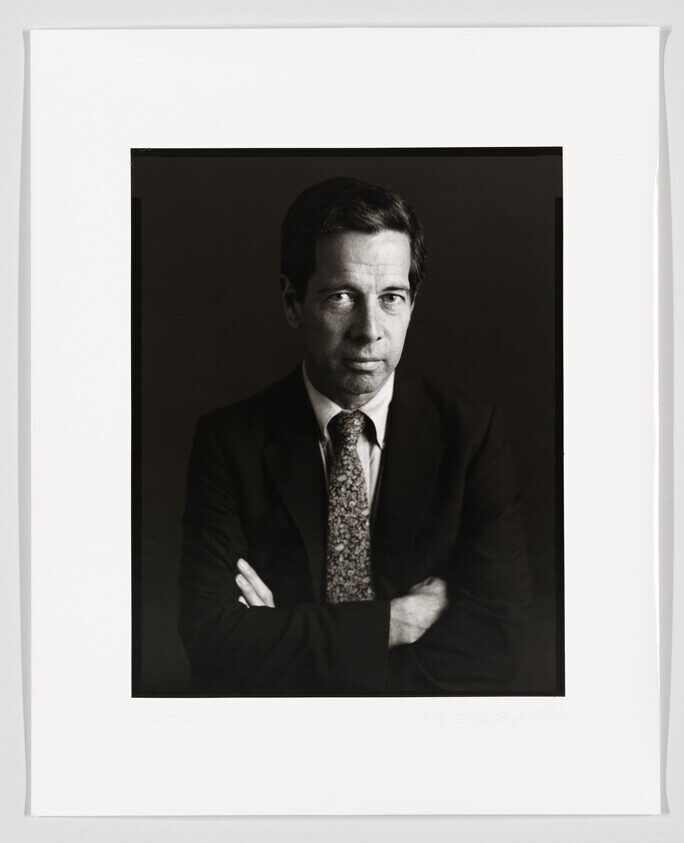
Calvin Tomkins made a career writing about giants. For more than 60 years, he covered the greats of modern art in intimate, reflective profiles in The New Yorker. Today, he passed away in his home in Middletown, Rhode Island at 100 years old.
In 1959, Tomkins received an assignment to cover a French artist he didn’t know much about named Marcel Duchamp. It launched a career as one of the preeminent chroniclers of the personalities behind the 20th century’s most totemic art. Tomkins’s profiles introduced the world to the minds and lives of generational artists like Robert Rauschenberg, Jasper Johns, John Cage, and Kerry James Marshall. As recently as 2024, he was still penning sweeping profiles, including of Rashid Johnson, ahead of the artist’s Guggenheim survey. Few writers have a body of work so insightful; even fewer have one that so cleanly maps onto the history of contemporary art.
“I wanted to choose subjects whom I not only could get along with but who would be interested in the experience, who would sort of open up themselves to the process, with the idea that maybe they could learn something too,” said Tomkins in conversation with Randy Kennedy at Hauser & Wirth in March 2020.
Below, read a few of his greatest hits from a late-career portrait of Georgia O’Keeffe to a dispatch from the 1960s Marcel Duchamp craze.
“Beyond the Machine” on Jean Tinguely, 1962
After a spell at Newsweek, Tomkins joined The New Yorker at the beginning of the ’60s. His first artist profile for the magazine was a playfully ribbing portrait of the sculptor Jean Tinguely, whose (somewhat unreliable) mechanistic sculptures captured the world’s changing relationship with machines. Tomkins writes that “at the Stedelijk Museum, a large Tinguely ‘meta-matic’ painting machine, powered by a gasoline engine, was installed in the reception room, where it was supposed to produce abstract drawings and at the same time pump the exhaust from its engine into a balloon, which would eventually fill up and explode, pouring forth fumes and driving the guests from the room; the machine was un able to do any of this, because another artist, perhaps enraged at such theatrical egocentricity in a mere machine, had poured beer into its fuel tank.”
“Not Seen And/Or Less Seen” on Marcel Duchamp, 1965
Although Tomkins first profiled Duchamp in 1959, he revisited the artist and his work many times over the years. Eventually, he released two books on the artist, Duchamp: A Biography in 1996 and Marcel Duchamp: The Afternoon Interviews in 2013, based on the conversations conducted for this piece. “A good deal of the new art both in this country and in Europe seems to make its appeal less to the eye than to the mind, and if the intellectual level of this appeal is rarely exalted, it is more often than not carried out in a spirit of mockery, iconoclasm, or sheer bumptiousness not far removed from the hilarity that Duchamp aimed at,” he wrote in this installment. “It was Duchamp, after all, who suggested that art could be a form of play—a game between artist and onlooker. As for commercialism, the astonishing prices paid for some of the pop masterworks may be the most hilarious aspect of the current reaction.”
“Georgia O’Keeffe’s Vision” on Georgia O’Keeffe, 1974
By the early ’70s, Georgia O’Keeffe had lost most of her vision and was painting less and less. In the fall of 1974, Tomkins traveled to O’Keeffe’s home (and a local monastery) to reflect on the southwestern artist and her storied career. He wrote, “Georgia O’Keeffe, who is eighty-six, spends almost no time thinking about the past. ‘You’d push the past out of your way entirely if you only could,’ she said to me one morning last fall, sitting in the open patio of her house near the Ghost Ranch, in the New Mexican high desert, seventy miles northwest of Santa Fe. What interested her at the moment were the wild purple asters that grow so abundantly at this time of the year, when there has been enough rain.”
“Everything in Sight” on Robert Rauschenberg, 2005
Like Duchamp, Tomkins wrote about Robert Rauschenberg throughout his career. He also penned a book about the artist titled, Off the Wall : A Portrait of Robert Rauschenberg, published in 1980. For The New Yorker, he recalled their relationship, writing, “In 1961, when I first met Rauschenberg, he was just beginning to outdistance his reputation as the bad boy of contemporary art. His early work—the all-white and the all-black paintings, the paintings made out of dirt and growing grass, and, above all, the combines—had certainly attracted attention, but not the sort that offered much encouragement.”
“A Fool For Art” on Jeffrey Deitch, 2007
By the mid-2000s, the art world was going through major changes, and Tomkins was there to capture it all. In this profile of gallerist Jeffrey Deitch, Tomkins charts the rise of auction houses like Christie’s and Sotheby’s and the evolution of the contemporary collector. He recounted, “Contemporary art held little interest for the big-time collectors whom Deitch and Patrick Cooney, a young art historian who was hired to run the art-advisory service with him at Citibank, found themselves assisting. ‘I was only being paid about thirty thousand dollars a year,’ Deitch said, ‘but I was spending millions, flying first class to Hong Kong and Singapore, staying in top-level hotels, and taking clients out to expensive lunches. I had access to almost any collector, and also to important museum people, like Bill Rubin’—then the head of painting and sculpture at the Museum of Modern Art. ‘I was just living in this fantasy world.'”
More of our favorite stories from CULTURED
Our Critic’s Favorite Show This Month Is Hidden in a Subway Station
James Cahill Saw the Best and Worst of the Art World. His Latest Novel Exposes It All.
If We’re in the Golden Age of Documentaries, Why Are All These Documentarians So Worried?
Sign up for our newsletter here to get these stories direct to your inbox.






 in your life?