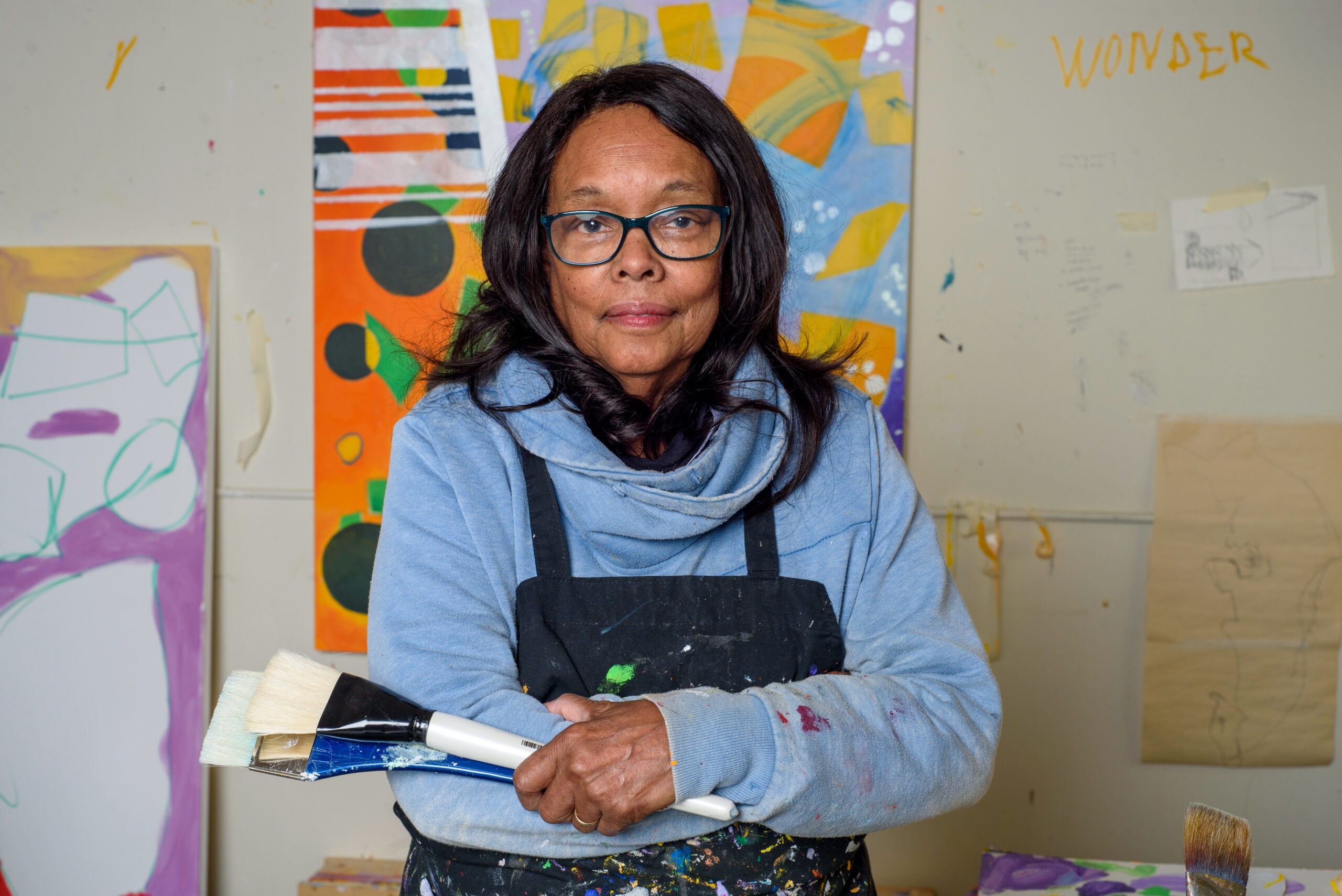
Cynthia Hawkins tried paint-by-numbers as a child, but immediately knew it was not for her. It was Piet Mondrian’s tree series that gave her permission to leap toward abstraction as an undergrad at Queens College. It’s a movement she’s been making her own ever since.
At 76, Hawkins has also cemented her legacy as a scholar and curator, but it’s her compulsion for mark-making and pursuit of color that keeps her coming back to the studio. Below, we speak with the artist about the latest iteration of a series she’s been working on since 1979, YouTube spirals, and her advice for young practitioners looking to balance art and life.
What are you currently sitting with in your studio? What is today looking like for you and the canvas?
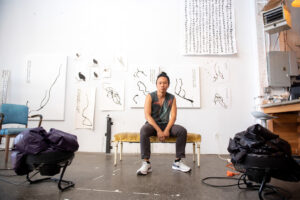
I am working on the fifth iteration of my “Maps Necessary for a Walk in 4D” series, which I’m calling—permanently or tentatively—Fielding Space or Maps Fielding Space. The previous four iterations were a buildup of these organic shapes with the map. This time I’ve taken the big organic shapes out, and we’re seeing how it goes. The background is still pretty vibrant, but it’s more abstract expressionist in feeling. I am trying to see how long I can hold off complicating it further. The way I use color is continuing here in that there is a deep consideration of complements. I am using this linear mark that was the original path for the “Walk in 4D,” which was from 1979.
Remind me, it was from your commute in New York?
Yes, from my apartment to the 86th Street subway station. I raised it on a 45 degree angle. This was not part of the previous 30 or 40 paintings, but it is now. I’ve done 40, 50 works on paper to flesh it out. I don’t plan much. I get a feel for the new direction and do a lot of small works on paper and then go for it.
You’re speaking about holding off or holding back in this iteration of the series. How does that restraint feel to you right now?
The inclination is towards the complexity of the last three [iterations]. There’s this complexity of organic shapes mixed with some sort of geometry, some weird little forms, circles, and small squares. All of it doesn’t happen in every painting, but in those paintings the depth of field was much deeper, which was something I wanted. I’m trying to maintain the depth through the color relationships in the background, the layering, and the surface marks. If the background is red, then we can have a pinkish-red shape move out of the background and a green passing over it, creating a complementary shock.
I know you did a whole investigation into green, and you’ve spoken about how challenging the color is to work with. Is there a color that is speaking to you these days?
I’m in love with orange and yellow. Yellow gives me a thrill; it excites my eye.
Switching gears and going all the way back, there’s a sweet anecdote I read about your father teaching you to draw Mickey Mouse cartoons as a child. Can you speak to me about your early relationship to art making—both in taking it in and making it yourself?
Besides learning how to draw Mickey Mouse, which was absurd, the first instance was [You Are an Artist host] Jon Gnagy, who was on TV. I got these drawing sets where you put the plastic on the TV—that was the best thing ever. I watched it all the time. Then I tried paint-by-numbers, but it was not for me. I would occasionally make a watercolor for somebody who didn’t feel well, and I would spend a lot of time on it. But by then I was thinking of about 100 other things that I could be when I became an adult.
Your formal art studies start at Queens College, when you walk by a ceramics studio. You don’t go into ceramics but painting instead. When did you first see yourself as an artist?
Not long after that episode. I was planning to be a history major, but then I went to the art department. You had to take all these preliminary classes, where they would decide whether you could be an art major. That was wild. I worked very hard at it. I still hadn’t decided whether I was gonna do oil painting. I thought I was going to do watercolors. I thought I was going to be [American watercolor painter] Charles Burchfield.
How did oil present itself?
First of all, it was so much easier, oh my gosh. And bigger so you could really get around in there. My real work began with these charcoal drawings of gym equipment, then of chairs laid out on the floor, laterally, and just drawing the intersecting lines from the front and from the back, layered. I don’t know how long I did that, maybe 15 times. They were small, then they got more complicated, and as I added geometry to it, they got bigger.
It was around then that I saw Mondrian’s drawings of trees, and that completely opened up everything because I wasn’t inclined to follow the rules. As I say, there’s enough people doing figurative work, I don’t need to do it. But to transition from the natural to the intellectual, say, was critical. Of all the people that influenced me back in that period, Mondrian was the most important. Hans Hoffmann came a little later.
When I was in college, I knew too many young artists who never knew what to paint next. I thought, I don’t ever want to be in that position. And I never have. My work begins somewhere within these geometric drawings of equipment and this linear mark making, and they get combined at some point. I always felt I was acquiring not just a method, but a vocabulary, a bag of tricks.
What state of mind do you need to be in face the canvas?
You get to the studio, you mess around for a little bit, then you turn around and look at what you’re working on. When I was in Rochester, I started to leave the mess palette from the day before as a reminder. I would only clean it up in the morning. But I have to say, the worst thing happened: I started watching YouTube. I’d go in, have my coffee, and watch YouTube. It’s taken over my life.
What are you watching on YouTube?
Well, it started out being quite reasonable. Then one day, I happened to see little toddlers doing something cute. It’s just like, “Oh, what’s this? Oh, what’s this?” Sometimes I listen to music, but I can only listen for 20 minutes or so.
What do you listen to?
Jazz or classical. But then I just have to close the laptop. Everything is so much better when there’s no noise at all.
You were an avid reader as a child. Has literature continued to play a role in your work?
After I finished my dissertation, I didn’t read anything for two years. Believe me, I collected enough books to last me quite a while so it wasn’t my intention to not read anything. I just wasn’t under any pressure. Since then I’ve been collecting catalogs of work that I like. I found a catalog about Native American abstraction from 1940 to 1970 that I didn’t know existed, and Arab abstraction from the 1970s, ’80s, and ’90s, that I didn’t know existed. I haven’t read any of them yet, but I have them all. I read some scholarly stuff that relates to aesthetics and Black aesthetics, and some philosophy, like Katherine McKittrick, who’s at the University of Toronto. I have three Fred Moten books. Fucking hard, oh my God.
It’s important that people understand that nothing comes easy, if you want to do right by whatever field it is. I saw in one of your articles that you asked somebody if they ever thought about giving up doing their work. I’ve had that thought a couple times, but I always had a plan. Just a few years ago, I could visualize myself walking down the road with a guitar on my back—by myself, mind you. Finally, my husband got me a guitar for Christmas, and I didn’t take a single lesson. I picked it up and it was very uncomfortable. I just realized, in order for me to be really good at it, I would have had to put in as much time as I have put into painting. So I was like, “Well, you might as well just go paint.”
You’ve had a parallel career in academia and as a gallery director at universities. I would love to hear what it’s felt like to have a hand in how art is contextualized. You’re not just in your studio—you’ve engaged with so many different stakeholders from students to the general public.
Because I’m so invested in what I do, I’ve always been accessible. If we’re at an opening and somebody asks questions, I’m always available to have that conversation. When I started teaching studio art and then art history classes, I always wanted people to understand the ramifications, that art is not separate from the everyday, it’s not separate from your history.
Any vocation comes with a certain amount of sacrifice, what do you feel like you’ve given up to be, and stay, an artist?
I wouldn’t say that I gave up anything, I fought to keep it. Eventually I had two kids and there was a time where I would occasionally just go mad, like, “I’m going to the art store. I’m getting this no matter what. I don’t care.” I fought to keep [my practice] ongoing, because I wouldn’t know who I was without it. People ask about having kids, like, “Don’t they get in the way? How do you keep working?” For the longest time, you can just put them in a playpen in the studio with you; they don’t care. They interrupt you when they’re 30 years old; it doesn’t matter. You just have to find your way around it. The hardest thing is having a full-time job and making time. But if you are not from a wealthy background, you have to have a job. Nobody said you had to paint eight hours a day. In a whole [week] if you get 20 hours in there, it’s fine.
Interest in your work has blossomed over the past couple of years. How does it feel?
It is really great; I am very cautious. When other artists ask me how this happened, I [tell them] really feel like a third party is required. My friend in Durham, North Carolina, who is not even a painter, knew a lot of Black artists and a lot of collectors. He would just send emails to everyone he knew, like, “Do you know about Cynthia Hawkins?” And I do the same. When I saw the Just Above Midtown show [at MoMA], I told Chris about Janet [Olivia Henry]. I was like, “You’ll love her work, blah, blah, blah.” And he was taken right away. It’s totally paying it forward, but it’s really about the stuff you like and the people you think are interesting.
What advice would you give to a young artist who looks up to you?
Not to stop. When we came up, we never thought about money. All we wanted was an exhibition, a group show. You really just have to be committed. Everybody has periods where they don’t work as much—that doesn’t mean you stop. It’s interesting how much I think about my work. It pops in my head in the kitchen, when I’m falling asleep, when I wake up. Once you’ve been so engaged for so many years, to think about not doing it is really unthinkable. It’s as important a part of your life as your kids. You’re not the same if you stop doing it.
More of our favorite stories from CULTURED
The Substack Stars: 21 Newsletters That Your Favorite Writers Can’t Get Enough Of
In Wayne Koestenbaum’s First Novel in Two Decades, Gay Lust Incarnate Is a Rabbi With a Dad Bod
Eva Victor Made the Breakout Indie of the Year. Now, They Have to Do It All Over Again.
What Is It Really Like to Work at a Black Art Institution Right Now?
In Paris for Fashion Week? Catch These 11 Must-See Exhibitions While You’re There
Sign up for our newsletter here to get these stories direct to your inbox.




 in your life?