The American Land Art pioneer Robert Smithson (1938–73) liked to say that museums are tombs. A glance at the slate of recent and upcoming programming at major institutions won’t convince you otherwise.
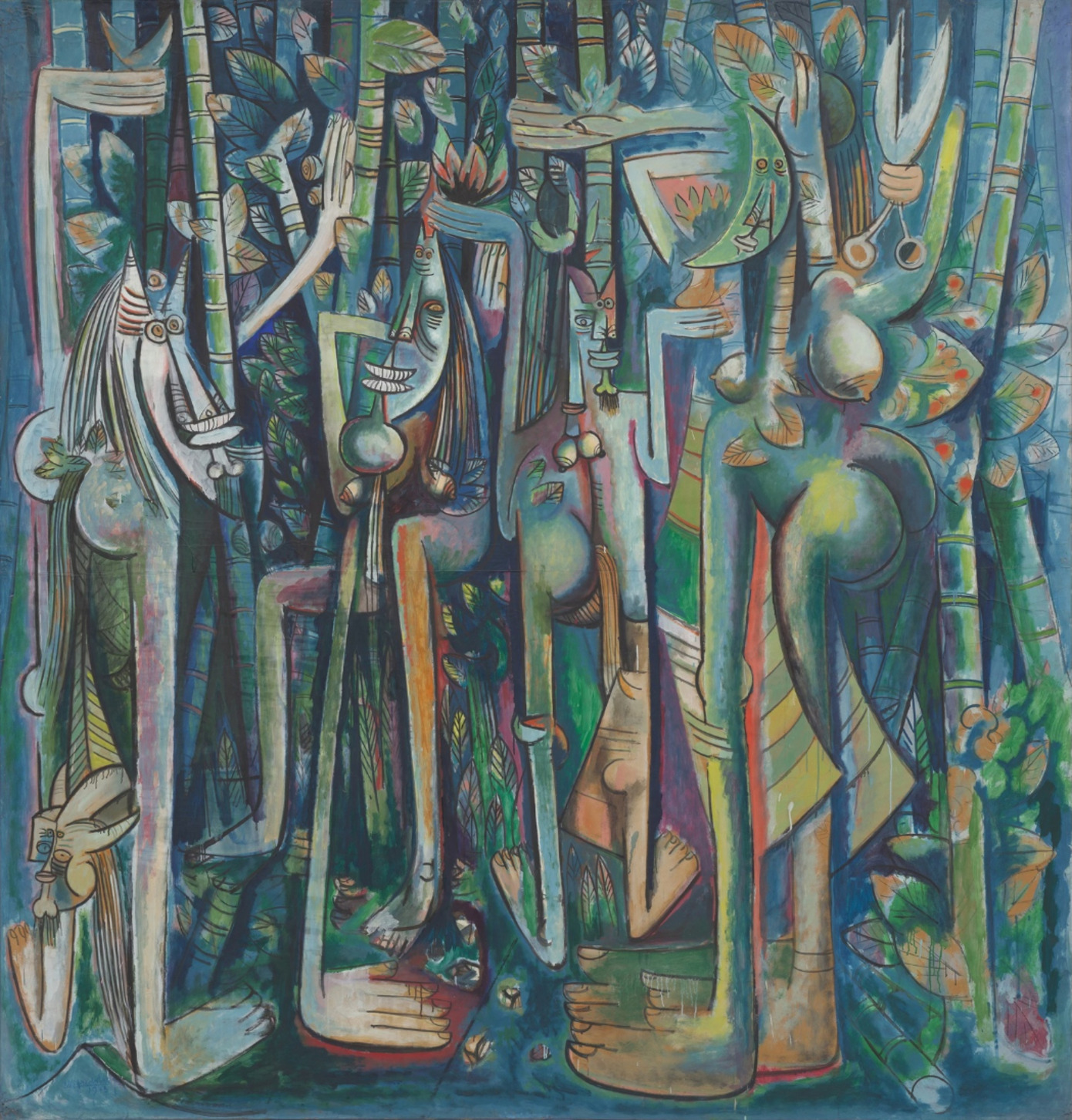
Many of last year’s biggest museum shows, even in institutions dedicated to contemporary art, were given over to ghosts. In 2019, by CULTURED’s count, 18 percent of solo exhibitions at New York museums that regularly feature modern and contemporary art focused on dead artists. Last year, that share more than doubled, to just under 50 percent. At the Museum of Modern Art in New York, the year ended with exhibitions of Wifredo Lam (1902–82), Helen Frankenthaler (1928–2011), and Ruth Asawa (1926–2013). Jack Whitten (1939–2018) was before that, and this spring brings Marcel Duchamp (1887–1968). The Jamaican-born abstract artist Mavis Pusey (1928–2019) received star treatment at Philadelphia’s Institute of Contemporary Art last year. The Broad in Los Angeles, known for late billionaire Eli Broad’s baubles by Jeff Koons, Barbara Kruger, and other surviving art stars of the 1980s, is currently going hard for Robert Therrien (1947–2019), a jokey sculptor of gigantic tables, chairs, and dishes. The ICA Miami’s two current exhibitions are postmortem surveys of Joyce Pensato (1941–2019) and Richard Hunt (1935–2023). The Pop artist Roy Lichtenstein (1923–97) headlines the Whitney this fall.
This trend in posthumous exhibitions comes at a time when contemporary art is self-conscious about being aimless. This isn’t necessarily to impugn the quality of these artists, or these shows, many of which are excellent. Clearly, too, there remains scholarship to be done, artists to discover, and movements to contextualize, especially through a postcolonial lens. (Mavis Pusey had never had a major museum survey, even though her career lasted about as long as Robert Rauschenberg’s.) But given the long lead time on museum shows, this noble revisionist project is cycling out of style. Exhibitions planned as part of a cultural swing toward equity during the Biden interregnum have landed in the vitriolic backlash of Trump II—where the overall tenor is outright nativism, and even some progressives and leftists in the arts have grown cynical about institutional diversity washing.
The bigger question remains: What is a museum for?
It used to be rare to give a living artist a big museum survey. But the modern and contemporary art institution model changed that. The “encyclopedic museum” had been an aristocratic pursuit at its core, edifying a public by flaunting an empire’s or a baron’s reach and taste. By the early 20th century, tradition-averse scenes like the Impressionists carved out space for themselves outside of the academic salons, and the historic avant-garde took root. Arrivistes like heiress Peggy Guggenheim, who had seats on fledgling museum boards and a gallery called Art of This Century, duly made their mark by championing modern radicals who were mostly still alive.
As the likes of Jasper Johns, Marcel Duchamp, or Pablo Picasso (the first living artist to have a solo presentation at the Louvre) entered the canon in real time, it became necessary to periodically trot out their greatest hits. Today, a modern and contemporary collecting museum has the conflicting remit to both appraise the era’s most “daring” art while also stoking interest in the history that preceded it. Smithson’s quip underscores the funerary quality of being canonized. A museum retrospective (most artists don’t like the word) means you’ve made it, but also implies that you’re done growing.
Which isn’t to say that culture is frozen. The issue is that museums founded to showcase a certain movement don’t easily flex beyond that time frame. When MoMA tries to bring A.I. and crypto artists into the narrative of Modernism, for example, the results are awkward. In 2022, they gave NFT-maker Refik Anadol a months-long residency on a throbbing LED screen in their lobby, where a muted Frank Stella once presided, and tried mightily to frame his A.I. experiments as the biggest avant-garde advance since photography; the truth, however, is that most A.I. artists only care about the canon insofar as they can mine it for data—as Anadol literally did at MoMA. Meanwhile, generational lag favors the modernists—MoMA, the Whitney, and the Guggenheim (and with them the modern idea of a public-facing art museum) were all established roughly a century ago. Midcentury masters are well-known enough to draw crowds, and the styles they work(ed) in (think Jack Whitten’s arc through Expressionism, Abstraction, and Futurism) remain broadly legible to an audience who grew up studying Jackson Pollock and Agnes Martin.
Simply because of the irregular growth of the art industry and the inevitable march to the grave, a mathematical scarcity has developed, with a finite number of exhibition slots going to established, rediscovered, and deceased artists. It’s similar to the inertia found in some MFA programs, where accomplished artists have locked up the tenured jobs and their former students can only hope to elbow their way into an adjunct gig or two.
The modernists and the boomers are still on top, even from beyond the veil. Heaven, as they say, is getting full.
There’s also a conspiratorial angle. No one is going to unearth Pablo Picasso’s racist tweets or demand Frida Kahlo retract her support for Palestine. Sure, dead artists’ histories can be re-evaluated through contemporary eyes (as with Hannah Gadsby’s widely panned Brooklyn Museum show exploring Picasso’s treatment of women). But insofar as they are unable to respond to current events, a deceased artist is politically inert.
Add the unpredictable vectors of institutional critique, where first the Left demanded anti-racist curating, then the Right demonized DEI, and it makes sense that museums see the appeal of known quantities. You can instrumentalize an artist as evidence of your institution’s commitment to XYZ cause, but with little risk of the artist’s own comments complicating things. In this light, the fiasco of a Philip Guston retrospective, delayed in 2020 so that institutions might properly contextualize his paintings of Ku Klux Klansmen from the 1960s, is a study in how to self-own. Guston was a political guy—he would have had ideas about how his goofy and irreducible paintings of evil hoods resonate in the age of Black Lives Matter. As it happened, in the absence of the artist’s voice, institutions panicked and fumbled. The show opened with trigger warnings and got a muted response.
There’s some notion that a posthumous oeuvre can safely be held up to the light of current events, to produce sparkles of depth and reveal the work’s richness, within the bounds of an established art-historical framing. A living artist’s work, on the other hand, is potentially volatile, subversive, even corrosive. They could turn against the institution. But if museums are favoring dead artists out of a sense of risk-aversion, they’re mistaken. As the case of Philip Guston proves, a strong artist will find a way to haunt you, in this world or the next.




 in your life?