

A last name can betray a lot. Even for the more anonymous of us, a Google search can reveal everything from idiosyncratic Spotify playlists to that one time you won a prize for archery as a teenager. A first name may signal you know someone, but what succeeds it gives you the shortcut to knowing about them.
Lila Feinberg, a poet turned playwright who has also worked as a Hollywood screenwriter, started going by Lila Raicek after her marriage to clothing manufacturing exec Douglas Raicek in 2024. The name change, until recently, obscured her connection to her ex-fiancé, the disgraced Amazon Studios founder Roy Price, who was accused of sexual harassment days after the Weinstein story broke in October 2017. (Raicek called off the wedding, which was scheduled for the following month.)
Now, her first novel, The Plunge, is resurfacing the media maelstrom that engulfed Raicek almost a decade ago, if only for the rough parallel between its logline—a writer picking up the pieces of herself in the aftermath of her fiancé’s very public scandal—and hers.
Raicek’s protagonist, Liv, does not have a last name. When we meet her, she has, in fact, very little. In the wake of her betrothed’s literal downfall—he has died, in the first of many departures from Raicek’s own biography (Price is alive and recently wrote an op-ed for The New York Times)—she’s sought refuge in a garret on the Upper East Side of New York, living out of a suitcase. In the ensuing 300-some pages, we follow Liv into a downward spiral that involves her yoyoing between a former neighbor and the older widow who’s become his disciple, trips to the Hamptons and Italy, and many metaphors about gems. (Damon, the neighbor, is a jeweler.)
The Plunge’s psychosexual intrigue makes it an apt binge read, but the novel deals in less easily packaged emotional territory: what regaining trust—in oneself and others—looks like after trauma, how cycles of denial and avoidance register in a body, where the fear of feeling numb will lead you. Raicek can veer into the verbose, but punctuates any melodrama with a subtle layer of self-aware humor that coaxes the reader back in willingly. She is at her strongest when reflecting our own voyeurism back at us. We rubber-neck scandal with little attention to the microseisms that follow it, when the people involved have to keep living. Liv is a walking, talking, fucking (lots of fun sex in The Plunge) study in the long shelf-life of pain that’s been made public.
Last month, I met with Raicek to discuss the experience of writing The Plunge. Perhaps fittingly, our conversation began with a discussion of the novel’s many name changes.
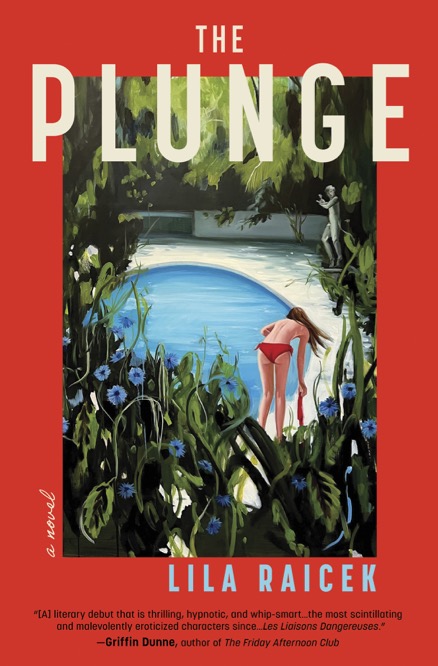
In reading the acknowledgements, I saw that you mentioned a title change. I always love to think about the road not taken. Can you tell me about that decision, and how you ended up with The Plunge as the book’s title?
Art is often an inspiration for my work and how I visualize a world. I was drawn to works that spoke to me as I was writing, and I kept kind of using those titles. Originally, it was Jules Olitski’s painting Burn and Glitter for a long time, and then it was Helen Frankenthaler’s Slice of Red, or A Slice of the Stone Itself. There was Blue Fire for a while, which had come from an [Anna] Akhmatova poem. Then, of course, the harsh reality of the commercial aspect settles in.
In naming my plays, it’s usually immediate for me. I’ve never actually grappled with a title. This was such an endless road, and I kept retitling and retitling, going back to art and going back to poetry. Then when I finally had a publisher, they were like, “Yeah, I don’t think a Jules Olitski painting is really the one.”
In this endless search, I was reading the diaries of Sylvia Plath, and there was a line that struck me, which ended up being in the epigraph: “This would be the one to finally pull me out of my plunge.” I had never heard the word like that. Of course, in the book, metaphorically, Liv is free-falling, plunging into darkness after she’s had this physical, real-life accident where she’s plunged off a cliff.
I love how stripped down it is.
There was the line, I think, that the character of Sam says to her: “You’re plunging from one thing into another.” I felt like that was the place I was actually writing from in terms of exploring the character. Even after we’ve gone through something deeply traumatic, how do we lose ourselves even further to get back to ourselves? I thought that was such an interesting word. Of course, now I see it everywhere—her plunging neckline, plunging off a cliff.
There’s the destructive death drive, but also sex drive, in the impulses of the main character, Liv. Reading it, I thought often about the female characters in literature who are unabashedly destructive. Someone like Chris Kraus in I Love Dick, almost monstrous with desire. Liv has these self-aware illuminations, and then she just continues to do it anyway. I was wondering how you found Liv.
It is a work of fiction, not a memoir. It is a cobbled-together composite of personal experience, research, and my vivid, overactive imagination. I had gone through a very transformational period of my own life when I was grappling with the duality of two cataclysmic and different losses: the dissolution of a very public relationship, paired with the devastation of the loss of my best friend.
I had moved from LA, where I had kind of transformed my own career in Hollywood, back to New York, and I was living in the maid’s room of a female mentor of mine. In personally charting the treacherous waters of grief and loss, and asking what it means to start over when you feel like the bottom has fallen out, I thought creatively it was an interesting time to explore the place of aftershock and aftermath. There have been a lot of portrayals of women who have gone on these very linear paths: Trauma happens, we move on. But what does that liminal space look like?
With Liv, I was interested in exploring the thanatos and eros and the drive of these two incongruent things, self-preservation and self-destruction. What does that messy middle ground look like? The other day I went back to the Neue Galerie, and I was looking at the Klimt she talks about in the beginning—this hollowed-out body. The character feels so depleted and devoid of her identity; she’s seeking light and heat and sex and all these things to make her feel again, and that felt like a really interesting and dramatic place for a character to begin from.
There’s the destructive death drive, but also sex drive, in the impulses of the main character, Liv. Reading it, I thought often about the female characters in literature who are unabashedly destructive. Someone like Chris Kraus in I Love Dick, almost monstrous with desire. Liv has these self-aware illuminations, and then she just continues to do it anyway. How did Liv come to you?
I think I’m drawn, as a writer, to grounding the reader in an outsider perspective in a world that you think is familiar. Isabel and Damon do live downtown, and Liv’s only safe space is the cocoon of this derelict maid’s room. She can feel geographically separate from the self-destructive spiral she’s in by retreating uptown. The room she’s living in mirrors her psychological state. I thought a lot about The Yellow Wallpaper, and I was rereading Jean Rhys’s Good Morning, Midnight. I’m always interested in writing things you don’t expect. You don’t expect this derelict room to be in a place that we associate with uptown. Central Park also becomes a very reflective space for her, where she’s taking these circuitous grief walks.
The Plunge is inserting itself in a long lineage of stories about trespassers, from The Talented Mr. Ripley to Saltburn to The Guest. I’m not saying that Liv is exactly that, because she’s almost invited in. And at one point you understand that Isabel knows exactly who she is. Still, from the beginning, there’s the sense that she’s the charity case. Why do you think there is such a fascination with the interloper and how you wanted to relish in that trope and maybe challenge it?
I am fascinated by those tropes, as I think we all are. You named the great ones. Those characters are often cast in binaries: pathological liars, manipulators, or grifters, like Emma Cline’s great book.
In the character of Liv, I was interested in subverting that role. She is an outsider, yet she doesn’t want to become part of the world, and she isn’t looking for any sort of financial gratification. What she wants is to feel connection again. She has come from a very public trauma where she feels like there’s a scarlet letter she’s walking around with. Often, with either public or private pain, we don’t want to go back to the people who know us the best. In this dazzling world she’s drawn into, they don’t know her. Damon knew her from a different life. Another title the novel was meant to be called for a long time was The Brilliant Glare of Things, from the prologue. She wants to be distracted, and this is a world rife with distraction.
The undercurrent of both the trespasser motif and the setting is of course class dynamics. You worked as the executive story editor on the 2021 version of Gossip Girl. For a generation of people, especially those who didn’t grow up in bi-coastal, cosmopolitan environments, the original Gossip Girl was an introduction to what wealth looked like in New York. I wonder how your experience of working in that tradition shaped this book?
You know, I never watched the original Gossip Girl. As someone who’s lived her life as a playwright, we always look for other sources of art in order to enable us to do the type of art we want to do. In many ways, that show enabled me to come back to New York and write a novel.
It does go back to the idea of the outsider. That juxtaposition of someone who’s not in the world, but can traffic in the world seamlessly, while always feeling like an outsider, is an interesting role to play in fiction. Having lived in New York for most of my adult life, with the exception of a stint in Hollywood, which I’m very much still working in, the boundaries are often blurred between artists and culture and power. Artists can be invited into a world that is bohemian in a sense, but also brushes up against different classes and power. I think I’m more interested, rather than class per se, in the idea of power—especially in the sense of desire. How does desire interact with power? How does it inform a power imbalance in life and relationships?
That also relates to your play My Master Builder, where the drama plays out in a power dynamic between three people, like The Plunge. It’s the oldest power dynamic in the world but still endlessly fascinating to build out.
There is a great Elizabeth Hardwick quote where she commented, “In Ibsen, it’s always the wives who invite the young woman into the house.” It’s in a way resonant with The Plunge, with Isabel. But the setup itself—the inciting incident of an outsider being invited in, the impulse to light a bomb under the past—feels very theatrical, almost Aristotelian. The three sides of the triangle and who at any given moment has the power are fascinating tensions to play with.
Who was the hardest character for you to write?
What was most challenging was the first-person narrative of Liv, which was the challenge I set up in wanting to write a novel. Theater is thrilling to me because, unless you’re breaking the fourth wall, you don’t really know the internal landscape. You’re watching that manifest in behavior, but one emotion can have 10 different actions behind it. With Liv, and making her an unreliable narrator, I wanted to give myself the challenge of asking: What does it mean to get inside someone’s head, even if she is grappling with truth and memory and the way it’s warped by trauma? How do we get under the skin of a character?
What did the writing process look like, compared to how you write your plays?
The intensity of writing a novel was something I had never quite experienced—the interior pain it requires, and the exclusion of my personal life. I was writing 18-hour days. The poet in me agonized over every word, every phrase. That was very different from writing a play, where you’re hearing it in somebody else’s body.
When did you know you could let the novel go?
A novelist friend said to me, “Novels are never finished, they’re merely abandoned.” This was the first thing I’ve ever written where I felt like it could just keep going. There’s something really thrilling to me about the containment of theater. It has to end. You’re watching it happen in real time. A novel can feel endless.

In the background of all of this, you’re contending with your own personal biography. You were set to marry a very powerful executive, Roy Price, when sexual harassment allegations against him came out in 2017. I’m wondering how you decided to toe the line between the autofictional parallels between you and Liv and how you let her come alive independently.
The writers I’ve most admired have unapologetically transformed emotional pain into fiction, and memory and experience into art. I decided to write this very much as a piece of fiction, and not as a memoir, for a multitude of reasons. As a writer, making meaning out of emotional discord means processing through fiction. Personally and creatively, as I was trying to understand how we chart the treacherous waters of starting over, I kept returning to what happens when our center of gravity has been lost, when we’ve been stripped of our identity. The book challenged me to reconnect with my own creative roots in prose and poetry, and to really think about how we transform darkness into art. In a lot of my work, there’s an emotional truth that becomes the scaffolding from which I build a story.
The Plunge is already rumored to be adapted with Nicole Kidman as the lead. You’ve been adapted as a playwright, you’ve adapted other authors. I’m curious how you feel about adaptation, having been on so many different sides of it.
I’ve been on multiple sides of adaptation, and it’s always fascinated me. So many beloved movies are adapted from source material people don’t even realize exists. Being on different sides of it keeps my life as a writer interesting. With something like the play My Master Builder, which was inspired by Ibsen, I was taking a scaffolding that was problematic in its portrayal of women and rewriting it in a completely different way.
Part of why I challenged myself to write a novel was that I wanted some agency over my own work. But it is a very interesting moment for adaptation. Dipping into the well of novels and plays often creates really interesting art. I’m excited about the prospect of my own work being adapted.
Theater is very much back in the zeitgeist too. Matthew Gasda published a piece for us last year about theater overtaking prestige TV as a cultural disruptor. There’s something about being in a room with other people and having a collective reaction that feels newly important. The rawness of it also feels very exciting.
My experience in London [where Raicek’s play My Master Builder, about a marriage that unravels during a Hamptons party, had a West End run last year] was wild. Being a provocative American playwright putting a very provocative play on stage was thrilling in itself, but having that on such a magnified scale—on the West End, a thousand people a night, sold out every night for 13 weeks—I almost felt like an outsider in my own play. It was unbelievable watching the audience cry, laugh, scream. So many people said to me that they couldn’t snap themselves out of the play, versus the desolation and isolation of writing a novel. It’s such an internal process.
Theater’s so much more porous.
Yes. Theater is a mirror for our lives. My goal as a playwright is to ask unsettling questions. You want people to walk away in an unresolved place.
The ending of The Plunge leaves you in that space too. What are the next couple of months going to look like for you?
Hopefully, my play Fire Season is coming to New York. I’ve been commissioned to write [another play] about Edvard Munch’s muse. And my graduate school play, Vertebrae, has resurfaced too, and I’m adapting it for television with Nina Dobrev [attached]. It’s an erotic thriller that takes place in the medical world and subverts the trope of a medical drama. And hopefully another novel in the works.
I think the only thing we didn’t talk about was desire. Is that an interesting thing to talk about?
I really appreciated how you wrote the sex scenes in The Plunge. Sex scenes can be so annoying in books, honestly, but these felt very cinematic. Are there any books about desire or sex that felt like touchstones?
A director who saw my play and read the book said, in a very pithy way, “Oh, your genre is eroti-cry.” Even though it’s very arch, I thought it was so true. What I find so interesting is the space where we can hold two incongruent and almost juxtaposed truths at the same time: desire and pain, desire and suffering, pain and pleasure, agony and ecstasy. There’s such raw work by women in that genre that have felt underappreciated—Jean Rhys, Marguerite Duras, Annie Ernaux. I also got a great blurb from Susanna Moore—[her book] In the Cut is one of the great books that really toes that line.
You’re mentioning Duras, and there’s so much in her work about alienation, and being alienated from yourself. That feels really present in how Liv is dealing with sex. It’s a way to both abstract herself but also to feel very whole.
The character transports herself through sex as a way to both connect and disconnect from her body. I’m always interested in looking at the dark underside of passion and desire, at the dark cracks beneath the lustrous surfaces of things. That feels like an interesting place to write from, and a harder place to live from—[I’m] learning that lesson.
More of our favorite stories from CULTURED
14 Books Our Editors Can’t Wait to Read This Summer
Inside the Closet of a Revered Stylist Who Has Only Worn Prada For Over 30 Years
Charles Melton Actually Has No Idea Where His Career Goes From Here
Introducing a Play For Every New Yorker Who’s Had More Bad Dates Than Good
7 Commandments for Rookie Collectors, From CULTURED’s Power Art Advisors
Sign up for our newsletter here to get these stories direct to your inbox.


 in your life?