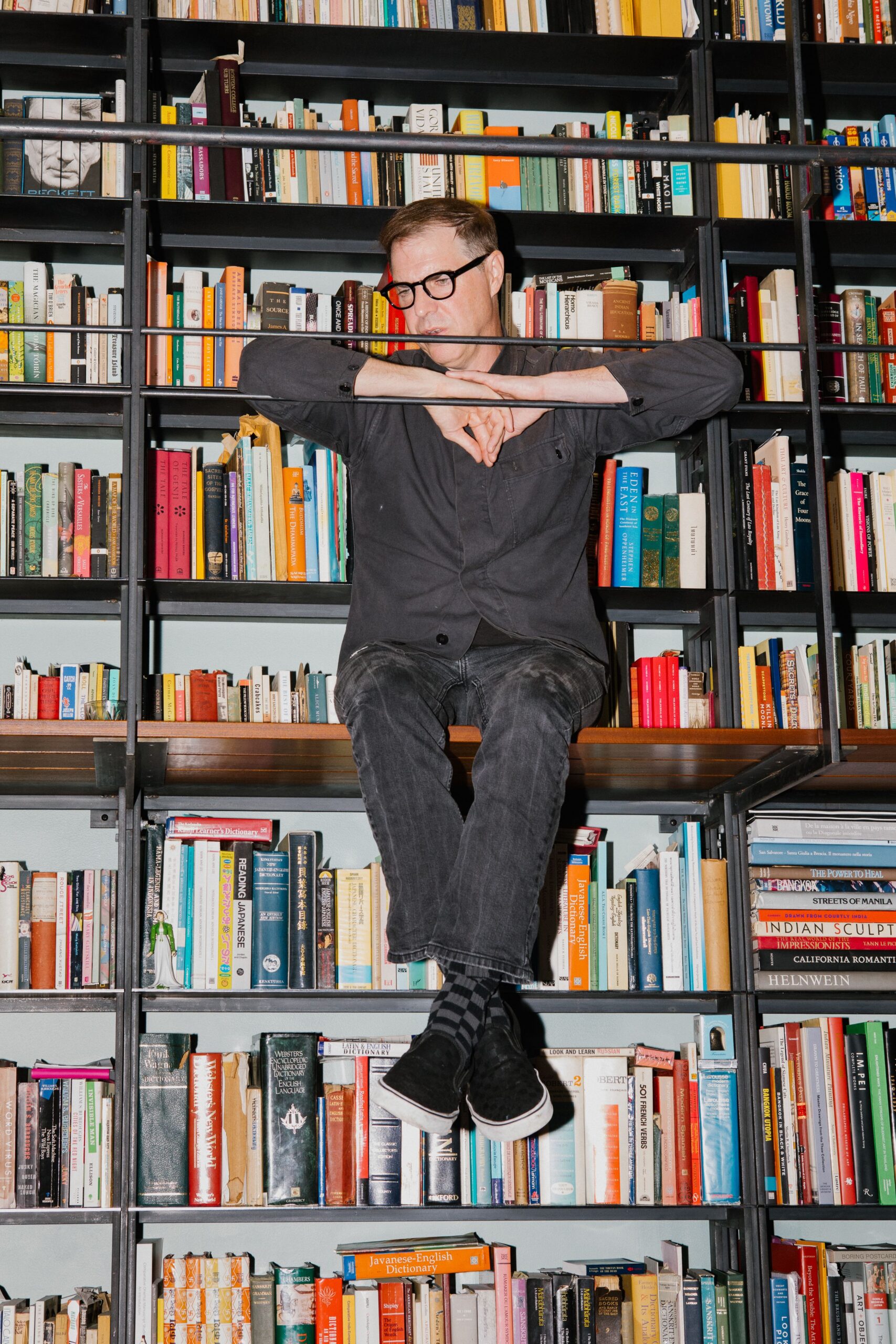
UPenn’s Department of Religious Studies chair is undoubtedly one of the country’s most unorthodox professors—and one of its most popular. McDaniel’s classes include day-long reading sessions, forgoing technology and sex, and crying sessions. But, he’s managed to accomplish what many academic institutions haven’t: getting the younger generations to finish a book.
Name an influence of yours that might surprise people.
Fugazi and the Fifth Dimension.
What keeps you up at night?
Christopher Isherwood’s books and the entire city of Philadelphia, I love this place, but it’s loud as fuck.
What is your biggest vice? Your greatest virtue?
Drinking and drinking.
What’s been the hardest part of your career so far?
Paper cuts.
What do you think is your biggest contribution to culture?
I try to introduce great books to my students. Many of my students are complicated—most people are—but literature takes them from complicated to complex. Complexity defeats simplistic arguments, binary thinking, knee-jerk reactions, base bigotries, prosaic reflections, emotional drolleries, and uninformed opinions. Complexity makes us kinder, better listeners, more empathetic partners, and reliable intellectual and emotional resources for those around us. We feel pain, joy, loss, anxiety, longing, passion, and regret alongside characters. Our perception becomes embodied and nonlinear. We slow down and sit with boredom, sit with discomfort, and sit with sadness. We feel more and feel more deeply, not just know more. Good literature helps us understand akratic choices—those choices that we and others constantly make that seemingly go against our best interests. We might not make better choices, but books help us develop a more complex awareness of the bad choices we inevitably will make.
What do you want to see more of in your industry? Less of?
In education, I want to see a return to valuing the humanities over “practical” or “real world” training. Students often seek out literature, music, art, dance, or even wine or peach pie not because they want to accumulate knowledge or pleasantly pass the time, to remain in familiar rivulets, but because they crave something more, some mystery, some uncertainty. I want my students to see the classroom not as a place of transferring and acquiring knowledge only, but a space of shared and expansive thought, a hypnotic topography, for us to not simply learn about history or art, poetry or music, but to learn from it. To dance in the uncertain.
What are you looking forward to this year?
What I look forward to every year: getting into long conversations about really sad books with people who just want to hide.
What’s one work of art that got you through an important moment in your life?
James Baldwin’s Giovanni’s Room and Carson McCullers’s Ballad of the Sad Café—they both ask, in the most complex ways, the only real questions that matter. Who should I love? Who will love me? Am I lovable? How could I love better? Have I ever made another feel loved? What would I risk for love?
What’s something people get wrong about you?
That I’m lonely. Just because I often like being alone doesn’t make me lonely.
When you were little, what were you known for?
Being forgettable.
What question do you ask yourself most often while you’re making work?
Will this create more kindness in the world, and if it doesn’t, then why the fuck am I doing it?
Where do you feel most at home?
In a library, ironically, a quiet place, where I have met the loveliest of people.
What would you like the headline of your obituary to be?
“Local Falconer Killed in Totally Predictable Falcon-Related Accident.”
What would you wear to meet your greatest enemy?
Short shorts, because my calves are so nice.
What would you be doing if you weren’t working in your field?
Being an itinerant existentialist, captain of industry, amateur antiquarian, capable hostess, mendicant phenomenologist, southeast regional comptroller, proto-indo-europeanist, or assistant branch manager.
To read more from the 2026 CULT100 honorees, see the full list here.




 in your life?