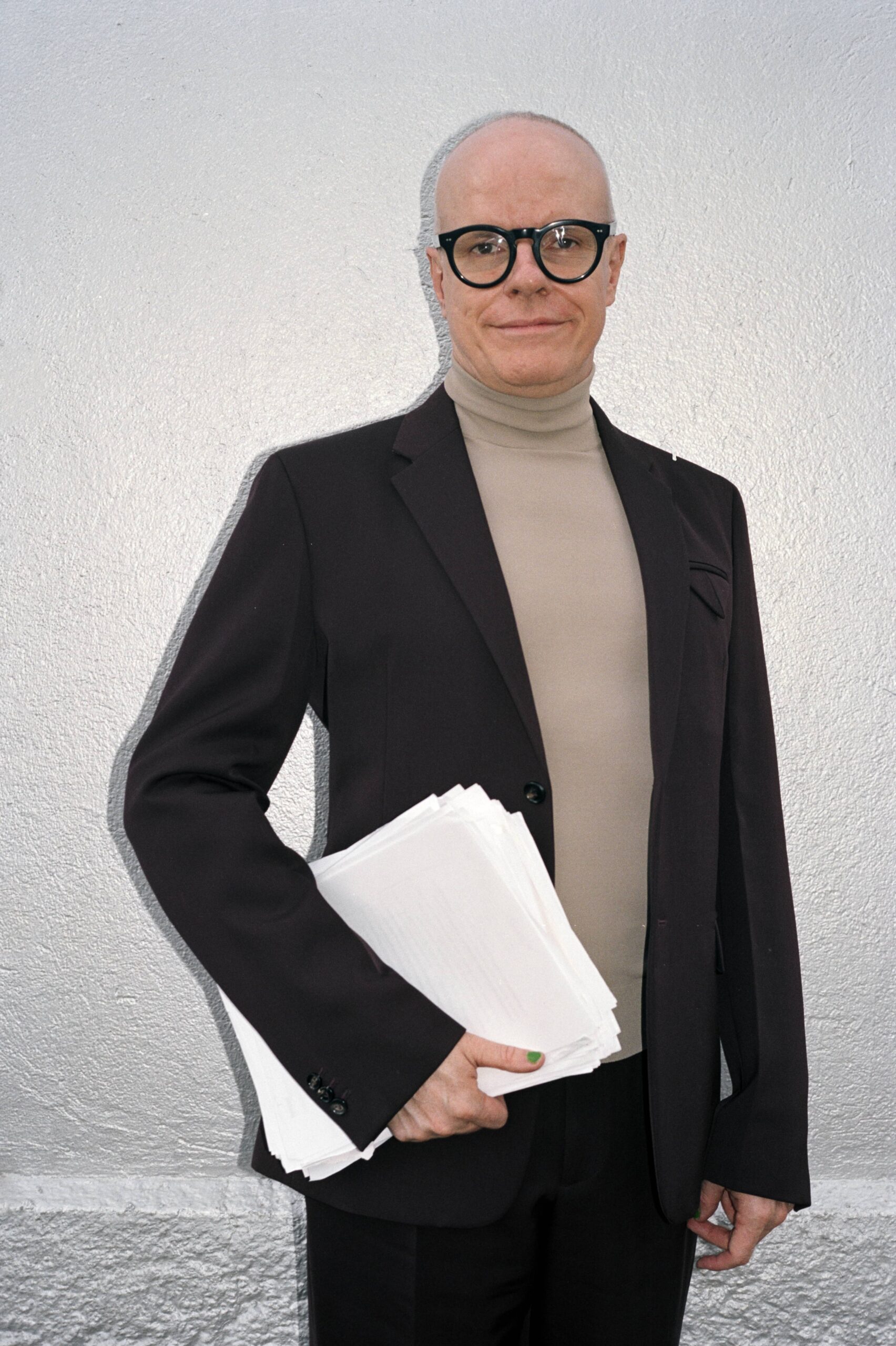
There are over-achievers, and then there is Hans Ulrich Obrist. At 57, the Swiss native—the rare curator to become a known entity outside the confines of the art world—has a menace of a track record: over 350 exhibitions organized, 2,000-plus hours of interviews with artists in the archive, hundreds of aphorisms from creatives of all stripes recorded on his Instagram (part of the now-famous Post-it note project inspired by none other than philosopher Umberto Eco and artist-poet Etel Adnan). In 2006, the same year Obrist joined Serpentine Galleries, where he is now the artistic director, the curator even started the Brutally Early Club, a salon-style cultural discussion group hosted at 6:30 a.m. in cafés across Europe and New York.
Obrist’s literary predilections are unsurprisingly also ambitious. He buys a book a day, a habit that’s currently left him with an archive of over 40,000 tomes, many of which are housed at LUMA Arles. As Life in Progress, a memoir tracing his life in art, comes out Stateside, we sat him down to talk about a few of his favorites and where this fervor all began.
What are you reading right now?
I’m always reading. I have a ritual where I buy a book every day. That means I’m always surrounded by huge piles of books at home, and I have an archive of more than 40,000 books. I’ve just got a tiny apartment in London, which is full of books. The main part of the archive is in Arles, at LUMA. It’s always been really central in my life, the idea of the book. Lately, we’ve been working closely at the Serpentine with Holly Herndon and Mat Dryhurst, and I’m also working with them on an exhibition for the Palazzo Diedo in Venice. And they’ve recommended to me several times this book by Kenneth O. Stanley, Why Greatness Cannot Be Planned. It’s a really interesting book about A.I.—and in a way beyond A.I., just about the fact that very often it’s a kind of serendipity. Whistler said, “Art happens,” and I think a similar thing is true for exhibitions … There’s often a focus on algorithms which guarantee a certain result, but very often it’s the risk-taking of something which doesn’t guarantee a result through R&D. Stanley talks about these stepping stones, and for me it reminded me a lot of how serendipity often works with my own projects.
If you look at my handwriting project, it began 12, 13 years ago when I was in Umberto Eco’s home, and then Umberto Eco actually said at the end of the visit, “Handwriting disappears. You should do something about it.” He gave me a task almost, and I left his apartment rather dizzy. I thought, Wow, could I do that? I’m not an expert in calligraphy. How could I contribute? Then a few weeks later, Ryan Trecartin downloaded the Instagram app. He had quite a lot of followers early on, and he posted that I had joined Instagram. There was a kind of peer pressure that I should post something. I didn’t know what to post; I knew I didn’t want to post selfies or my food or whatever. I wanted to post something which was mission-driven.
Then my partner the artist Koo Jeong A and I spent Christmas and New Year’s with Etel Adnan and Simone Fattal. The four of us were going on walks, talking about serendipity. One of my favorite books is Walks with Walser by Carl Seelig. It’s kind of about Walser, after being in and out of exile, at the end of his life, stopping writing and would go on these walks. And Carl Seelig would actually write down the walks with Robert Walser. I started a museum for Robert Walser as a student in the restaurant where he always stopped during his walks. And the microscripts of Walser, of course, are very beautiful also. People always thought they were secret writing, but it was actually handwriting so microscopic that it took very long to decipher it. So I’ve always had this passion for handwriting.
We were in this café because it was raining. Then Koo, Simone, and I started to answer a few text messages. But Etel Adnan, who then was already in her late 80s, didn’t have a smartphone. So she took out her little notebook and started to write a poem. And that was the eureka moment. I thought, Eco asked me to do a movement about handwriting. Ryan Trecartin wants me to join Instagram. Here I am with Etel—and I’m always with artists and writers and poets—so I could just, every day or every week, whenever I meet them, ask artists to handwrite a sentence. That’s become now a whole series of books, and I’ve done it for 12 years on Instagram. I hope that I’ve somehow done what Eco wanted me to do.
Then I’m reading a lot of Hildegard von Bingen at the moment. We’re working on this project with Ben Vickers and Soundwalk Collective, and different composers. It’s a sound project in a garden in Venice, which will be part of the Vatican Pavilion. So I’m reading a lot of Hildegard von Bingen because this holistic work where she brings together healing, environmentalism, music, spirituality, and visions is so relevant for our time.
I’m also reading a lot of texts by young authors for Serpentine Reader. Bettina Korek [Serpentine’s CEO] and I decided to start this project to focus on new forms of writing and invited Hanna Girma to curate it. Girma invited the novelist Stephanie Wambugu, visual artist Ebun Sodipo, writer and editor Eliot Haworth, theorist Alex Quicho, and many more to write on the topic “I hope this finds you well.”
I’d love to walk it back to your preliminary relationship to reading growing up. I know that you had an accident as a young boy that wound you up in the hospital where you began to read a lot. How did you get to this place where you’re buying a book a day, where you’re surrounded by thousands of books? What were the first books that you remember loving, and where does that urge begin?
It started definitely at the moment of this accident, because I was 6 years old, and there was a speeding car which knocked me over, and I was for a month in the hospital. So my parents brought books to me, and that’s where this kind of started. My parents were not really into art. They had a few novels at home, but otherwise there wasn’t really art present. I really discovered art for myself through printed matter. It came to our household through the timetable of the Swiss railway system. Today the train schedule is online, but at that time you got a big book every year. It was actually kind of romantic, because one could dream of one’s travels looking at this book every day as a child. And each year the Swiss railway system asked an artist to do the cover.
My parents didn’t take me to museums, but they took me to a library, because in St. Gallen there was this monastery library. We went there several times, because they took me once, and I was so passionate about it. You had to wear these felt shoes. It has a Rococo building, which burned down in the Middle Ages, but they preserved the original cloister monastery plan from the 11th century. And it had a lot of medieval codexes. This was amazing as a child—to basically experience time travel, that you could touch a book which was written centuries ago.
Another thing happened, which was kind of book-related. I grew up in this small village in Switzerland, and I was also an only child, so it was quite a lonely situation. The mountains blocked the view to the sea. So I just basically started to study and read and read and read as a child, and also learn languages. Because in Switzerland, you already have three languages—French, German, and Italian—as a given. Then I wanted Spanish and English to get ready to travel and to go to big cities. I read about the Swiss artists who had left for Paris, so I thought I would probably one day have to do the same. Always on the way to school, because there wasn’t a gymnasium in the small town where we were, so we had to go by train to another city, which was near the border to Konstanz [in Germany]. So every day for lunch, with fellow pupils, we went to Germany.
There were bigger libraries and bookshops there, because Konstanz is a university town. And on the way to school, we always passed by these haunted houses. One day I asked the teacher, “What is this house?” He explained to me that this was the clinic of Professor Binswanger, who was this very well-known psychiatrist—Foucault wrote his thesis about him. But he told me also that the clinic became very legendary, because it had a very famous patient, Aby Warburg. During his stay at the clinic, he wrote his famous “Lecture on Serpent Ritual.” The teacher said, “You should really check out Aby Warburg, because you’re interested in art and books.” I became super obsessed, going to libraries in Konstanz, looking at what I could find on Aby Warburg, and obviously, as a 16 year old, I didn’t fully understand what the Mnemosyne Atlas was, but I did understand that it was about making unexpected connections. Based on that, I started to collect a lot of postcards of artworks and curate my first “exhibition” in my room.
Where’s your favorite place to read, and your favorite time?
I always try to read everywhere, wherever I am, which is why I always have books with me. I never leave the house without three or four books or without my iPad. But my favorite place to read has always been the night train. The great thing about the Europe of my childhood and adolescence was that you had night trains everywhere. I didn’t even have money for hotels, so I would just go by night trains with an Interrail ticket for students, and I would travel all over Europe, and I would read on the train. I also love reading in hotel rooms and in cafés. I basically spent 15 years in Paris; I did what Giacometti and Meret Oppenheim did as Swiss people—go to Paris. There I started to read a lot in cafés. Now podcasts and audiobooks have added another layer to reading. I spend an hour every day at the gym, or running in Kensington Gardens, so I listen for an hour every day.
A lot of my ideas came from spending time in the Engadin in the Swiss mountains. Maybe the altitude, maybe it’s the air, maybe it’s the light… I spend a lot of time in the small town of Sils Maria, where I did one of my first exhibitions with Gerhard Richter in the Nietzsche-Haus, where Nietzsche wrote Thus Spoke Zarathustra. So many artists, poets, and philosophers have spent time in the Engadin—it’s quite magnetic. In ’93, we spent two weeks there with Gerhard Richter installing the exhibition, and I spent a lot of time in the reading room of the Hotel Waldhaus. Reading rooms in hotels can be very magical, and this reading room is particularly magical, because literally from the window there is the mountain.
What are your favorite podcasts?
I love Holly Herndon and Mat Dryhurst’s podcast Interdependence. I’ve been listening to Rick Rubin’s podcast Tetragrammaton. It keeps changing.
How do you find your next book?
It’s very often artists or writers recommending books. Whenever I have a meeting, I very often leave the meeting and immediately order a book. At the Serpentine, we have Koenig Books, the bookstore I go to most often because I’m there every day when I’m in London. I also love their headquarters in Cologne. It’s so full of memory and unexpected finds. In London, I’m also extremely fond of the London Review Bookshop.
What’s your relationship like to reading when you’re visiting an exhibition you haven’t curated? How do you interact with the catalog, the wall text?
It’s important that texts in exhibitions can really be both the most advanced yet accessible. They shouldn’t reduce the depth of the work, yet at the same time they shouldn’t be impenetrable. During my Paris years, I spent a lot of time with the writers of the “Nouveau Roman,” who were very old when I was very young. I always had this idea of finding mentors and learning from them. Nathalie Sarraute was my neighbor, and she was one of my favorite authors. I don’t understand why people don’t read her so much anymore today. And this “Nouveau Roman” generation kept telling me the same thing: “We should do stuff which is most advanced, most experimental, yet fully accessible and fully mainstream.”
How do you get there when you’re thinking about exhibition texts when you curate?
It’s important also to often give the voice to the artist. There is this great app, Bloomberg Connects, which we have at the Serpentine and many other museums have, that gives a lot of background information, and the visitors can actually listen to the artist, listen to the curator, really go into depth with contextual information. It’s there but not necessarily imposed … Text can be present through videos also of the artist talking, through letters the artist has written. In the archive in Arles we have little Post-it notes, and every visitor can take the Post-its and put them on their fridge or wherever. That becomes a different way of integrating the text and the voice of the artist.
It’s interesting to think about where one can encounter books. Since 2000, the Serpentine Pavilion has been happening every summer. It’s free, it has no doors, and people can just walk in. Increasingly the commissioned architects seem to bring books into the Pavilion, which is really new. Minsuk Cho from Mass Studies created an empty courtyard, where he made a playground for children, a listening room, and a library of unread books, where people could bring unread books so that all people could read them, which was really fun. The Singaporean artist Heman Chong has been doing these libraries for a while in biennales and exhibitions, and he did one for our Pavilion. Last year, Marina Tabassum created a library of her favorite books. We’re living in a time where it’s important to think about libraries, because libraries need to be reactivated. I’ve just spoken to Pedro Reyes, and he created a library in his studio where people can come and borrow books. His passion is creating libraries in many Mexican cities. When we talk about books, it’s important to talk about libraries.
Is there an artist you feel deserves a biography that doesn’t have one yet?
The David Hockney exhibition opened at the Serpentine, and he’s created this very long work, which is a walking experience, reflecting on a year in Normandy. It made me think a lot about Monet also, who was of course an inspiration for Hockney. I actually read, for the first time, Jackie Wullschläger’s biography of Monet, and it was such an amazing book. She ends the biography with the last chapter on Hockney and other contemporaries. Monet’s radicality has inspired so many and continues to inspire.
Several of the artists whose archive exhibitions we’ve done in Arles would make for amazing biographies. Think about Etel Adnan’s life, Gustav Metzger’s life. A few years ago, Asad Raza, Gabriela Rangel, and I did a show at the Americas Society about Lydia Cabrera and Édouard Glissant. I had never read Lydia Cabrera before. Her work is really a strategy for surviving our own period of homogenization. She was an amazing historian, an involuntary exile, and it’s concerning that her work remains ignored. It’s just so relevant for what’s happening in the world now—the focus on rituals, voices, and listening. How great would it be if there were an amazing biography of Lydia Cabrera?
Is there one book that you would press into the hands of an aspiring curator or artist?
There are so many, but if I have to pick one, it would probably have to be Glissant. I came to Glissant’s books through Alighiero Boetti, who was working on this amazing work with Annemarie Sauzeau, Classifying The Thousand Longest Rivers of the World, an artist book where he classified the thousand longest rivers and showed different sources showing that it’s order and disorder because you can’t measure a meandering river. The order is also disorder. When you asked me before about text and exhibitions and books, you also asked me about catalogs. When artists work on artist books, they are often as important as an exhibition. They spend months or years on them, yet it’s still a very under-acknowledged history. Boetti’s Thousand Longest Rivers is a case in point, but there are so many extraordinary artist books.
My advice to young curators is of course to read books, but also have conversations with artists. Most of my work grew out of dialogue with artists. You can’t figure out what artists want to do unless you listen. That is still as relevant today as when I started 40 years ago as a teenager. Many artists have projects that don’t fit within typical exhibition parameters—durational projects, farms, gardens. We need to listen and help realize them.
But if I have to recommend one book, it would be Sartorius: Le roman des Batoutos by Glissant. I learned so much from him. Half of my shows grew out of his ideas of mondialité and the archipelago. Sartorius is a very little-read book, and it’s fiction. It’s quite beautiful to familiarize oneself with Glissant through fiction rather than essays. It’s a tale of a utopian society where identity comes not from genealogy but solely from being in constant exchange with others.
To give you a second answer from a living author, I’d recommend Souleymane Bachir Diagne. We’ve just done a book with Lorenzo Marsili on how, in a fragmented and polarized world, we can rethink universalism not from a Western-centric point of view and that’s of course the point of Diagne. Le fagot de ma mémoire is a kind of autobiography exploring his influences Henri Bergson and Muhammad Iqbal and the universal as a plurality rather than an imperial imposition. This is crucial for our time and for curators. How do we imagine common horizons, reject European exceptionalism, this imposition of the Western-centric universalism, and think about a pluriverse?
I was struggling at my own attempt at a biography. I kept reading books in many languages because I wasn’t sure which language to write in. I don’t have a mother tongue anymore. I grew up speaking Swiss-German, but it’s not a written language, so I can’t write in it. French became my main language during my 15 years in Paris, then English became my main language after moving to London in 2006. I started to write the book in German, but it didn’t work at all. Then I tried English, which didn’t work either. In the end, I wrote it in French and Le Seuil published it. I wanted it published not in an art publishing house but in a literary publishing house. Later, it was translated into German, which was a strange experience—reading my own book translated by a translator into my kind of mother tongue—and then into English by Dona Watson for Penguin. It suddenly felt too long, so I spent the summer editing it by about 30 percent. Thinking about autobiographies made me realize that I needed to read more artist biographies. Now I’ve ordered many.
Hans Ulrich Obrist’s Required Reading
Le fagot de ma mémoire by Souleymane Bachir Diagne, 2021
(Amazon)
Sartorius: Le roman des Batoutos by Édouard Glissant, 1999
(Amazon)
Monet: The Restless Vision by Jackie Wullschläger, 2023
(Amazon, Barnes and Noble)
Walks with Walser by Carl Seelig, 2017
(Amazon, New Directions)
Why Greatness Cannot Be Planned by Kenneth O. Stanley, 2015
(Amazon)
More of our favorite stories from CULTURED
How The Pitt’s Patrick Ball Went From Role-Playing Corporate Trainings to Starring on Broadway
The 2026 CULTURED Power Advisor List: Meet the Art Advisors Shaping the World’s Top Collections
A New Book Unearths the Heated Rivalry Between Artists Peter Hujar and Paul Thek
Speed Round! 13 Critics Review 25 NYC Shows Before You Finish Your Morning Coffee
Sign up for our newsletter here to get these stories direct to your inbox.




 in your life?