When Marcia Tucker founded the New Museum in 1977, the city of New York was barely emerging from bankruptcy. Music bolstered the weary metropolis—that year alone saw the birth of hip hop during an infamous 25-hour summer blackout, the opening of Studio 54, and the golden age of punk. Art was changing too. Artists who’d lived in lofts since the 1950s and ’60s saw a gallery scene emerge around them in Soho, Jean-Michel Basquiat’s SAMO tag began to crop up across Manhattan, and the Heresies Collective and A.I.R. Gallery injected feminist critique and concerns into a still all too male-centric ecosystem. The New Museum arrived onto the scene as quite the novelty—it was the first contemporary art institution to open in New York since WWII and a distinctly downtown one at that.
In the almost five decades since, the museum has continued to serve as a counterweight to its loftier Uptown peers, giving both early exposure and historical resonance to an ever-morphing avant-garde. The institution settled into a permanent home in 2007, its SANAA-designed tower like a futuristic ship anchored on the Bowery. On March 21, the New Museum will re-open with double the footprint: a 60,000-square-foot expansion courtesy of OMA has shot up next door.
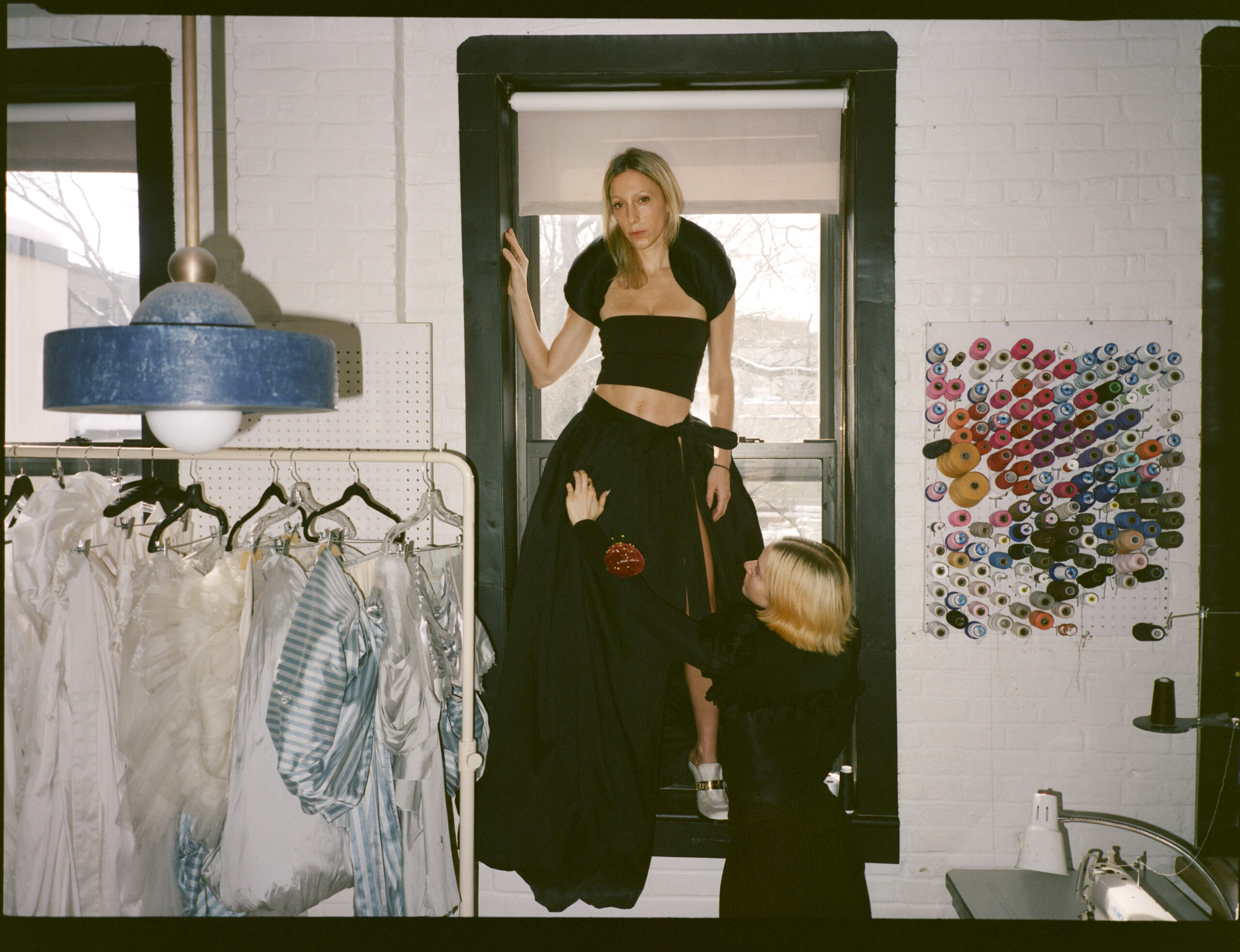
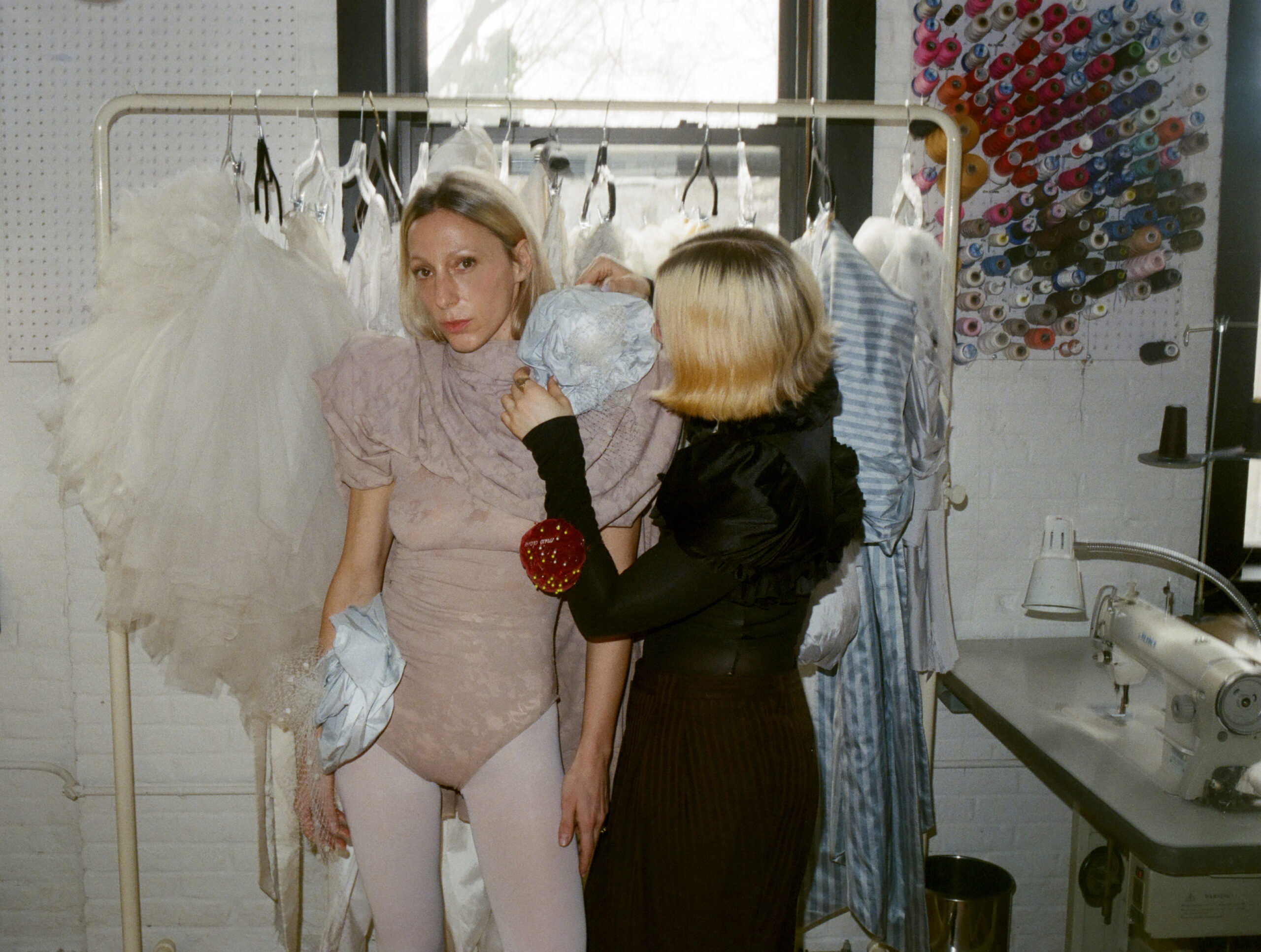
To mark the occasion, we paired three artists featured in “New Humans: Memories of the Future”—the first exhibition to unfurl over the entirety of the new New Museum and the latest in a history of choral group shows that act like temperature checks on the time (this one grapples with the living legacy of technological change)—with three members of another industry that’s indissociable from downtown New York: fashion. Over the last few weeks, independent designers Hillary Taymour of Collina Strada, Claire Sullivan of Miss Claire Sullivan, and Zoe Gustavia Anna Whalen welcomed Camille Henrot, Ivana Bašić, and Cato Ouyang into their studios for a fitting. The freewheeling conversations that followed zigzag from eulogies to bygone downtown eras to the city’s affordability crisis, becoming intimate referendums on what making a life—and a living—as a creative in New York looks like in 2026.
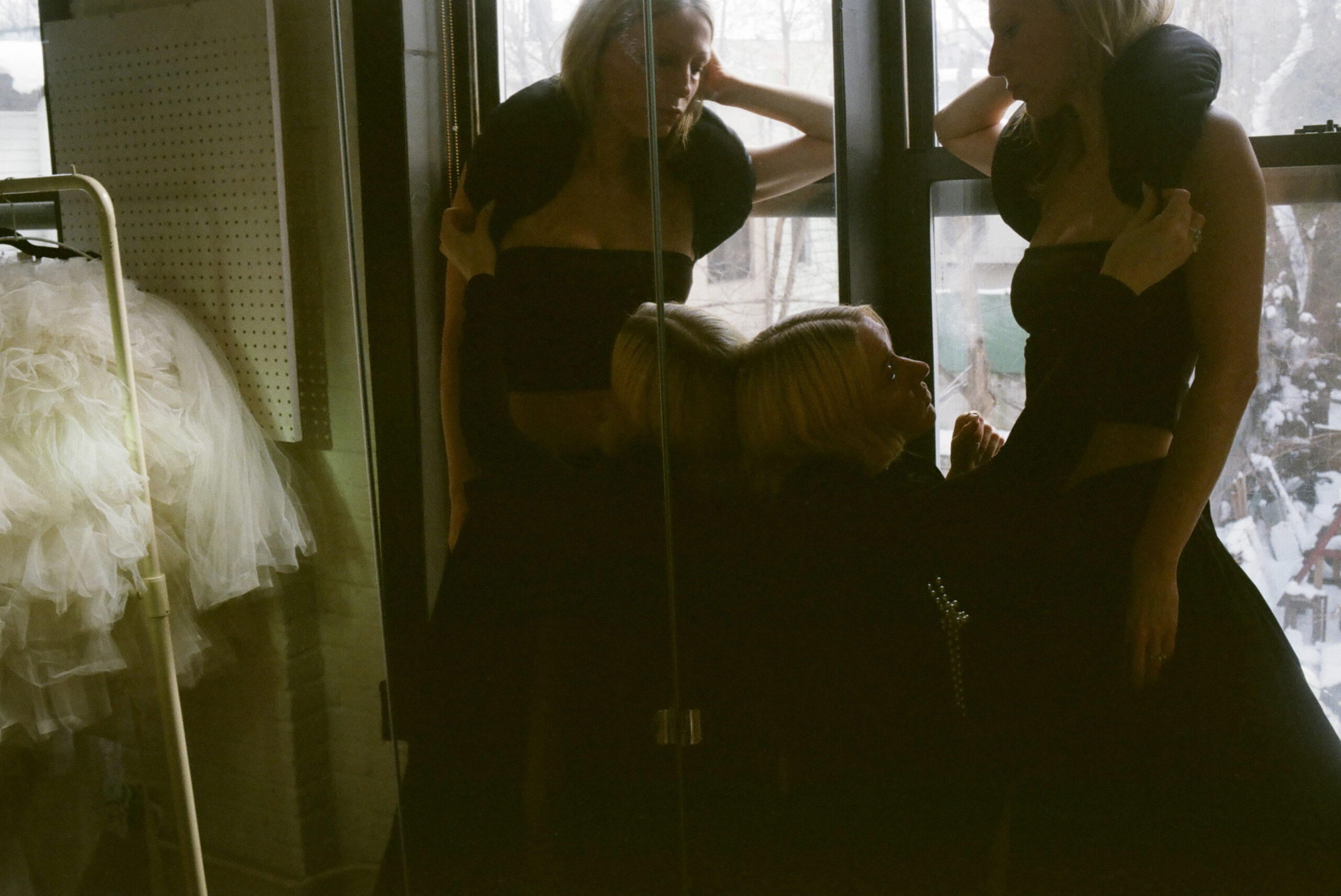
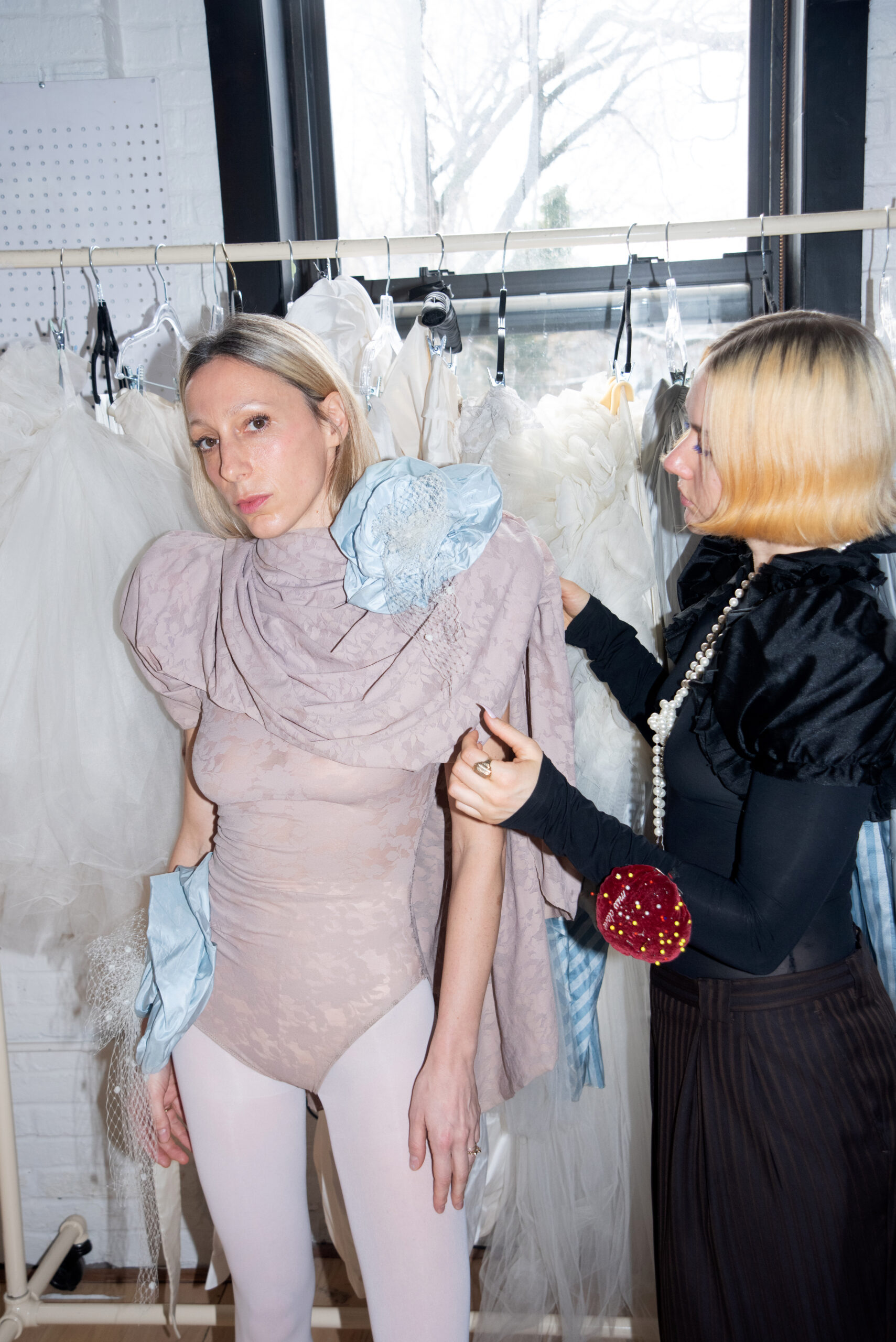
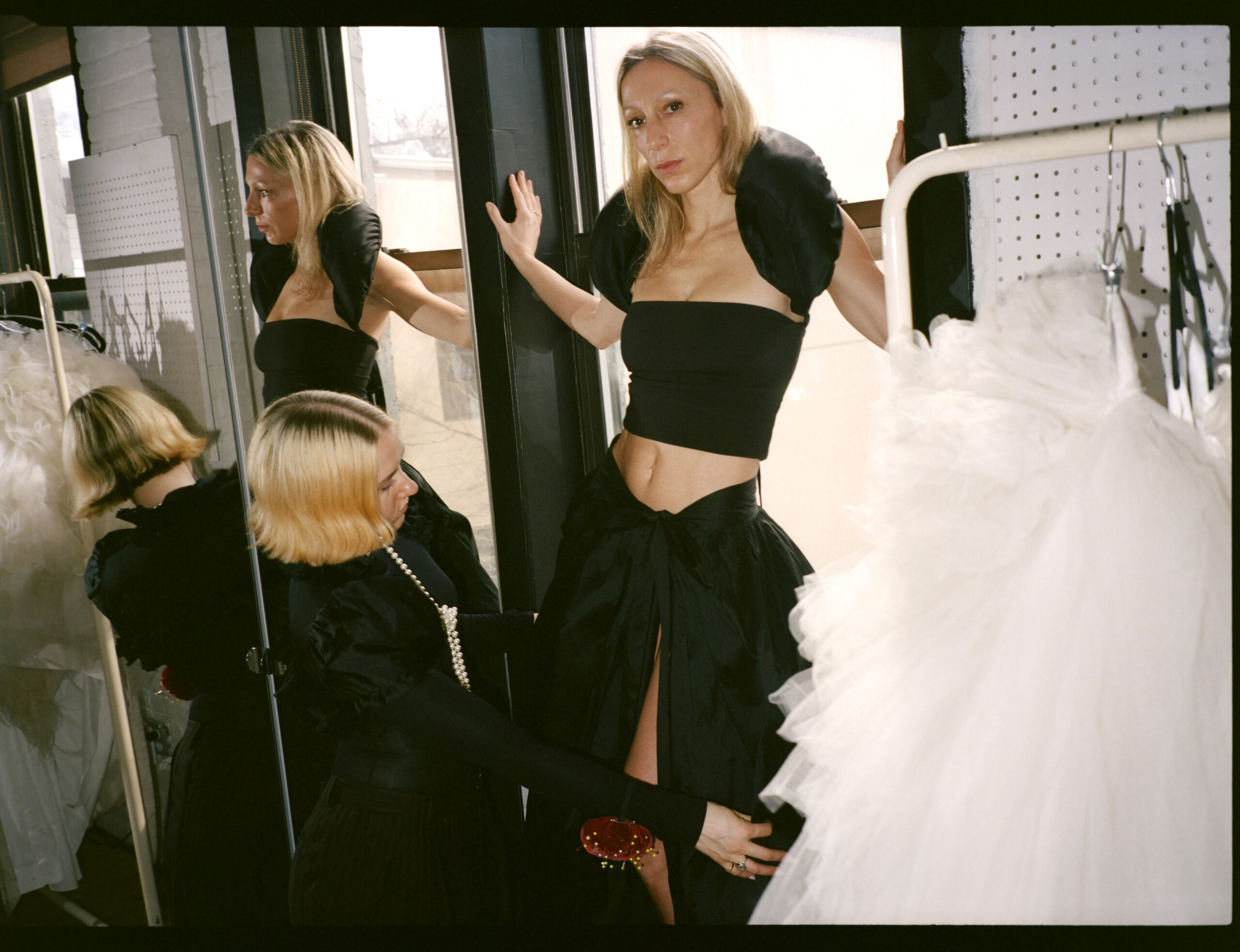
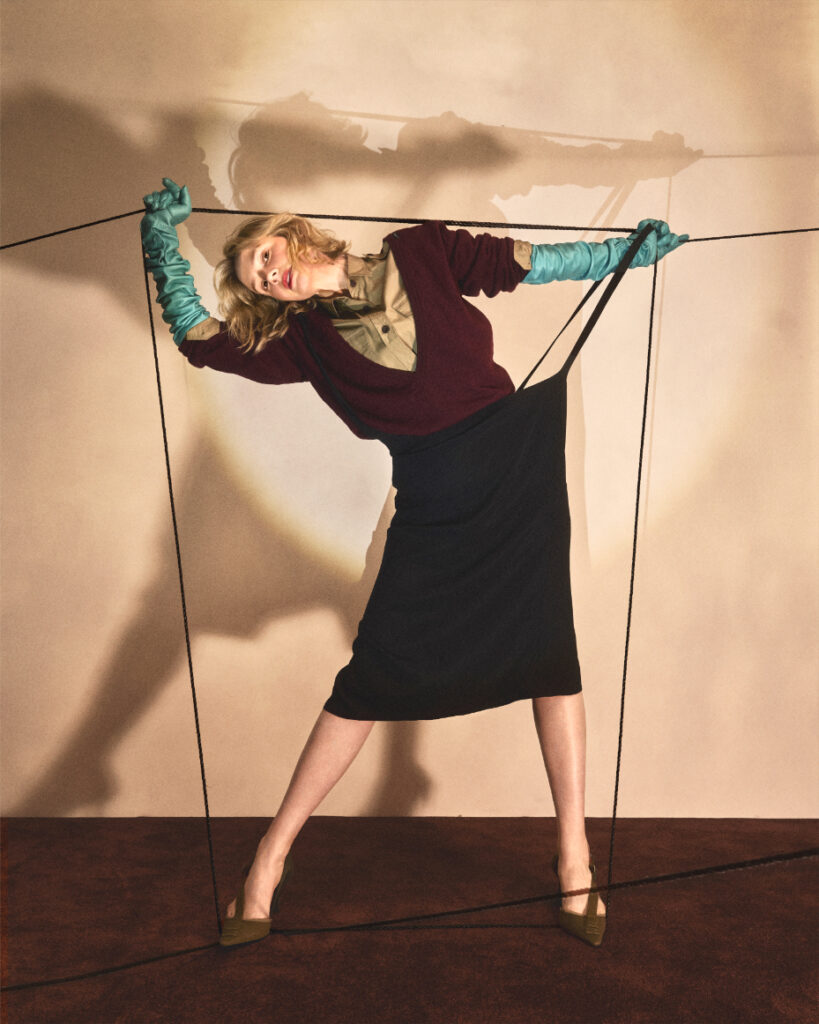
Below, Claire Sullivan, who since leaving Vaquera has made a name for herself with designs favored by pop stars (Addison Rae, Lady Gaga, Rosalía) and artists alike, meets Ivana Bašić, a Serbian sculptor whose works mingle human abjection, material transcendence, and alien futures. Her Blossoming Being #2, which depicts a figure in the midst of leaving its bodily form behind, will be on view in “New Humans.”
What are your New York origin stories?
Claire Sullivan: I was born and raised in Virginia, but my mom grew up in Jamaica, Queens, and my dad grew up in Brooklyn Heights so I grew up coming to New York all the time. When I was like 5 years old, I decided I was determined to live in New York. I said, This is going to be my home. I went to school in Chicago, then I moved to New York in 2016. What about you, Ivana?
Ivana Bašić: I moved to New York in 2010. I lived in Serbia before that, which is where I was born. I was born in Yugoslavia in the ’90s, and by the time I was 13, we had already had two wars. There was all the trauma from the collapse of the entire country, culture, currency and economy—every single part of reality collapsed by the time I was a teenager. It was a really intense thing to live through. People were just really trying to survive there. There was no space for anything beyond bare life and survival.
I was just really suffocating there because there was nothing else that was possible. Museums were closed for 20 years. I didn’t study art because there was no art at the time in the country, and I didn’t even know anything about it. So I studied design. I had these young professors who were really excited and really cool, and they were telling me about New York all the time. And it became, in my mind, this place to go to—the center of the world—where you can measure yourself up against the best ones.
So I applied to a couple of schools, and I eventually did my master’s in what turned out to be a technology program [at NYU], which I was not aware of because I’d never been to the States and applied online. I ended up being in this program with people making robots and iPhone apps; it took me two years to realize that it wasn’t an art school. I didn’t realize there was this whole other world of makers. I found my way eventually to the art world, but I really came to New York as an absolute outsider in every single possible way.
Sullivan: That’s a really inspiring story and so New York too. New York is full of people who felt like outsiders or who came to New York to get away from something. Do you feel like it’s been the escape you needed?
Bašić: Definitely for what I wanted, which was to come to a place to be free from the self I was before and create a new one from scratch. It is a place of such high density, high ambition, and high competitiveness. It will extract the maximum of your potential out of you, and I wanted that. In that way, it’s a catalyst for whatever is in you.
But honestly, I don’t know anybody who has lived the life I have lived in New York, having a corporate job for 12 years and working nights and weekends in the studio to create an art practice. A lot of the art world comes from way more privileged backgrounds. Increasingly, fewer and fewer people are able to penetrate in this way. It definitely felt like a place of a lot of opportunity, but I’m not sure it feels like that now.
Sullivan: It’s one of the most magical cities in the world, but it’s also one of the most expensive cities in the world to live and to make an art career and to keep your feet on the ground.
Where do you go to feel inspired, and where do you go to feel seen? I’ll go to the museums and galleries, and I’ll get inspired by art. But I feel like where I mostly get inspired is actually on the dance floor, like the New York nightlife scene. When I first moved to New York, I was going to China Chalet and putting on a cute look and going to be seen.
Bašić: Me too.
Sullivan: That was so important to that era for me, like 2016 to 2018. Then I started going more into the rave scene, and I just remember getting overtaken by the music. All of a sudden it didn’t matter that I was there wearing something—it was that I was there dancing. That’s a huge part of my inspiration: just making these connections on the dance floor—I don’t even know what their names are. We just dance together when we see each other. Where do you go to find inspiration?
Bašić: A lot of my inspiration doesn’t come from the outside—I very much turn inward. But I think in terms of things about New York, I’ve been to this place Earth a couple of times. There was this play by Gideon Jacobs called Images that was really amazing. It was one of the things that stuck with me for a while. Being an artist who works with such high production, with such a heavy material practice, this idea of creating a space that showcases work that is ethereal and immaterial—the opposite of this capitalist professional artist model—is really inspiring, and something that I feel like my practice is also moving toward. Also downtown, there’s this space at 365 Canal Street called A365, that my friends Florian Meisenberg and Henry Gunderson have been running. It’s this amazing loft where they throw these private parties and salons and gather poets and artists and make shows. It’s really beautiful and feels warm, like family. It’s something one needs to ground oneself in this hustler life of New York.
Sullivan: I think it was Jane Austen who said everything happens at parties. I feel like everything happens through connection for me.
When you first moved here, did it meet your expectations? How did it surprise you?
Bašić: It was quite a culture shock, to be honest. There are so many cultural conventions that you don’t really know at first—there’s a way of participating in a certain scene, in a certain economy. Especially the art world—it’s so opaque in terms of the way you’re supposed to communicate, the way power structures work, the way hierarchy works. All of those things are impossible to see from the outside, and nobody can really teach you or tell you about it. That was the biggest learning curve.
I didn’t really understand at first that you’re supposed to build a network. I was like, The work is going to do its thing. And then I realized, No, it’s not. It took a while. This is something I really try to share with my interns and students that come through my studio: to open up this black box of how you enter the art world, build a network of allies and people who support you and people you support back. That’s your lifeline in New York.
Sullivan: The point about New York allies is really true. When I first moved here, my mom dropped me off at the Myrtle Ave/Broadway stop, and I got on the train with a suitcase to go stay with my cousin in Manhattan. I remember getting on the train and looking around and being like, Okay, I guess I live here now. Looking at everyone on the train, I thought, If everyone here can figure it out, I can figure it out. And every time I go across the bridge and see the skyline, I still get excited. There is a certain amount of jadedness that happens. I have to remind myself every day that I’m actually living my dream just by being here. What I would tell myself [back then] is to continue to be authentic. In New York, there can be a pressure to put ourselves in a box—what we do, who we interact with, what scene we’re part of. I’ve spread across a lot of different networks in New York. It’s not strategic: I genuinely gravitate toward different people and spaces. I would tell that to anyone new here: Don’t have too high expectations, allow things to flow. But also, you have to work really freaking hard to be able to live here. New York is for hardcore dreamers.
When you’re talking about building a network and finding community, how did you go about that? Who were your early champions?
Sullivan: When I first moved to New York, I immediately started interning for Vaquera, where I eventually became a creative director and owner with the three others. That just immediately plugged me in. I feel very grateful that I came into the city and just immediately got plugged into this scene. I ended up making so many friends working in nightlife too. I worked in a couple different restaurants and bars and at a certain point was working at a bar in Bushwick that was also a club. I met everyone I am close with in nightlife in that space. It’s about remaining open and willing. I would have never been in the same kind of conversations that I was in with Juliana [Huxtable] or with DOSHA [Antonio Blair] of House of LaDosha or with these people who were frequenting the bar that I was at if we weren’t just there building community.
Bašić: I started building my practice in a way that was quite uncompromising in terms of my materials and the way I was making work. As a young artist just starting with very limited financial means, that set the work apart from the very beginning. People were making work with what they could afford, and I was working like a maniac—corporate job and nights in the studio—just being like, I will make the work the way it needs to be made. If I need to work all the time to make the money to make the work, I’ll do that.
In the beginning, it felt like we had this whole generation of artists going out together. It felt like this amazing, vibrant time, like such a community. The first show I ever had was in this space Grand Century that Dora Budor, Olivia Erlanger, and Alex Mackin Dolan were running in their studio. Everyone was living on Broome Street. We were all going to China Chalet. A lot of us were just starting our careers, not necessarily knowing where we were going, but full of enthusiasm and hope. Looking back, it’s really amazing because pretty much everyone created an incredible career for themselves.
Early on I understood: you need to go to openings. You meet people. You create this community. I was also really lucky early on to meet Chrissie Iles from the Whitney, who is an incredible curator. I was lucky enough to work with her on the show at the Whitney, “Dreamlands.” That was my first big break. Then there was a show with Signal at Andrea Rosen, which was a huge part of my career because they had the most amazing community gathered around there. Beyond that, the thing that really changed the full track of my career—and this is what made New York possible—was that I didn’t go to art school, and I had absolutely no idea how to make anything. I started out with this revolt toward the technology program I was in. I was so depressed by the banality of technology, so I had this impulse to escape into materials. I started experimenting and making all this mess, and I went to Craigslist. It was like the universe sent me this person whose name is Bill Mulkins, who is this material alchemist who worked for Frank Stella and Louise Bourgeois. I found him on Craigslist. He was sick at the time and couldn’t really work, and he was looking for a job. We started working together, and he taught me pretty much everything I needed to know in order to start. He became my collaborator and my friend, and we worked for many years together. He was effectively the MFA I never had.
What do you think is missing from New York right now?
Sullivan: New York is so full; I don’t necessarily think there’s anything specifically missing as a whole. One thing I would love to see more of in the fashion community are spaces to come together beyond just going to shows. New York is having a rich moment right now. A lot of people are leaving, and that’s creating a vacuum for more inspiration and talent. Of course there are institutions I miss—diners I used to eat at that closed, clubs that don’t exist anymore. I grieve that, but I do think there’s a pendulum swing. My friends just opened a shop called Surrender Dorothy, which has such an old New York feeling. I think more of us are swinging back toward building community in a tangible way that’s less online.
Bašić: Over the past five years, it’s felt almost impossible to make work in New York, and in the U.S. in general. The prices of fabrication and materials have gone up so much that if you’re a sculptor, it’s effectively unsustainable to make work here. When I arrived, New York felt like freedom and experimentation. Now everyone is shrinking their work. If I make it any smaller, it’s going to be jewelry. It feels like New York is becoming a place for presentation, not production. Creativity is not in New York—that’s a massive problem. Even for where I am in my career. Not even talking about young artists who are supposed to come here. The interns who come through my studio come from extremely privileged backgrounds; I don’t see as many working-class kids trying to make it. Class diversity is completely disappearing, and honestly, those who come from the most underprivileged backgrounds are often the most radical thinkers and artists. They have the most courage to break rules. It’s such a loss if those people cannot participate anymore.
After the pandemic, there was this explosion of new project spaces and downtown avant-garde scenes. It felt like things were going to change for good. But everything reverted back, even worse than pre-pandemic. It feels like the dead-on grip of capitalist corporate America. All the places that have been here more than 15 years are closing. Everything new opening is for the wealthiest. That doesn’t feel good.
More of our favorite stories from CULTURED
Dries Van Noten Opens Up About His Next Chapter: ‘We Didn’t Stop to Have a Quiet Life’
Psychoanalysts Jamieson Webster and Adam Phillips on How to Get the Life You Want
The Best Oscars Red Carpet Looks of All Time, According to 14 Very Opinionated People
Love Story’s Costumes Could Have Tanked the Show. Then Rudy Mance Stepped In.
Is the 82nd Whitney Biennial Weird Enough to Match Our Chaotic National Mood? John Vincler Thinks So
Sign up for our newsletter here to get these stories direct to your inbox.

 in your life?