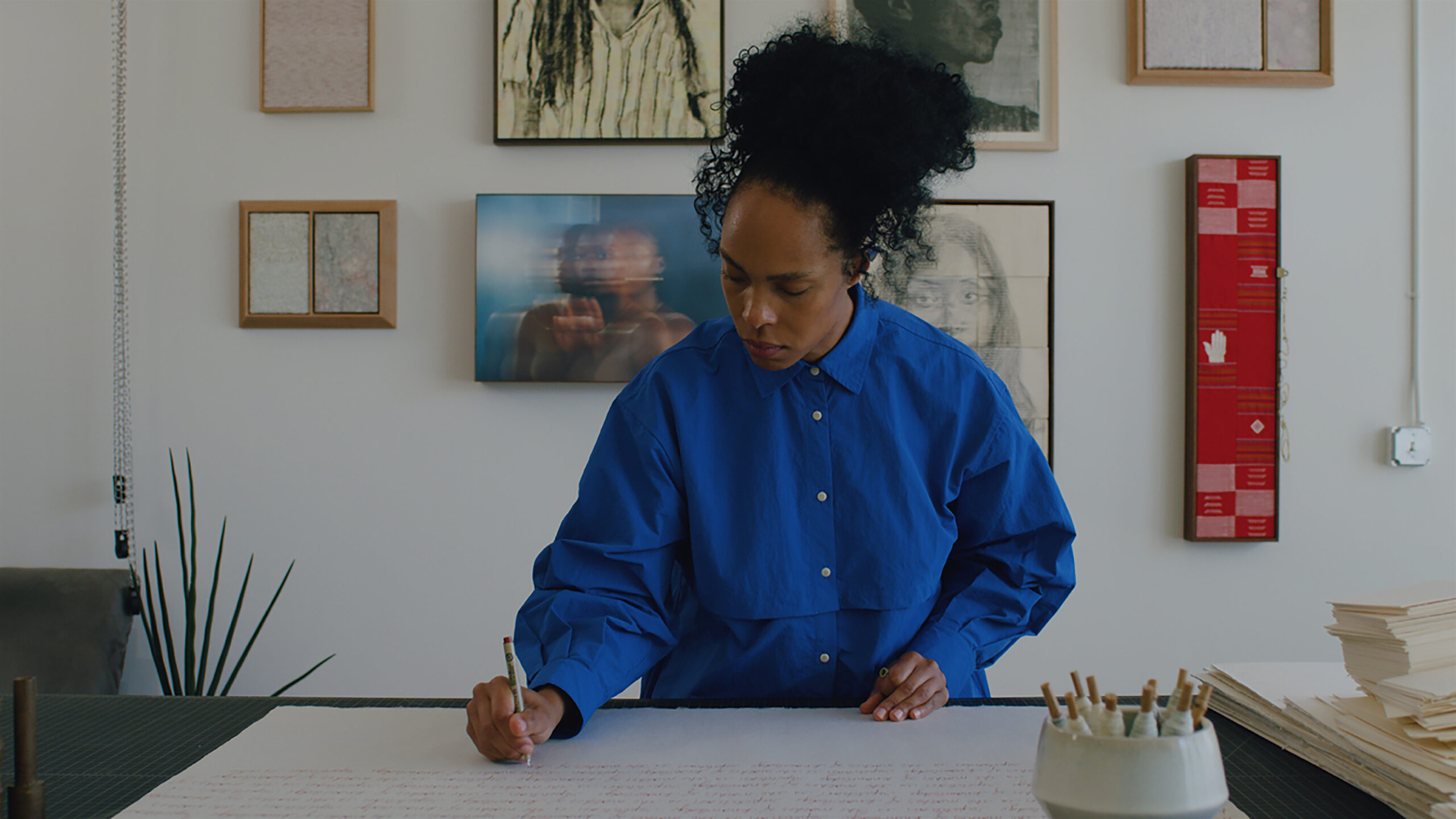
Kenturah Davis knows a thing or two about inscribing a body and place with meaning. The artist, based between Los Angeles and Accra, Ghana, creates large-scale drawings and carbon pencil rubbings of bodies in motion that reveal debossed text below: Zora Neale Hurston excerpts, sheet music, or transcripts of Senate debates on the 13th Amendment. She’s no stranger to site-specific public works either; her 2019 mural capturing the faces of downtown Inglewood greets riders of the Crenshaw/LAX rail line every day.
Davis’s relationship to placemaking was disrupted when she lost her Altadena home and studio in the Eaton fire last year. In the aftermath of this devastation both personal and communal, she helped organize “Ode to ‘Dena,” a group show at the California African American Museum honoring the neighborhood, a longtime hub for Black creativity. (Her father and mother, who are also artists, contributed pieces to the exhibition. Even her son, then 2 years old, made a watercolor.)
Since then, Davis has thrown herself into the task of preserving and repairing the scorched landscape caused by the fires. Her next undertaking? Rest Stops, a restorative public art project and community garden. Her goal is to establish 10 green spaces in the neighborhood by 2027. And what does it look like to rebuild a studio practice after so much loss? Davis took CULTURED into her new Altadena sanctuary to show us.
What’s the first thing you do when you enter your studio?
I make tea and warm incense. Gyokoro is my favorite tea right now. I also shave up little pieces of palo santo and heat it up in my incense warmer.
What’s on your studio playlist?
The sonic rotation in the studio almost always includes Alice Smith, Little Dragon, James Blake, Santigold, Lauryn Hill, Kendrick Lamar, and Outkast… but yo, I’ve been revisiting some movie soundtracks and finding little gems. “Lovers” from House of Flying Daggers; “Last Time (I Seen the Sun)” from Sinners. The Love Jones soundtrack includes Duke Ellington and John Coltrane’s “In a Sentimental Mood.”
What’s in your studio fridge?
Baking soda, pomegranate seeds, oat milk, batteries for my camera.
When do you do your best work?
I’m definitely a night owl and used to hit my stride around midnight, but now that I have a young child, I’m forced to achieve my best by 5 p.m. when I grab him from daycare.
What was the last time you completely lost track of time while working?
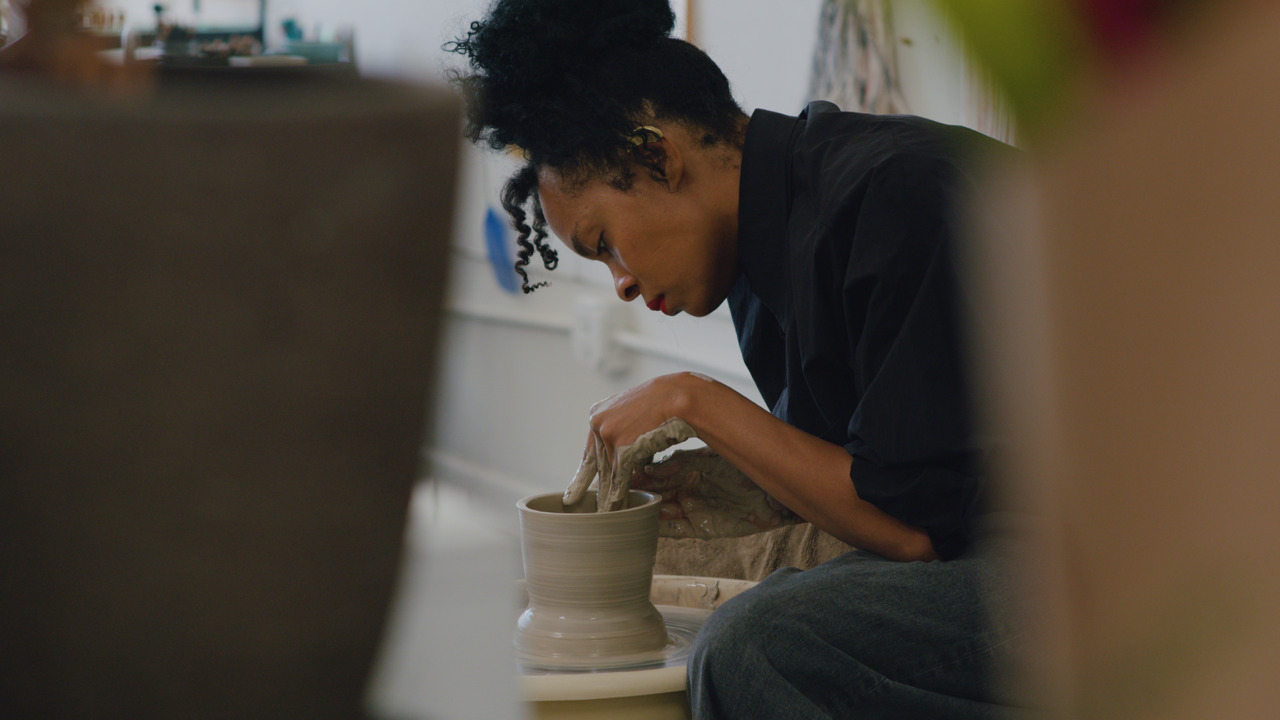
After the LA fires, where I lost my home, weaving studio, and woodshop, I started taking pottery classes. Lately I’ve been totally immersed and obsessed with getting good at it. I can easily be in there for five hours straight, with no breaks, just working at the wheel. The time just flies by.
On a scale of hoarder to Marie Kondo, where do you fall?
I’m kin with Marie Kondo, about two cousins removed. But my hoarding weakness is books and paper. (Perhaps you can’t tell because they are stored neatly.)
Is there a studio rule you live by?
Feel free. Within these walls, I can do whatever I want.
What’s your studio uniform?
Denim is the time-tested workwear I no longer try to escape, so there’s a few pairs of jeans/overalls I usually put on. My shirts and hats are a bit more adventurous; all with Doc Martens or Birkenstock shoes. Tell us about the best studio visit you’ve ever had.
A memorable studio visit was during grad school, with an anthropology professor at Yale, Paul Kockelman. I took his course “Meaning and Materiality.” When I invited him to the studio, he brought conditions in my work that I never would have thought of.
What’s the weirdest tool/instrument you can’t live without?
I have some old school spindles used for spinning thread. I use it to make paper thread for the weavings in my work.
What book changed the way you think about art?
Toni Morrison’s essay “The Site of Memory” is really important to me as she’s writing about writing. Her ideas around history and memory and truth map really well onto my practice as an artist. If I could add a second book, Carlo Rovelli’s The Order of Time is a really cool primer for learning about quantum physics and how my perception of time is relevant to my work.
If you could change one thing about the art world, what would it be?
Artists often get paid last. That ought not to be the case.
More of our favorite stories from CULTURED
10 Collectors Share the Book That Changed How They Think About Art
Nobody Sings About Sex Like Peaches. With Her First New Album in a Decade, She Shows Us Why.
Stylist Jason Bolden Spotlights 3 Young Black Designers You’ll Soon Be Seeing a Lot More Of
The 14 Horniest Places in New York, According to Jordan Firstman, Francesca Scorsese, and More
Sign up for our newsletter here to get these stories direct to your inbox.


 in your life?