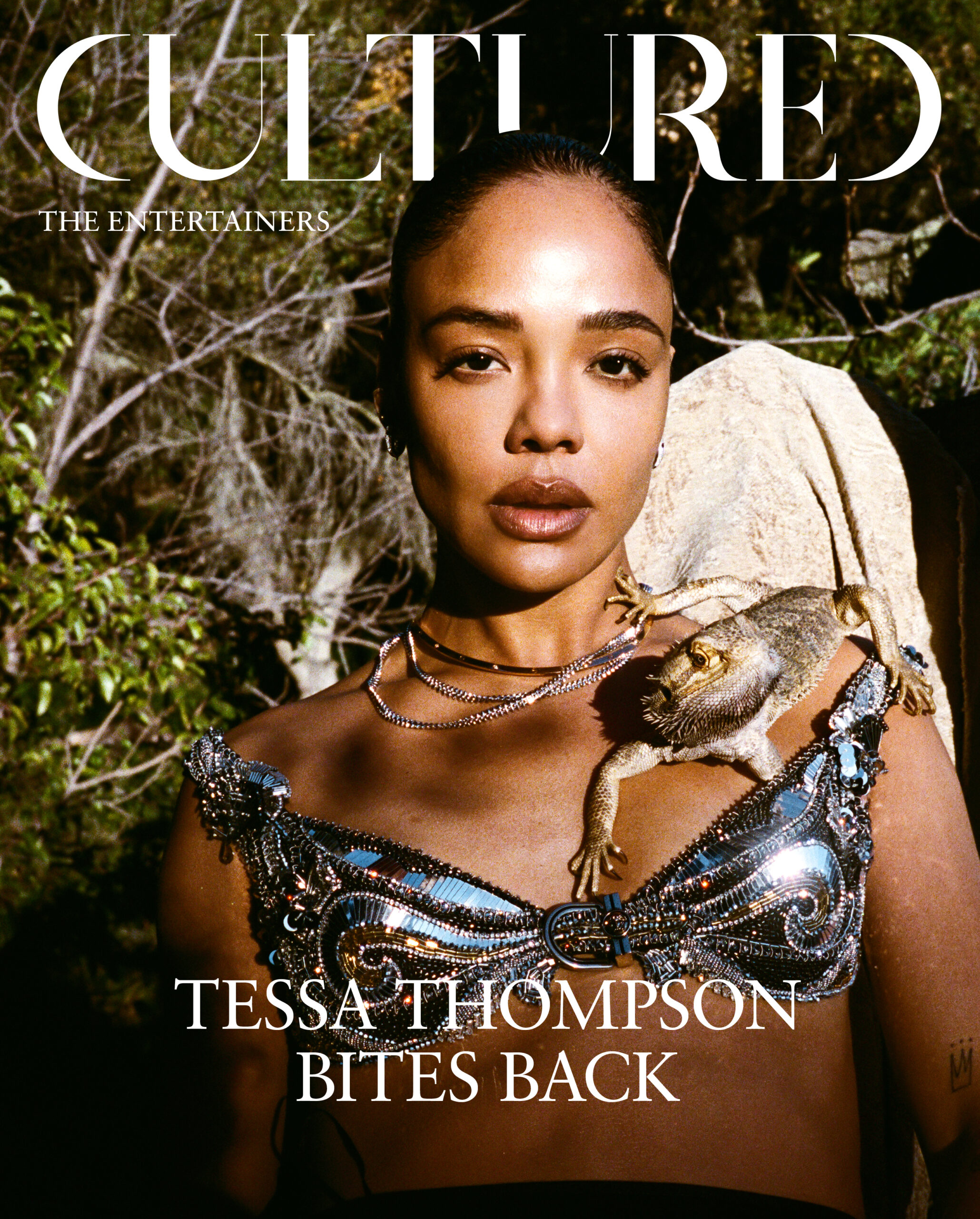
“Tessa Thompson is everywhere,” Janicza Bravo says when the pair sit down for a rare Zoom call in January. Their friendship typically takes place in person; Thompson can be spotted waiting for Bravo—who is known for running late—at restaurants around Los Angeles, where they both live.
The director’s not wrong. Though Thompson has been in Hollywood for over two decades, this is shaping up to be her busiest season yet. She made her rounds on the award circuit for Hedda, Nia DaCosta’s reinvention of Henrik Ibsen’s 19th-century play about an aristocratic woman defying every norm imposed on her. (Her role as the titular Hedda Gabler has won her a Critic’s Choice award and a Golden Globe nom.) His & Hers, the mystery thriller limited series she leads with Jon Bernthal, hit 19.9 million views on Netflix within days of dropping in January. She’s brought her new production company, Viva Maude, roaring to life with both of those projects.
Next, she’ll be making her Broadway debut opposite Adrien Brody in The Fear of 13. The production, which begins previews this March, tells the story of a man who spent more than two decades on death row before being exonerated with new DNA evidence. “I’m really in these streets and for the streets,” Thompson tells Bravo, when reminded of the deluge of projects set before her in 2026.
Bravo—who has ventured further into television since her 2020 film Zola with directing credits on episodes of The Bear, Poker Face, and Too Much—witnessed Thompson’s work ethic, and some of her newfound executive skills, firsthand when the two teamed up to produce Is God Is, this May’s debut from playwright Aleshea Harris, about a pair of twin sisters out for revenge against their father.
“The image for me is you’re in the garden,” says Bravo, noting the years Thompson, now 42, spent sowing the seeds that brought her to this moment. “You’re doing somewhat of a harvest right now, actually.” Here, the pair revel in the abundance.
Janicza Bravo: I’m going to jump in. Where are you?
Tessa Thompson: New York, my favorite city in the world. And I say that with some measure of embarrassment—
Bravo: Worth noting that you do live in Los Angeles.
Thompson: At the risk of sounding like Mary Tyler Moore, I feel really alive in this city. And at the risk of sounding saccharine, I feel most like myself. The things that I love to do, I do more here. Even last night, I flew in, and I was so tired. I’d been with you the night before, and then I went home and had to pack.
Bravo: For the reader, you actually pack your own bags. Guys, the stars are just like us.
Thompson: And I’m a terrible packer, so I really shouldn’t be in charge of packing.
Bravo: You’re an over-packer.
Thompson: Hugely. Don’t know an edit.
Bravo: Can’t handle an edit.
Thompson: So I was busy overpacking; I didn’t sleep. I arrived here so tired, but tempted to leave the hotel. To do what, I don’t know. I took a bath, I started Heated Rivalry because that’s what you do in these times. But I think what I like about being here is I feel, even if I’m not participating, that all the things that might bring me joy or excitement or curiosity are possible.
Bravo: Since we are talking about New York, you’re going to—drumroll—debut on Broadway in just a few months.
Thompson: That’s also maybe what I feel—a sense of this impending excitement. I’ll be here doing a thing that I have long dreamt of one day getting to do. It’s been a circuitous route to get there. And here I am. And Coltrane is here.
Bravo: Coltrane the dog, not the musician. Just in case someone’s like, Is that his ghost she’s with? What was the last play you did?
Thompson: The last play I did was called Smart People by Lydia Diamond. And we did it here with Mahershala Ali.
Bravo: Humblebrag. That was when?
Thompson: You know what, Janicza, I don’t know. What is your relationship with time? I think I know because I’m waiting for you sometimes for like 45 minutes when we have dinner, and I’m like, Wow, she never met time.
Bravo: Time feels like a Western construct, and while I do inhabit the Western world in my day-to-day and in my business practice, I think that I actually am from another plane. My relationship to time is that I am there when it is the right time for us—
Thompson: For you! I’ve known that about you for a long time. This is what it is to know and to love you. “It hasn’t reached my desk,” as Ayo [Edebiri] said on the Golden Globes red carpet. So many things never reach my desk. Everyone’s posting photographs from 2016, for example.
Bravo: Why is this happening?
Thompson: I don’t know, it hasn’t reached my desk yet!
Bravo: Sometimes I like not knowing. Is it a year of the horse? Was it a horse before? Are we horse again? It made me realize my relationship with time.
Thompson: When you asked me how long ago that play was, I thought it was at most seven years. Then I spoke to Mahershala Ali— humblebrag, name drop—and he was like, “Ten years ago we did this play.”
Bravo: So either seven or 10 years ago, according to Mahershala—and I hope his name appears three times in this article—this play happened. What does it mean to be returning to Broadway? I imagine Ms. Tessa Thompson is booked and busy. Many things do come across your desk.
Thompson: Maybe it had to do with having done Hedda, which is an adaptation of a play. Making that piece felt like making a play, even though we were making this cinematic work. This real hunger emerged, though I’ve always been drawn to the stage. It was the first thing I imagined I would do—TV and film felt like, not even an afterthought.
Even though I was born and raised in Los Angeles, I did not understand how people came to be in movies because no one in my world was in movies. When I would come to New York and visit my dad and my family here, I would see plays. When my father [a musician and singer-songwriter] would work in the theater, I would be on the stage. It was always something I dreamt about, because I understood how to dream about it, I suppose. Soon, I started to think, Geez, it’s either been seven or 10 years, according to me, and Mahershala.
Bravo: That’s the fourth Mahershala mention. On the sixth time, does he suddenly appear on Zoom?
Thompson: I hope so… I started to think, Goodness, this is a muscle that might atrophy, and it’s the thing I want most deeply. This is a newer piece of work, and I’ve done so much classical work. I’ve done so many adaptations of things, and I’m really interested in new work too, cultivating a relationship with this generation’s writers who are making work that hopefully we’ll look back on. It’s also based on a real-life story. I think a lot about the utility of story—why do we tell the stories that we tell? This particular story takes place inside the carceral system, and I know that’s something that we need to talk about more in America.
Bravo: One of the things I wanted to ask was essentially how you go about picking the work that you want to sink your teeth into. Also, from a producing standpoint, I want to make sure that we’re bringing up Viva Maude and what you’re building there.
Thompson: Viva Maude is something so integral to the way I want to work. When you’re making films at any level, but particularly at the indie level, there’s so much work to get it there. I wanted to feel like I was a part of that work that. You and I have done that in the form of Is God Is.
[Viva Maude] gets its name from a character in a film that I really love called Harold and Maude. I love that character so much, because it feels like she kind of created a trope—the manic pixie dream girl—but also upended it by being 80 and suicidal. Which is why I fucking love your work, Janicza, and was such a fan and admirer of yours before I became a dear friend, because I feel like you offer the kind of protagonists that feel both of their time and ahead of their time. They feel impossible to define, they feel singular, and they feel like they usher the audience into a new space and a new way of seeing. Viva Maude came as an experiment in creating architecture and infrastructure around doing that in real time.
Bravo: This isn’t a company started by an actor basically to launch more of their own work that they’re in.
Thompson: No. In some ways, I felt this anxiety around the first two projects, Hedda and His & Hers, coming out with me in the center. That felt like a real misdirect in terms of what the company wants to do and how it wants to establish itself. Never mind that. As an actor, personally, the thing that has always guided me is, Is there a spark? I still really am dying to be in one of your frames. I wanna say that here in the hopes it’ll be in print.
Bravo: Do you find yourself thinking about the audience and the reception?
Thompson: I would be lying to say I don’t, particularly with starting the company. I can never trust that the director I’m producing for is gonna know. I need to know, so I know how to protect them. I’ve read like the top line of stuff, for example, with His & Hers.
Bravo: Are people sending you things, too?
Thompson: Yeah, of course.
Bravo: Why are we sending people anything? Have I told you that twice I’ve accidentally sent the wrong link? And it was a link that was, like, emotionally damaging. An it’s-time-to-walk-into-traffic kind of link.
Thompson: I sort of do that to myself, though, because I am famously like, Stay off the Internet, stay off the Internet, stay off the Internet. But then I’m like, Don’t click on that. Oh God, I just clicked on that. The fortress around you is interested in sending you the good shit. And I go, Well, what about the bad, because it must exist? In creation now, I do think not about reception, but I think about the audience in ways that I didn’t before.
Bravo: Is this with age, or is this with producing?
Thompson: Maybe it’s a function of both. Maybe it’s also a function of the times in which we live. I used to have a bottomless appetite for things being dark or cynical. Maybe I will grow to appreciate that again in the things I watch and create. But I’ve always been interested in things that are audacious in some way, and to me, what’s most audacious in the times we live in now is to make something that is optimistic.
Bravo: You’re looking to evoke more pleasure.
Thompson: I think so. I certainly felt that with His & Hers or Hedda. They are characters that might be unsavory, but ultimately, there’s something in it…
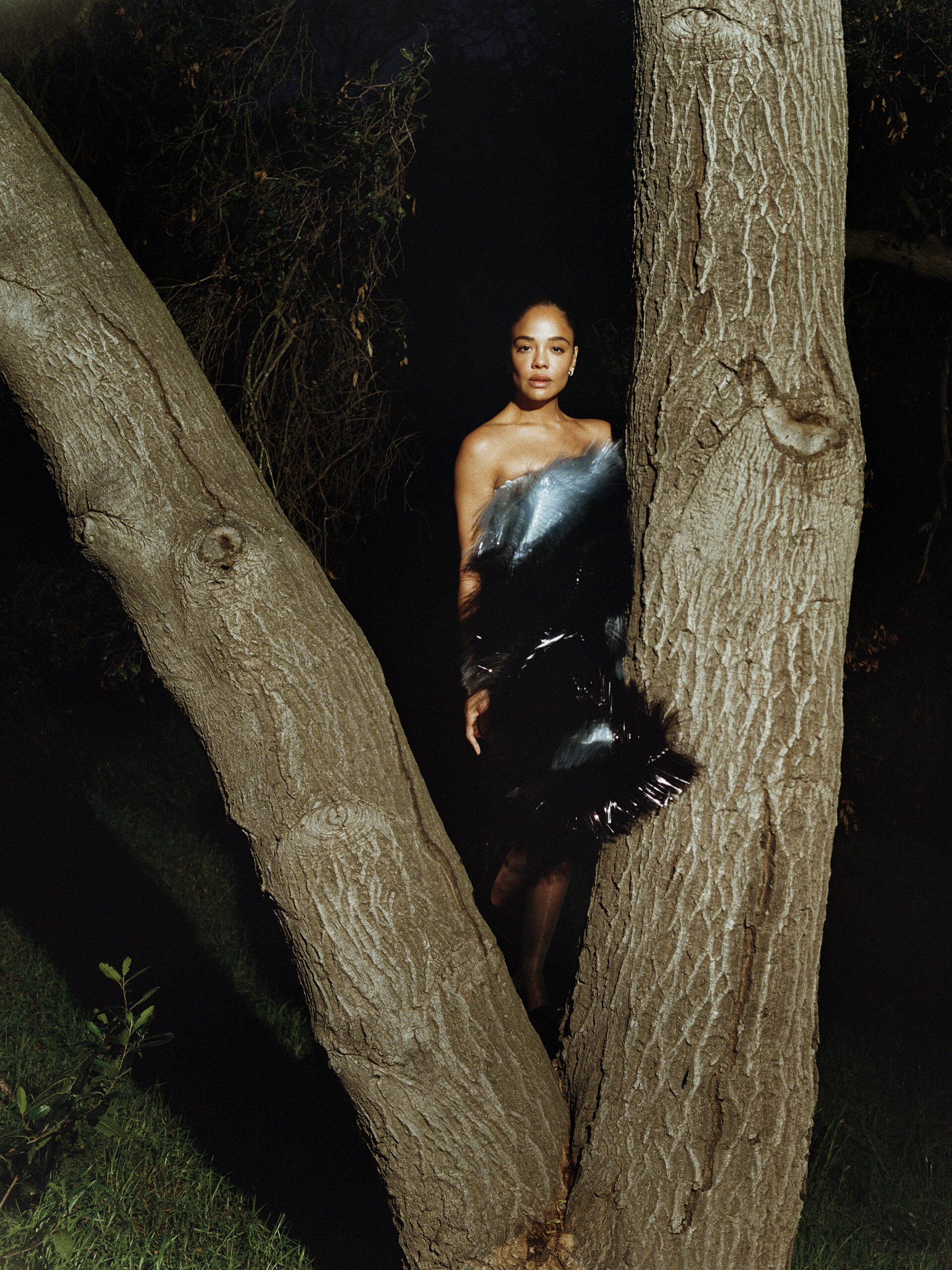
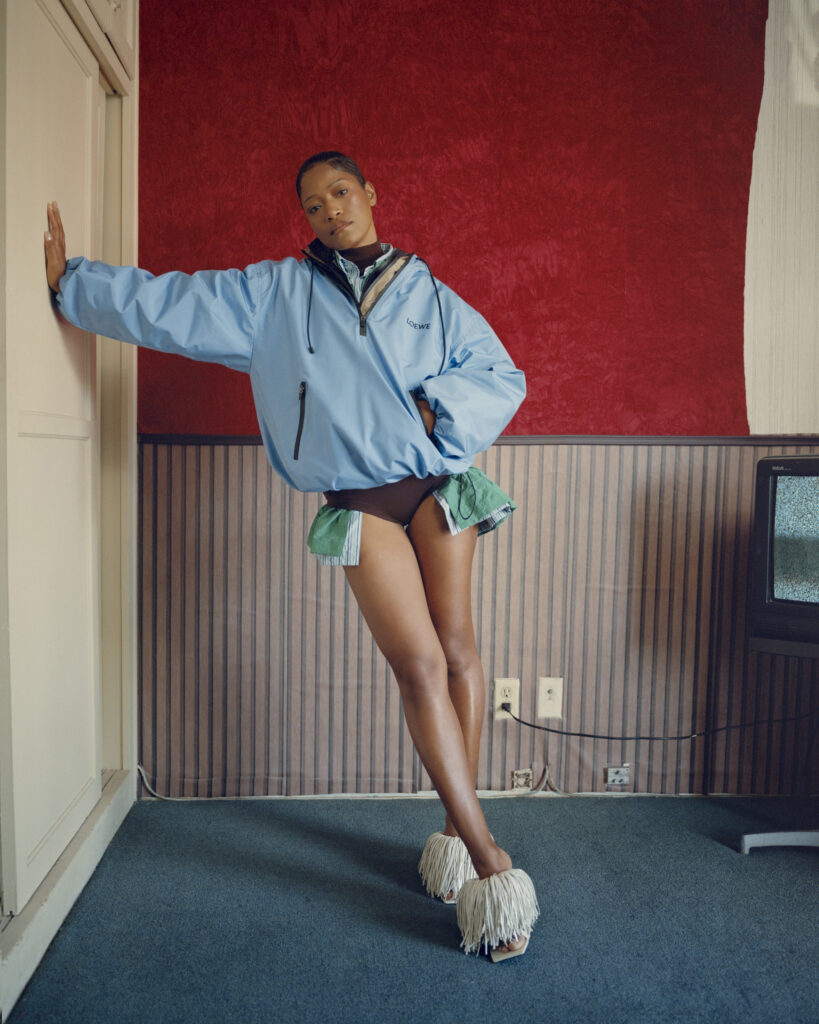
Bravo: Both with great clothes, though. The most important thing about both those characters—the clothing is really fantastic.
Thompson: Which is its own kind of optimism. Times are tough, but you can look fab.
Bravo: Times are tough, but tailoring is key. I remember when we were at the beginning of the pandemic. There was this question of, what is the value? Somewhere inside the muck, there became some clarity around all these people at home watching. People need some form of escapism.
Here we are six years later in this moment where things feel murkier than they’ve felt maybe in quite some time, and there’s a larger disparity between people and where they’re coming from and what they desire. The work feels, again, invaluable. You have a film that we are orbiting around in this conversation called Hedda. You’ve got His & Hers that just came out. And now you’re about to do Broadway. There isn’t a place that I can look where you’re not gonna be. How do you take care of yourself amid all of this making?
Thompson: It’s coming off a period where I’ve been the least visible I’ve been in a really, really, really long time. It was a period of deciding intentionally not to be in spaces, not to be hyper-visible, because I didn’t have something to promote.
Bravo: Not to be in these streets.
Thompson: It’s interesting returning to the streets. Then also the hyper-visibility that comes from being on a platform like Netflix, which is very different than the spaces I’ve been on before. I feel like I’m reengaging with my relationship to it. Just being on a carpet and feeling like you’re ready for consumption, I suppose, that I belong to an audience in a different kind of way. I think I have a better approach to being in these streets than I used to, having some break from it.
Sometimes I have these sorts of out-of-body experiences, where I feel like I’m hovering slightly above or below myself, but I’m not in my skin. What I’ve experienced recently is feeling really in the room. Maybe it’s also a function of age, and also the culmination of so much thought and labor. Particularly with building this company, it’s felt for a long time now like things are kind of hypothetical. So now, to be able to bask in and live in the reality of it, good, bad, whatever, and for the reality to feel, by and large, pretty good, that people are watching, people are engaging, that does feel like the restoration.
Bravo: I want to close with something that you started this conversation with, which was that you’re in New York and you feel most like yourself. And as someone talking to you from LA, I’ll try not to take it personally. Could you, in a handful of words, define what you are, especially right now?
Thompson: In this current moment, I am ever reaching towards that which does not yet exist, you know? Continuously trying to wrestle myself into a kind of divine discontent, which is not to say that I don’t appreciate all of the fantastic things. But I’m striving in this world, in this little time, relatively speaking, that we all have, to try to make the spaces that we exist in more beautiful than they were when we arrived in them. Whatever that looks like, whatever that means.
Pre-order your copy of the Entertainers issue, with Tessa Thompson on the cover, here.
Creative Direction by Studio&
Makeup by Alex Babsky
Hair by Lacy Redway
Nails by Stephanie Stone
Casting by Tom Macklin
Set Design by Romain Goudinoux
Project Management by Chloe Kerins
Creative Production by Katie Binfield
Fashion Assistance by Cydney Moore and Chiara Giangola
Lighting Assistance by Phil Sanchez
Second Lighting Assistance by Talisa Choi





 in your life?