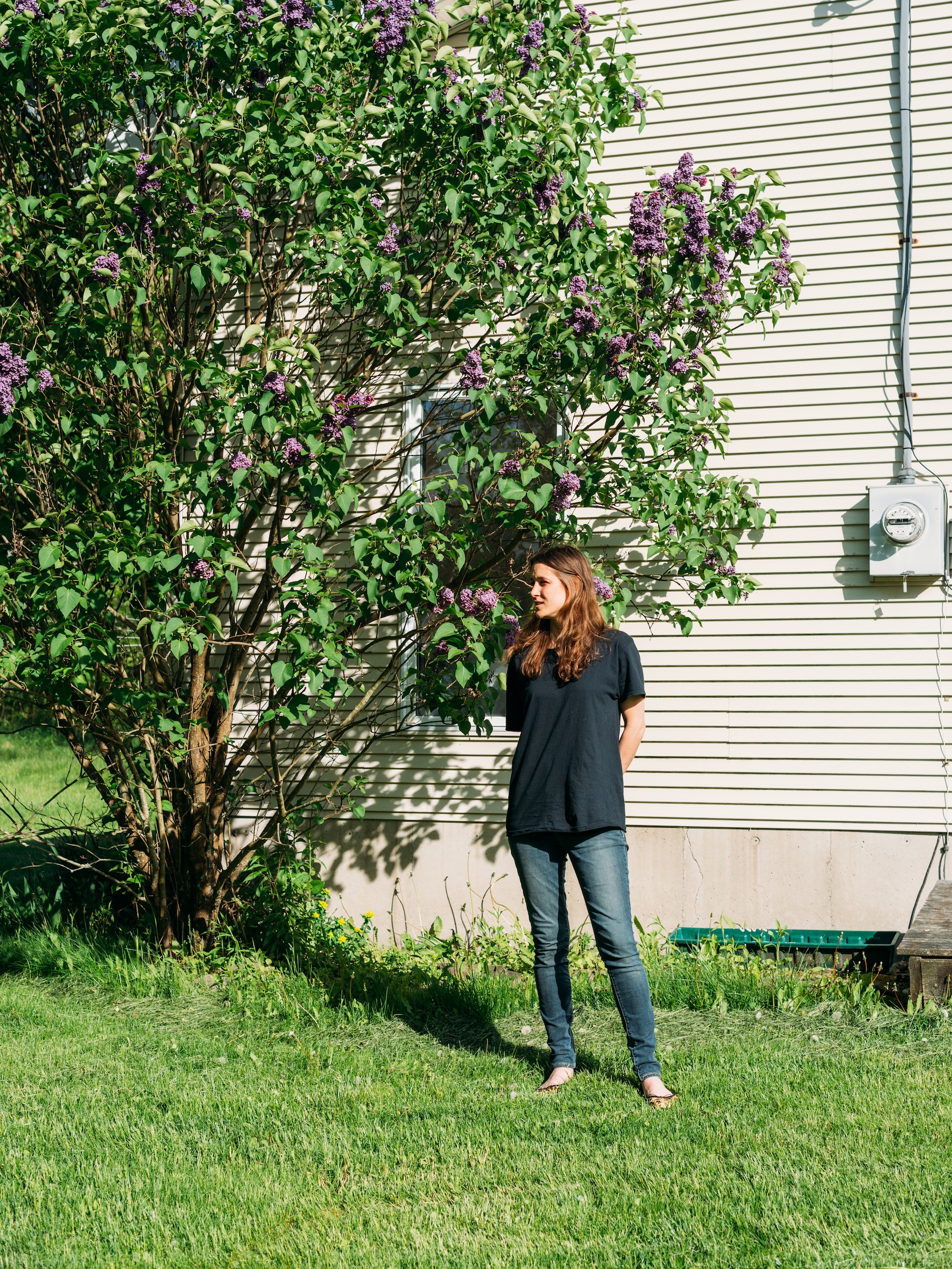
I drove up to visit artist Jo Nigoghossian at her studio and home in Columbia County, New York on a rainy Saturday afternoon. I learned that the Yale MFA graduate ended up living a two-and-a-half-hour drive north of the city after just one week in New York.
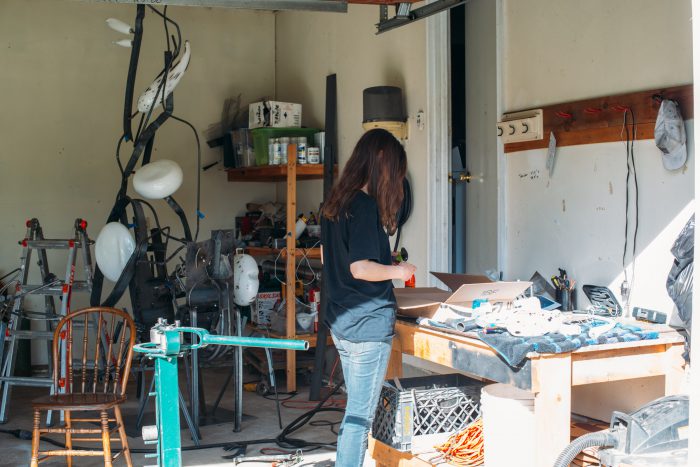
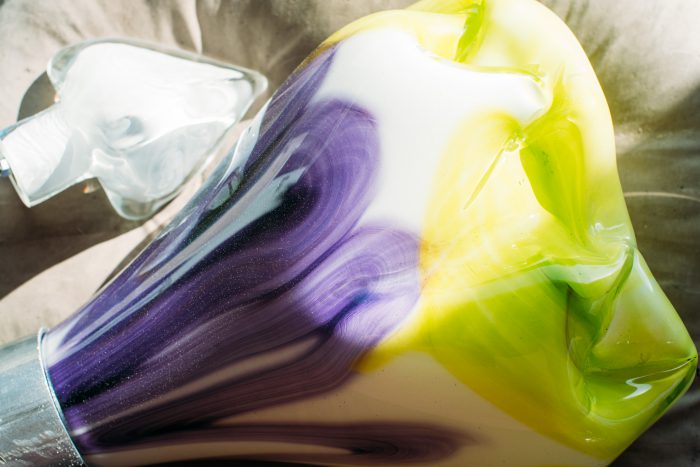
The place she found almost a year ago—an oddly laid-out little ranch house with beige wall-to-wall carpeting and skylights—looks barely lived in. Except for the work spaces, that is: an extra bedroom full of bulbous glass pieces she’s been commissioning from two glassblowers in nearby Canaan, and the garage, which holds the two sculptures she’s making for an upcoming show at Team Gallery.
After Nigoghossian makes us English breakfast tea with almond milk, we sit down in her kitchen to talk. I learn that the first video Nigoghossian made, while she was a student at the San Francisco Art Institute, was inspired by a serendipitous sighting. Noticing some small children pretending to be strippers in a playground visible from her window, she began filming them almost reflexively. The quality was low and the editing, she says, choppy, but there was something in it that she couldn’t look away from.
Her sculptures began similarly. Ambiguous armatures covered in bent black scribbles that hang somewhere between exuberance and anxiety, their general form was inspired by a Dieter Roth drawing. More specifically, the two pieces she’s making for Team, one vertically oriented and the other horizontal, both of them to be ornamented with the spotted and colored glass pieces from Canaan, were inspired by shrimp she began etching while on a residency on Captiva Island in 2015.
As most sculptors, Nigoghossian is uncomfortable talking about her work, and herself, and at one point, as she starts to say something but cuts herself off, I jokingly reassure her that there is a line between being pompous and self-deprecating. But this quickly becomes a serious conversation about process. She tells me that she does use opposite poles to orient herself as she works, poles that we ultimately manage to identify as representational and expressive. The two latest sculptures she’s making will look like shrimp, but not too much like shrimp; she will draw on her own emotions to make them, but again, not too much—her attention must always be directed back to the steel itself.
Finally, I slip into the garage. On the back wall, behind her oxygen and acetylene tanks, are five huge strips of butcher paper, across which Nigoghossian has made a giant chalk drawing of a semi-abstracted shrimp.
In front of the tanks are two enthralling black steel explosions the size of SUVs. Though they’ll be shown indoors initially, they’re meant to be outdoor sculptures. Her one concession to practicality is a couple of steel plates attached to the bottoms—though it’s not clear exactly how practical they are. “My sculptures often have this unstable quality,” she says. “I like the bottom to be smaller than the top.”
In answer to another question, “How long does it take you to make one of these?” Nigoghossian responds, “As long as I have.”





 in your life?