
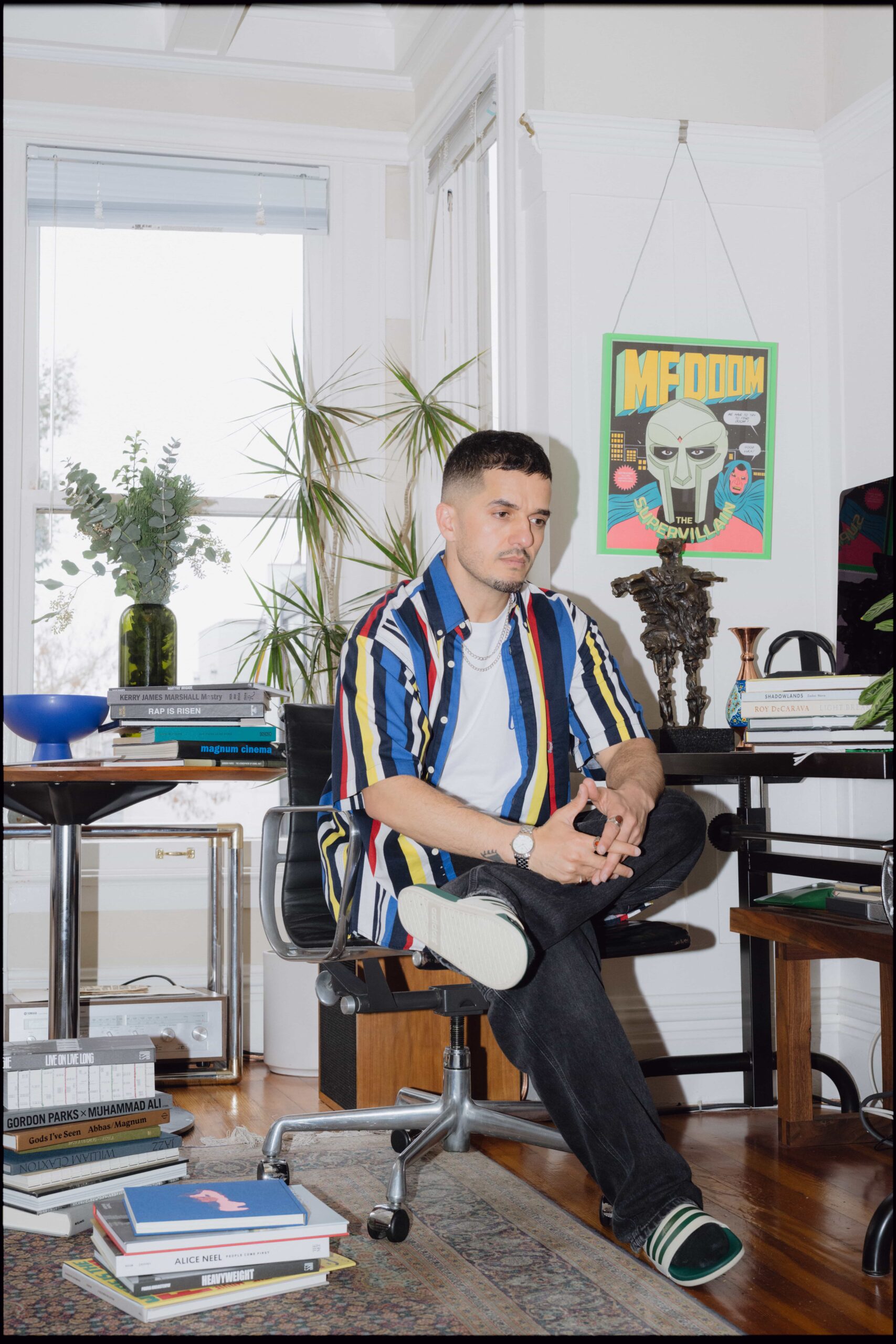
Filmmaker Mohammad Gorjestani, known for the SXSW Grand Jury Award-winning documentary short Exit 12, is counting down to the release of his feature debut, From the Mat, this fall, which chronicles the world of wrestling in Iran. The Even/Odd studios founder will also continue to tour “1-800 Happy Birthday,” an installation dedicated to Black and Brown individuals killed by the police.
What keeps you up at night?
I think a lot about what it means to be from a diaspora, especially from a part of the world that has known so much grief because of what the country I’m living in has done to it. There’s this thing that happens when you occupy two nervous systems at once: two worlds, two histories, two versions of yourself running parallel operating systems—what Du Bois called “double consciousness.” For those of us from places like Iran, it has its own specific weight.
And I don’t think of navigating that as a journey. A journey implies you know where you’re going. It’s more of an odyssey. Toni Morrison wrote that “all water has a perfect memory and is forever trying to get back to where it was.” I think that line frames a lot of thoughts at night. So much of the work I’m trying to do is help facilitate that return, both for myself and for a collective community I want to continue to build.
When you were little, what were you known for?
Alright, I’ll take it back to when I was 4. My mom tells a story about the last summer before we immigrated, during the Iran-Iraq War. We had gone up to Darband, in the mountains, to get out of Tehran while missiles were targeting the city. And apparently, I would look out for all the other little kids—tell the adults to give the kids fruits and food; try to direct the situation. My mom loves that story because she says I was always paying attention to everything around me. I like to think that was the beginning of something because I think about directing as a form of awareness and caretaking—of the people you’re around, of your collaborators, of the story itself. Maybe, maybe not, but it’s a cool story.
What would you be doing if you weren’t working in your field?
Working with youth. Coaching wrestling, specifically in low-income communities. Wrestling is a sport that doesn’t demand much resource-wise—not a lot of equipment, not a lot of fees to participate. And it’s not something you can ever master, which is what makes it great. You get to know your body, your balance, your breath. You’re constantly problem-solving under duress, making decisions that feel enormous in the moment and then it’s done. And then you go again. You feel the highs and lows, often with the same people, trading those roles back and forth. So you learn how to be with people in stressful situations. And you learn how to find the joy inside that. You are constantly sculpting different parts of yourself every single day. I think that’s what’s been taken from so many people living under socioeconomic stress: the ability to sculpt themselves and build confidence. Wrestling is one of many avenues that gives that back, so maybe I’d be doing that.
What question do you ask yourself most often while you’re making work?
Am I making this without the dominant culture interfering in my process? So much work is pressured to exist in response to something, or in rejection of something, and I try to resist and dissent that. I want to occupy a space that’s void of the impulsive contexts that have become overlords in our industry. I want to create something that isn’t trying to anticipate what someone might think about it. Those forces are always in the air, and it takes an intentional awareness to stop, check in, and make sure you haven’t let them in without knowing it. Those forces can even be polite and friendly sometimes, but they’re still not welcome.
What’s your biggest vice? Your greatest virtue?
Honestly they might be the same thing. I just love making. All the time. I don’t really think of my work and my life as two separate elements. It’s all one existence, and I’m inside of it, constantly trying to make things. That’s the virtue. The vice is probably the expectations I carry because of it. I’ve had to learn a more healthy relationship with that over time, through the highs and lows, through joy and grief, through getting older and having more perspective.
What are you looking forward to this year?
Completing From the Mat and premiering it. It’s a feature film I shot in Iran in the summer of 2024—alongside a body of photography and an installation—that explores Iranian consciousness and identity through the lens of wrestling. For me it was also a homecoming, a pilgrimage, so completing the film is completing the journey in many ways. And I’m looking forward to continuing to take “1-800 Happy Birthday” around the country. We had a great installation at Fort Mason and the Black Panther Party Museum in San Francisco, and now we’re looking to activate it from the Midwest to the East Coast.
What do you think is your biggest contribution to culture?
Trying to create infrastructure for stories and projects that would traditionally be “harder” to make. Even/Odd as a creative studio and production company is built to place a signal into culture, to try and shift it, and cultivate community around that work. I like to believe that co-authorship is a future-proof way of working. It centers very specific, very niche ideas, empowering that specificity instead of trying to shove new ideas into what I believe are antiquated processes. That’s where my real contribution lives beyond my own projects.
That is what will yield a higher percentage of more original projects and add collective value. I think lingering is a quality of good art. It means you experienced something that continues to require processing and is likely reprogramming something spiritually in you. That’s what I’m trying to continue to build a scaffolding around.
Where do you feel most at home?
Anywhere I can be in the flow of my own thoughts. For me that happens the most when I’m in motion. Running is big for me. I’m a bit of a gym rat, and I try to get on the wrestling mat when I can. A lot of my creative thinking emerges when my mind is focused on something physical, so there’s this whole other undercurrent running beneath it. I had a monk-type homie many years ago, and he read my chart and told me that I’m the kind of person that meditates when they’re moving. It was an unusually cathartic moment that I never forgot, and I felt like I unlocked something.
What’s been the hardest part of your career so far?
Filmmaking and art are resource-heavy, and when you look around, there’s a certain class that’s more represented than others, especially under capitalism and the history of this country. As a first-generation kid who grew up in public housing, I’ve spent a lot of my life building not just a financial base for myself but for my parents, too. I’m the first everything, you know? There was no safety net. A lot of sacrifices came with that. But I’m also grateful for it. It guided me toward resourcefulness, self-reliance, and a non-traditional entry into a creative practice that I believe is more sustainable, even if it took longer to develop. I feel like I’m just now stepping into making the work I would have made all along if financial survival hadn’t been the most constant thing occupying my mind for thirty-plus years.
What do you want to see more of in your industry? Less of?
I want the distance between maker and subject to close. And I don’t just mean ethnicity or culture. I mean class, gender, geography, all of it. When we decide to break that proximity, there should be a very intentional reason that adds to the project. We’re conveniently confusing extraction for representation, especially when we’re mining the periphery of life and culture for stories. It’s packaged as participating in representation when really it’s just passing through and extracting value. It’s a colonial mechanism in disguise, and the proof is who benefits and profits when you follow the trail.
What I want to see less of is also reactive work. People in positions of means are waiting for something to happen in the world, mobilizing to make something about it, then moving on to the next thing. When you look back at the places those stories came from, not much has shifted. When that becomes the common way things are made, everyone starts to adjust and believe that this is what it means to be an artist. Artists should respond to the times, but not in this way, which has become almost algorithmic and liberalized.
What I want to see more of is long-term investment, especially in the communities the stories come from and in the people who have real ties to them. When the maker has genuine proximity to the subject, another possibility arises: the work stops being extractive and becomes generative. It creates the conditions for a true redistribution of creative and economic power over time. Not top down. Something that grows from within, a cultivation.
To read more from the 2026 CULT100 honorees, see the full list here.

 in your life?
