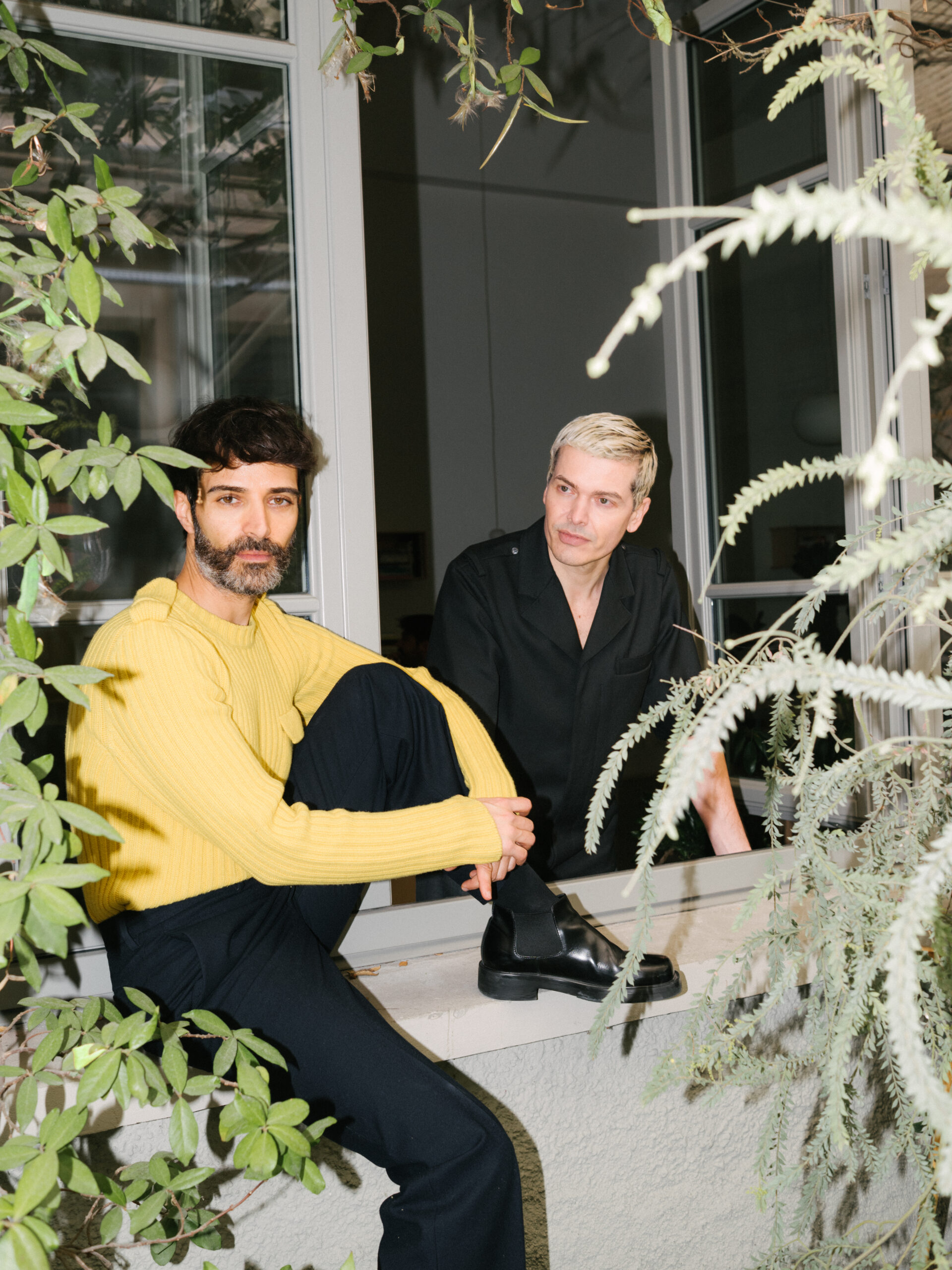
Andrea Trimarchi and Simone Farresin of Milan’s Formafantasma have emerged as fashion and art’s go-to design studio. In the last year, they’ve designed runways for Meryll Rogge’s Marni debut, scenography for the new Fondation Cartier, and a quietly radical take on the Shaker legacy for a show at the Vitra Design Museum.
What keeps you up at night?
The awareness that design still operates largely as a tool that sustains extractive systems while presenting itself as progressive. The gap between what the discipline claims to do—improve the world—and what it actually enables in terms of environmental depletion and labor exploitation is not abstract; it has material consequences. This is difficult to ignore.
What’s something people get wrong about you?
That we are pessimistic or anti-design. The critique we articulate is not a rejection of the discipline, but an attempt to expand its responsibilities. Criticality is often mistaken for negativity, but it is a form of care.
Name an influence of yours that might surprise people.
Reading corporate reports and legal documents. They are often more revealing than theoretical texts because they show how power actually operates in material terms. But also the movies of David Lynch. That full trust on intuition and imagination is so inspiring.
What do you want to see more of in your industry? Less of?
More accountability—designers taking responsibility for the full life cycle and implications of their work. Less production justified by narratives of innovation that are disconnected from necessity or consequence. More intelligent people working in marketing.
What question do you ask yourself most often while you’re making work?
Who benefits from this, and at whose expense?
What do you think is your biggest contribution to culture?
Introducing a mode of practice where design is not primarily about form-making but about inquiry—using objects, exhibitions, and research as tools to expose political, ecological, and economic structures. Not proposing solutions prematurely, but making complexity legible.
Who do you call the most?
Each other. The practice is built on continuous dialogue, and most decisions are the result of extended conversations rather than individual positions. Also, we are a couple so we need to agree on what to have for dinner, the groceries, etc.
When’s the last time you laughed hysterically?
When we saw the first prototype of a product we worked on with a company. It was so hilariously bad it was funny. Honestly, this is often the case. Developing a good product takes a lot of time and many prototypes.
What’s your biggest vice? Your greatest virtue?
Vice: Being too critical. Sometimes it’s trying to see and notice only what doesn’t work.
Virtue: Persistence in questioning assumptions, even when it complicates outcomes or slows processes.
What’s been the hardest part of your career so far?
Maintaining a critical position while remaining within the system is structurally challenging.
What grounds you, and what invigorates you?
Grounds: Each other, research, evidence, poetry, and direct engagement with materials and their histories. Invigorates: Encounters that shift perspective, collaborations with communities that challenge the limits of our discipline, and our very own way of looking at things.
To read more from the 2026 CULT100 honorees, see the full list here.

 in your life?