Art history’s most famous love stories are cautionary tales. Think: Frida Kahlo and Diego Rivera, Lee Krasner and Jackson Pollock, Pablo Picasso and Dora Maar. A new exhibition in New York offers a considerably less tumultuous vision of artistic romance. “Couples,” at Eric Firestone Gallery, features the work of 26 artist-partners (through May 2) who explore material, color, and form in a complementary fashion. CULTURED brought together five duos featured in the show to answer questions about what it’s like to mix the professional with the personal. Each artist was instructed to answer without peeking at their partner’s responses, revealing just how compatible they really are.
Caitlin Lonegan and Spencer Lewis
Los Angeles
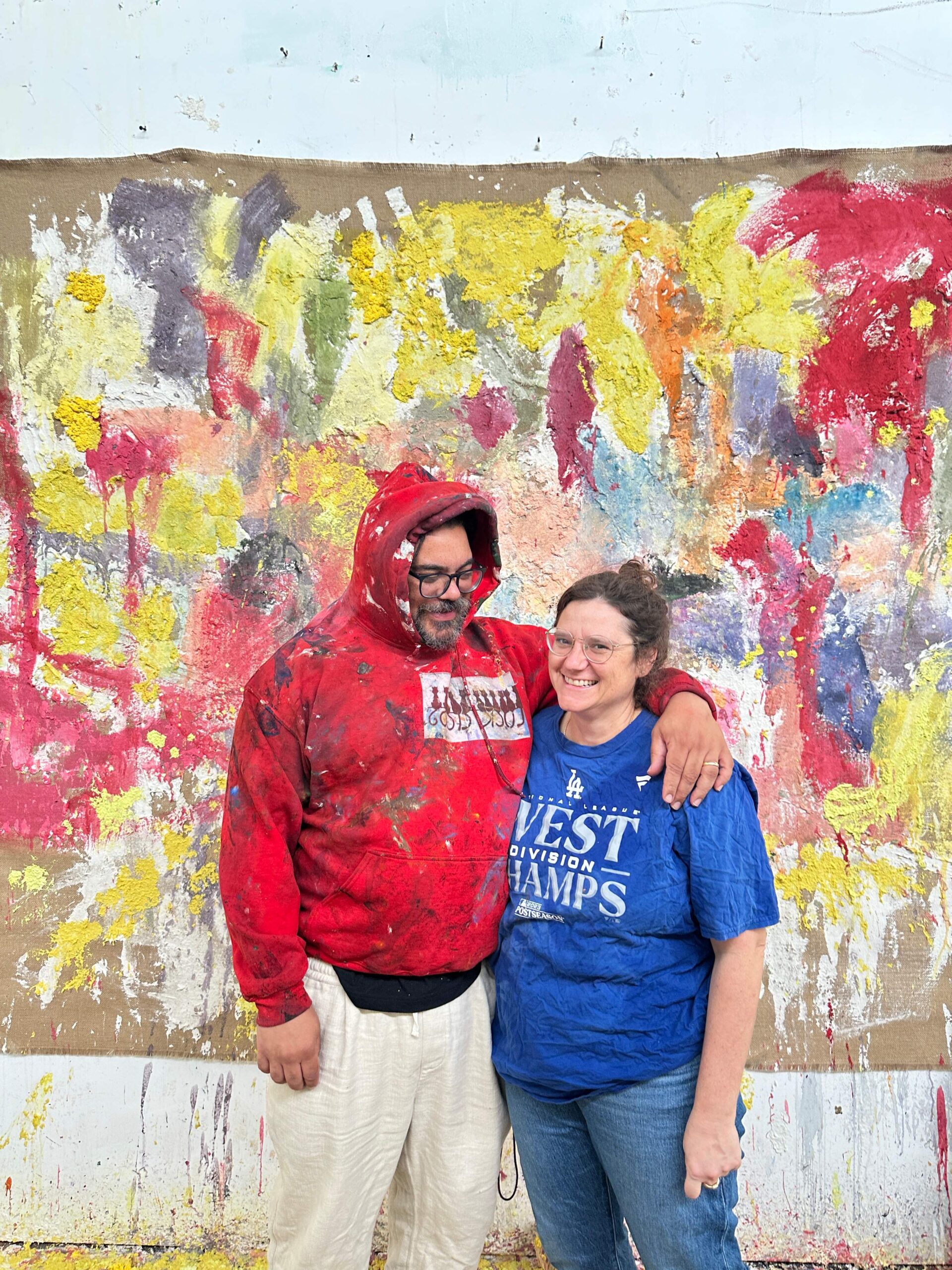
What’s the best thing about being married to another artist?
Caitlin Lonegan: The best thing is understanding one another.
Spencer Lewis: They understand why you are so crazy.
The worst thing?
Lonegan: It’s not an easy life.
Lewis: They themselves are crazy.
What artist couples are role models for you? Cautionary tales?
Lonegan: Charline von Heyl and Christopher Wool. I love their paintings, and they have formidable, independent careers. Lari Pittman was our teacher in graduate school, and I’ve always admired how he and Roy Dowell treat one another with kindness, care, and respect.
Lewis: I always thought Jonas [Wood] and Shio [Kusaka] were a nice artist couple. After seeing the Pollock film, I thought Lee Krasner and Pollock were like the worst case scenario.
Do you share a studio? Work far apart?
Lonegan: We work in separate studios. When we first graduated from UCLA, we shared a studio in Atwater Village that we divided with an L shape. I mostly used it during the day, and Spencer mostly used it at night. We grew out of that pretty quickly.
Lewis: I do love being close by if possible, like when we were first together. Now we are maybe 15 minutes away and we come to each other’s studios only three or four times a year.
What’s your relationship to talking about your work to each other? Showing work?
Lonegan: We met in graduate school—talking about art is a central part of our relationship. We try to ask each other if one has the mental space to talk about work, otherwise it would be never-ending.
Lewis: We’ve always talked a lot—I’m surprised we still have anything to talk about. She’s the only person who listens to me, and I love talking to her about art.
Who’s the biggest diva in the studio?
Lonegan: We are both divas in the studio, but in different ways.
Lewis: Probably Caitlin, but I’m a bigger diva in real life.
Describe your partner’s approach to art-making in three words.
Lonegan: Deep, exhaustive, exploratory. (Or, physical, expansive, playful…)
Lewis: “She’s a genius.” Or: looking–pouncing–thinking.
How do you deal with any feelings of jealousy that might surface in terms of your partner’s art career?
Lonegan: Therapy. And if the seed of the jealousy or envy is a concrete, structural power imbalance, being sure to address the issue.
Lewis: It’s hard being an artist so it’s natural to feel jealousy, but I honestly want the world for her as much as I want things for myself.
When have you been proudest of your partner?
Lonegan: I am proudest of Spencer when he persists in pursuing his dreams in circumstances that are less than ideal.
Lewis: I’m really proud of her all the time. But I remember being really proud when she was in “Made in L.A.”
When have you felt the most artistically challenged by your partner?
Lonegan: When we were in graduate school, he used to tell me what he thought was wrong with my work and how it should be different. My response was almost always an emphatic “no,” but with that “no,” I’d find words that taught me the parameters I was unwittingly applying to my work.
Lewis: I suppose we are naturally competitive, so I feel challenged when she makes good work. But she always used to tell me I make things too complicated, and I’d take that as a challenge. Plus, she likes a lot of work that I do not, so that grows my horizons.
What advice would you give to an artist couple that’s just gotten together?
Lonegan: Make space for non-art things.
Lewis: Regardless of occupation, honor and cherish your partner.
Michelle Segre and Steve Dibenedetto
New York
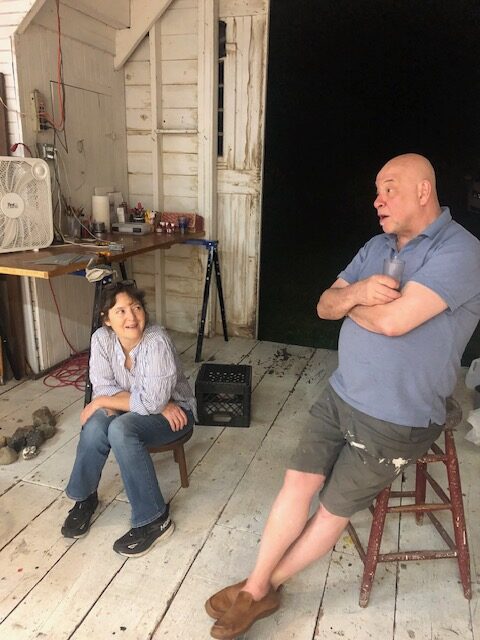
What’s the best thing about being in a relationship with another artist? The worst thing?
Michelle Segre: Best: Stealing ideas. Worst: Complaining endlessly about the same things.
Steve Dibenedetto: Best: Getting ideas from them. Worst: Them getting ideas from you.
What artist couples are role models for you? Cautionary tales?
Segre: Role models: Linda Montano and Tehching Hsieh. Cautionary tale: Linda Montano and Tehching Hsieh.
Dibenedetto: Role models: Marcel Duchamp and Rrose Sélavy. Cautionary tale: It’s not advised to go to other people’s studios together.
Do you share a studio? Work far apart?
Segre: No. Extremely.
Dibenedetto: No. Very.
What’s your relationship to talking about your work to each other? Showing work?
Segre: We talk to each other every day about our work—it’s like going over the dailies with the film editor. Studio visits, not very often. That would lead to divorce.
Dibenedetto: We do it. Carefully.
Who’s the biggest diva in the studio?
Segre: This is an Equal Opportunity Diva House! Everyone gets their turn.
Dibenedetto: Oh, pleeeezee!
Describe your partner’s approach to art-making in three words.
Segre: Tortured. Rampant. Chaos.
Dibenedetto: Highly energetic confusion.
How do you deal with any feelings of jealousy that might surface in terms of your partner’s art career?
Segre: Jealousy is a great motivator! Otherwise, why get out of bed?
Dibenedetto: Order one more drink.
When have you been proudest of your partner?
Segre: That time he left that painting alone the first time it was done.
Dibenedetto: Big sales.
When have you felt the most artistically challenged by your partner?
Segre: Literally every time in the early stages of a body of work…
Dibenedetto: Every studio visit.
What advice would you give to an artist couple that’s just gotten together?
Segre: Never share a studio.
Dibenedetto: Ha!
Trudy Benson and Russell Tyler
New York

What’s the best thing about being married to another artist?
Trudy Benson: We both understand the draw of the studio and we aren’t jealous of time spent there.
Russell Tyler: The best thing about being married to another painter is sharing a common passion.
The worst thing?
Benson: Neither of us has a stay-at-home husband/wife.
Tyler: When the market is bad, both of us have to bear the brunt.
What artist couples are role models for you? Cautionary tales?
Benson: Role models: Josef and Anni Albers. Sally and Peter Saul. Cautionary tales: Frida and Diego. Carl and Ana. Pollock and Krasner.
Tyler: Role models: Stanley Whitney and Marina Adams. Cautionary tale: Carl Andre and Ana Mendieta.
Do you share a studio?
Benson: We have studios side by side, and paint on either side of a shared wall.
Tyler: We work about 50 feet from each other.
What’s your relationship to talking about your work to each other? Showing work?
Benson: I trust Russell the most when it comes to my work. He is a brilliant colorist, so I often ask for his opinion. He knows my work better than anyone, maybe even me. We have exhibited together several times, but only when it works. Russell’s creative arc is pretty varied and exciting, so our work doesn’t always make sense in the same show.
Tyler: We’ve really refined over the years how to communicate criticism versus praise in a constructive way. Timing is everything. In many ways our work complements each other—we share a love of the square.
Who’s the biggest diva in the studio?
Benson: Russell!
Tyler: Moi.
Describe your partner’s approach to art-making in three words.
Benson: Color. Texture. Weed.
Tyler: Zany, Brainy, and Bold.
How do you deal with any feelings of jealousy that might surface in terms of your partner’s art career?
Benson: I got over that in my 20s. I want the best for Russell and I know he truly feels the same. We are each other’s biggest fans.
Tyler: When I was younger, I used to get a bit jealous of her meteoric rise. Now I know that her wins are my wins.
When have you been proudest of your partner?
Benson: Every single solo show I get to soak up the love by his side.
Tyler: I have been proud of Trudy many, many times, but a few highlights would be “Abstract America Today” at Saatchi Gallery in 2014, and being reviewed in The New York Times—twice!
When have you felt the most artistically challenged by your partner?
Benson: When he offered constructive criticism after a major solo show. I saw the grouping of paintings with fresh eyes, and I think it has really benefited the work I’ve made since.
Tyler: Trudy challenges me to be a little more consistent with my content.
What advice would you give to an artist couple that’s just gotten together?
Benson: The only constant is change. The studio is the only other woman.
Tyler: You can’t expect your career paths to align—there will be ups and downs. Be as supportive as possible.
Sahar Khoury and Alicia McCarthy
Oakland
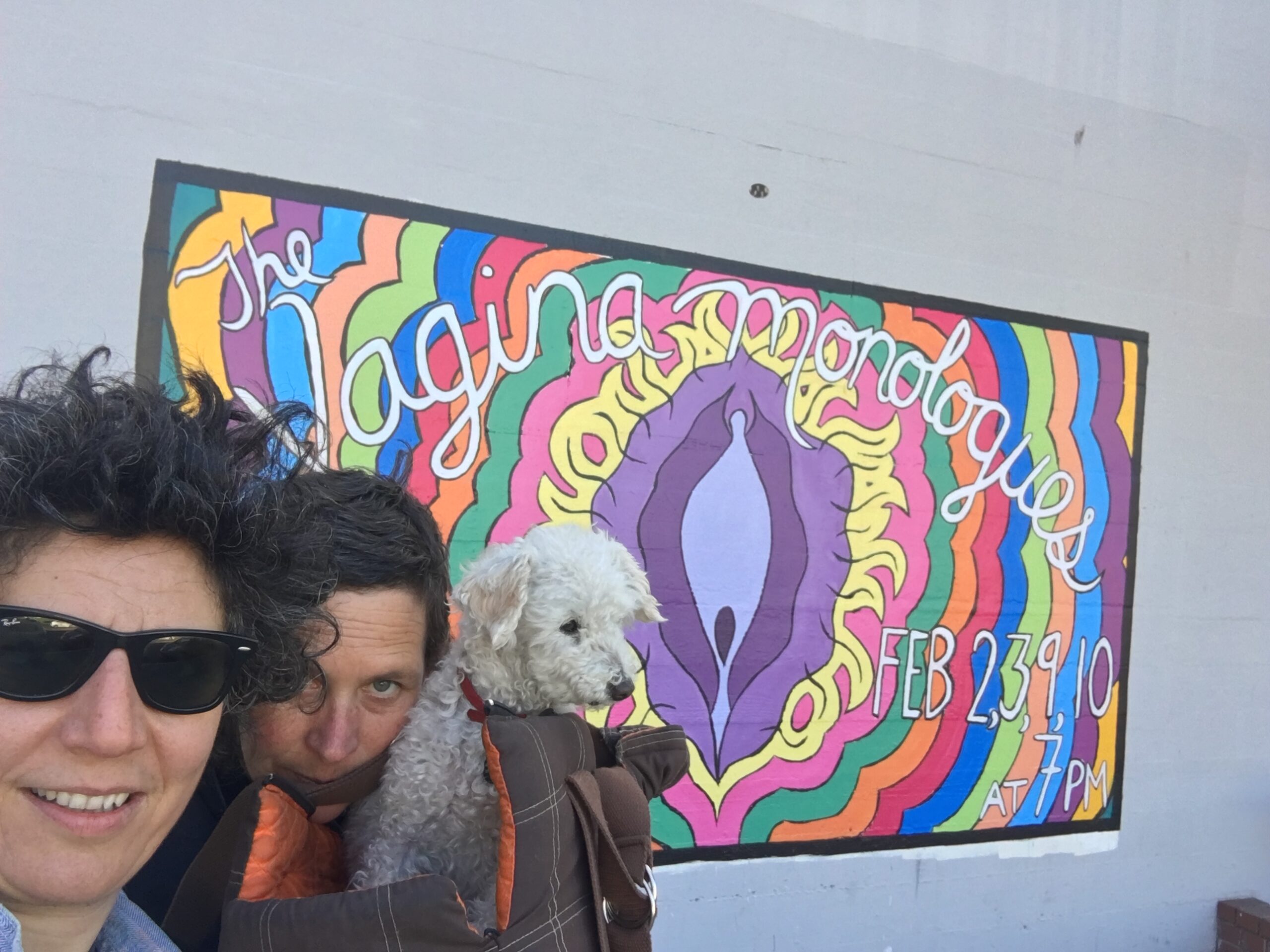
What’s the best thing about being in a relationship with another artist? The worst thing?
Sahar Khoury: Best: I don’t have to explain that I need to drag in seven plastic loveseats into the yard for a while. Worst: Lots of trip hazards and paint residue in and on everything.
Alicia McCarthy: The best and worst thing about being with another artist is the same answer: it never stops.
What artist couples are role models for you?
Khoury: Ones I have never met: June Leaf and Robert Frank, Etel Adnan and Simone Fattal. People I know: Marie Lorenz and Jeff Williams; Jeffrey Cheung and Gabriel Ramirez; Mario Ayala and Mia Scarpa—it is a journey of very bright lights, harsh shadows, and candlelight, and there are moments of being in each one together and alone.
McCarthy: Etel Adnan and Simone Fattal.
Do you share a studio? Work far apart?
Khoury: We do not share a studio, but are in each other’s spaces when needed or on a deadline. Sometimes we have worked far apart for residencies. It can be nice to use language to describe what is happening since the other person doesn’t know intimately the circumstances in which you are working.
McCarthy: In the 20-plus years we have been together, I would say we’ve experienced every combination of shared and solo studios, as well as our home.
What’s your relationship to talking about your work to each other?
Khoury: Usually, I feel like very little has to be articulated before Alicia fills in—she understands the feelings of the work, its continuum and its interdependence with my history. But talking logistics for either of us has never been a strong point. I think that is because we work in different mediums, with different equipment and methodologies.
McCarthy: See answer to question number one.
Who’s the biggest diva in the studio?
Khoury: Hmmmm… newlywed question, haha. I think we will both say me—I take up more space, no question.
McCarthy: Esther, our last pooch, was the only diva.
Describe your partner’s approach to art-making in three words.
Khoury: Collaborative, Meta, Hermit.
McCarthy: Keep it real.
When have you been proudest of your partner?
Khoury: Well, “proud” is not a word either one of us really loves. But seeing her painting in San Francisco on 7th and Market that spans 110 feet really blew me away—it was done in classic Alicia style, with friends she loved and from many walks of life, embracing the street and studio together in one, and not compromising any part of her process or the weave, even at that scale.
McCarthy: Every damn day.
When have you felt the most artistically challenged by your partner?
Khoury: When I think a work I made is honest and she lets me know that it doesn’t read as honest and it just kills me, and I question it: Are you just mad at me? Is your “data” really coming from the work? Or is it from our life together? This tug of war is a juggernaut I’m not sure any couple will ever get out of.
McCarthy: When she used to ruin paint brushes—but that’s in the past.
What advice would you give to an artist couple that’s just gotten together?
Khoury: Always support each other first and don’t service the bigger entity that wants to eat our art alive and make it a relic to explain.
McCarthy: Acknowledge the privilege and never entirely lose yourselves.
Tamara Gonzales and Chris Martin
New York
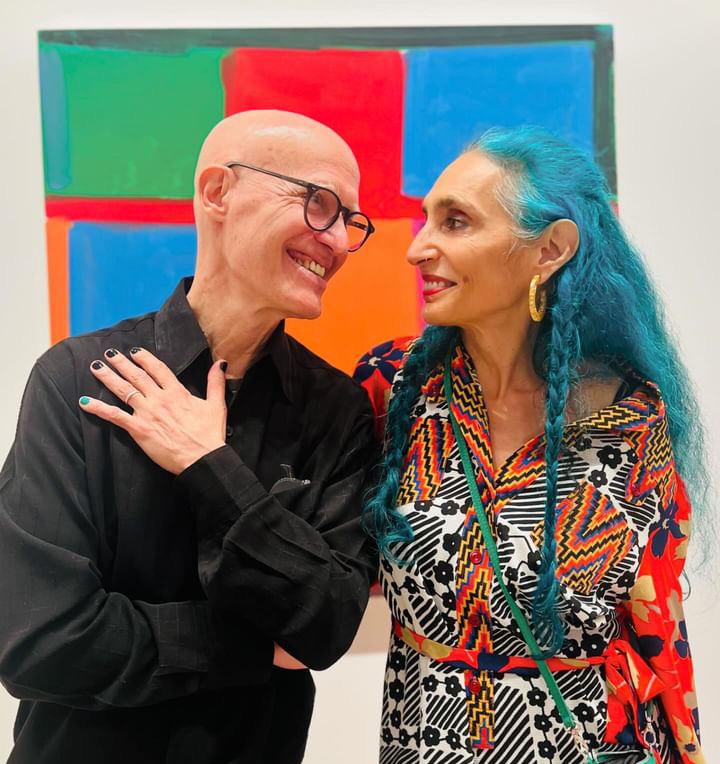
What’s the best think about dating/being married to another artist?
Tamara Gonzales: There is a mutual understanding about “time spent” in the studio.
Chris Martin: Conversations about art.
The worst thing?
Gonzales: Storage.
Do you share a studio? Work far apart?
Gonzales: We keep separate studios, but over the years these have moved closer together.
Martin: Separate studio.
What’s your relationship to talking about your work to each other?
Gonzales: We talk about working all the time.
Showing work?
Gonzales: We have had one show as a couple. It was in 2021 at The Pit gallery in Los Angeles. It was titled: “Talking all morning.”
Who’s the biggest diva in the studio?
Gonzales: Chris.
Martin: Me.
Describe your partner’s approach to art-making in three words.
Gonzales: Fearless, Fun, Monumental.
Martin: Filled with love.
How do you deal with any feelings of jealousy that might surface in terms of your partner’s art career?
Gonzales: Same as all the rest of the demons. Banish to hell.
When have you been proudest of your partner?
Gonzales: So many times, it’s hard to chose… I’m going to say when I see him championing the artists he loves.
When have you felt the most artistically challenged by your partner?
Gonzales: When he’s championing the other artists he loves.
What advice would you give to an artist couple that’s just gotten together?
Gonzales: Understanding that when shows are up there can be a lot of hopes both met and unmet, and that these can remain hidden until said time. We give each other a lot of slack on the emotional front until the show is down.
Martin: Enjoy.
More of our favorite stories from CULTURED
How The Pitt’s Patrick Ball Went From Role-Playing Corporate Trainings to Starring on Broadway
The 2026 CULTURED Power Advisor List: Meet the Art Advisors Shaping the World’s Top Collections
A New Book Unearths the Heated Rivalry Between Artists Peter Hujar and Paul Thek
Speed Round! 13 Critics Review 25 NYC Shows Before You Finish Your Morning Coffee
Sign up for our newsletter here to get these stories direct to your inbox.




 in your life?