If you want to understand the unique position of Dallas in the art world, just look at how its collectors and artists interact. As philanthropist Grace Cook says, “collectors here grow with artists, and that changes how people collect.”
Those connections often tie back to the Dallas Art Fair, which returns for its 18th edition from April 17–19, once again taking over the Fashion Industry Gallery downtown. Its intimate scale and tenor encourage genuine exchange—one that privileges passion over posturing. To better understand what sustains that dynamic, CULTURED spoke with five Dallas collectors about how they approach the scene, and why their city continues to thrum with a confidence entirely its own.
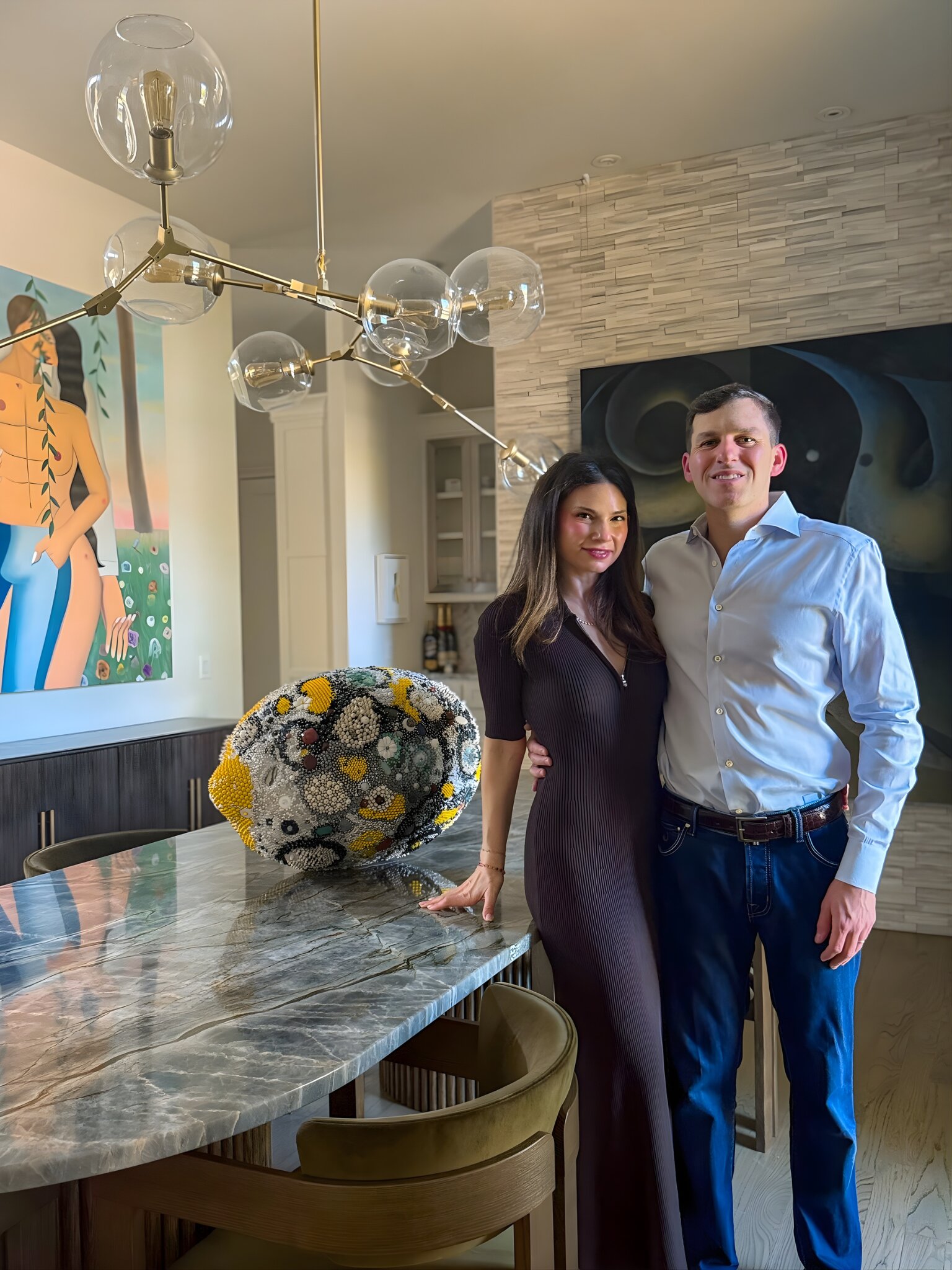
Adam and Rachel Green
In his youth, Adam was influenced by the patronage of his parents, who founded the Green Family Art Foundation. Since opening its doors in 2021, the nonprofit space has showcased a contemporary collection with a focus on highlighting underrepresented creatives. Adam furthered the family’s trajectory in the arts as an advisor, establishing Adam Green Art Advisory in 2016. Rachel is the founder and CEO of L’Epoque Parfums, intertwining her love for craft with fragrance.
How would you characterize the personality of the Dallas art scene?
Dallas has an incredibly generous and collaborative art community. One of the defining characteristics is how hospitable collectors are with one another and with visitors coming from out of town. We love when people open their homes and collections to curators, artists, and fellow collectors, and strive to do the same. Creating community amongst the Dallas art scene ultimately strengthens the broader cultural ecosystem of the city.
Can you describe your collection for us?
We started collecting art about 20 years ago, focusing on artists whose work we felt strongly about, and where we could acquire excellent examples early on, such as Dana Schutz and Nicole Eisenman. Over time, the collection has grown to include artists across multiple generations who feel in dialogue with one another. We believe that kind of generational conversation helps a collection tell a richer story. A good example in our collection is Ilana Savdie and Lynda Benglis. Benglis was a trailblazer in the 1970s with her use of beeswax, a material Savdie engages with in her own way today. Savdie has cited Benglis as an important influence on her practice.
If you could snap your fingers and instantly own the art collection of anyone, who would it be and why?
There are many collections we admire. Some that come to mind are Beth Rudin DeWoody, Pamela Joyner, Patrizia Sandretto Re Rebaudengo, and Bob Rennie. For us, a meaningful part of collecting is the journey, what types of works we acquire over time, and what they meant to us in that moment. You develop relationships with artists, galleries, and institutions, and each work becomes connected to a particular moment. Those experiences and relationships are what give a collection its personality. They say life imitates art, and part of our collecting strategy was the inspiration for Rachel’s fragrance line, L’Epoque Parfums, which emphasizes collecting different fragrances to mark different moments throughout your life.
What factors do you consider when growing your collection, and how has it changed alongside your home?
There are several considerations when we look at a potential acquisition, and many are the same factors I discuss with my clients as an art advisor. First, we discuss the artist and whether their practice resonates aesthetically and fits within the broader scope of the collection. We also look closely at the specific work and whether it feels like a strong example of the artist’s practice. Price is another factor, and whether we feel the work has long-term significance and value.
Where the work will hang is actually less of a priority. We have always felt that if a work is truly great, you can find a place for it. For the past 15 years we were primarily based in New York, so our collection was limited to the 1,500 square feet or so of our Manhattan apartment. Now, we divide our time between New York and Dallas and have much more space for art. One of the unexpected joys of having a home in Dallas has been to have so much space to enjoy art with our family.
Which work in your home provokes the most conversation from visitors?
A rotting lemon sculpture by Kathleen Ryan that sits in the center of our dining room table. At first glance, it looks like a giant lemon that has started to decay, but when you look closer, the mold is made from sparkling gemstones. People are immediately drawn to it because it is both beautiful and a little grotesque at the same time. The contrast between luxury materials and the subject of rot fascinates people, and it almost always becomes a conversation starter.
Do you have an art-fair or museum-going uniform?
The first, and perhaps only, rule of attending an art fair is wearing comfortable shoes since you are on your feet for hours. For Rachel, it is usually black jeans and her combat boots from the Row. For Adam, it’s a blue blazer, jeans, and some well-hidden snacks to keep us energized throughout the day.
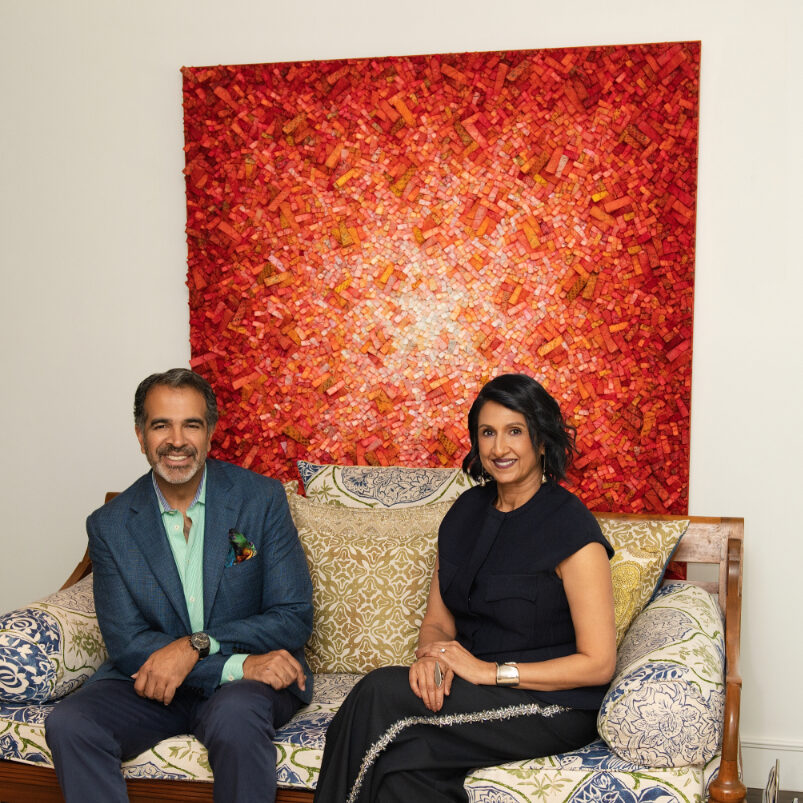
Gowri and Alex Sharma
For 10 years, Gowri served as a UNICEF board member before stepping into her role as executive board member of the Texas Women’s Foundation. In 2022, Gowri was chosen as the first person of color to serve as the president of the Dallas Museum of Art’s Board of Trustees. Alex is a partner at the hospitality-oriented EQ Group, as well as the Lookout at Lake Chelan resort group.
Can you describe your collection for us?
We have always collected what we loved. We came into our marriage as two people who both loved art independently but from very different perspectives. Our biggest purchases have always been our fastest, as we tend to haggle a lot more about the smaller stuff. Initially, we bought a lot of things from the Dallas Art Fair. Over time, we’ve built relationships with many galleries and bought things directly from them or during our travels. Our collection is pretty eclectic, but in the past year or so we have become a lot more focused on Indian contemporary art.
What’s the strangest negotiation you ever had with an artist or dealer?
This one happened recently, and we blame technology! We were looking at available pieces on the gallery iPad. Just as we decided on a piece and the gallerist was about to click on it, the green button turned red. It was sold right under our noses. The gallerist spent the rest of the time together trying to convince us to get another piece, but we were not interested in anything else.
What factors do you consider when expanding your collection? And how has your collection changed alongside your home?
We welcome a wide range of mediums and storytelling. We seek art that sparks intellectual curiosity, resonates personally, or invites multiple interpretations. We can always use more wall space, and between storing and rehanging, we try to keep our walls current.
Which work in your home provokes the most conversation from visitors?
We have a beautiful large piece by Nabil Nahas from his “Fractal” series that is an abstract layered work in a deep blue. Because it occupies a place of pride in our home, it gets a lot of attention.
What book changed the way you think about art?
Just Kids by Patti Smith. Widow Basquiat by Jennifer Clement. Ninth Street Women by Mary Gabriel.
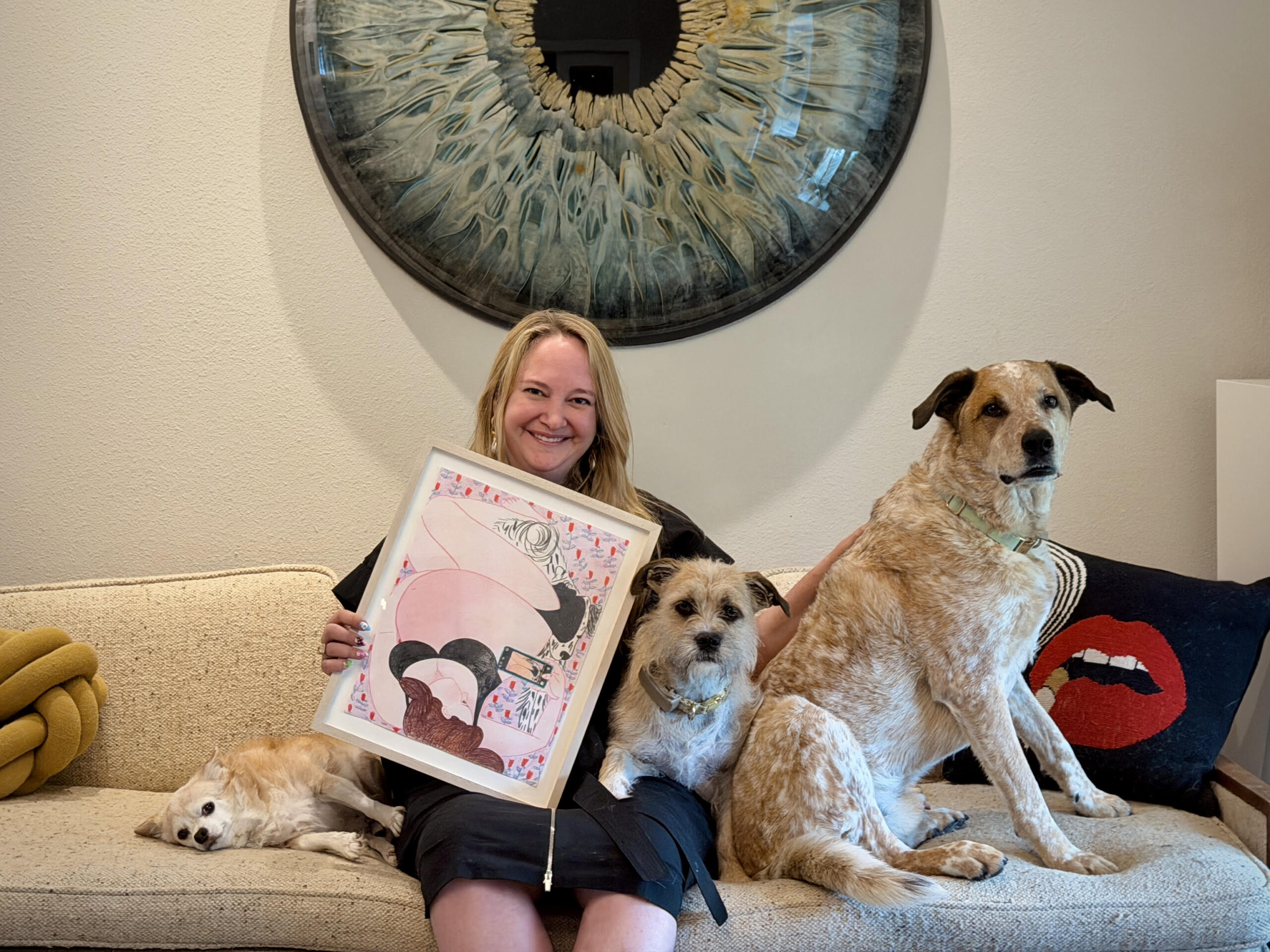
Grace Cook
A committed philanthropist, Cook serves as a board member of the Arts Community Alliance, the Dallas Symphony Orchestra, and the Thomsen Foundation. She puts her energy into fostering a vibrant cultural scene in Dallas through this nonprofit work—hosting fundraisers, connecting like-minded patrons, and helping secure financial support and educational programming to keep the arts alive and buzzing.
How would you characterize the personality of the Dallas art scene?
The Dallas art scene is very relationship-driven, but not in a surface way. Collectors here grow with artists, and that changes how people collect. It’s not about looking at the market to decide what matters. You really see that at the Dallas Art Fair. Galleries come in from other cities with a sense of what they think Dallas will respond to, but collectors here already have a point of view. Sometimes those align and sometimes they don’t. Dallas doesn’t adjust quickly just to meet what’s being presented, which is what gives it its backbone.
People underestimate that. Dallas collectors aren’t looking to be told what’s important. They already know what they like, and they’re willing to stand by it. There’s also a strong local layer that doesn’t always get talked about enough. The Cedars Union gives artists space to develop here, which keeps the scene from feeling overly shaped by what’s coming in.
If you could snap your fingers and instantly own the art collection of anyone, who would it be and why?
I’d choose Debbie and Eric Green. What stands out is their relationship with artists. You can feel that their collection has been built through real engagement, not just acquisition. That’s what gives it weight. I always come back to the Hugh Hayden and Theaster Gates works in their home. There’s humor in Hugh’s work that pulls you in, but it doesn’t stop there. And with Theaster, I remember talking to him about Chicago hot dogs at Afro Mingei at the Nasher, which is such a normal conversation, and then you’re standing in front of work that carries so much history. That contrast stays with you. It’s not that I want their collection exactly. It’s that they built it in a way that feels real.
What was your biggest influence in fostering your passion for art?
My grandma, Margaret McDermott. She didn’t just collect art, she shaped how I understand it. Her home was constantly open, and people moved through it in a way that made the work feel accessible, not distant or overly protected. I remember bringing my art history class there in high school, and for me, it felt completely normal. Watching everyone else react to it made me realize how unusual it was.
She trusted her own eye completely and didn’t feel the need to explain it. She lived with art in a way that made it part of her everyday life. That shaped how I see it now. It’s not separate from anything. It’s something you live with, return to, and build a relationship with over time.
What book changed the way you think about art?
The book that changed how I think about art is Reflections, which my grandma wrote about her collection. She didn’t want to release it while she was alive because she didn’t want to have to sign copies. She lived to 106, so it came out later. The book is very much her voice. It’s about the works she lived with and why she was drawn to them—not an academic breakdown. She always called them “pictures,” which kept everything grounded and personal.
Do you have an art-fair or museum-going uniform?
For the Dallas Art Fair, it’s the floors. They’re cement, so the shoes matter more than anything. My first year I put a lot of effort into my outfits. Every year after that it’s become more spur of the moment, except for the shoes. Those I plan. Some have to be broken in months ahead of time, and at this point I’ve built up a solid rotation of big-soled, comfortable ones. I’m probably only a few years away from Crocs.
It’s one of the few places where I’ll wear things I wouldn’t normally wear day-to-day. A little more out there, a little more sleek. I also love wearing pieces by Hollie Brown because it feels like wearing art while you’re surrounded by it, without overthinking it.
To join this year’s Dallas Art Fair from April 17-19 and experience the presenting galleries like these collectors, purchase tickets here.
More of our favorite stories from CULTURED
Legendary Art World Deviant Paul McCarthy on Santa Claus, Trauma, and the Rise of Fascism
Gabby Windey Shares Her Book Recommendations for the Manosphere and Depressed Women Everywhere
15 Collectors Offer Their Best Advice For Getting Started
Bryan Stevenson on What Social Justice Movements Can Learn From March Madness
A Guide to the Real-Life New York Restaurants Where Characters Eat on TV
Sign up for our newsletter here to get these stories direct to your inbox.




 in your life?