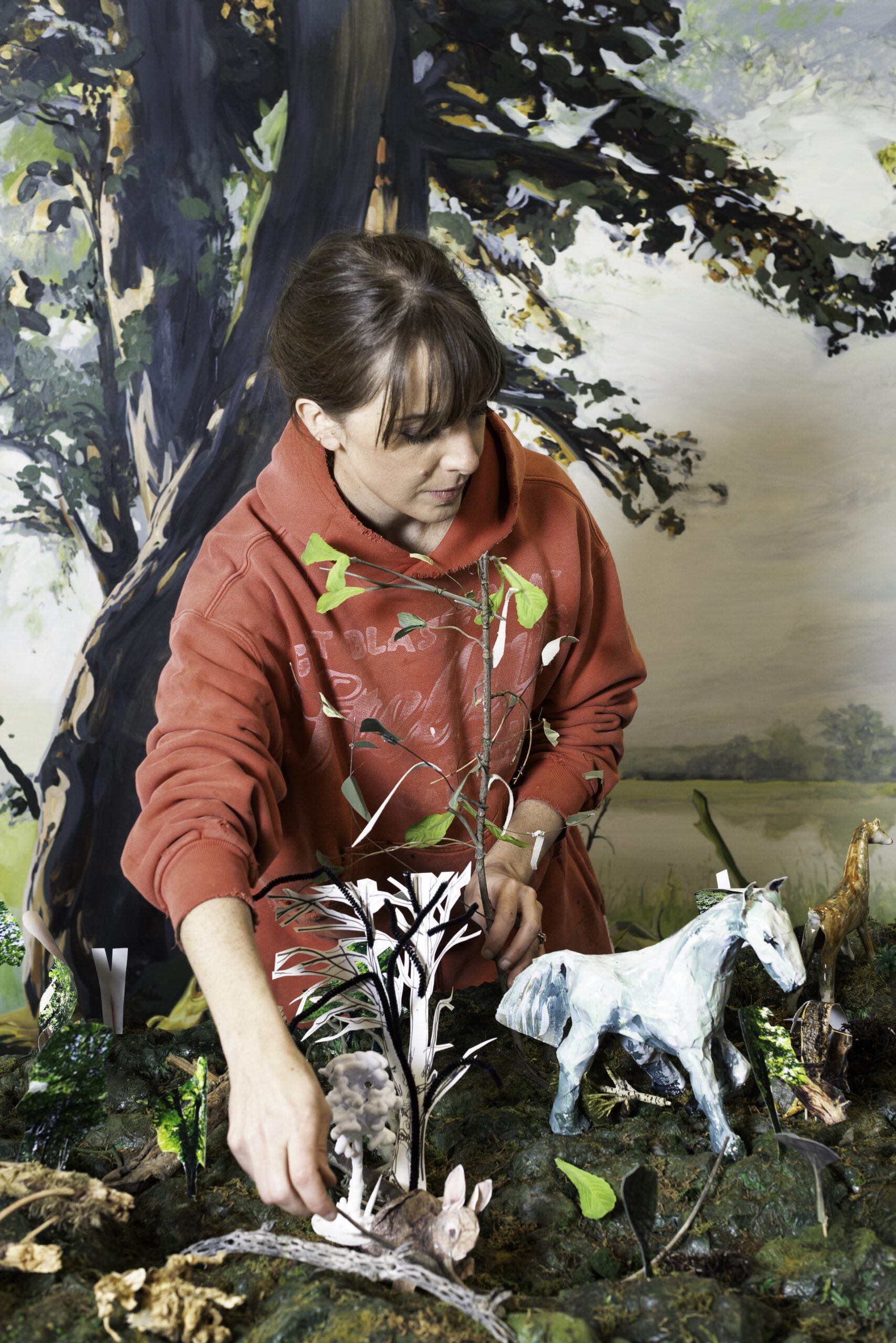
“A lot of the animals in this show are more pastoral, bovine, and, dare I say, American,” says Emma Webster from her studio in Los Angeles. “The type of animals we don’t think of as having big personalities.” The 37-year-old artist, known for her uncanny landscapes, is putting the final touches on a host of paintings that will make up her first solo exhibition with Petzel since joining the gallery’s roster, opening April 30.
Strewn around the studio are models made out of clay, pipe cleaners, wire, and ceramics, and vast canvases depicting horses, cows, dogs, and other domestic animals. The eclectic smattering of materials is a nod to a creative process Webster has honed since she was first pursuing her MFA at Yale. The artist, who previously worked in set design and interactive advertising, first builds scaled-down maquettes, often of shadowy, arboreal landscapes, but more recently of roaming animals. Next, she 3D-scans her creations and renders them in Blender, creating a digital diorama where she can move and manipulate her subjects just so. Only then does she use those digital dioramas as the references for her paintings. The result is a rendering of a rendering of a rendering, an effect that some find unsettling, but Webster considers a reflection of herself.
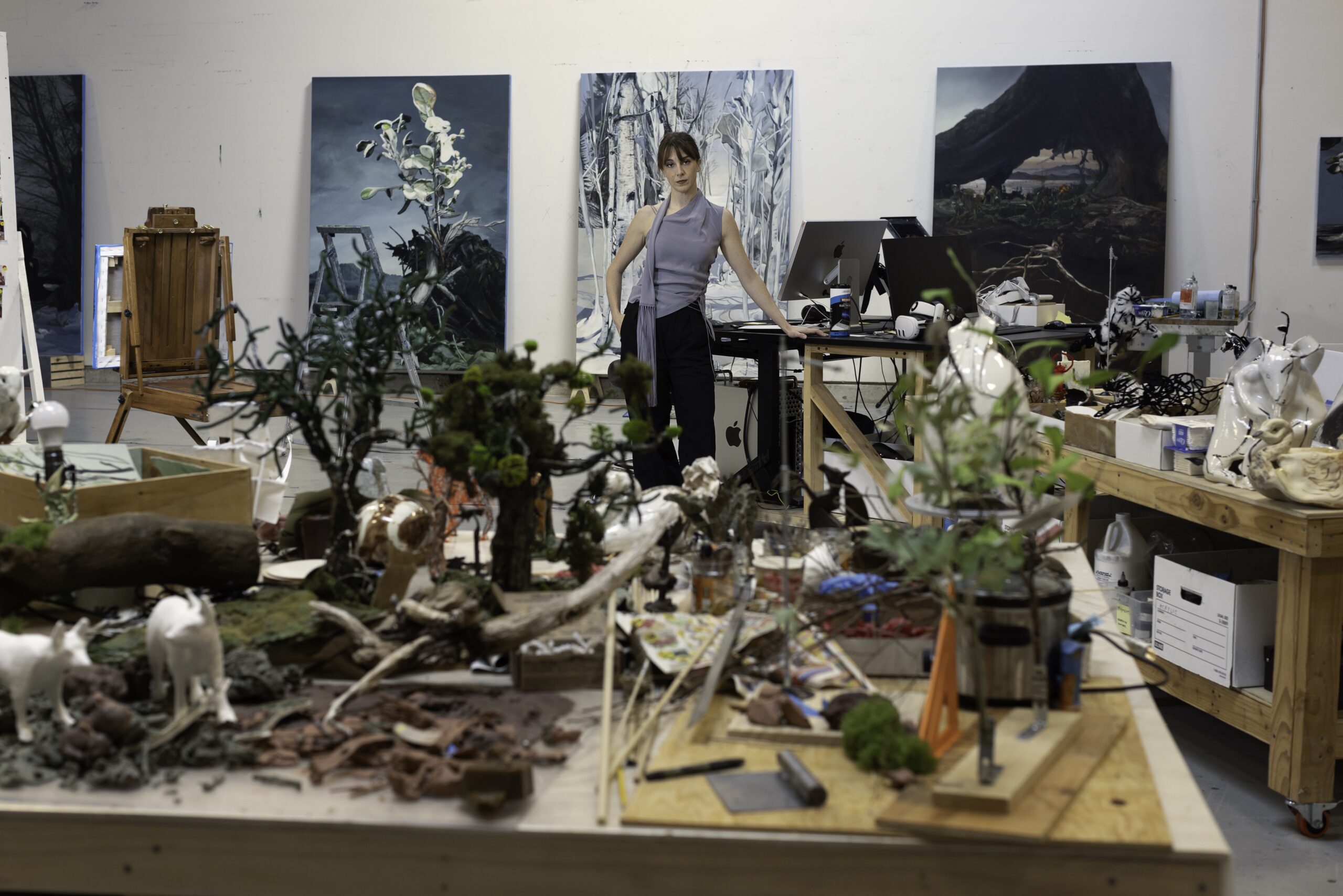
“This is by far the most complicated and silly process,” she says. “There’s a certain level of futility that I enjoy about it because it allows me to fully escape into these worlds.” For the first time, at the Petzel show, she will display this digital diorama, projected in the gallery’s entryway where viewers can interact with the space in real time.
As a child in the ’90s, Webster loved to play Sims, Zelda, and Legos, exploring the mutability of digital spaces, but she was also fascinated by the worlds of animals and fairy tales. This show bridges the two. Many of the paintings situate the viewer at a dramatic, canted angle below the creatures, looking up at the world. Webster says she wanted to explore passivity and the human impulse to seize power from those who seemingly have none. Her creatures don’t have to be just one thing, the same way she isn’t just one thing. And at a time when many are wary of new technologies seeping into visual art, Webster still holds on to that naughties sense of optimism about her tools’ capacities for endless recombination. “They’re hybrids because we are all hybrids. We have all these conflicting narratives within us, both when we look at things and when we make things.”
For Webster, the allure of her landscapes and the animals that inhabit them is the alternate realities they make manifest. “It’s not just that they come alive,” she says with a wry smile. “It’s that they know something you don’t know.”
More of our favorite stories from CULTURED
How Blue Ribbon Survived a Mob Run-in and Transformed Late-Night Dining
Why Cookbooks Are the Next Frontier for Narrative Writing
You’ve Heard About the New Museum’s New Building. The New Show Is Even Better.
Everyone Was Afraid to Touch Nadav Lapid’s Satire of Israeli Artists. Now, It’s Being Released.
Where 27 Artists Are Hanging Out in New York Right Now
Sign up for our newsletter here to get these stories direct to your inbox.


 in your life?