Welcome to the Critics’ Table’s first Speed Round. Never before have our contributors agreed so readily to an assignment. One sentence? No problem! (And from Vuillard to Victor Van, their picks are as varied as their definitions of “one sentence.”) To map our picks and plan your route, enter the Critic’s Table hashtag #TCT in the search bar of the See Saw app.
CHELSEA / WEST VILLAGE
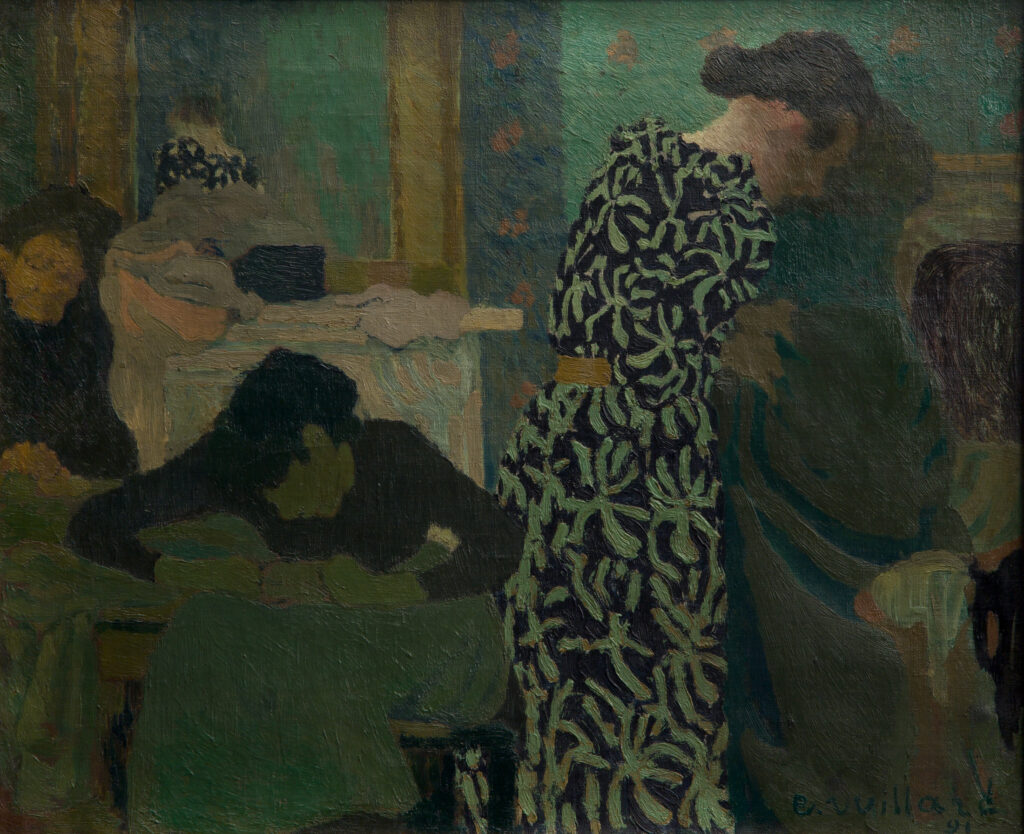
“Édouard Vuillard: Early Interiors”
Skarstedt | 247 West 25th Street
Through April 25
The show includes one of the painter’s most famous, most deeply influential and profound works: like the Gersaint shop sign is for Watteau, The Flowered Dess, 1891, is for Vuillard, “advertising” another little big revolution: Intimism.—David Rimanelli
Ralph Lemon, “From Out of Space”
Paula Cooper | 521 West 21st Street
Through April 11
For the artist, a keen reader of Benjamin, history appears as ruins, and ruins become a stage through which to fall: in a short, potent video shot in Money, Mississippi, cameras soar above the remnants of Bryant’s Grocery and Meat Market, where 14-year-old Emmett Till met his end, scanning the Tallahatchie for his corpse and peering through rotten lace into his hearse.—Ciarán Finlayson
“Art (by) Dealers”
White Columns | 91 Horatio Street
Through April 25
Charity pages: 93 works by dealers; blind buy, 500; name revealed @ purchase; polymarket af; I asked Gia if Anatoly was the sneakers.—Whitney Mallett
Nicola Tyson, “NEED”
Petzel | 520 West 20th Street
Through April 25
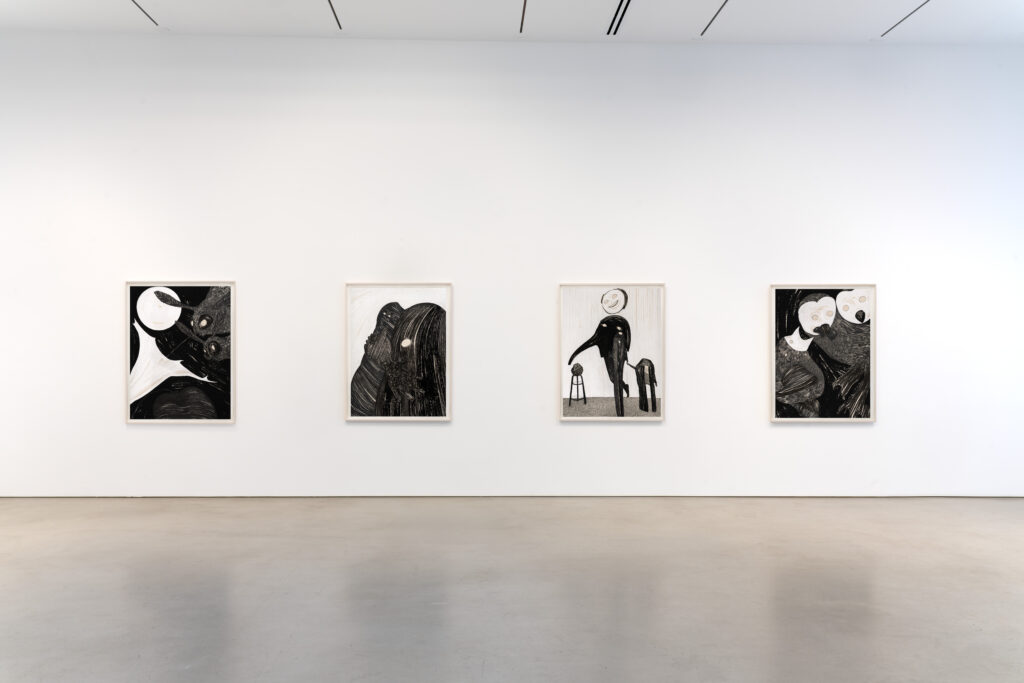
The artist happened to be at the gallery when I came by, and she remarked that my dog, whose pale head was peeking from a dark bag, looks like she might have stepped out of one of the big works on paper on the walls around us, I think because of their shared black-and-white palette (the drawings are done with charcoal and white conté crayon, mostly), but also, maybe, because Tyson’s semi-abstracted, sometimes comic, totemic figures—odd couples, conjoined families, a self-portrait—are animalian, not strictly humanoid, unknowable and wild beneath their housebroken charm.—Johanna Fateman
Anne Truitt, “Waterleaf”
Matthew Marks | 523 West 24th Street
Through April 18
Twelve of what at first appear to be identically-scaled, imageless monochromes in slightly off-putting, off-pastel shades, ranging from buttercream to tawny apricot to damp rose to dusty lilac to dingy seafoam, redolent of nursery or hospital waiting room interiors, eventually reveal a similar cross form on square sheets of paper, whose rough edges lend the works an undulant object-quality, and which would be more effectively shown unframed, entering them into a fuller dialogue with the entire space and the artist’s three, characteristically human-scaled, free-standing rectangular columns, each painted a much deeper, more vibrant color: egg yolk cadmium, brilliant ultramarine, and an almost blackish green.—Jarrett Earnest
Paul Chan, “Automa Mon Amour”
Greene Naftali | 508 West 26th Street, 8th Floor
Through April 25
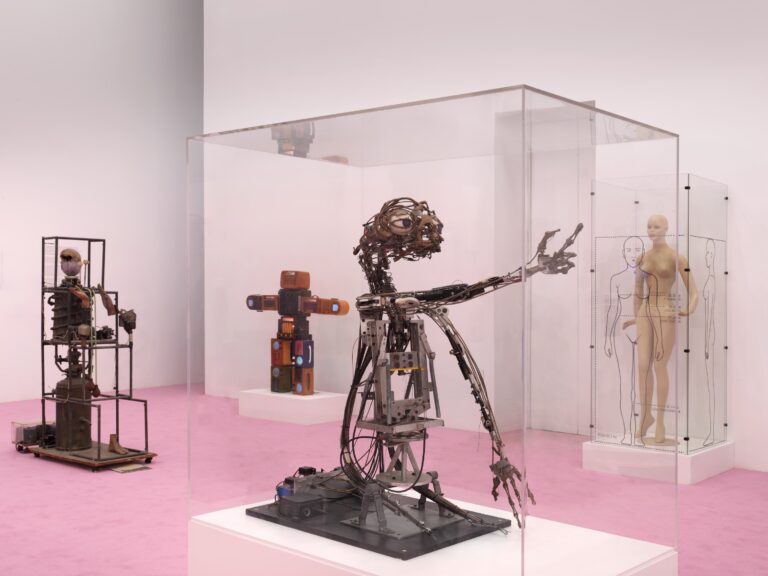
In one standout work from his “Breathers” series, installed high on a wall, the neo-conceptualist creates a quasi-religious tableau akin to the Four Evangelists bringing the Good News from electric fans and vinyl fabric.—David Rimanelli
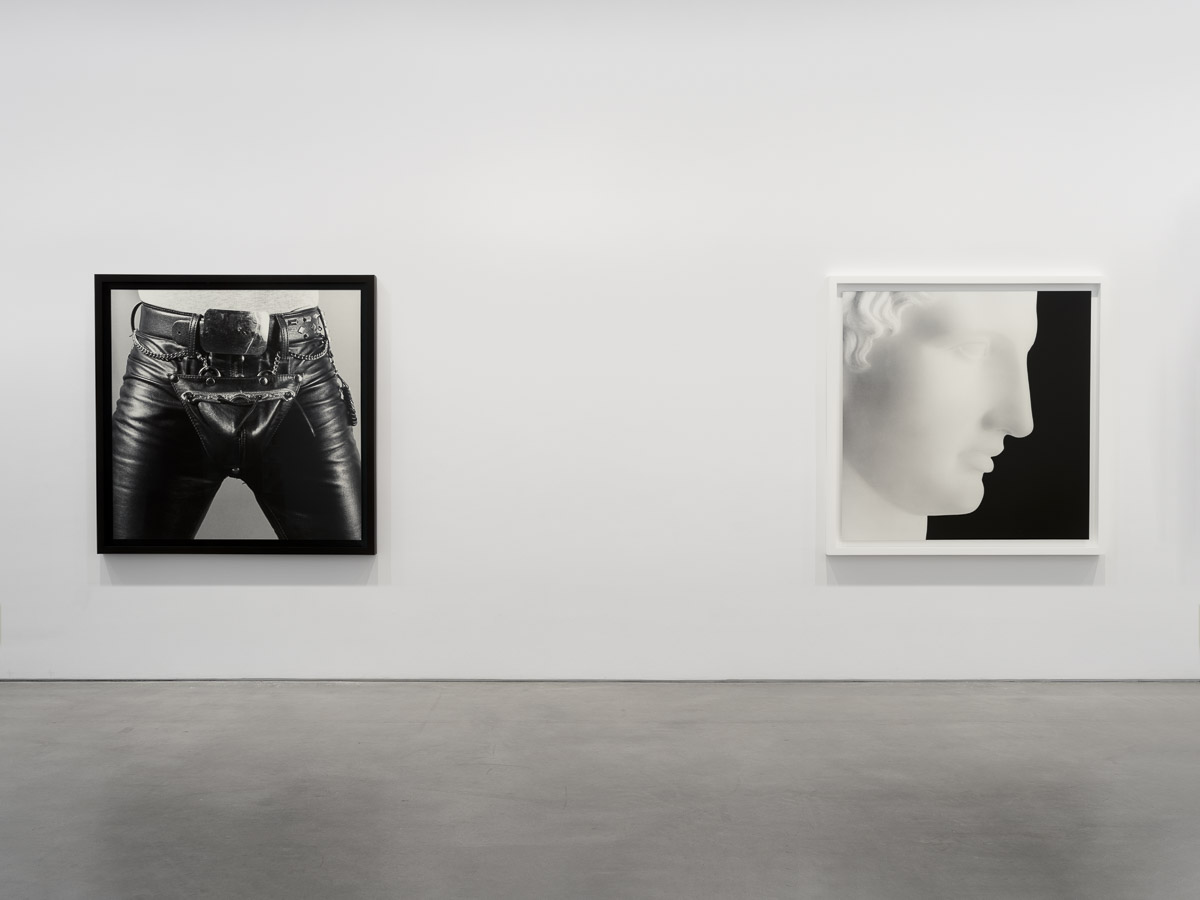
“Robert Mapplethorpe”
Gladstone | 515 West 24th Street
Through April 18
It’s self-evident that these posthumous silver-gelatin blowups of some of Robert Mapplethorpe’s most iconic images are justified by the logic of his work, that his pictures are even more powerful at this scale, because, above all, Mapplethorpe is our great visual philosopher of power, making adamantine emblems of the fucked-up power dynamics of desire, control, fame, beauty, etc.—all inherent within the most basic photographer and subject, subject and object relationships—and while it would be easier on everyone’s nerves, not to mention their politics, if he just didn’t do that, he did: here the photographs are again, stronger than ever, inescapable.—Jarrett Earnest
Torbjørn Rødland, “Bones in the Canal and Other Photographs”
David Kordansky | 520 West 20th Street
Through April 25th
In a number of the artist’s images here, his subjects (slender women, naked bodies, clowns) are lit from behind as if standing in front of a train or car headlights; their silhouettes’ shimmering edges make the photos seem to glow from within and lend them a beautiful, eerie drama.—Gracie Hadland
“The Lost Beauty of Humankind: Robert Bergman’s Portraits in the Hill Collection”
Hill Art Foundation | 239 Tenth Avenue
Through April 11
People are all different, although at certain levels of abstraction they may remarkably resemble one another, just as paintings and photographs may resemble each other in many ways while remaining importantly, fundamentally, different, however there is no way to tell except by putting things side by side and looking for yourself, and so, writer-theorist David Levi Strauss does exactly this, brilliantly, in curating an exhibition of Robert Bergman’s lush photos of down-and-out people encountered on the street—wrinkled, scabbed, looking back and away—alongside a selection artworks, including a state-of-the-art reproduction of a Pontormo portrait (much better than a normal print, but in no way approximating the surface or experience of the real painted object), which is placed next to a Bergman image of a staring youth—the similarities and differences can only be grappled with in real time and space, which is what exhibitions are supposed to do, make visual arguments in their own terms, which Strauss clearly understands and pulls off with deep feeling, and with the overall effect of an artwork itself.—Jarett Earnest
UPTOWN
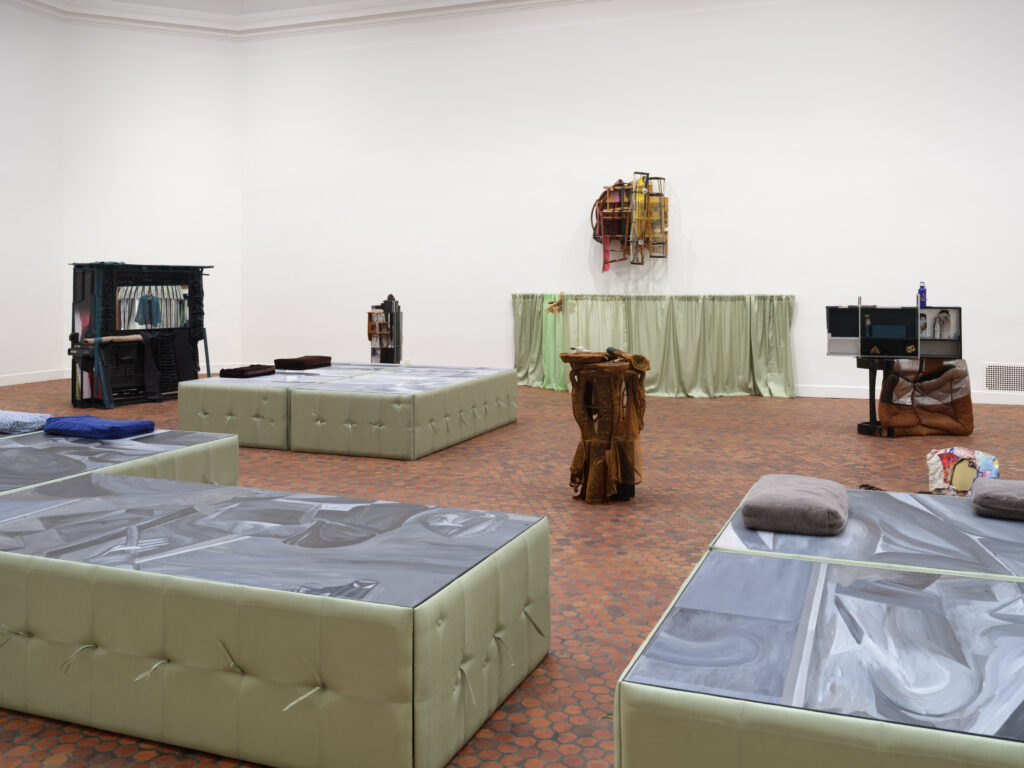
Jessi Reaves, “process invented the mirror”
Arts and Letters | Audubon Terrace Broadway between West 155 and 156 Streets
Through July 3
The tomette floor pairs so well with the celadon curtain, it’s hard to imagine both that this show was at the Walker without it and that Reaves’s Frankenstein furniture won’t forever excite me.—Whitney Mallett
“Afterlives: Contemporary Art in the Byzantine Crypt”
The Metropolitan Museum | 1000 Fifth Avenue
Through January 10, 2027
Staged as a literal underbelly to what is sure to be a ticket- and money-printing exhibition of the great 16th-century “influencer”—the museum’s words, not mine—Raphael, upstairs, contemporary works spanning the last few decades, including the recently late Melvin Edwards’s welded steel evocation of lynching and Michael Aschenbrenner’s blown-glass bones bound into splints with cloth and twigs, are densely clustered with artifacts of late Roman, Byzantine, and Coptic origin, forming an almost injuriously compact yet conceptually weighted exhibition stashed in a solemn brick gallery unearthed during the museum’s structural renovation.—Paige K. Bradley
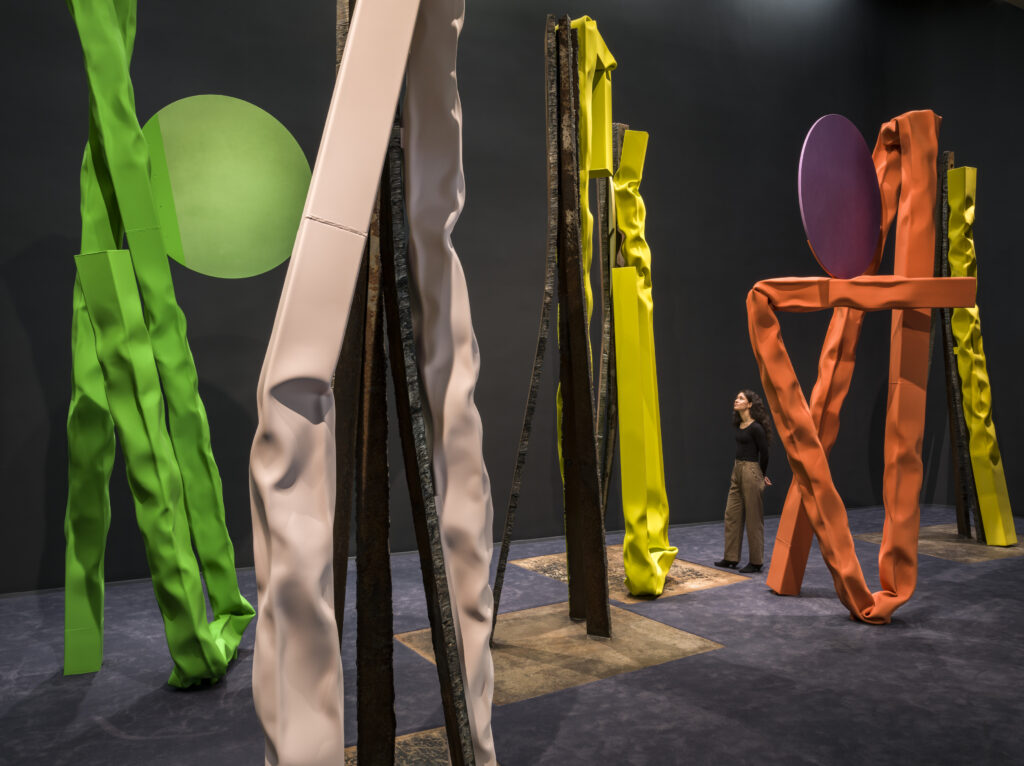
“Carol Bove”
Guggenheim Museum | 1071 Fifth Avenue
Through August 2
No one has really killed it on the museum’s central ramp since Hilma af Klint, whose paintings, commissioned by the spirit guide Amaliel, were, as luck would have it, meant for a spiral-shaped temple—not until Carol Bove likewise answered the call from another realm (let’s imagine) to do the rotunda up again, similar palette more or less, but this time in supple monuments and missives in pinched and draped steel.—Johanna Fateman
Dorothea Rockburne, “Time Measures Itself”
David Nolan Gallery | 24 East 81st Street
Through April 18
I once heard Dorothea Rockburne say, “Art is language, don’t make it do”; this gathering of works, past and present—she is 96—centers on the perception of material and form, as if to also say “now is all we have,” and even the scent her materials throw off keeps me grounded.—Paige K. Bradley
Rachel Rose, “The Rest”
Gladstone | 130 East 64th Street`
Through April 25
I hunched to peer into these small, capacious paintings that enchant the Hudson Valley by blurring representation with expressivity and myth—the world seen through a devotional tear.—Brian Droitcour
SOHO / TRIBECA
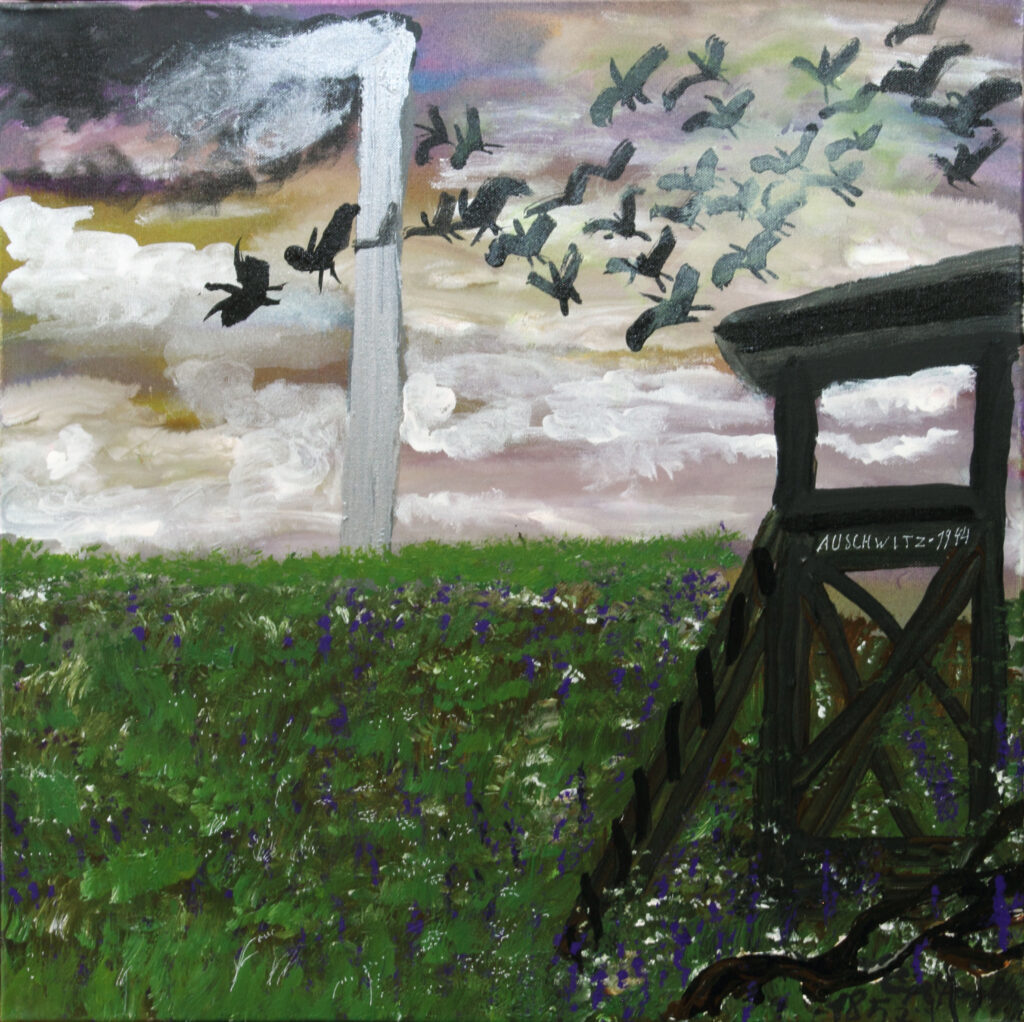
“Ceija Stojka: Making Visible”
Drawing Center | 35 Wooster Street
Through June 7
Curator Lynne Cooke introduces the mesmeric genius of Ceija Stojka—self-taught artist and survivor of the Romani Holocaust—whose work, including images recalled from internments at Auschwitz, Bergen-Belsen, and Ravensbrück, transforms unspeakable atrocities into emanations of pure life force.—Margaret Sundell
Doron Langberg, “Landscapes”
Deitch | 18 Wooster Street
Through April 25
With triangulating sites—in Israel, Ukraine, and Fire Island—painted at the scale of Pollock and Delacroix, the artist, once and maybe forever a darling of queer figuration, now turns to landscape, exorcising the settler-colonial sublime in a nervy mix of registers: from the heart and the pit of the stomach, a searching illogic of reduction and distortion that stuns.—Johanna Fateman
“Claudio Perna: Idea Como Arte”
ISLAA | 142 Franklin Street
Through May 2
This show’s reticent wall labels prove that—without knowing the precise rules of Claudio Perna’s game—you can still relish the late Venezuelan Conceptual artist’s photos, collaged maps, and scribbled notes, which together start to form an intriguing portrait both of a man and of his home country.—Dawn Chan
David Armstrong, “Portraits”
Artists Space | 11 Cortlandt Alley
Through May 23
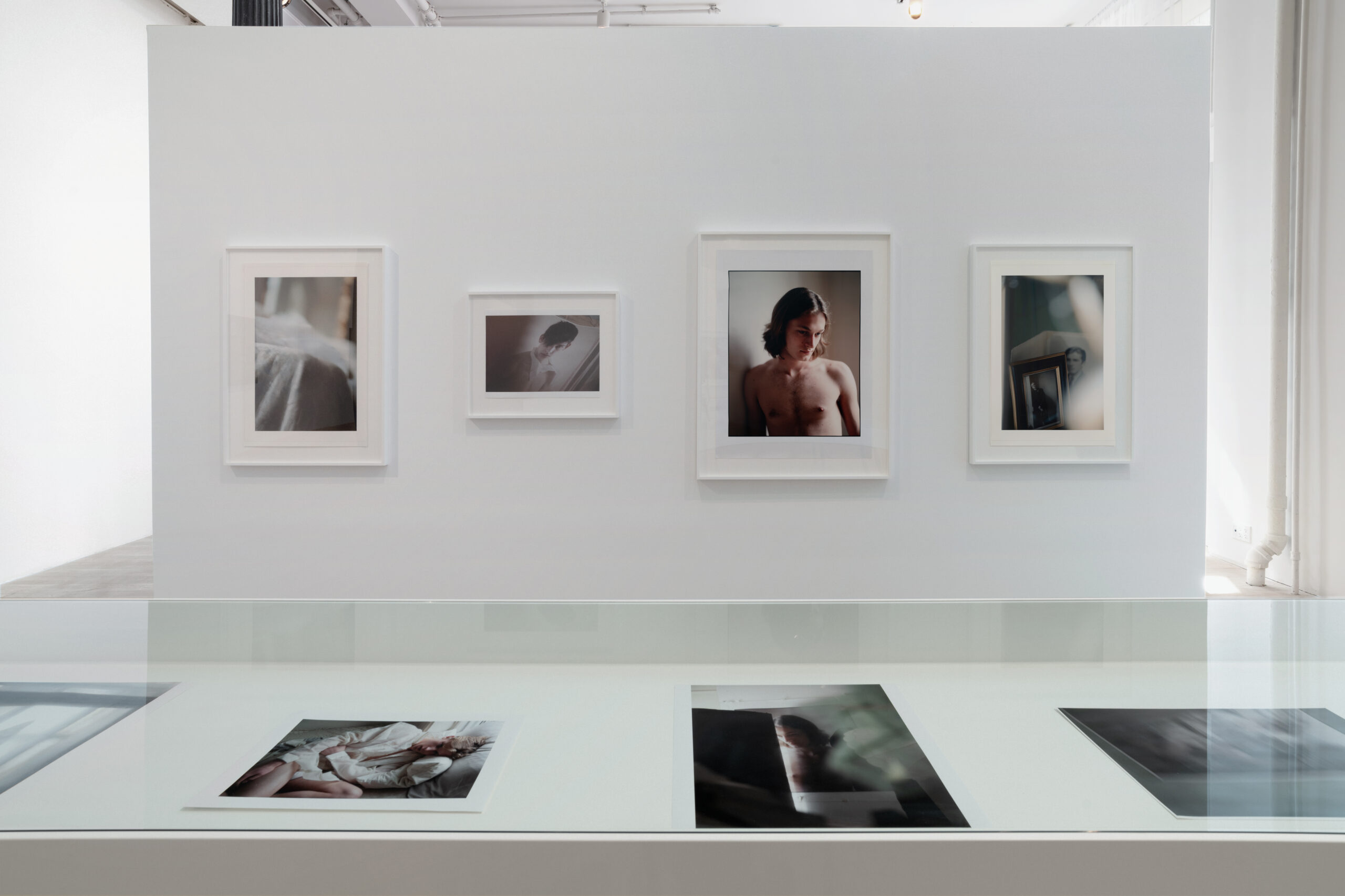
Of course he shot with a medium-format Rolleiflex at the chest, the eyes tell it: let’s look a moment longer, now at David, no, at Boris, Monica, Andrew, Ethan, Eduardo, Marcus; I still have your picture on my wall.—Devan Díaz
Eli Hill, “Internal Weather”
Harkawik | 88 Walker Street
Through April 25
The painter’s melancholic portraits, drenched in cool blues and haunting reds, capture gay boys running on trails and slouching in chairs before mirrors, the works lovingly depicting the fraught competition of perception played out on sun-kissed Fire Island or in chilly Brooklyn apartments.—Grace Byron
LOWER EAST SIDE
Yuval Pudik, “Time Takes a Cigarette”
Palo | 21 East 3rd Street
Through April 25
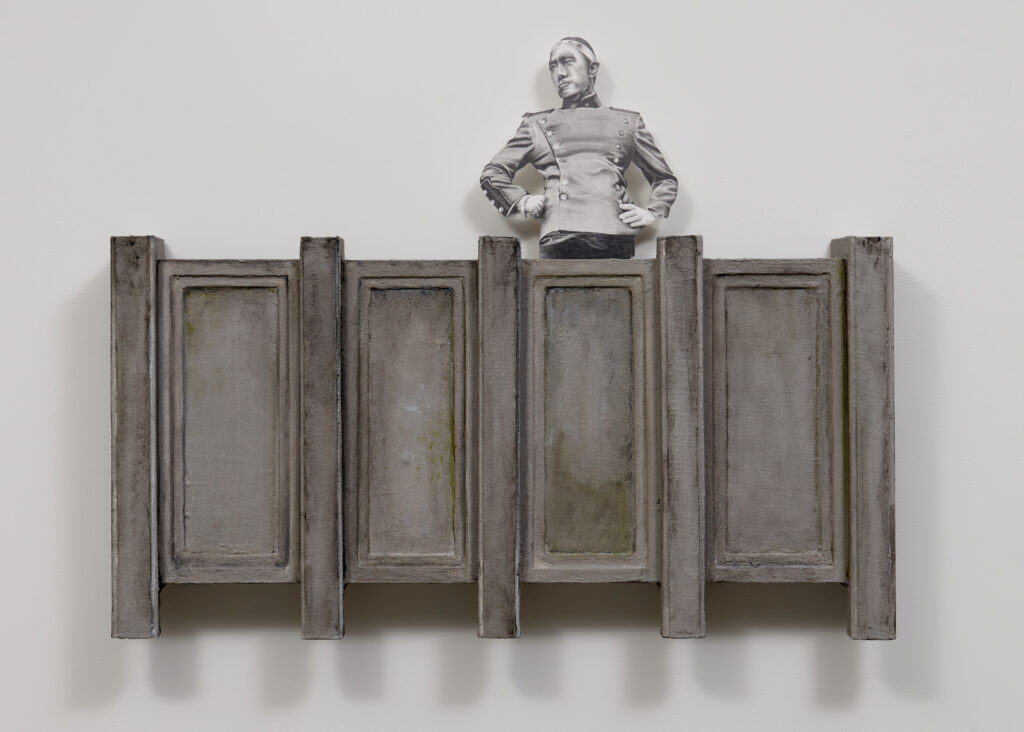
In the front space, by the window, is a little cut-out graphite drawing of novelist Yukio Mishima peering down from a three-dimensional recreation of the brutalist balcony where he gave his failed speech to overthrow the Japanese government moments before committing seppuku in 1970, mounted to the wall like a puppet theater, high up, impotently addressing the rest of the works in the exhibition, which include a life-size drawing of Eugène Delacroix’s tomb beneath a snaking cursive line (the David Bowie lyric that gives the show its title), in between a number of collaged objects and drawings of collaged objects that mine the thornier problems of “queer history,” a precarious fantasia of which this artist is an elegant, hard-bitten analyst.—Jarrett Earnest
Gelitin, “All for All”
Perrotin | 130 Orchard Street
Through April 11
The mashup of relational aesthetics and Viennese Actionism had a heady appeal for biennial curators at the top of this century, but tastes have changed, and now the collective’s playful and occasionally lewd modular garden-tile portraits are hawked as rustic tchotchkes for the red chip set.—Brian Droitcour
dean erdmann, “Vitrum”
Company | 145 Elizabeth Street
Through April 18
In the basement gallery, a dazzling and enigmatic glass ATV sits atop a small black stage, inflaming the viewer’s machismo or masochism amidst a series of mechanical parts and imagery frozen into casts and pictures.—Grace Byron
Victor Van, “Great Expectations”
Open Studio | 127 Henry Street
Through April 24
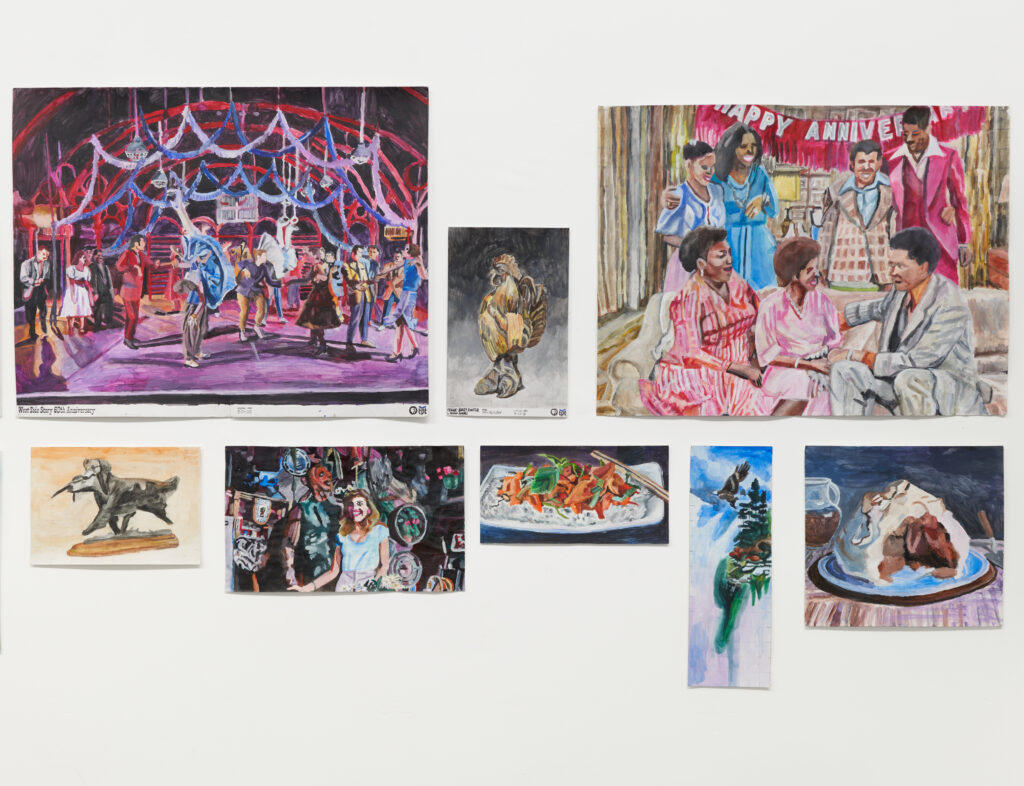
With titles like Unforgettable Thanksgiving Surprises at Walt Disney Resort, IHOP Mexican Churro Pancakes, and Wheel of Fortune 7000th Episode – New!, Victor Van’s peppy paintings on paper have the power to really turn your day around.—Sam McKinniss
Brock Enright, “I AM SO PRETTY”
Club Rhubarb | 3 Prince Street
Through May 19, by appointment
Come, be led up the stairs and through two floors of this townhouse “gallery” (someone lives here) to see a wide range of works by this immersion-oriented, multimedia bowerbird of an artist: things-embedded-in-fabric paintings, all manner of assemblages (free standing, hanging from the ceiling, tucked into drawers), environmental works, and don’t miss the videos in the bathroom, where one highlight is a Jackass-meets-Vito Acconci performance related to Enright’s previous business venture, a boutique kidnapping-roleplay service. —Johanna Fateman
QUEENS
Pat Oleszko, “Fool Disclosure”
Sculpture Center | 44-19 Purves Street, Long Island City
Through April 27
Walking in, one immediately devours Pat Oleszko’s colorful blow-ups, which tickle and delight; anthropomorphic bulldozers and missiles, with playful puns scrawled on them, turn the barren concrete rooms into a carnival.—Grace Byron


 in your life?