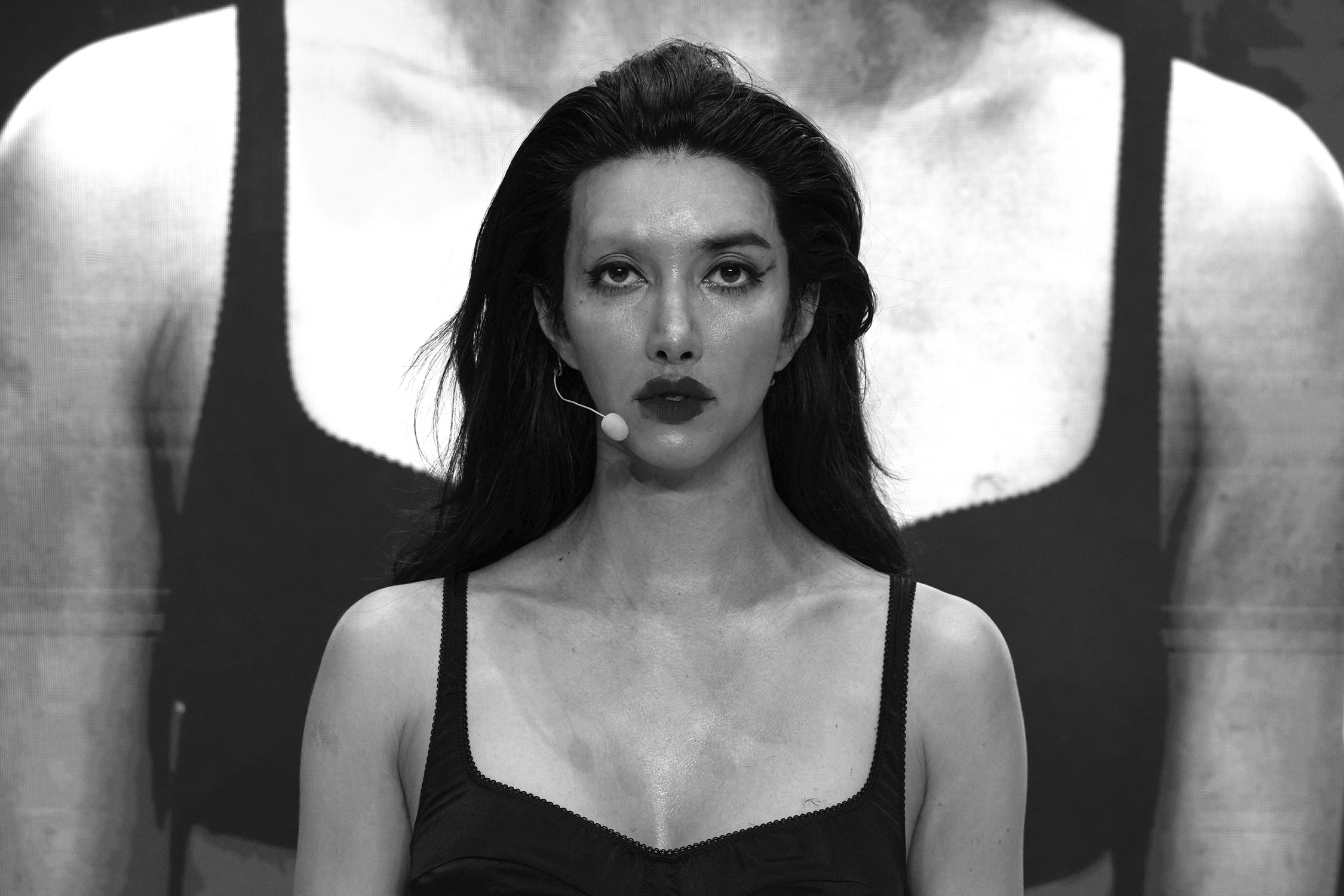
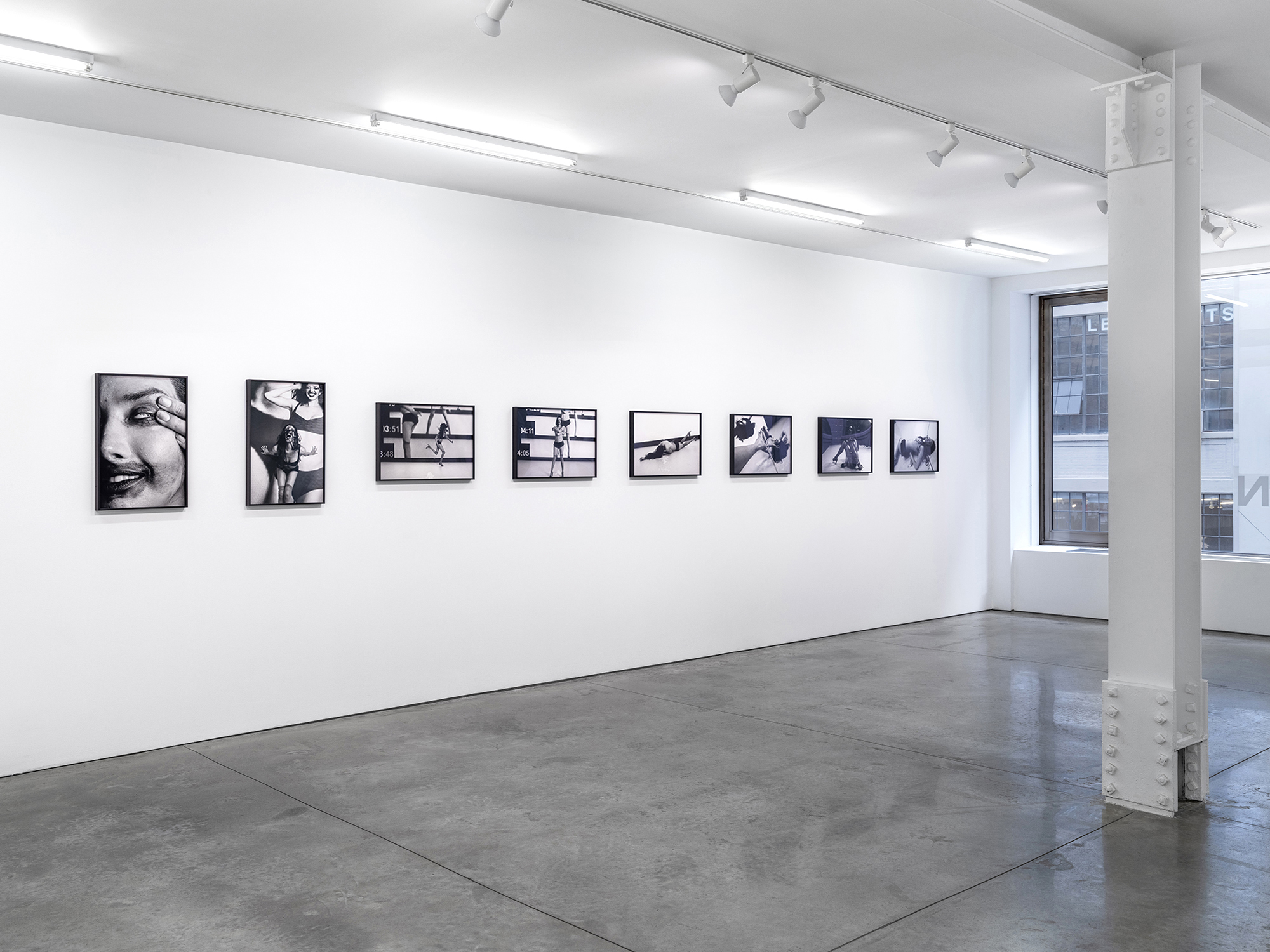
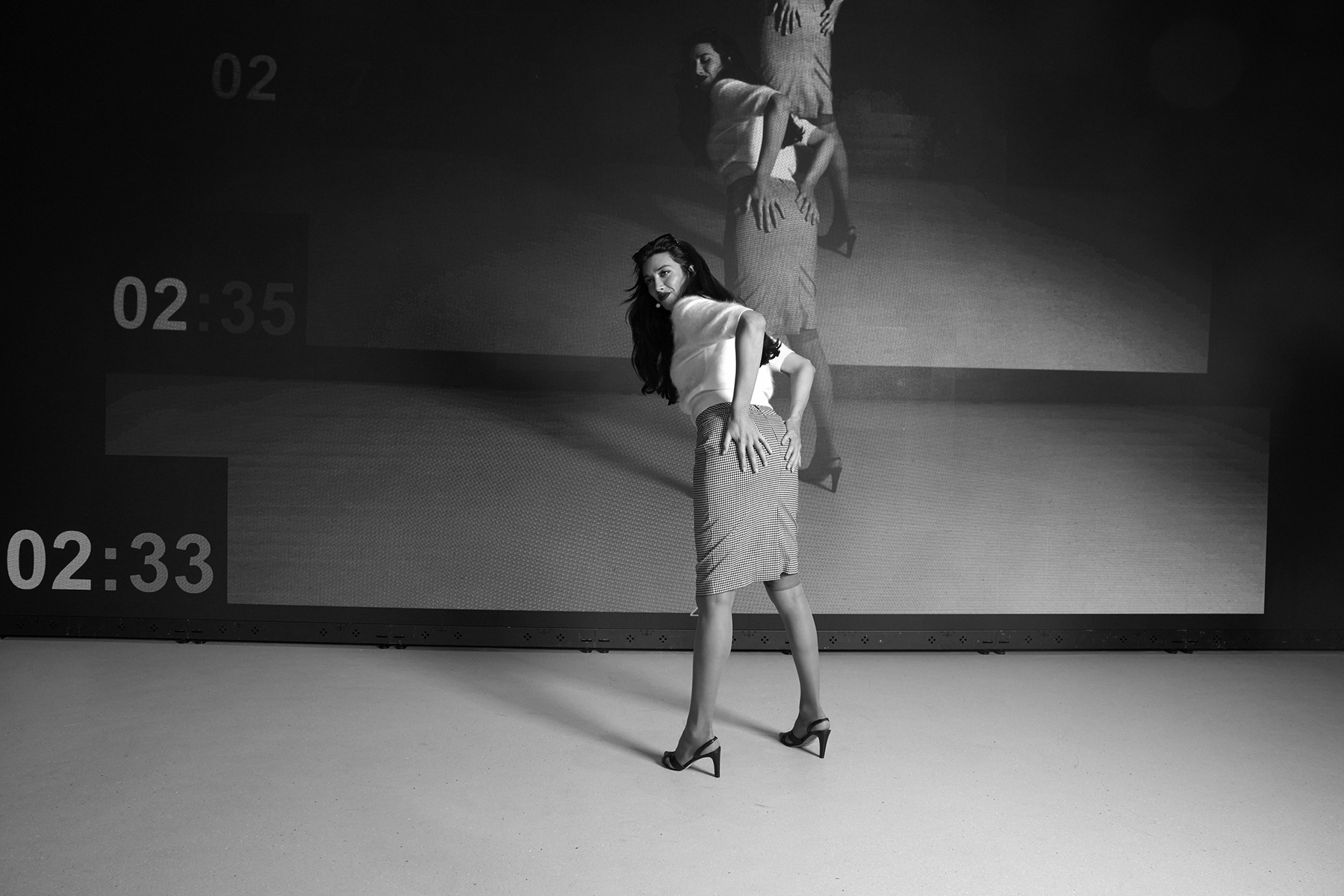
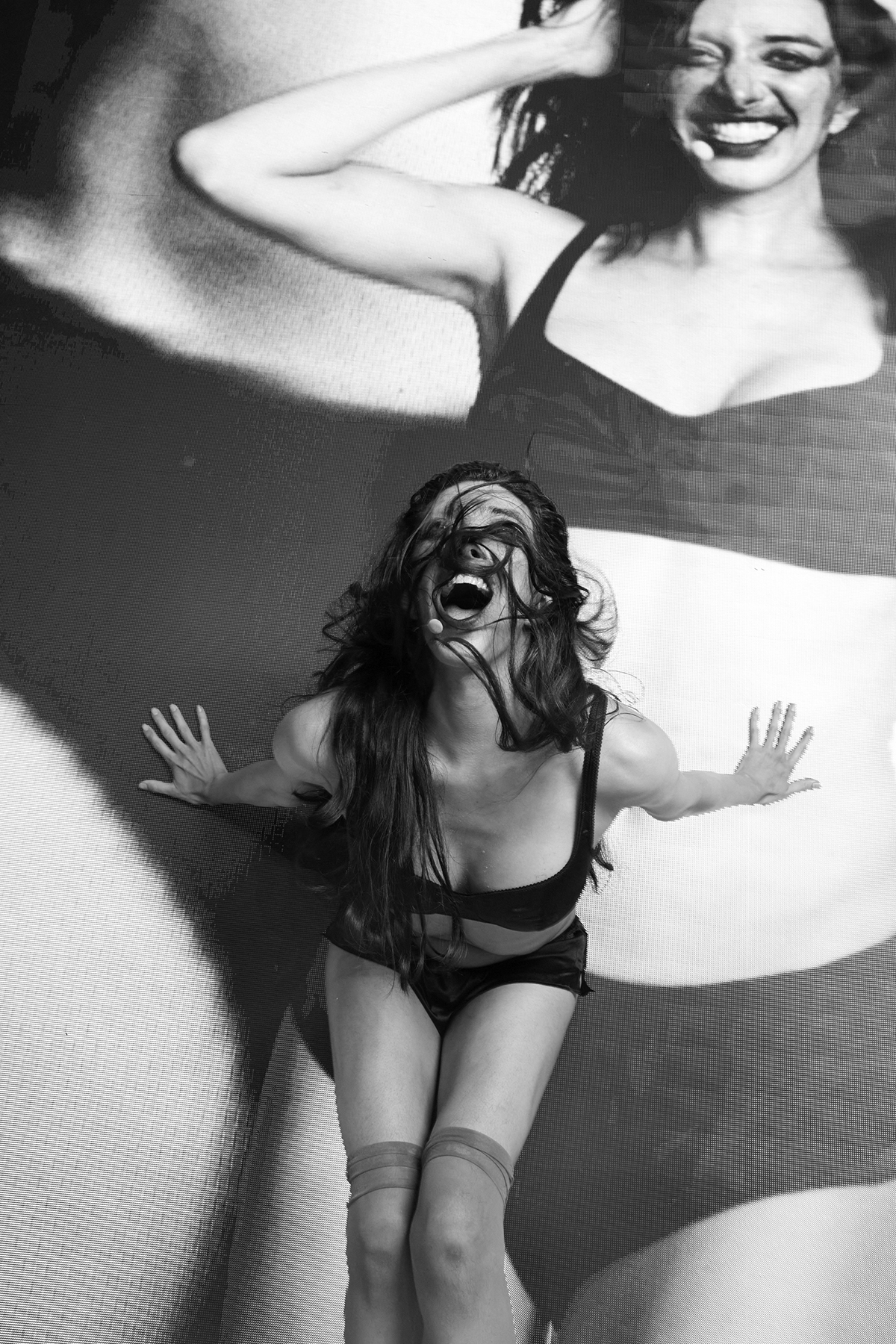
Martine Gutierrez is an enigma, a shape-shifting artist. Her recent show “Lottery” at Ryan Lee Gallery in Manhattan chronicles a performance she staged at Paris Photo just last year, where attendees were asked to “dom” Gutierrez by telling her what to do. The photos that resulted were displayed alongside a video installation recreating a waiting line. I met up with Gutierrez a few weeks ago to see the stunning show afterward. She created a meta conversation where she acts as both the interviewer and the interviewed, drawing on elements and inspiration from our talk. Below is the text she created.
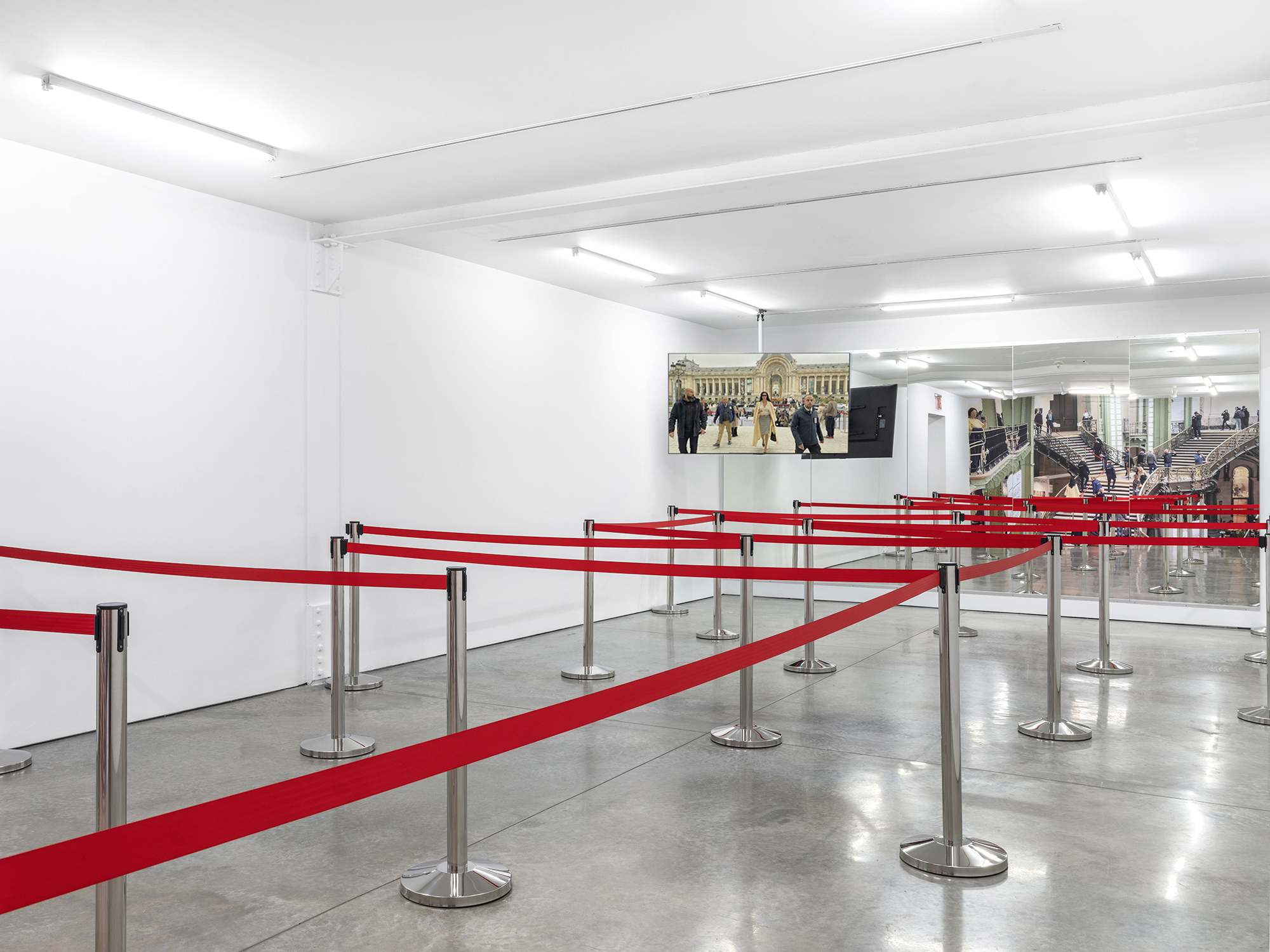
I love the “waiting line” you recreated in the gallery. Talk to me about that choice and why it felt important to include alongside the photos.
The red blockades are actually the same ones used in Paris—they are very expensive. I hope it felt like you were VIP. I like the gallery to feel active, like arriving at an airport.
The entire exhibit feels a bit like a tease. Even as we wait for the video to finish counting down, you show us your arrival at the Grand Palais, but do we ever get to see Lottery take place?
It’s true, I am edging New York. They need it—New Yorkers are so spoiled. At the opening I think it was expected that Lottery would happen again. It didn’t—blue balls for sure.
Yes, and you only exhibited 17 photographs, how many in total were taken during the performance? Was there a reason you chose not to share them all?
755 photographs were taken in Paris. I only chose to show the images that were compelling. What’s left out of the time line a viewer has to imagine.
How did you come up with this concept—the performance itself? What did you want to convey?
I was thinking about what it means to be a muse—what a muse is to others, but also what it requires.
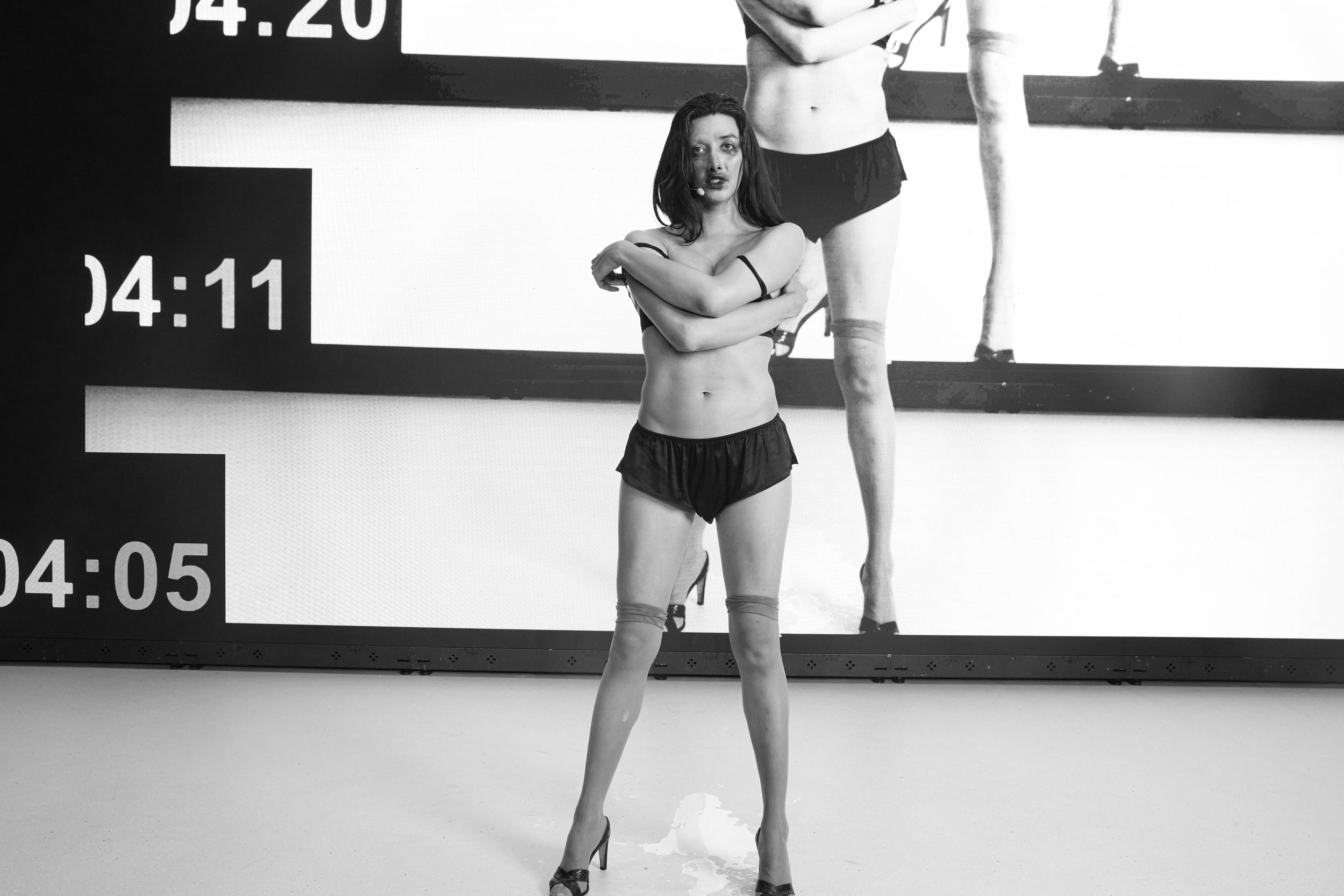
Were you thinking of specific artists or specific dialogues performance has had?
Yes, and no. Marina [Abramović] would say, performance exists in the memory of those who witness it. I like that. For Yoko [Ono] it’s a practice to engage people, and spark collective responsibility, which is very Lottery. Regina [José Galindo] might conjure violence or spark activism, more like Faith [Ringgold]. Needless to say, the body is central material. Who the individual is contextualizes how an audience interacts with them.
So you are mostly looking at artists who are women, performing in the ’60s and ’70s?
Yes, I’m in that camp, but it’s also up for debate because of my background. And it feels a bit like who cares, we’ve seen it all before—it’s hard for anyone to make anything not in direct reference, because everything echoes something else.
But that’s part of the conversation, right?
Yes! Performance is always in conversation. It thrives on the personal and the present moment—which made Lottery into a wild card. There were stakes to be raised. Initially I was invited to the Grand Palais to speak on what I do… I muse.
True. You are a well-known muse, and mused on by many. Some might say you’re an ingénue, especially for a film maker—Julio Torres continues to put you in everything he directs.
I love Julio [Torres], he has taught me so much about colors. I feel I know him intimately, but the challenge is letting him know me. A muse is unknowable in a way, it can be anything.
You are a bit of an enigma. It’s hard to predict what you’ll choose to do next. Why choose the camera as your tool?
Believe it or not, I have an aversion to my picture being taken. I’m always trying to escape a camera, unless it’s mine.
Really? But isn’t being on camera your job? You are known for taking self-portraits.
Yes, but when I take pictures of myself it’s different—I have control. It’s the only time I’m free in front of the camera. When it’s my camera, my image, it’s no longer about what the world projects onto me. I get to choose.
How are the images in Lottery different from images you would usually take of yourself?
For starters, I’m not alone. I muse for whoever is behind the camera. Every image is a new request, made by someone in the audience playing the Lottery. I state that I’ll do anything they ask if they agree to take the picture.
Was the audience at the Grand Palais all strangers? Did that make it easier to give up control?
There were a few familiar faces, which was reassuring—but my invitation was part of Paris Photo’s lecture series, so the audience was very international. Foreign. The further Lottery went, the more demanding it became—each round the stakes raised and got more chaotic.
Other than documentation, what did the camera become during the performance?
The camera became a witness, it made visible the public’s continence. Giving power to a stranger puts them face to face with a moral temptation. It’s a test. How far will you go? When I look at the photographs they reveal more about the person behind the camera.
How far did you go?
Lottery played as far as it could before Paris Photo pulled the plug.
They stopped the performances. Did it stop because something bad happened? How long did it take?
About 60 minutes in Lottery was interrupted. I think there was concern for my well being.
It only took an hour to escalate that much? Why?
Um, because I didn’t bring the rope.
Rope!? Can you describe what was happening when you were interrupted?
There is a photo of it. I chose to show it—the last photograph taken before security stepped in.
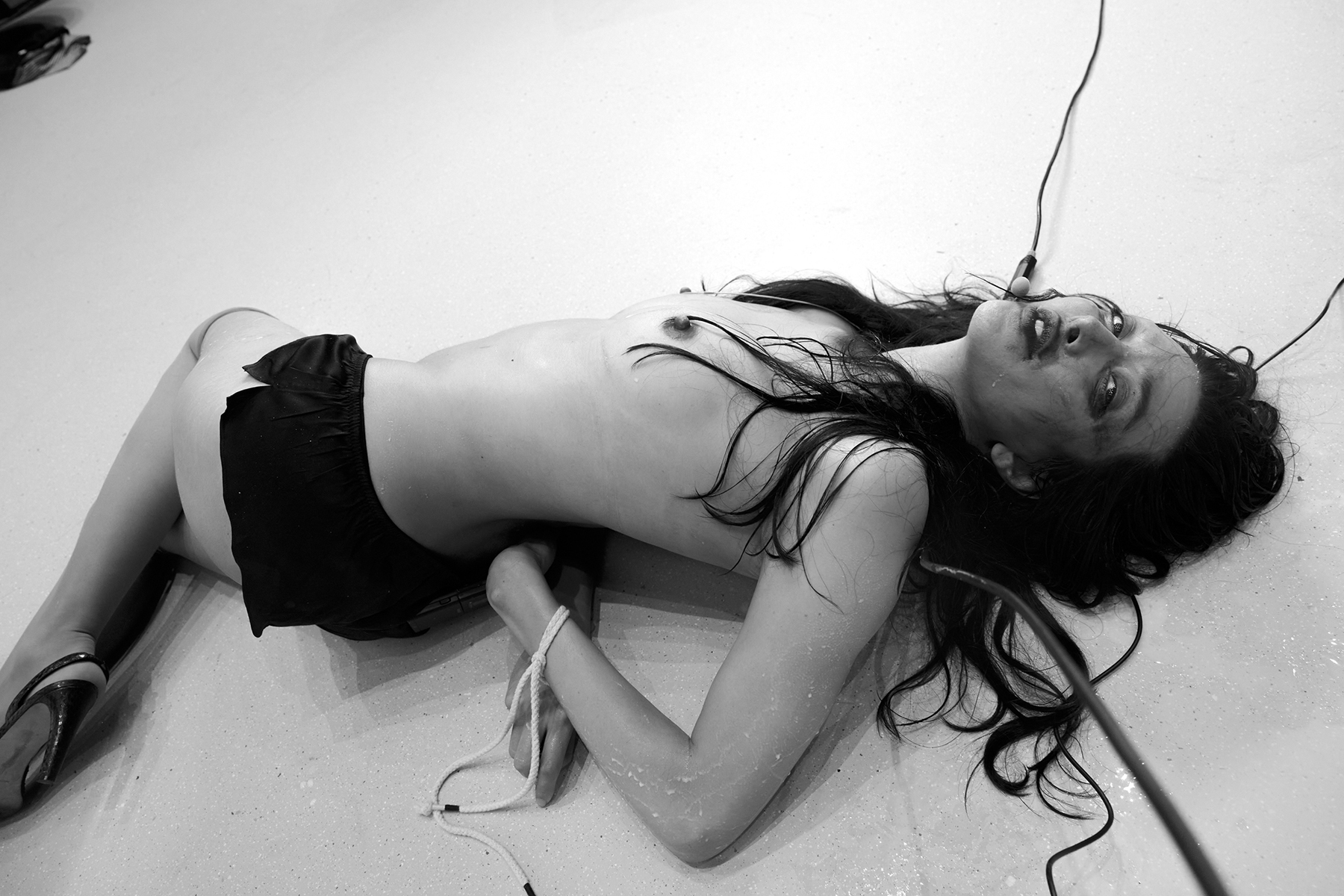
Yes, I heard security whisked you away. What had been asked of you just before?
By this point, I had been asked to remove almost all my clothes, and had been tied up on the floor, with my hands behind my back. But I also think collectively the room felt the echo—foreshadowing what would come next.
Of chores, the performance is already in reference to collective responsibility. I think of Yoko’s Cut Piece. I also think of [Harvey] Weinstein’s victims, and the images of sex trafficking currently in the news cycle. We are inundated with images of violence against women, in cinema, in fashion, in pornography, etc.
Absolutely. And we’ve been overexposed to images so frequently that they no longer shock us.
How had you originally planned for the performance to end?
I didn’t get that far. My concern was, how do we play Lottery? How do I get strangers to play with me? Because of cancel culture or whatever, I had hoped we learned something from the past. Instead it all went the same way.
It’s so discouraging. Maybe the audience was re-enacting what felt expected, because they knew the references. This was after all, an audience of art lovers—these were your fans! How did you feel? It must have been very difficult.
That’s a secret I’ll never tell.
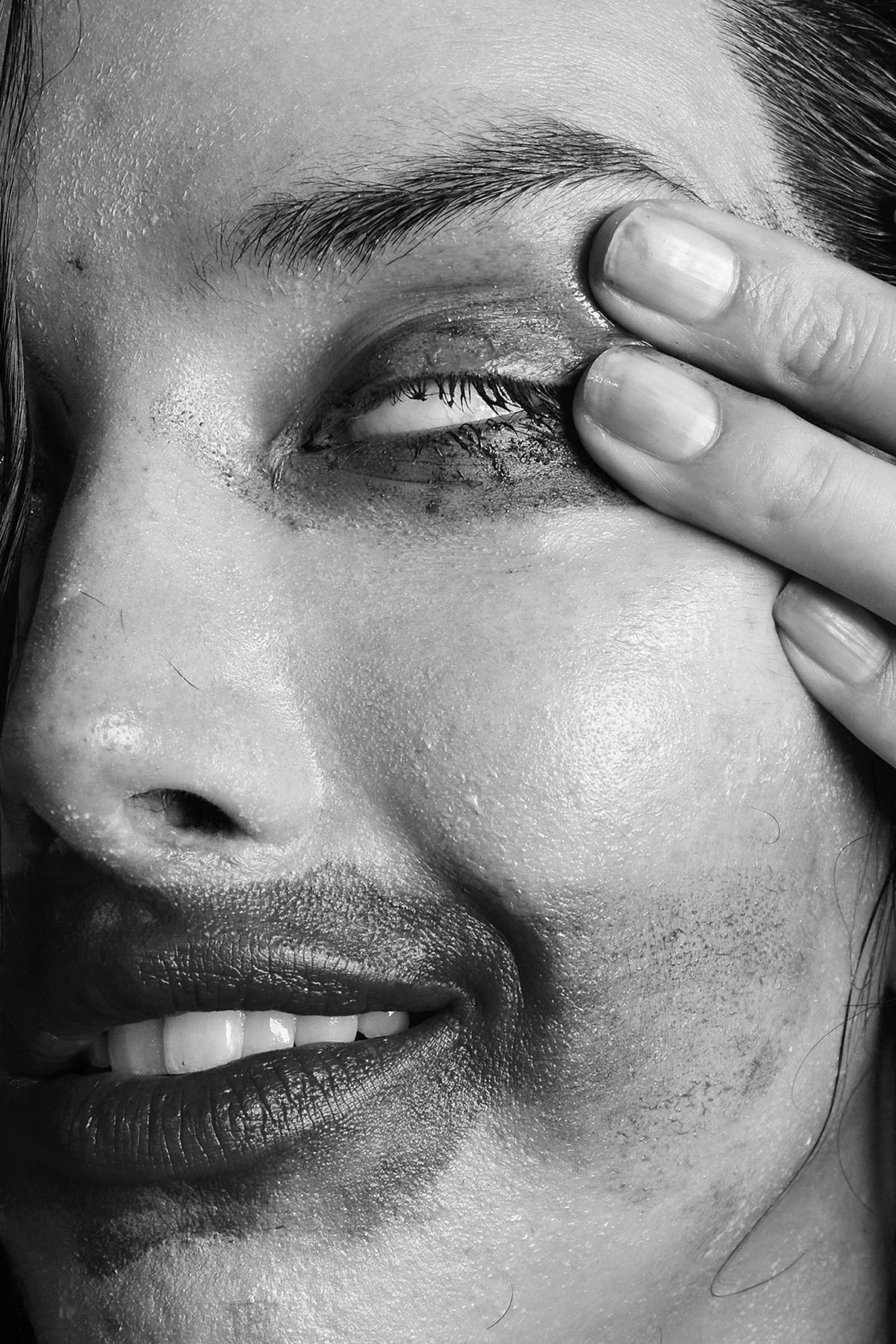
Well then, what was the easiest request made by a Lottery photographer?
To shave off my eyebrow.
Shave off your eyebrow?! Where did the razor come from?!
My purse. Sometimes I have to shave my face! And he knew that—we had history. The request did not come from a stranger.
How did you know him?
I used to be in love with him. It was years and years ago. It’s all very Marina [Abramović].
Very Marina [Abramović]—the echo continues! Did he know you were in love with him?
If he didn’t, he does now.
Talk to me about the other citations you’re drawing on in this body of work?
You know the story of the magic lamp? Well, I’m the genie of the camera, and your every wish is my command. But once my camera is in the possession of another, all your power over me is gone.
Why go through all this? Are you searching for something specific?
A diamond in the rough.
I thought you were going to say S&M.
Well, yes! And the performance continues to draw criticisms for its depictions of bondage, spanking and sex—but you know what? You can’t exercise submission without domination. I’m not a victim. People don’t realize the submissive has just as much power, without them there is nothing to be dominated.
I see, it’s a contract of consent. What do you think Lottery says about power?
Everything! Everything is about power and our proximity to it.
You spoke a little when we first met about different ways femininity traffics and filters in different countries. How much do you think beauty played a role in the audience interacting with you?
When I muse on femininity it transforms the genie—I am made into a wonder woman. And like all women, especially the most beautiful, we are made targets of violence—by men but also by other women, who ridicule beauty for what it elicits.
Martine, you are Wonder Woman. But for the sake of the argument, l’ll agree the construction of femininity is something that’s applied, what then is underneath? Who is Martine? Are you the genie or the muse?
Both. The muse is the genie—the genie is the muse, she is your ingénue. She is an idea, a projection made true through a wish.
I see. Before the performance was put to an end, do you think it was your beauty the audience was after––or the power you have to wield beauty?
Beauty makes an almighty prisoner, it puts the genie in the lamp—so to speak. During Lottery, I was treated the way society has always treated women, as an object. The experience was the closest I may ever come to truly understanding womanhood.
More of our favorite stories from CULTURED
Legendary Art World Deviant Paul McCarthy on Santa Claus, Trauma, and the Rise of Fascism
Gabby Windey Shares Her Book Recommendations for the Manosphere and Depressed Women Everywhere
15 Collectors Offer Their Best Advice For Getting Started
Bryan Stevenson on What Social Justice Movements Can Learn From March Madness
A Guide to the Real-Life New York Restaurants Where Characters Eat on TV
Sign up for our newsletter here to get these stories direct to your inbox.


 in your life?