Bryan Stevenson looks at justice a bit like playing the piano.
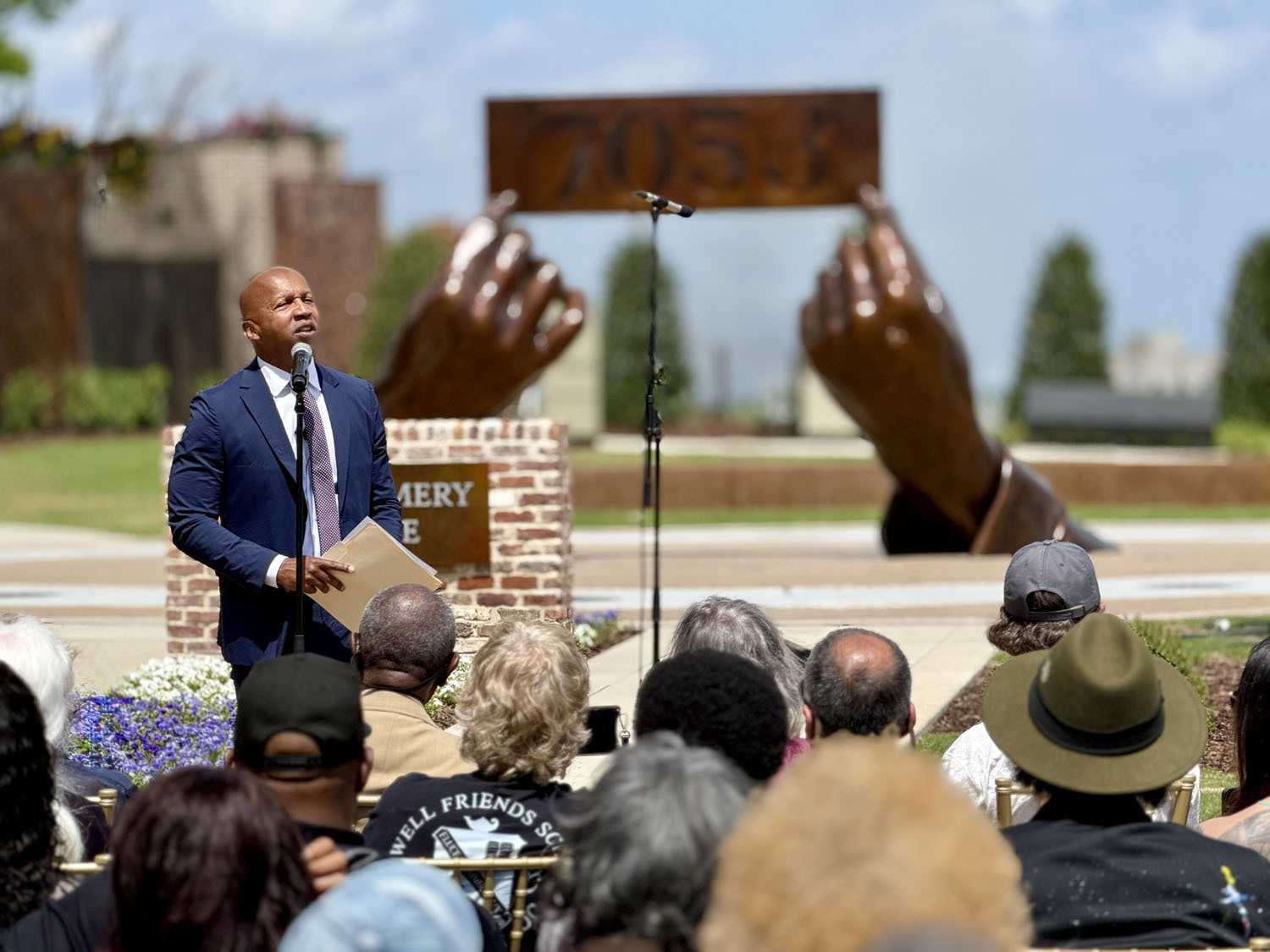
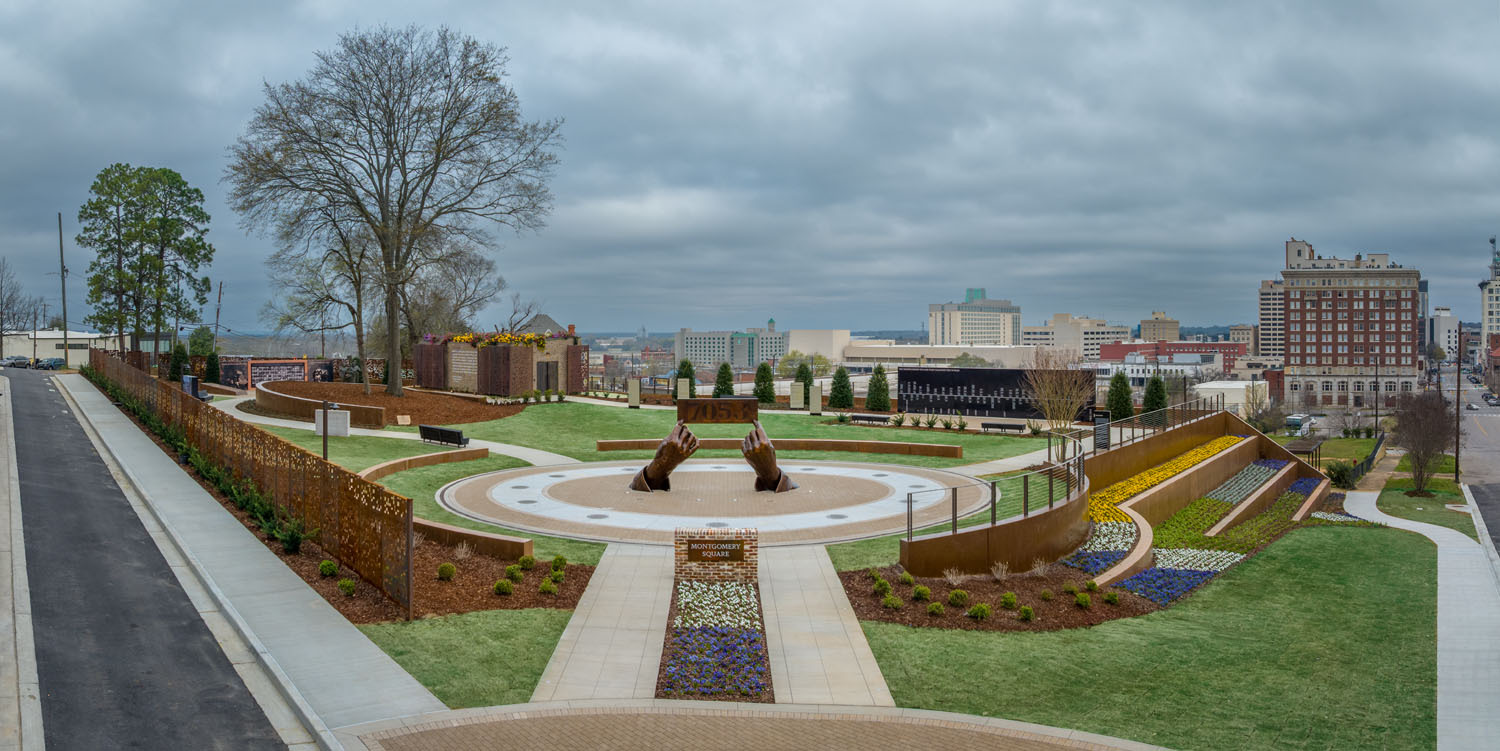
“Sometimes, the rhythm in your left hand is completely different from your right,” he tells me. “We have to keep time in both hands.” While Stevenson is indeed a musician, he spends most of his time committed to ending American mass incarceration and excessive punishment. As a civil rights attorney for those on death row and the executive director of the Equal Justice Initiative (EJI), keeping time in both hands is a challenge that calls on his own time-honed rhythm. From their offices in Alabama, Stevenson and his team shift policy to protect those made vulnerable by structural violence in the immediate while also investing in longterm narrative change. The latter takes shape through various EJI sites, from the Legacy Museum and the National Memorial for Peace and Justice to the Freedom Monument Sculpture Park—all of which deepen understanding of the country’s legacy of enslavement, Jim Crow and segregation, and contemporary mass incarceration. Last month, on the anniversary of the Selma to Montgomery March, the organization opened its newest site: Montgomery Square, which commemorates the acts of courage that culminated in the Voting Rights Act of 1965.
On our call, Stevenson walks me through his ideas about automatic voter registration for Black people of age as a counter to decades-long Black voter suppression. I couldn’t help but think of Steve Bannon’s assertion last week—that ICE agents swarming our airports is a test case for upcoming elections. We are currently being called to further EJI’s work, to reckon with what will be required of us to address, undo, and build past long entrenched anti-immigrant rhetoric and policy. In other words, “we have to get at the narratives that have made some of these policies popular enough that they’re now being implemented so recklessly,” Stevenson urges.
Following the Square’s opening, Stevenson and I discussed local reactions to the new site, what accountability looks like in our current sociopolitical context, and what we stand to learn from March Madness as a community practice.
Let’s start with the opening of Montgomery Square. How do you envision the space in conversation with EJI’s other sites?
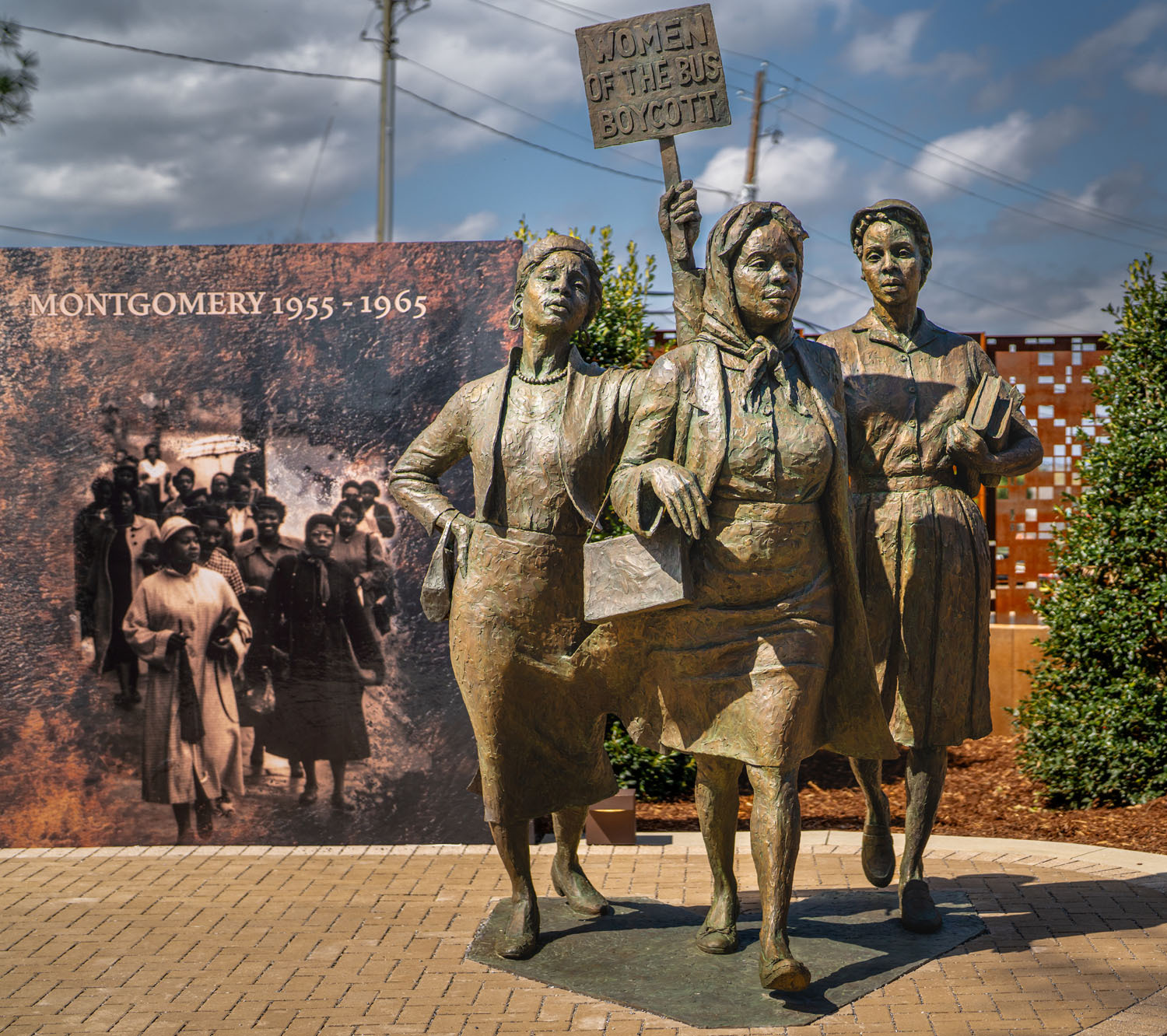
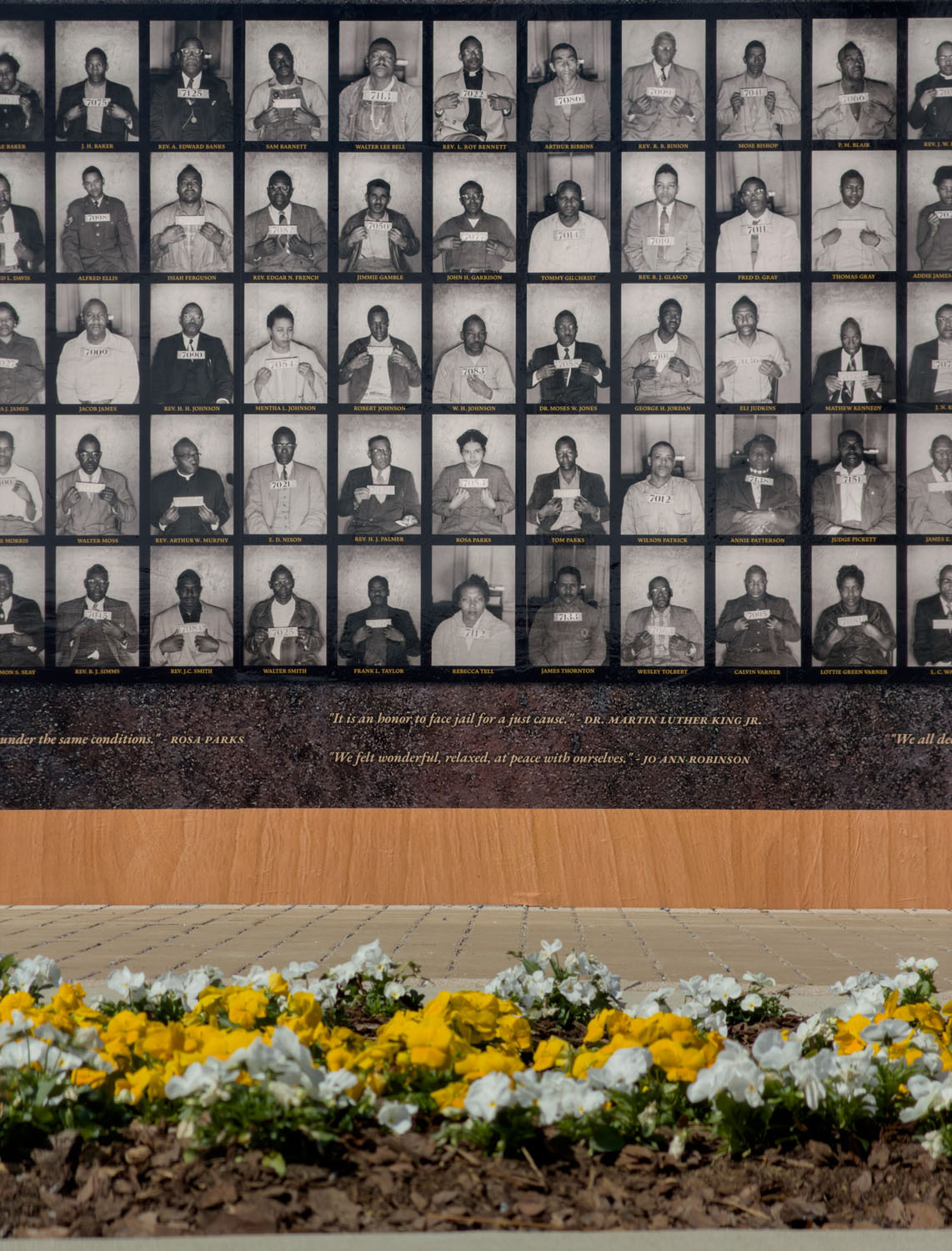
The museum is the comprehensive narrative space for people to understand this long history of racial inequality. We have [sites] that do deeper, more immersive work around slavery and lynching. The square focuses on the third era, Civil Rights, and Montgomery as a community. In many ways, it was the 50,000 Black people in this city who chose to stay off of buses for 382 days that gave birth to the Civil Rights Movement—1955 to 1965, in retrospect, fundamentally changed America. The collapse of Jim Crow and the passage of the Voting Rights Act allowed millions of Black people to vote for the first time, which has had a profound impact on this country’s legal, cultural, social, and political landscape. We put that in context to elevate the identities of people whose names are not well known: Linda Blackmon Lowry, one of the youngest marchers on Bloody Sunday, Sheyann Webb [who] was just 8 years old, people who worked as maids and cooks and domestics [who] were the heart of the boycott. This movement was sustained largely by women; the Women’s Political Council was the primary political movement that predated the boycott.
You’ve created a gathering place commemorating public memory.
It’s been really exciting to create an opportunity for people to share their lived experiences. The boycott was 70 years ago, the Selma to Montgomery march 60 years ago. We’re about to lose a lot of these voices and memories that can enhance our understanding. We’re [conducting] interviews and hearing people … [like] Dr. Viola Bradford say, “I just was so torn and conflicted, but I went into my classroom and I said to my classmates, ‘If you want to be free, come with me!’” It’s that kind of rich storytelling that I think decades from now will enhance the work of people trying to understand that moment. Courage in the face of overwhelming political, military, and economic power is a really resonant idea at this moment. We wanted to dramatize the courage of [these] people … and remind people that [others] have done so much more with so much less throughout our history.
You talk about “the ordinary and extraordinary courage of Black Americans,” in the same breath that you discuss the courage it takes to face harms caused as a country. In this current moment, what or who has stood out to you as particularly courageous?
The four million Black people emancipated out of the Civil War could have said, “We want revenge, retribution against the people who enslaved us.” They could have given in to legitimate anger and bitterness about the way their children had been sold and separated. They had this uncanny wisdom to know that wasn’t going to allow them to be truly free, that they would be burdened and imprisoned by hatred. Hatred is not a weapon you use against somebody else; it’s a poison that undermines your own ability to be fully human. It’s just uncanny to me that the community saw that, recognized that, and made the choice to build, to create, rather than to just engage in destruction.
You have to open a door for people to be something other than those things which are not healthy. And that gets to the other kind of courage: the courage to confront and acknowledge histories of oppression, bigotry, and violence—and then opt for something better. We do not have to be defined by our bigoted history; we have to acknowledge it, but there is a way forward. It’s funny, college sports are like a religion in a place like Alabama. Watching March Madness, people of all races are so engaged and celebratory when their team wins. These teams are disproportionately African American, but that doesn’t mean in places like Alabama, Georgia, Florida, and Mississippi people aren’t excited. They want the elation of being a legitimate champion more than they want the false echo of this narrative of racial hierarchy. If we can do that in the sports arena, in cultural spaces where people appreciate the artistry and ability to entertain, we can remedy the harms of history rather than be defined by them.
I’ve witnessed an urge to employ the same punitive tactics that we’ve applied to criminalized populations toward ICE agents—a “lock them up” mentality toward those who perpetuate structural violence. What do you think true accountability looks like?
We have to want to do something more than replicate the abuse of power that has created many of the issues that we see. Accountability doesn’t mean cruelty, it doesn’t mean abuse. It does mean acknowledging harm and wrongdoing and articulating a way forward that allows us to disincentivize new manifestations of these problems and histories. Many of the people who were complicit in mob violence or in segregation were doing what the community told them to do. They weren’t questioning [it]. There are studies of people who allow themselves to be pulled into cults. People who create cults have the power to create enormous fear or enormous anger. If you persuade someone that the world literally is going to end in a week, you can get them to do things. When they get on the other side of it, they realize, “The mistake I made was letting my fear overrun my capacity to reason, to be informed, to think critically.” I think that’s part of what we have to help people do: step back and realize that’s not healthy. When you don’t allow your actions to be shaped by anger, you actually do things that make you proud.
And what a beautiful motivator, pride—rather than shame.
This is my sports analogy again. It’s complete unbridled joy to have this team represent your community in a way that is successful. People are literally crying tears of joy, and they’re crying tears of sadness when they lose. My friend from North Carolina was literally sobbing on the phone because Duke lost. This is deep, which speaks to an honest emotion. The opportunity to have that kind of joy, that kind of fulfillment, that kind of dynamism, is something I think we have to offer. I want something in this country that feels more like freedom, more like equality, more like justice. I want that for all of us, because I’ve experienced something better than Jim Crow segregation. I’ve experienced something better than the fear of terror violence and lynching. I’ve experienced something better than the cruelty and sorrow of enslavement. It’s just important to want more for the people that come after me.
Along the thread of something better, what organizing efforts or initiatives you’ve seen in the past 18 months do you feel have been most effective?
I’m very proud of what many of the organizers in Minneapolis did, particularly the faith-based organizers that were attentive to creating community around these issues. It wasn’t, “You’re evil. I’m good. Let’s go beat up evil.” It was trying to get beyond that binary. They certainly created opportunities for people to come together who wouldn’t historically. They made it an issue about the character of their community, not just about where you stand on immigration issues. They asked, what is a space you want to live in? A space where there are armed machine guns on every corner? The spectacle of this violence and this threat and this rhetoric was a wake up call, and they opened the door so that people like that could be part of this effort. At the same time, [they] put enormous pressure on these forces of menace, threat, and intimidation that were so pervasive. That’s the power and the beauty of really effective organizing. And it’s still early, but what’s happening in some of the political campaigns is encouraging to me. Candidates that are talking about affordability, about excess as a threat to creating the common good—whether that excess is on the right or the left. We have to be bold and courageous enough to acknowledge that.
When you mentioned the power of faith-based organizing, I thought both about the role of churches during the Civil Rights Movement and, simultaneously, the image of Zohran Mamdani praying during Ramadan with people who are incarcerated at Rikers. It’s beautiful to see the power that faith can have as a unifier, rather than a Christian nationalism that is harmful and divisive.
In this moment, people need to believe things they haven’t seen. They have to believe that we can achieve things we have not. That was certainly key to the Civil Rights Movement. There was no precedent for mass economic boycott by Black people in this country to yield the kind of change that people were seeking. They didn’t know that if they stayed off the buses for a month or two months or three months, that it would work. And yet they continued to believe it would work—despite the threats, despite the bombings, despite all of the pushback. Celebrating and spreading the idea that we should believe more, we have to believe things that we haven’t seen, is important to how we not only survive, but create an era that uplifts, restores, encourages, and builds.
Are there ways you believe EJI’s work can be mimicked elsewhere?
For the last three years, we’ve been providing support to people who are food insecure through our anti-poverty initiative. I want to present this model particularly to progressive states where I think we can find ways to help people who won’t leave their home because they’re so terrified that their status makes them a target. We engage people in a way where they have the latitude to think in a healthy way about what kind of representation they want, what kind of governance they want. When you’re literally starving, when you are unhoused, when you can’t see what’s going to allow you to exist in a couple of days, those are very difficult questions to be thoughtful about. And that’s what kills community. That’s what blocks the evolution of a neighborhood.
We’ve similarly led a project to provide healthcare to people coming out of jails and prisons for three years, and we’ve seen remarkable success. The recidivism rate of the people we touch is dramatically lower than the people we don’t. If we prioritize healthcare for people coming out, I think we can improve public safety and actually begin using health as a frame for how we create communities with less crime and consequently less punishment. How do we create a world with no crime? With less poverty, less economic suffering, less mental health challenges. And we need to figure out how we cure trauma. If we had invested as much as we’ve invested on building jails and prisons over the last 50 years on eliminating and treating trauma and mental health, we’d be in a radically different country that is safer, healthier, and where families have an opportunity to recover, live, and flourish together. It would be something really remarkable.
And how about replicating EJI’s work narratively?
The truth telling we’re trying to do around lynchings can be done in a host of other areas. I think there will be a new day for what’s referred to as DEI in this country. [What] if corporations were just honest about all the women [they] denied promotions and leadership to in the ‘70s and ‘80s, [that they] denied opportunities to people of color because they didn’t think people would trust or be willing to be managed by a Black or Brown person? And then said, “Today, we’re going to do something different.” If we had done that the first time around, you would not be able to dismantle these programs in a matter of hours just because somebody says, “Oh, that’s not fair.” That’s the kind of narrative shift I hope we can make as we restore and recommit to doing things that our society desperately needs to do.





 in your life?