Growing up in Anaheim, California, right next to Disneyland, writer and scholar Rhae Lynn Barnes knew what blackface was from a very young age, even if she didn’t necessarily know its history. She heard it in the notes of “Zip a Dee Doo Dah” and “Camptown Races” that soundtracked the park’s rides and films. She saw it in certain grotesque cartoon caricatures. When she went to college, she was surprised to read history books claiming that the practice had dominated Antebellum American entertainment and then, apparently, vanished by 1900. How could that be, she wondered, when she had grown up with the legacy of this kind of performance in her own back yard?
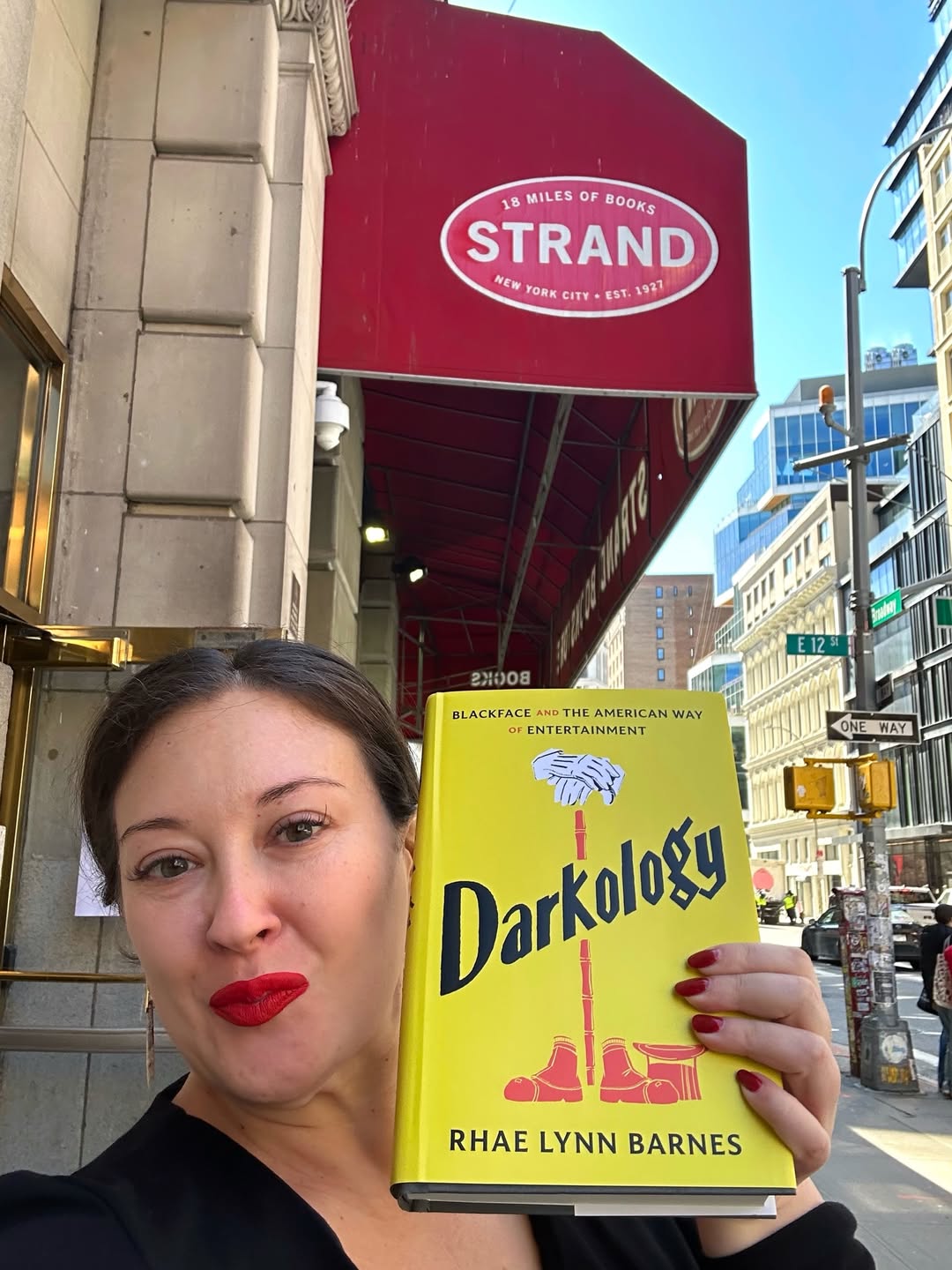
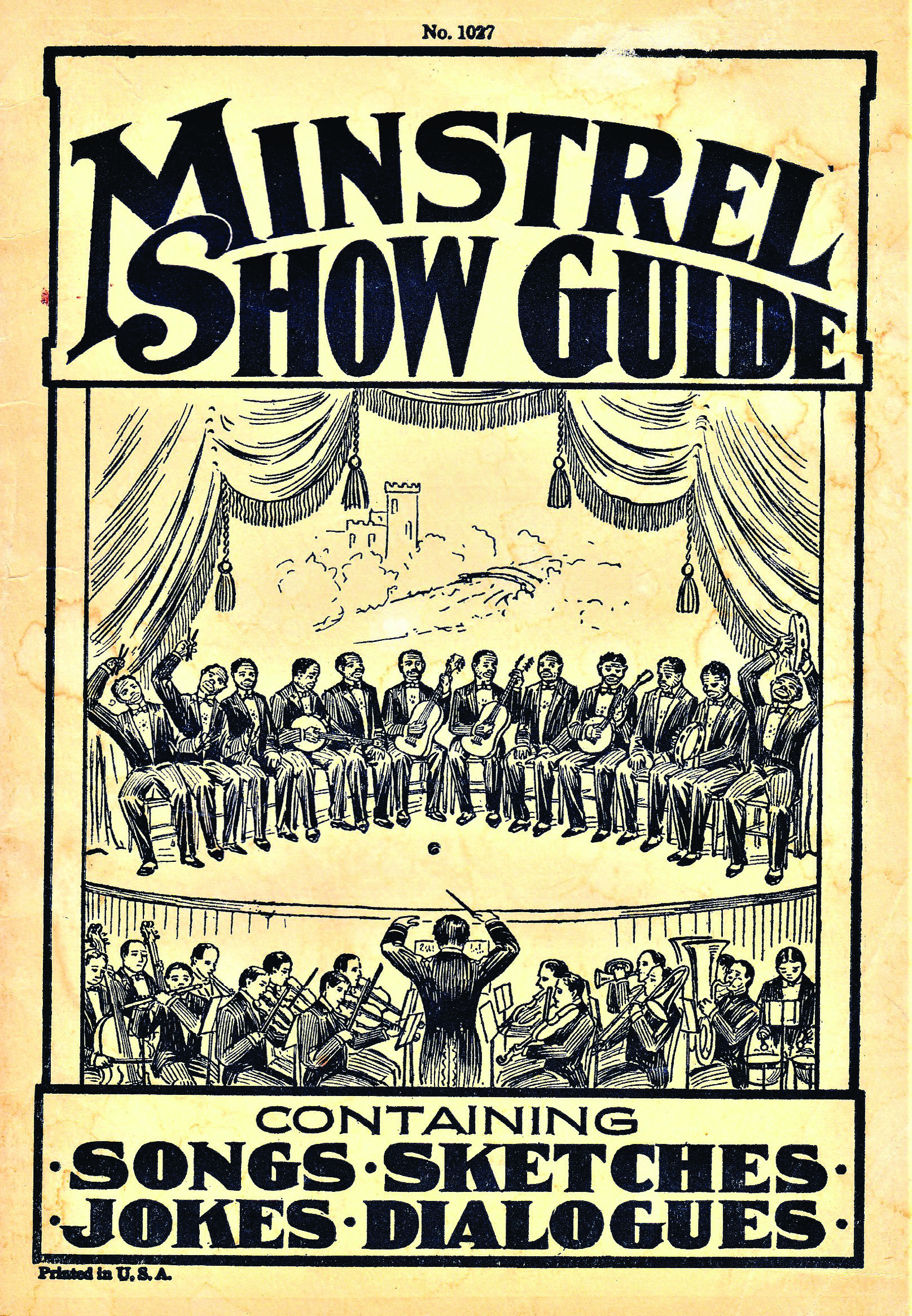
Barnes, who now teaches at Princeton, has spent the last two decades researching the history of amateur minstrelsy—not performed in vaudeville theaters but instead in American living rooms, schools, USO shows, fraternal lodges, and fundraisers throughout the 19th and 20th centuries. She’s chronicled her findings in her new book Darkology: Blackface and the American Way of Entertainment. Barnes charts the sordid, complicated truths of America’s recent history through an avalanche of archival evidence. The Gridiron dinners in Washington (what eventually became the Washington Correspondent’s Dinner) often featured minstrel performances. Stars like Shirley Temple, Frank Sinatra, and Bing Crosby all performed in blackface. The Elks, America’s oldest fraternal order, started as a social club for amateur minstrels. The shows were even put on in Japanese internment camps during WWII—by the prisoners themselves.
Barnes writes with clarity about the ways in which these kinds of events built the bedrock of a culture of racial exclusion by perpetuating harmful stereotypes of Black Americans as lazy, foolish, or violent. Looking beyond the world of professional theater, she also underscores how minstrelsy became central to the American psyche as school teachers, pastors, politicians, and judges upheld them as true representations of American slavery and Black life, often in all-white towns. In her research, Barnes dug through musty attics, sealed archives, forgotten family photo albums, major publishing houses, and the basements of members-only clubs. By illuminating the painful history of something that was once considered normal, even patriotic, the author hopes to unsettle America’s visual and performing cultures that have been lodged in racial inequality for so long.
Could you talk about your own experience researching this topic? I know it wasn’t easy to get into the archives.
An irony of the Civil Rights movement is that it was so successful in convincing people that minstrelsy was dangerous and that these caricatures had real-world implications that it’s really hard to talk about now. There are teachers who’ve been fired just for teaching the history of this performance. Some liberals feared that even researching this material would reanimate it, while others tried to hide family histories tied to these publishing lineages.
There are other, less extreme complications too. One is that these materials were created during Jim Crow, when libraries themselves were segregated institutions. These materials were often cataloged under “Black Americana” when they should really be classified as white supremacist Americana. I still encounter people saying, “Why do you feel you can write this Black history?” But the truth is, it’s a history of white supremacy.
So I had to get creative when I was researching. One example: I write about how the Elks Club, founded in 1868 by professional minstrels, became the largest fraternal order in America. Whenever I tried to access their original rosters, I was kicked out—these were members-only, white-only spaces. So I turned to actor headshots from the 19th and early-20th centuries. Many featured lapel pins with order numbers and induction years. Using magnification, I reconstructed membership rosters that way.
At the Elks headquarters in Chicago, which is a massive palace, they had blackface artifacts displayed in the basement, but I wasn’t allowed into the private library. As security escorted me out, they joked that I was the “Erin Brockovich of blackface.” I said, “That’s fine—she wins in the end. Please keep calling me that.”
One of the most surprising parts of the book for me was the prevalence of blackface performances in Japanese internment camps. Can you talk about how you discovered that?
It started as a question: if these performances really were everywhere, where are the strangest places I can find it? Internment camps were surprisingly accessible because most documentation was produced by federal employees—photographers like Dorothea Lange and Ansel Adams—so the materials are in the public domain. What struck me most was that it was all women performing—hundreds of them—because the men were in military camps or at war. Blackface is typically male-dominated, but here women were leading performances.
That’s fascinating. You write about those performances and how those who get welcomed into the American project are often at the cost of excluding others. A lot of the book also focuses on blackface during times of crisis—like the Great Depression, World War II, even polio hospitals. Can you talk about that pattern?
Blackface has always been tied to moments of national crisis and white anxiety—whether about emancipation or economic collapse. From its inception, America was built as a white supremacist, slave-based project. Even the Declaration of Independence includes grievances about slave uprisings. Throughout history, blackface became a way for people aspiring to whiteness to access cultural citizenship. Even into the 1970s, it remained a powerful unifying force. It became the easiest way for people to be accepted as American.
Once you get to the ’70s, one of the things I thought about was Joni Mitchell, who is an artist I love, but who also has a long, strange history with blackface performance. Hearing the way she talks about her relationship to doing blackface, I get the sense that she saw it as admiration or something more positive.
Also, she was someone who had polio. She’s pretty disabled on one side of her body. As time goes on, blackface is increasingly used by liberal artists and also by Black actors, in an ironic way as cultural criticism. The problem is that most of white America doesn’t understand that nuance and continues to read it in a flat way. So its destructive and negative effects keep being perpetuated, even if what the artist themselves was trying to say or do was more complex.
A really clear memory I have is watching an episode of The Golden Girls where Rose and Blanche are about to meet Dorothy’s future daughter-in-law and her family, who are Black. They’re wearing what’s essentially a brown face mask, with their hair tied up and dressed in a way that ends up resembling mammy figures.
It’s meant to be ironic—they turn around, and everyone is horrified. But even as a child, I remember thinking, Why do I know this is funny because it’s wrong? Why do I understand that this is taboo, but have no idea what’s actually happening? I didn’t know the larger cultural history that was being referenced in that moment. Another example is Ted Danson performing in blackface while he was dating Whoopi Goldberg.
And, surprisingly, she defended him.
Yeah. Sarah Silverman did something similar on her show—she appears in full blackface and sarcastically says, “As you know, there’s nothing harder in America than being a Jew.” She’s using it to critique racism and antisemitism, but that nuance often gets lost and it still really upset people. As a result, many of these moments have since been retracted or removed from circulation. In a lot of cases, you can’t even find them on YouTube anymore—they’ve been flagged or taken down as sensitive content.
Can you talk a little bit how, in the later half of the book, blackface becomes more culturally unacceptable? That’s a story I don’t think we hear very often—usually it’s framed as something that existed in the 19th century and then simply disappeared. I’m curious about what you discovered there, and about some of the specific people you highlight who were actively fighting against it.
That, in many ways, is part of the legacy of the mothers in the Civil Rights movement. From the very beginning, Black Americans were protesting blackface. Frederick Douglass was one of the first to call it what it was: appalling, grotesque, a caricature. But it was often treated as a secondary issue, because emancipation, voting rights, and other civil rights struggles felt more urgent.
In the book, I talk about James Weldon Johnson and Bob Cole. Bob Cole, in particular, was something like the Chris Rock of the early 20th century, an edgy performer who could also work on Broadway. He was constantly forced to engage with blackface, and at one point he tried to invert it by performing in whiteface around 1902. It’s one of the earliest examples of that reversal—something you later see in performers like Eddie Murphy.
Eventually, when James Weldon Johnson becomes president of the NAACP, he recognizes a deeper problem. Even though Black performers were often compelled to participate in these traditions—and could even raise significant funds for civil rights causes through them—the performances still reinforced harmful stereotypes. There was an early national campaign against blackface in 1915, particularly in response to The Birth of a Nation, but then the issue faded somewhat from public focus, especially in the 1930s and 1940s.
During World War II, however, it reemerged in a striking way. Sixteen million Americans were serving abroad, and minstrel shows were often part of the official entertainment provided to troops—including Black soldiers in segregated units. If you think about that—serving a country that already treats you as a second-class citizen, being sent into a brutal war, and then the one form of relief you’re offered is a blackface minstrel show—the level of degradation is profound. Many soldiers describe a visceral sense of humiliation and othering, and a realization that their service did not translate into recognition of their humanity.
When they returned home, alongside Great Migration mothers and their families, there was a growing recognition that these cultural forms were not trivial. Blackface functioned as a kind of “skeleton key”—it helped justify and sustain the broader system of discrimination, from voting restrictions to lynching to everyday social inequality. Jim Crow itself is named after a minstrel character.
So Black mothers, sometimes joined by white Jewish mothers, began organizing against it. They protested performances in person, wrote letter campaigns, and pushed the NAACP to take the issue more seriously. What made this especially dangerous was that, unlike protesting something like The Birth of a Nation, which targeted a distant film industry, these protests were directed at local, amateur productions. That meant confronting neighbors, schools, and community institutions.
Many of these women—who had already fought to desegregate neighborhoods and schools—found themselves standing alone against entire communities, demanding to be recognized as human beings. And that’s when you begin to see the depth of what this meant, not just politically but psychologically—the weight of double consciousness, and the struggle to assert one’s worth not only as an American, but as a human being.
Why do you think histories like this are still relevant for artists today?
As someone who loves art—music, painting, performance—it was also deeply unsettling to see how these forms, which feel so central to my own sense of self, were weaponized in such harmful ways. What surprised me most was the federalization of blackface, realizing that it had been actively supported and promoted by the government. I couldn’t understand at first why there were millions of these shows happening everywhere. But once I saw that this was part of a broader federal project, framed as patriotic, everything began to make sense.
Since I know CULTURED is an arts publication, I’ll mention something I’ve researched extensively but didn’t include in this book. It’s about Basquiat’s engagement with blackface and performance history. What I found so interesting is that, as an artist working in the 1980s, especially in the era of VHS and cable television, these images were incredibly present for him. You can see them all throughout his visual work, including references to specific blackface performers. I think, more broadly, that within American visual culture, there are endless references to this history.
More of our favorite stories from CULTURED
James Cahill Saw the Best and Worst of the Art World. His Latest Novel Exposes It All.
Marc Jacobs Doc ‘Marc by Sofia’ Makes the Designer Look Cool. But Is That It?
Margaret Cho Grew Up in a Gay Bookstore. Of Course Her Reading List Is Incredible.
20 Years and $720 Million Later, Michael Govan Takes Us Inside the New LACMA Galleries
Revisit 5 of the Late Legend Calvin Tomkins’s Most Essential Art-World Profiles
Sign up for our newsletter here to get these stories direct to your inbox.






 in your life?