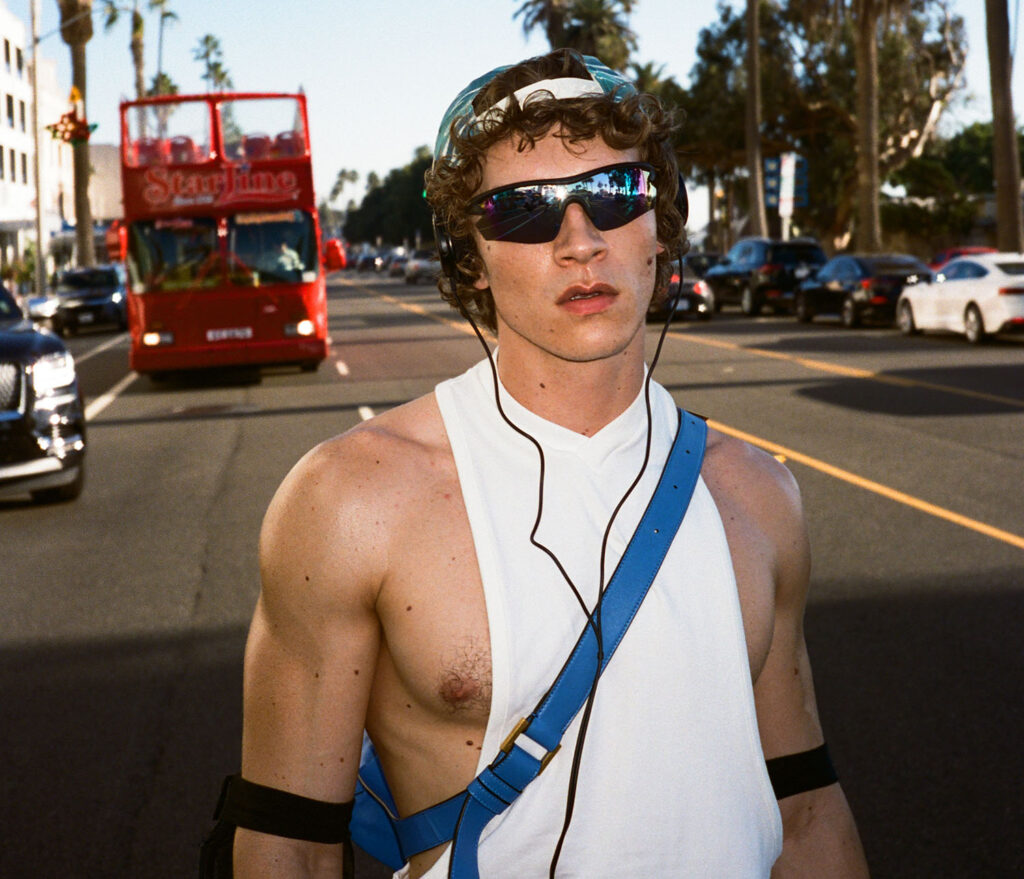
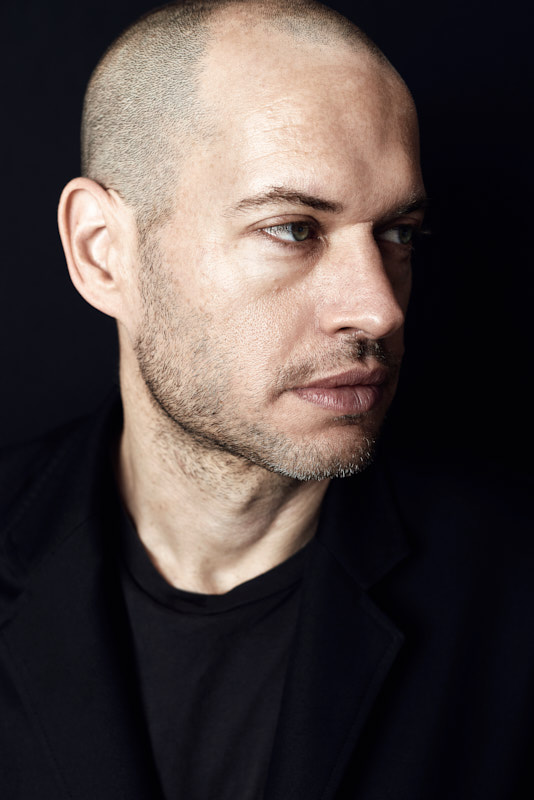
At the beginning of Nadav Lapid’s fifth feature film, Yes, the protagonist, an Israeli musician, goes for a bike ride with his infant son on a beautiful day in Tel Aviv. The sun streams down on the pair as he coos in his child’s ear, pointing out the passersby. “Good Tel Aviv. Good tree. Good boy. Good lady. Good soldier. Good limping man. Good scooter. Good soldier. Good man. Another good soldier,” he murmurs. The father locks up his bike and looks at his phone. A news bulletin tells him that dozens have died in an airstrike in Gaza. The world drops out around him. Screams echo in his ears.
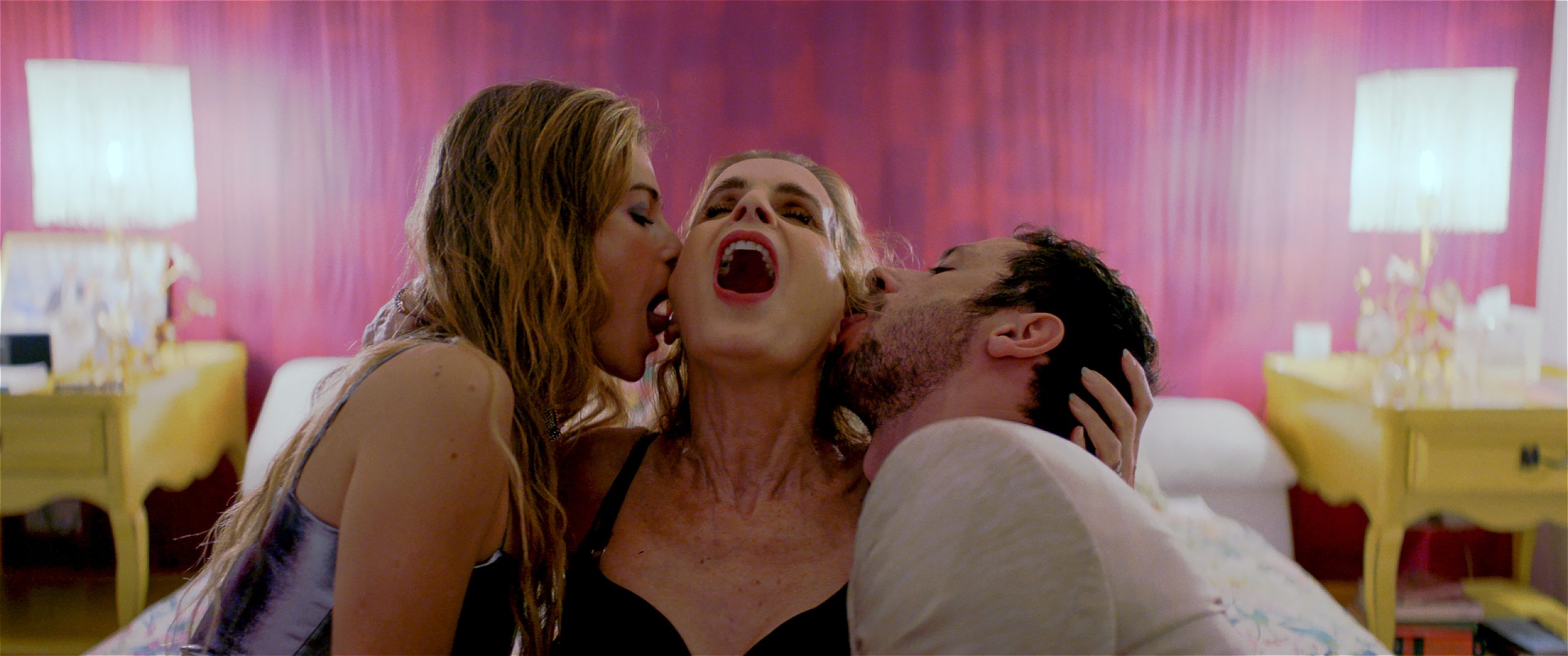
Yes feels like a heart attack. It also feels like everyday life. Two married artists, in the wake of the October 7 attacks and subsequent brutality in Gaza, adopt an unrepentantly hedonistic approach to life. They shamelessly party, throw themselves into orgies, and snort whatever they can get their hands on, all alongside ministers of war and Russian oligarchs. When the protagonist is asked one day to compose a rousing new national anthem, he has only one response: yes.
Lapid, known for Synonyms and Ahed’s Knee, which won the Jury Prize at Cannes in 2021, has emerged as one of Israel’s greatest contemporary filmmakers—and one of its most scathing critics. His collaborators bring their own audacious credits, too. Leading man Ariel Bronz, a Ukraine-born, Tel Aviv-based performance artist, is perhaps best known for shoving an Israeli flag up his rear end onstage, eliciting boos from the audience and, later, questions from the police.
Lapid’s combustible, relentless satire captures the cognitive dissonance of the past few years: unimaginable violence, irredeemable wealth, and an endless firehose of stimuli to cope with the contrast. For this film, he was specifically interested in the psychological landscape of the perpetrators, those who are complicit in violence (especially artists), and the circus they make out of daily life. As he says, “Yes is not a movie about October 7 and Gaza. It’s a movie about the world in which we live.”
Lapid has lived in Paris for several years, but he returned to Israel for the project. Producing a fierce indictment of a nation-state from inside of that very nation-state is, as it turns out, not so easy. Crew members refused to participate. Actors dropped out. He had to bring in a Serbian makeup artist because no Israeli would do it. As an émigré, Lapid experienced his own kind of shock returning to the city where he had lived his whole life, one that he believed had crossed a psychic and political threshold from which it could never return. When the city first appears onscreen in Yes, it is an assault, set to head-pounding techno. “Everything was exploding with meaning,” says Lapid. “I felt like the stones were vibrating, all the time.”
Finding someone to distribute a film like Yes is not easy, either. It premiered to critical acclaim at Cannes, although, notably, out of competition. It received a release in France, but many American film festivals refused to show it before the New York-based art house distributor Kino Lorber eventually picked it up. Yes will be in theaters beginning March 27 in New York and April 3 in Los Angeles.
For Lapid, it is essential for artists to make unflinching work about moments of crisis while they are unfolding. “One of the sicknesses and the disease of our time is that people are afraid to simply say what they think,” Lapid said. “So I will not be afraid to say what I think.” Here, the director lets it all loose.
Do you enjoy talking about your films?
It’s a love and hate thing: I enjoy it, and then I hate myself for enjoying it.
It’s exciting that the film finally has distribution in the States. It was a difficult journey, right?
Yeah. I think that we should all praise the courage of Kino Lorber and ask ourselves, When did it happen that releasing a film became a courageous act? From the very beginning, even during its production, the movie became a kind of detector of courage and cowardice. Maybe in an unsurprising way, cowardice is a more popular quality than courage, but luckily there are still some courageous ones.
When I was watching the film, I was really thinking about the film industry right now. The Oscars just happened, and there was the censorship controversy at the Berlin Film Festival. It’s interesting what people were or were not willing to recognize, what they were or weren’t willing to say. What do you think is missing in the cinematic landscape right now?
Most of us will agree that we live in a unique, horrific, terrifying moment. We have this experience where things that look unimaginable and unthinkable become, on a daily basis, the most concrete. Chaos and craziness become the only truth that we understand. We don’t understand anything anymore. All convictions and beliefs that we once felt are falling to dust. It’s a very big question: in such a moment, which films do we produce? Which films do we give our awards to, do we define as important or meaningful?
I think that movies become, consciously or unconsciously, a kind of tranquilizer. They become like a little pill that you take when you are too stressed in order to forget or calm down. For many people today, when they go to watch a movie, the most intense and most truthful moments take place just before the beginning of the movie when they read the news on their phone and then just after the end of the movie when they check their phone again to see what took place during these two hours. In the middle, there was a kind of fake normality, which I think, in such a moment, becomes almost a collaboration with chaos. You hide instead of revealing.
I was curious to hear your thoughts about the Berlin Film Festival, during which politicians condemned filmmakers for making statements in solidarity with Palestine as antisemitic. Festival director Tricia Tuttle, in particular, became the center of heated scrutiny from German politicians, and she almost lost her job.
The fact that the director of the film festival was supposed to be punished is not only incorrect, it’s a vivid example of a kind of barbarism. There’s something extremely barbarian in thinking and acting like the role of all these film festivals is to only furnish for political figures the images that they want to see, and the moment that it’s not the case, they should guillotine the festival’s leaders.
But I must say, this vulgarity and this permanent assault and ignorance of the liberty of artists, from my perspective, it’s not only coming from the places you expect—from authoritarian regimes, from stupid right-wing prime ministers. It also comes from people who see themselves as very illuminated and who sometimes belong politically to the other pole. I sometimes think that a perverted conviction became very common, as if the role of film for people and even some intellectuals is to be a kind of audiovisual demonstration of only their ideas. In a way, my film examines this perspective.
Very much so. It’s about an artist who’s asked to create propaganda.
I always feel that an artist should aspire to satisfy no one. The artist’s only home should be the paradox and the contradiction. This demand that good political cinema is only political cinema that I agree with or that agrees with me, it’s so vulgar. It’s a vulgarization of art because it makes an advertisement out of ideas.
Can you speak a little bit about the use of music in the film, specifically electronic dance music and propaganda music? For me, the electronic music definitely evokes the attack on October 7.
I would say that Yes could be seen as a film of a DJ because it’s a little bit of a musical. The movie begins with “Be My Lover,” with a techno, decadent hit from the ’90s, and ends with a genocidal hymn. It’s not that I think everyone who dances to a techno hit is condemned to become a fascist, but I think you can see the trajectory of the movie through the songs. The songs and the dancing are moments where you go beyond the narration.
To give you an example, there’s the moment where the head of staff and his colonists are shouting maybe the biggest, most romantic love song ever, “Love Me Tender,” as if it were a war song. He is always contaminated with blood, or maybe he’s the meeting point between love and death. You ask yourself whether a love song can be sung in the middle of this war, which is one of the questions that the movie is raising.
I’m curious about this concept of love and relationships during war because in many ways, Yes is a love story between a husband and wife.
When I finished the first version of the script years ago, I sent it to one of the French producers, and I told her, “This time, it’s a romantic comedy. It might look a little bit too sweet, but at least maybe it will be high at the box office.” I totally believe that at the heart of the film, there is a love story. It’s a movie that begins with the kiss and ends with, for me, maybe the most romantic possible gesture in such a dark time: going nowhere together.
The movie is a collage between a love film and a political horror film. And as the movie advances, the love film is defeated by the political horror film. The movie raises the question, “Can beauty still exist inside of agony? Can a love film still be done in such a moment?” And in the end, the answer is yes and no.
I thought a lot about Cabaret, the musical and film, which also deals with hedonism in times of crisis. There’s that song “I Don’t Care Much,” which is about how living under fascism has made people emotionally numb. I suppose Yes is a different side of the same coin. People are so overstimulated. They’re so hedonistic and debaucherous, but it still has that same kind of numbing effect.
The movie was shot in real time. The movie was shot in Israel while the war was taking place. One of the things that strikes me the most is that you can feel it in the movie, this ecstatic morbidity, as if it’s an endless dance party, but the dance floor is dead bodies or something like this. It’s a moment where just talking onscreen is not enough. It’s not stimulating enough, almost in a physical way. You speak loud; you’re almost singing. Even when people say good morning, everything is so ecstatic.
You’ve been living in Paris for a couple years. How was it to return to Tel Aviv to make the film?
I spent seven months in Tel Aviv before shooting the film and then another three months or so shooting. The thing that struck me the most is the extent to which I was fascinated by Tel Aviv. Of course everything felt familiar, whatever that means. In one second, everything goes back, but at the same time… I don’t know. Street corners looked fascinating to me. Everything was exploding with meaning. I felt like the stones were vibrating, all the time. Tel Aviv is not a beautiful city, but there are moments of beauty when you pass the day in Tel Aviv—of course, near the beach, people jogging. There are moments of sweetness.
I was born there. I grew up there. It feels as if, in like 10 seconds, Tel Aviv will not exist beyond the political context. Tel Aviv would only exist as a sociological or political value. It would be the main center of this nation that committed what they just committed, and in this sense, I felt I had this role of… not saving, because you cannot save it, but perhaps eternalizing these slight moments where people were still just people. I was moved by the familiar, all the time.
The film has music festivals. You have scenes that overlook Gaza, right there by the border. What was the most difficult part to film?
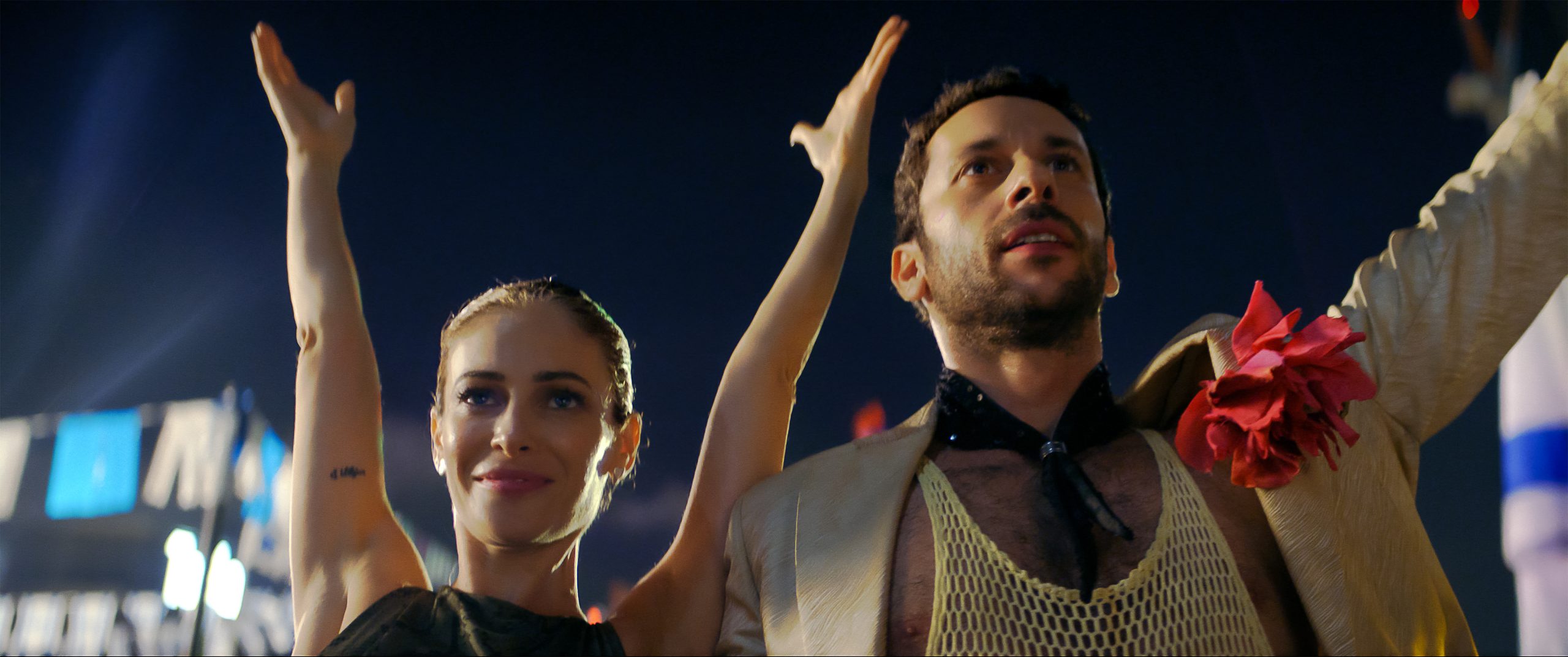
Shooting near Gaza was complicated on many levels. It’s rare in the history of cinema that a movie is shot in the middle while the real event is taking place. Usually fictional movies try to be realistic, they try to show exactly what’s happening. But Yes took a totally different strategy. When I was shooting, I felt that this moment will never come back. It’s a moment that cannot be refabricated.
I remember, there is this scene where they dance on the roof at an Independence Day party. I tried to imagine what it would look like if [filmmaker and Nazi propagandist] Leni Riefenstahl directed a musical. When you shoot in the world with 200 extras, there’s always the one person that doesn’t have good tempo or turns right when they should have turned left, and it makes you crazy because it should be like Leni Riefenstahl—it should be perfect. So you spend the first half of the day just getting the one shot. And then comes the lunch break, and you open your phone for the first time since the beginning of the day, and it says 180 people just died.
These are the moments when you ask yourself if the camera is in the right place, if you’re shooting the right thing. These were the moments that were most complicated.
The film made this big impression at Cannes, but then it had a long journey to be distributed. Can you tell me a little bit about that?
The life of Yes was dictated by the courage of certain individuals, but also by the fear of big institutions. A lot was written about it, mainly in the French press,. I don’t think that anyone thinks that the movie was left outside the Cannes competition because of mis-en-scene after my previous one [Ahed’s Knee] won the Jury Prize.
The same should be said about the major film festivals in North America. These people—some of whom I’ve known for many years and most of them showed all my movies—they’re fearful. They were watching Yes, and the only thing that came to their mind was what would happen to them.
Did you hear that noise? [holds up phone] This means that there is a missile attack on Tel Aviv. I have this application that tells me since my dad lives in Tel Aviv, so I want to know.
In a way, I can also understand. They were making a calculation, and they felt that they have much more to lose than to gain. I don’t even like this idea that I’m courageous or taking risks. I’m doing what filmmakers should do. These people should also use their power, their position, in order to put the maximum amount of truth on the screens. And I think they don’t.
Yes is a fascinating example because this is exactly what the film deals with. It deals with fear. It deals with the question of to what extent you can still be loyal to yourself as an individual in this society. You can love or hate my film, and people love or hate it. But I think there isn’t another film like 2026 more than Yes. It provides the spectator with sequences that he’s never seen before, which I think is a big virtue that justifies its inclusion in all the festivals and theaters. These people can be creators or they can be bureaucrats. They’ve chosen to be bureaucrats.
Are you working on anything new right now? Knowing the ordeal that you had to go through, would you make another film in Israel?
My French producers pray, Please, don’t make another film in Israel. Poor people. It’s not their fault they found themselves digging inside Israeli politics, trying to understand.
Right now I’m working on a script that takes place in Paris but trying to examine the notion of living in exile. It’s a departure, living with Israel behind my back, but, in a way, it’s logical that the next one will take place in a new land. It’s geographical detachment, but it’s also a mental one.
And I’d love to shoot a Western in Arizona. If someone has a good script of a Western taking place in Arizona, let me know. [laughs]
Do you find Paris inspiring as a place, or is it just based on what you know?
When I walk on the streets of Paris, and I see the buildings, they’re the buildings that will never be mine. They’re the buildings I will never be intimate with. They’re the streets that will never talk to me in a low voice telling me secrets in my ear. Everything is elsewhere. Is it inspiring? Sure, in a certain Parisian way.
What do you think people get wrong about your films?
There are a lot of films all over the world that are done from the point of view of the victims, which is a good thing, of course, because for many years, many victims’ voices were muted and now, not all of them, but some of them can express it. But people got so used to movies done from the point of view of the victims that they forgot the extremely important role of movies done from the point of view of the perpetrators. To grasp the world in which we live, the reality of the terrible events like the ones taking place in Israel and Palestine, this point of view is essential.
This point of view creates inevitable complexity. From time to time, I try to imagine a movie like Zone of Interest but if it was made in real time by someone like [Austrian filmmaker] Fritz Lang in 1943. And I think in order to understand the phenomenon of that time, this hypothetical movie would have been as essential as a hypothetical movie shot by a prisoner in Auschwitz. Or a movie about a German couple in Munich. I would have loved to see a movie from that time about the inner universe of these Germans in ’41, ’42, ’43. Yes is not a movie about October 7 and Gaza. It’s a movie about the world in which we live.
More of our favorite stories from CULTURED
James Cahill Saw the Best and Worst of the Art World. His Latest Novel Exposes It All.
Marc Jacobs Doc ‘Marc by Sofia’ Makes the Designer Look Cool. But Is That It?
Margaret Cho Grew Up in a Gay Bookstore. Of Course Her Reading List Is Incredible.
20 Years and $720 Million Later, Michael Govan Takes Us Inside the New LACMA Galleries
Revisit 5 of the Late Legend Calvin Tomkins’s Most Essential Art-World Profiles
Sign up for our newsletter here to get these stories direct to your inbox.





 in your life?