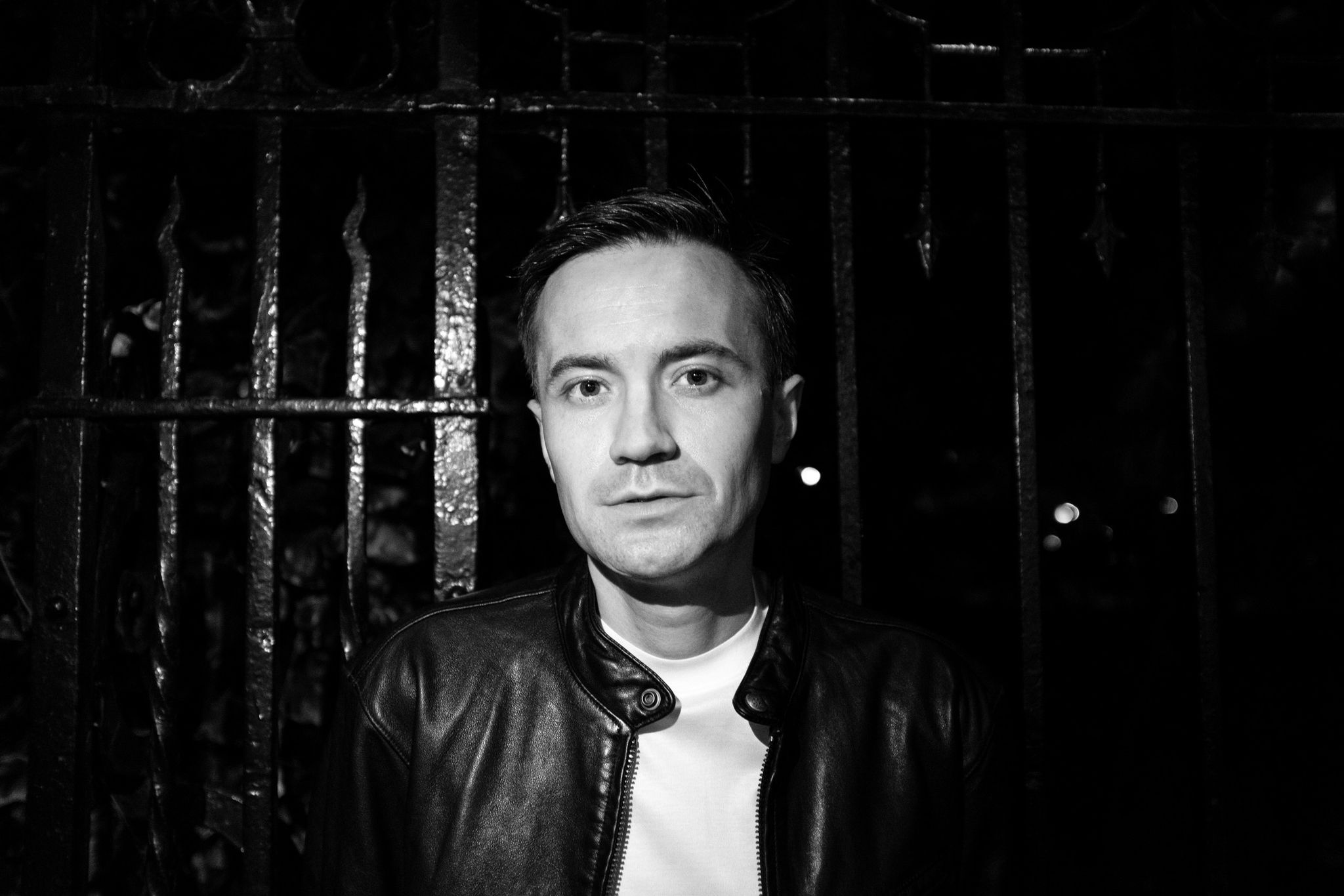
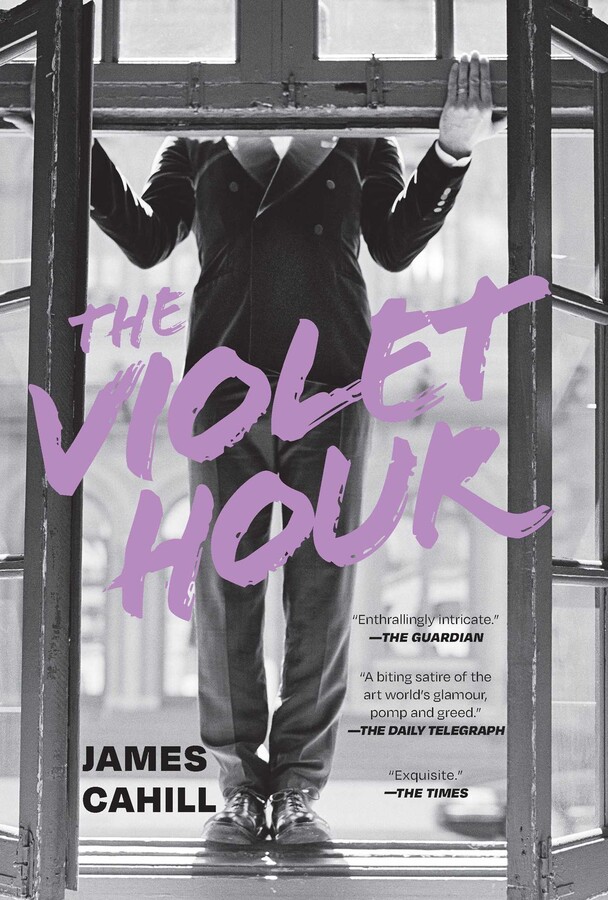
At the beginning of The Violet Hour by James Cahill, a young man teeters on the edge of a London balcony before plunging to his death below. Learning how and why he fell takes readers into the lives of three players in the global blue-chip art market: Thomas Haller, a vaunted abstract painter with a tormented past; Lorna, his first dealer and champion, now estranged; and Leo, a billionaire art collector enraptured by Haller’s latest work. What begins as a mystery grows into an exploration of the passionate, generative, and, often, deeply compromised relationships that make up the art world. The novel, out now, probes the messy, intoxicating intersection where creativity, money, friendship, sexuality, and professional personas collide.
Cahill is no tourist: The London-born, Los Angeles-based writer and critic has worked in the contemporary art business since he was 21, including a 12-year stint with Sadie Coles. The Violet Hour feeds the voracious current appetite for novels, film, and television about the lives of the extremely wealthy. But where stories like My Year of Rest and Relaxation or Industry provide biting satire swaddled in a Loro Piana sweater, The Violet Hour takes a much more empathetic look at the emotional and psychological core of relationships irrevocably altered by money. There’s a pleasing verisimilitude to Cahill’s portrayal of mind games at gallery dinners and the fervor of the Venice Biennale, but as he says, the novel’s heart is human drama, not status signifiers.
CULTURED sat down with the author to discuss the myth of the great male genius, complicated relationships between mentors and mentees, and when the truth of the art world becomes stranger than fiction.
Was your family into art?
No, I came to it completely cold. And it was all really very opaque to me when I first started out. As a reader, I suppose some of that opacity needs to be there because, even if you’ve been in that world for a long time, it still often feels… I don’t know, like the seven circles of hell or something: there’s always another, more exclusive sector that you haven’t broken into.
This novel is about the high-end, blue-chip, international, moneyed part of the art world. There are many other parts besides that, and I’m very much aware of that. I did, with a couple of characters, want to portray a little bit of what it feels like and means to be on the fringe or even the outside of it, or somebody for whom success has been elusive.
One of the big tensions of the book is about the gulf between the act of creativity and the machinery of art sales, and how that gap really seems to just be getting larger. I’m curious about your own personal thoughts on that matter, especially considering how the story turns out.
Take my main character, Thomas Haller. He is somebody who, at the beginning of the story, has mysteriously walked away from the art scene, and no one quite understands why. Even though he’s at the height of his success in many ways, critically and commercially. What he’s had to become, in terms of his public image and his renown, feels so distant from what he originally wanted or intended for himself that he feels like he’s been ripped apart or actually been imprisoned by this public image that he has to conform to.
A lot of what we find out about him has to do with that gulf between who he was and what he’s become as a globally successful abstract painter. We were talking before about the elusiveness of success for some artists, but I was also interested in what success means and what it costs once you do attain it.
Did you have any inspirations for that character?
I guess I was thinking generally about this kind of archetype of the heroic male painter, which is in many ways now a redundant archetype that we’re all moving past, but I think there is still a hankering for it or a nostalgia for it in some quarters of the art world, including among artists. This kind of desire for a sort of, for greatness, a slightly old-fashioned concept of genius.
In many ways, Thomas suffers from that desire. He clings to that image of himself, even as he also recoils from it. People hail him as the heir to Mark Rothko because of these big, turbulent, abstract coloristic paintings he makes. But actually, as the story progresses, you realize that his style of painting is really a veil for things that he can’t openly express or articulate about his life and his past.
We discover that his paintings are not spontaneously emerging from him, but are actually abstracted from something more specifically representational. Towards the end, he has a triumphant return to creativity that has more to do with expressing things from his biography. Correct me if I’m wrong, but to me, it seems like the book takes a stance venerating art that is still personal as opposed to commercial. Does that feel accurate?
That feels right. Thomas, as a character, suffers from this gnawing nostalgia. He is obsessed with earlier versions of himself. He looks back a lot to that time in London in the mid-1990s when he and his friend, and later dealer, Lorna, were first friends. He looks back to that as an idyllic moment that he’s desperate to get back to and, of course, can’t get back to because of everything that’s since happened and what he’s since become.
That question of whether he’s an abstract painter or not, at one level, could seem like a relatively technical thing, but in the context of the story, it ends up having profound significance because it has to do with what kind of man he is and who he has sold his soul to. Without giving too much away, you come to realize that when he was still fairly young, he became obsessed with this older guy, Claude, who molded him and turned him into the celebrated abstract painter that he is today, almost like a kind of Pygmalion. I think the tragedy of his situation is that ultimately he doesn’t break out of what he’s become. Other characters do, but he is incapable of that.
Were you reading anything at the time you were writing? Who were some of your literary influences?
When I’m writing, and even when I’m not writing, I try to read as prolifically as I can. Iris Murdoch, for example. I’m endlessly fascinated by the way in which she makes small-scale, fairly mundane, ordinary life appear dark and weird and perverse. Off the top of my head, writers like Justin Torres here in Los Angeles. His last book, Blackouts, was an astonishing work of fiction. Garth Greenwell is a writer I like very much as well.
Alison Lurie, wrote an extraordinary book from the ’60s called The Nowhere City. It’s about a husband and wife who move to Los Angeles, and he absolutely loves it and she absolutely hates it. Over the course of the novel, those two perspectives reverse almost perfectly. I’m reading a lot about LA at the moment because of the nonfiction book I’ve been working on, which I could also tell you about.
You focus a great deal on the relationship between an artist and his dealer. What interested you about this relationship? Were the characters inspired by any figures that you encountered in your own life?
I guess it brings me to a larger point about the art world setting of the novel, which is that I don’t think you need to know or even care that much about the art world to get drawn into the story. This is really a story about human drama: loss and longing and betrayal and desire. That relationship between artists and dealers is just one way of dramatizing a very close, intense human relationship involving often an imbalance of power or a changing power dynamic at least.
Lorna was Thomas’s first dealer from before he was famous, and the way their relationship gradually unravels, is a useful way of thinking about the way in which somebody’s success or two people’s respective success can irrevocably change their friendship and, in the end, tarnish and transform that friendship into some sort of professional mimicry of what it used to be.
Thomas’s relationship with Claude, which is also fundamentally a relationship with a dealer, has an altogether darker aspect because that is much more about the way in which sexual attraction can result in a form of control and obsession can result in this lifelong subjection to a person even after the romantic-sexual part of the relationship has long ended. The forms of control that people enact over one another are something that interests me greatly. You see that magnified in certain ways in the art world, but it’s also a universal human thing.
I feel like a decade ago there was quite a bit of cultural conversation around boundaries and relationships between mentors and mentees, in academia a lot, but also in a lot of different professional settings. And it is still an unsettled conversation right now. At the time, people really wanted to articulate clear boundaries between right and wrong, and now we’re at a place where we understand that things do get very gray, but we’re still trying to contend with what that actually means for ourselves and our relationships.
It’s a question that’s never really going to go away as long as we’re human and as long as we’re compromised in the way that we as humans are. Often, as a society, we’re always optimistically thinking about how we can or will be better, but I do have a sense in the end of human nature and its limitations.
It’s fascinating and all too often dismaying to see how, as soon as somebody is vested with power, they decide to exercise and abuse that power, including at the level of a personal relationship. Not necessarily a dictator or something like that, just the way in which somebody in a relationship who understands they have the power will, at a subconscious level or perhaps consciously, abuse it and manipulate the other person.
These things are complicated. Take the relationship between Thomas and Floyd. Thomas is not simply a passive victim. There’s a degree of complicity. He understands what’s happening, and it suits him to allow this situation to endure to some extent. That too is something that I think is intriguing. It’s very hard to generalize because these situations are very often very thorny and complicated.
That also brings us to Leo. He’s this aged, billionaire collector, the kind of man who will get into an awful spat with his brother and walk into Christie’s to throw around a couple hundred thousand just to make himself feel better. But you also pay a great deal of care and attention to him: why collecting matters to him, what void it fills, and how he became the person that he is. Can you talk a little bit about writing that character?
Collectors are a strange species. I have ample firsthand experience of that. If you take a character like Leo, he could so easily seem like a caricature, and I do accept that he and other characters in the novel might initially seem at least a little bit satirical or cartoonish. But in the end, I think they are true to life. Sometimes as a novelist you actually have to reign in the excess or the weirdness a bit because, although it might actually occur in real life, somebody reading it on the page is just gonna say that could never have happened or that nobody would be that dreadful. Yet they really can be and often are.
With Leo, you are dealing with somebody who has been corrupted by extreme wealth and power in the way that it’s almost impossible not to be. He is selfish, grasping, egocentric, all of these things, but I wanted to show a depth of memory and experience that would, in the end, humanize him at some level.
He has this voracious, almost obsessive desire to collect, which is born of many things. One of them is a desire for a form of immortality because he has no children. Another one would be as an elaborate form of consolation. It’s curious because you think of somebody like that as having everything, but of course, he’s haunted by loss and his immense loneliness. In some ways, collecting art is even a consolation for his own appalling personality, for having to live day-by-day, hour-by-hour with himself.
It made me think of Patrick Radden Keefe’s big New Yorker profile of Larry Gagosian.
An incredible portrait. It’s so easy in the art business, particularly with artists or gallerists, to see them in a certain light—and often they contribute to that because it serves them to be seen in a certain way. But nobody is just their image, right?
You hit on basically all the major art-world events: the Venice Biennale, gallery openings, the Met Gala. Was there a particular event that you were most looking forward to capturing on the page?
I did want to give something of a sense of the kind of wild, endless, frenetic carousel of events that the art year is made up of. The atmosphere at those things is often quite charged, and there’s this odd sense of lots of egos colliding and people observing each other in this surreptitious, passive aggressive way.
I used to think to myself, What would it be like for something really freakish and embarrassing to happen now? That’s why actually early on in the story, you have a private view where Thomas is having this big comeback moment at his new gallery in London, and suddenly this man walks in off the street in a state of abject hysteria. It completely destroys the moment. I suppose that was me playing a sort of game wondering what it would look like for it suddenly to be shattered by a moment of unpleasant reality.
Portrayals of the contemporary art world in the media really vary. What do you think others get wrong? What were you trying to show in your novel that hasn’t been shown before?
We are in this cultural moment, for one reason or another, where the lives of the rich and privileged and often idle are a huge source of fascination. If you look at programs like The White Lotus, or Succession, or Industry, people are riveted by this stuff. In some ways we’re no different from what we were in the mid-1980s when everybody was in love with Brideshead Revisited, the Granada TV show.
Often, these portrayals don’t get it that accurate because they lean too much into the satire or the absurdity. The high-end, glittering, blue-chip art scene is hard to satirize because the absurdity is just there: the opaqueness, the mystery, the weirdness. You don’t need to exaggerate that. A realist presentation will do just fine.
More of our favorite stories from CULTURED
Dries Van Noten Opens Up About His Next Chapter: ‘We Didn’t Stop to Have a Quiet Life’
Psychoanalysts Jamieson Webster and Adam Phillips on How to Get the Life You Want
The Best Oscars Red Carpet Looks of All Time, According to 14 Very Opinionated People
Love Story’s Costumes Could Have Tanked the Show. Then Rudy Mance Stepped In.
Is the 82nd Whitney Biennial Weird Enough to Match Our Chaotic National Mood? John Vincler Thinks So
Sign up for our newsletter here to get these stories direct to your inbox.





 in your life?