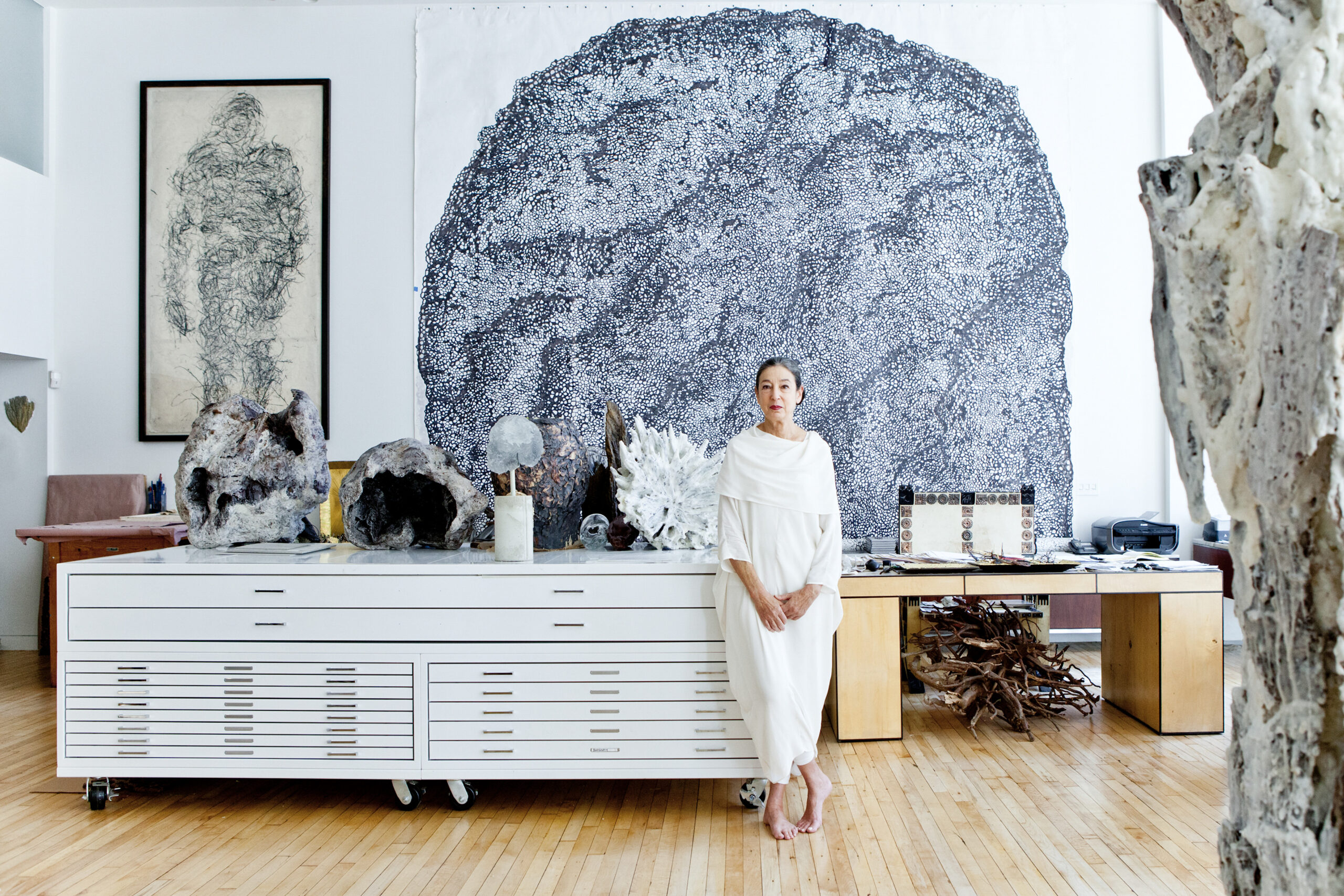
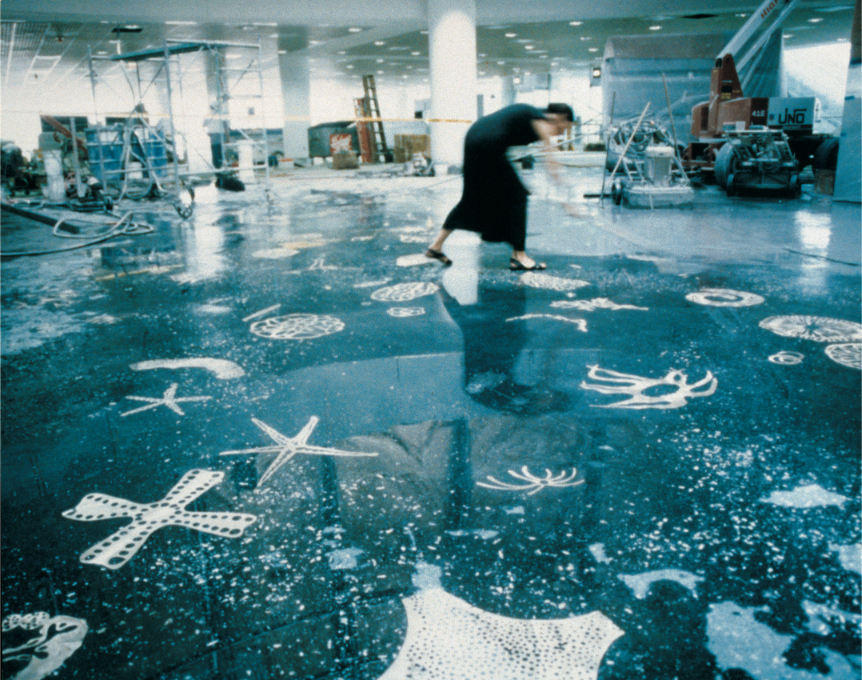
Growing up in Florida, Michele Oka Doner saw her father become a judge, then a mayor. If Miami gave her the civic gene, Detroit, where she moved in the late ’60s after studying at the University of Michigan, taught her how to put it to use. While there, Oka Doner, now 80, took her art off a pedestal (literally), giving viewers more direct contact with her sculptural relics inspired by the natural world. In the decades since, she’s brought her work even further into the public arena. Her mile-long floor installation at Miami’s airport is seen by over 50 million travelers a year.
The New York-based artist spoke to CULTURED ahead of the unveiling of Talisman, a new installation composed of 300 illuminated heads conjuring a sacred grove on the Park Avenue Mall at 66th Street this spring.
What are you sitting with these days, what’s on your mind in the studio?
I’m hoping today the final engineering drawings are approved by the MTA. Because the Talisman installation is going to be on the mall that runs over the tunnel for the Metro North. So I was put on a diet of 8,000 pounds. Then I have trees that will hold the Talisman. When they go in, they’ll be dormant. But when their leaves come out, as spring and summer unfold, they’ll have weight. So I had to do everything practically to get under this 8,000, including counting the weight of the leaves on all these trees. I’m being metaphoric—that would be like counting grains of sand.
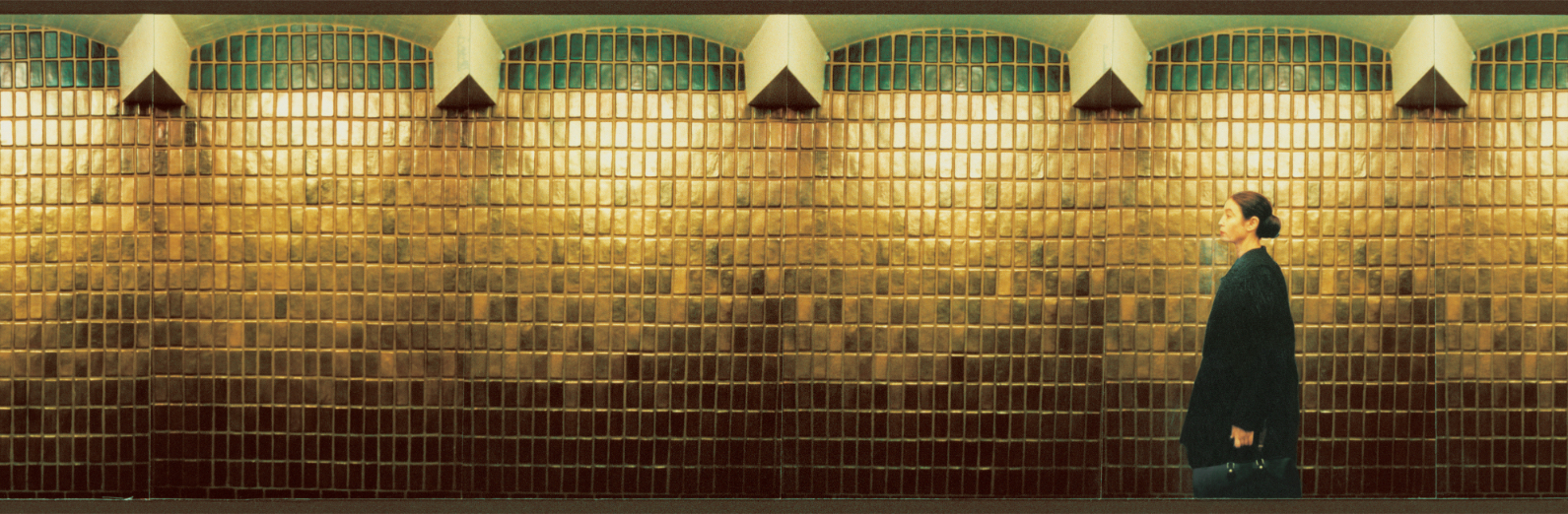
This isn’t the first time you worked on a project that involved the MTA. You installed Radiant Site at the Herald Square station years ago.
Yes, that piece is now in 35 plus years old. I won a national competition for that in 1987. I was new to New York. I’d been here maybe five, six years. And I submitted a very simple project for Herald Square, an inversion to create light instead of darkness when you descend. I basically sent in two paragraphs and a sample of a tile that was very low luster. I knew about luster from Pewabic Pottery in Detroit, where I had lived. When I won it, I was very surprised, but the idea resonated. I present transcendent ideas, instead of a visual assortment of elements. The whole idea of transcendence and talking to the community—the civic gene is what I call it—has always been a great motivator and has really helped me achieve a full and remarkable career in the public realm, as well as the private and the personal.
Can you distill where that civic gene comes from?
I grew up in a home that was civically oriented. My father was a judge and he ran for election in Miami Beach, Florida, in 1945. That’s the year I was born. My first 12 years were engaged with the community. People would come up to him in a restaurant if we were out for lunch. I listened to him speak to people about their issues—people didn’t hold back, it wasn’t as formal or removed [as nowadays]. He also had a law practice, and he made house calls. After dinner, I would go with him and listen to people express the problems that unfolded as you live a long life—a lot of them had to do with wills and estates. Then finally, he ran for mayor of Miami Beach. So my entire childhood from 1945 till I left for college in 1963, there was always a campaign or a discussion at the dinner table of what was going on in the city.
And I’ve [made work for] three federal courthouses and had to meet the judges. The first thing I said [each time] was that my father was a judge, and that disarmed them. They knew I would understand what they were doing. I find, in the life of an artist, as somebody once said to me, “Use everything you’ve got.”
Working in public art means that you’re not in the vacuum or bubble most people associate with artists. You’re interacting with so many stakeholders from the get go, involved in a network of other needs, interests, or limitations.
You’re also in service of a greater community. One of the bibles of my library is Lewis Mumford’s The City in History. In the beginning, he just nails it, with the Paleolithic era, which is when we settled down. You had caves to leave the collective hope and dream in. He also says that building cities made us into a civilization. That’s the wonderful thing working in a foundry has given me—a sense of what it really takes to make [something]. And living in Detroit too—it was the beating heart of this country when I came—was all about tool-making and creating. So Miami gave me a language, but Detroit really gave me the opportunity to put it to use and to see how it served.
When did you start thinking of yourself as an artist?
In 1960, when I was 15, artists were not so celebrated and talked about. They were a group of a band of crazy people, who cut off their ears or sat in a bar like Toulouse-Lautrec. It wasn’t a profession, so to speak. There was no money in it either. None of the artists I knew were quote unquote successful. But I come from a line of artists and scribes. So the hand-eye coordination and visual literacy was enormous in my home, so I had a head start. My mother always said her father studied fresco painting in Odessa. And when he came to this country, he worked in the first Metropolitan Opera House on the frescoes there. I had an aunt who was in Provincetown with Hans Hoffman and was in what would become the Whitney Biennial with Tibor de Nagy and Betty Parsons. She has kind of fallen off the charts because she’s what today we would call neurodivergent. She wasn’t very sociable; she didn’t like going to, you know, the Cedar Bar. But I would visit her at her West 13th Street apartment as a child. So I saw her life.
How do your ideas for your installations come to you? We can use the Talisman project as an example of that. Where does the idea for these illuminated heads come from?
Well, I had never done anything like that. But in 2009 or 2010, Guy Laliberté, who was then the generator of the magic behind Cirque du Soleil, commissioned me to make an outdoor setting for guests in his beautiful property in Ibiza. So I made a radiant disc table that would seat 12 to 14 and a beautiful bench around it—both of them cast bronze. He wanted a scrim to go over it to protect from the sunlight and the rain. I had been to Ibiza, and I said to him, “You’ve got these fabulous old ancient carob trees. Why can’t we make a sacred grove?” So they dug up all these fabulous old carob trees. I thought it might be dark in there so the idea of lighting the trees hit me. I always loved fireflies, so I thought, I should do something that feels like a million fireflies in the trees. Then I thought about the “Soul Catchers” series that I’d been doing—these shapes I’d make into lanterns. So I said to him, “Why don’t you pay me a design fee. I’m going to make you something. And then if you don’t like it, I’ll take it all back and give you back your money.” I made 110 of these talismans, they’re now called. That’s how it began.
I always wanted to come back to the idea, because it was so magical. And so when I was invited to [work on something for] Park Avenue, I looked at the trees, and I remembered how at Christmas time they ran that long row of [lights] that came on at dusk and kept going all night. The problem was I couldn’t touch their trees—the Parks Department wouldn’t be happy. Then I proposed to bring my own trees, and they were even more unhappy. They said there would be confusion between the art project and the Parks Department project. You see, this is what these projects are—they’re a process. So then one morning, I woke up and had an aha moment: If I bring the trees and put them on a pedestal, then they’re an art installation, and no one will be confused. So I then invited everybody to the studio and showed them a rendering of the trees up on a platform. You know where I think I got the idea is when you go to botanical gardens, and you see their bonsai collection, these miniature trees are on these long tables.
How has your idea of what art can and cannot do evolved over the years since you came up as an artist? I know that some of your early works, like A Death Mask, were quite political. You’re obviously very engaged with the natural world. I wonder how your idea of the power of art to move people has evolved, especially as someone who’s been doing so much of it in public.
You know, we, as artists, have the power to advocate. This is not about politics. This is much deeper. Artists, we’ve gotten off our track. I think that there’s a lot to be said on that. I look back on my Detroit years, just recently working on a zine for “Talisman,” because I did these small heads that were seeds in a pod. It was right after the Three Mile Island [accident]. It was the Republican convention in Detroit in 1980. Some artists got together, and I made two pods with these seeds inside that had mutated into skulls. That is the power of an artist. It’s not in the street. It’s not in somebody’s face. It goes into the unconscious, into the mind, into the body, into the soul. We’ve come through a time of big everything—big scale, big color, big balls. And, you know, there’s nothing more powerful than a sprouting seed in the dirt. It’s going to feed. It’s going to become a tree that gives shade. We have to get back to seeing again. And that is a big order. It doesn’t come back with aggression. It comes back with seduction.
You’ve worked with so many materials. How has your experience of the labor and the effort of art-making evolved over the years?
That is so important. Because we are evolved neurologically to move our hands. We come from separating nuts and pulling the meat out. We come from banging them with a stone to get them open. We come from pulling the roots out to harvest a carrot. You don’t see a bag of nuts in a grocery store with a shell anymore. When I was in Syria, before the terrible wars, I was with somebody who had a beautiful collection of textiles. And you know, damask cloth comes from Damascus, it has such a long history. We were invited to the home of one of the oldest families. And the collector said to the woman, “Miriam, tell me I can’t find any damask cloth. There’s nothing.” And she said, “My grandmother told me that in her day, all the women embroidered. And all the nervous energy came out of the tips of their fingers. And today everybody takes pills.” Wow, what an image. Think about it. Working with my hands has allowed me to process, to slow down, to connect to my primate self. Look at what we’ve come from and how much we’ve discarded that has made us a very anxious and neurotic culture at the moment.
What do you think has been the single greatest challenge of your career?
It is a challenge to take a singular voice, when the consensus is that you belong to either this group or that group, this trend or that group. That’s a challenge, but it wasn’t a burden I couldn’t shoulder. I enjoyed so much the process of transforming thoughts and dreams into a visual that I just kept going. I stayed on my track. Even in graduate school, I was the first woman really in this [program], and there were six men. I knew I didn’t want to be them. I didn’t want to paint stripes or targets. I didn’t want to weld I-beams. There was nothing they were doing that spoke to me.
What advice would you give an artist who looks up to you?
Well, it’s interesting, I remember reading as a child that there could be no Mozart today, because Mozart composed in a world that had silence, but today, there was too much static. So I have a quiet life. I really do take my time, and I don’t go on devices. And I still don’t know how to turn on our screen. I’m not a big watcher, because by the time television came to our home, I was 6 or 7, and I was already outside every time I had free time. I’ve never been a spectator, I’ve been a participant.
More of our favorite stories from CULTURED
Dries Van Noten Opens Up About His Next Chapter: ‘We Didn’t Stop to Have a Quiet Life’
Psychoanalysts Jamieson Webster and Adam Phillips on How to Get the Life You Want
The Best Oscars Red Carpet Looks of All Time, According to 14 Very Opinionated People
Love Story’s Costumes Could Have Tanked the Show. Then Rudy Mance Stepped In.
Is the 82nd Whitney Biennial Weird Enough to Match Our Chaotic National Mood? John Vincler Thinks So
Sign up for our newsletter here to get these stories direct to your inbox.


 in your life?