When Marcia Tucker founded the New Museum in 1977, the city of New York was barely emerging from bankruptcy. Music bolstered the weary metropolis—that year alone saw the birth of hip-hop during an infamous 25-hour summer blackout, the opening of Studio 54, and the golden age of punk. Art too was changing. Artists who’d lived in lofts since the 1950s and ’60s saw a gallery scene emerge around them in Soho, Jean-Michel Basquiat’s SAMO tag began to crop up across Manhattan, and the Heresies Collective and A.I.R. Gallery injected feminist critique and concerns into a still all too male-centric ecosystem. The New Museum arrived onto the scene as quite the novelty—it was the first contemporary art institution to open in New York since WWII and a distinctly downtown one at that.
In the almost five decades since, the museum has continued to serve as a counterweight to its loftier Uptown peers, giving both early exposure and historical resonance to an ever-morphing avant-garde. The institution settled into a permanent home in 2007, its SANAA-designed tower like a futuristic ship anchored on the Bowery. On March 21, the New Museum will re-open with double the footprint: a 60,000-square-foot expansion courtesy of OMA has shot up next door.
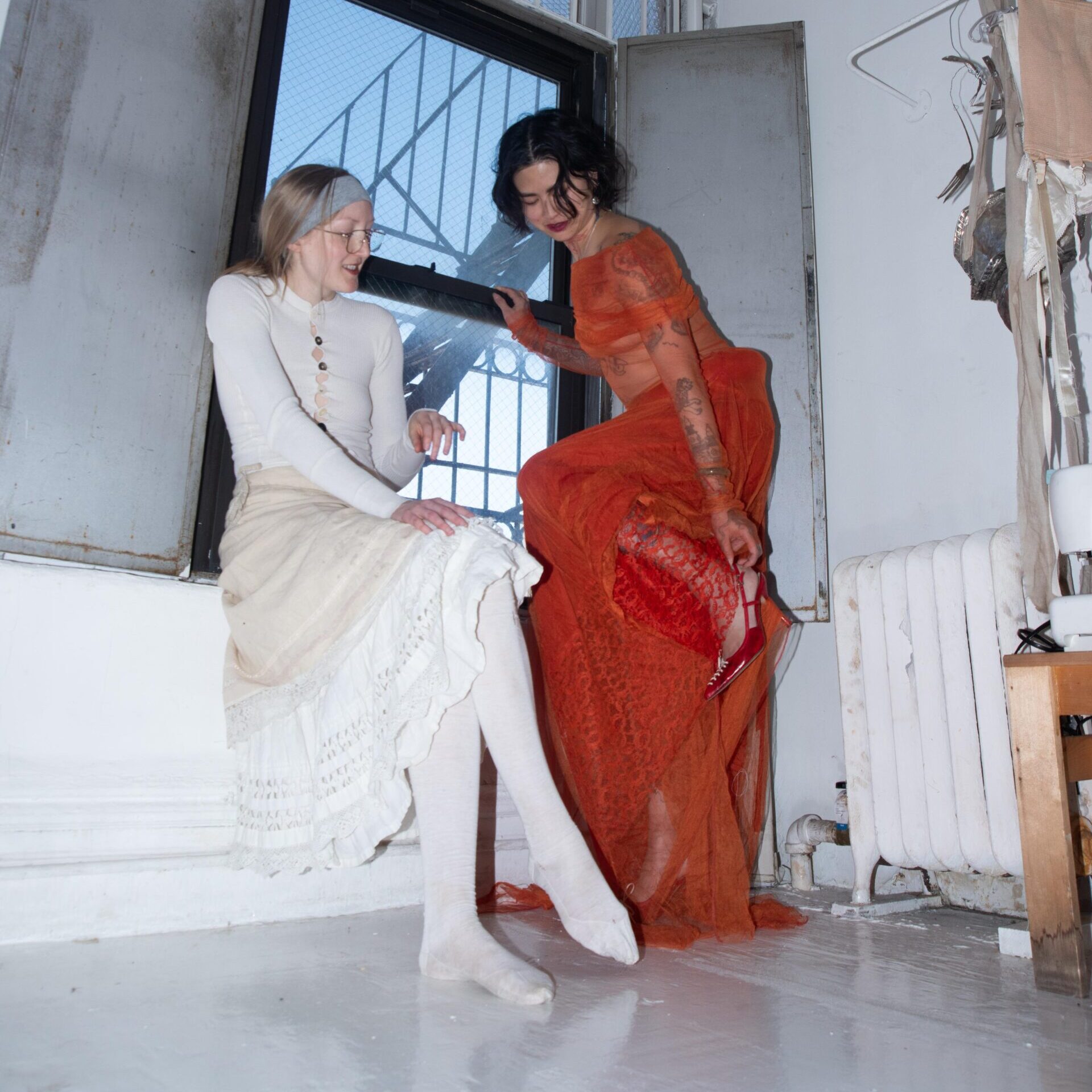
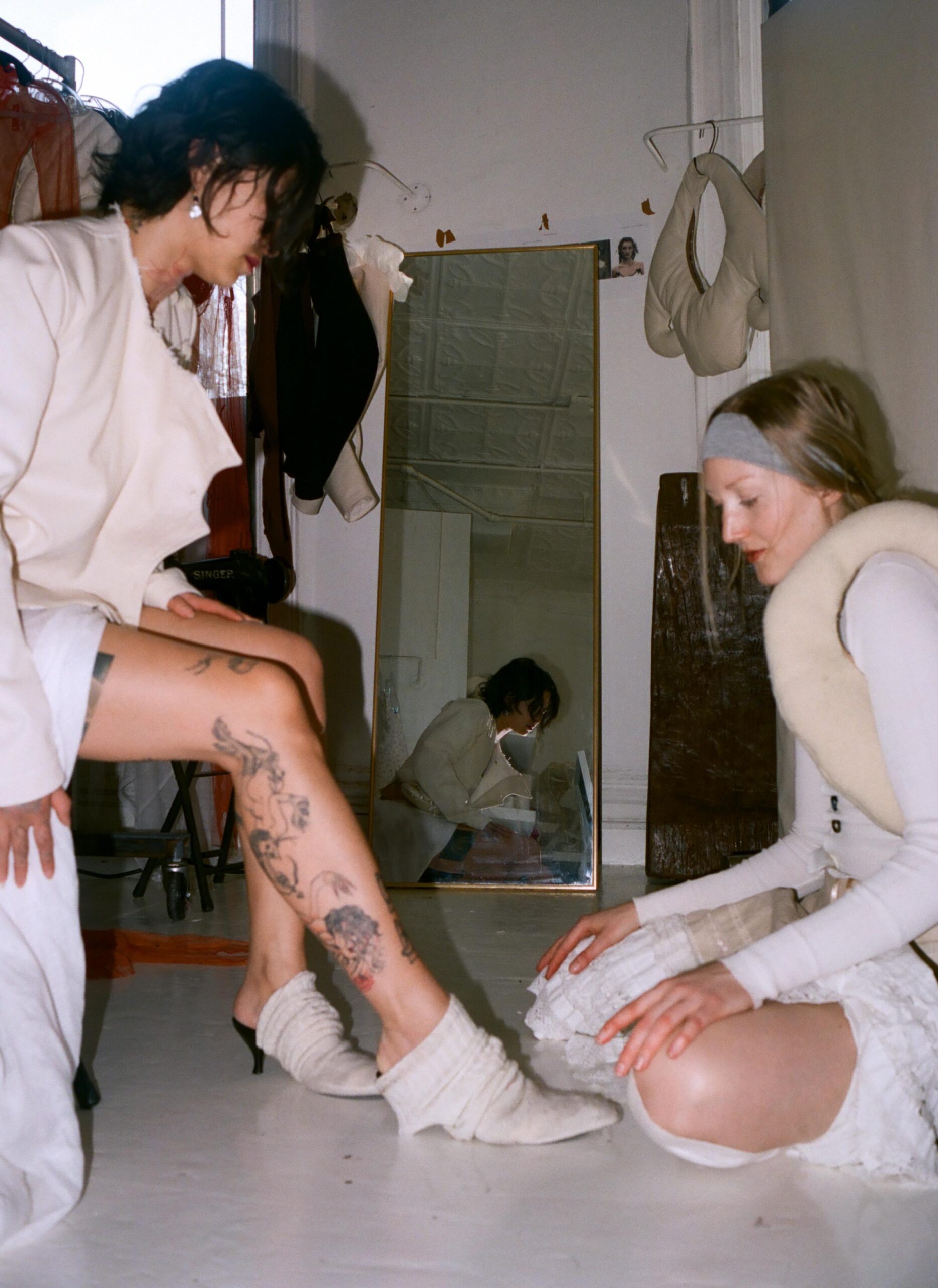
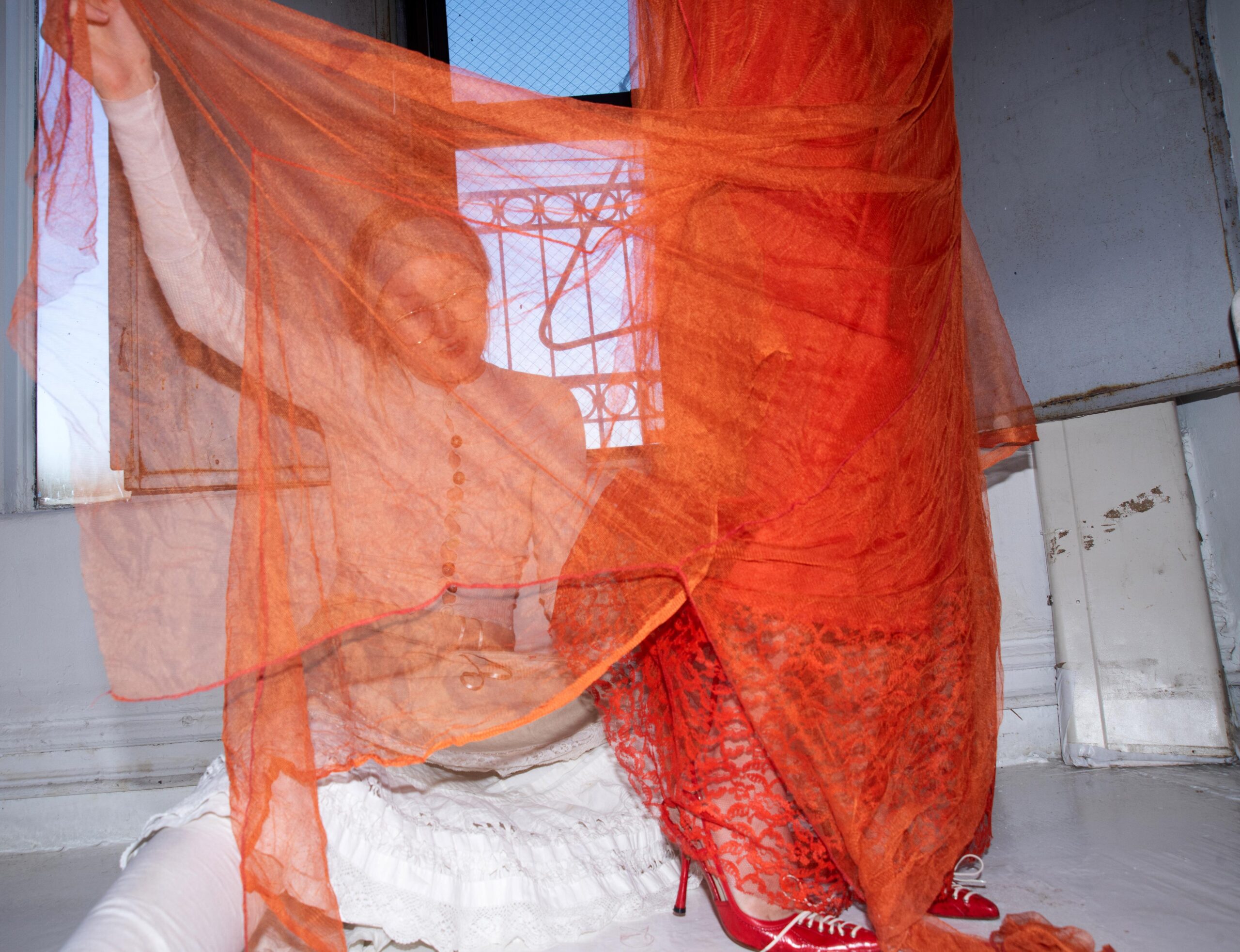
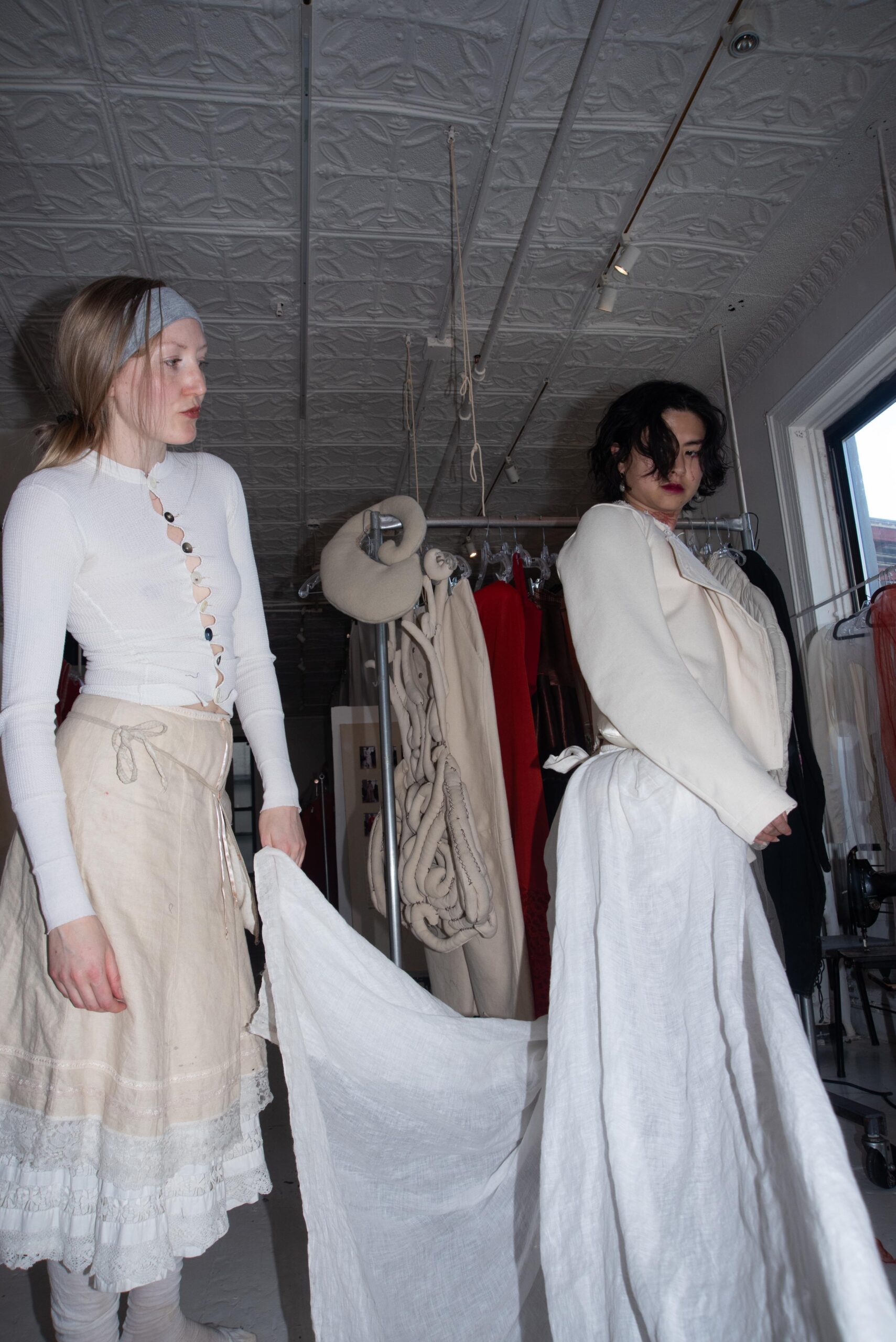
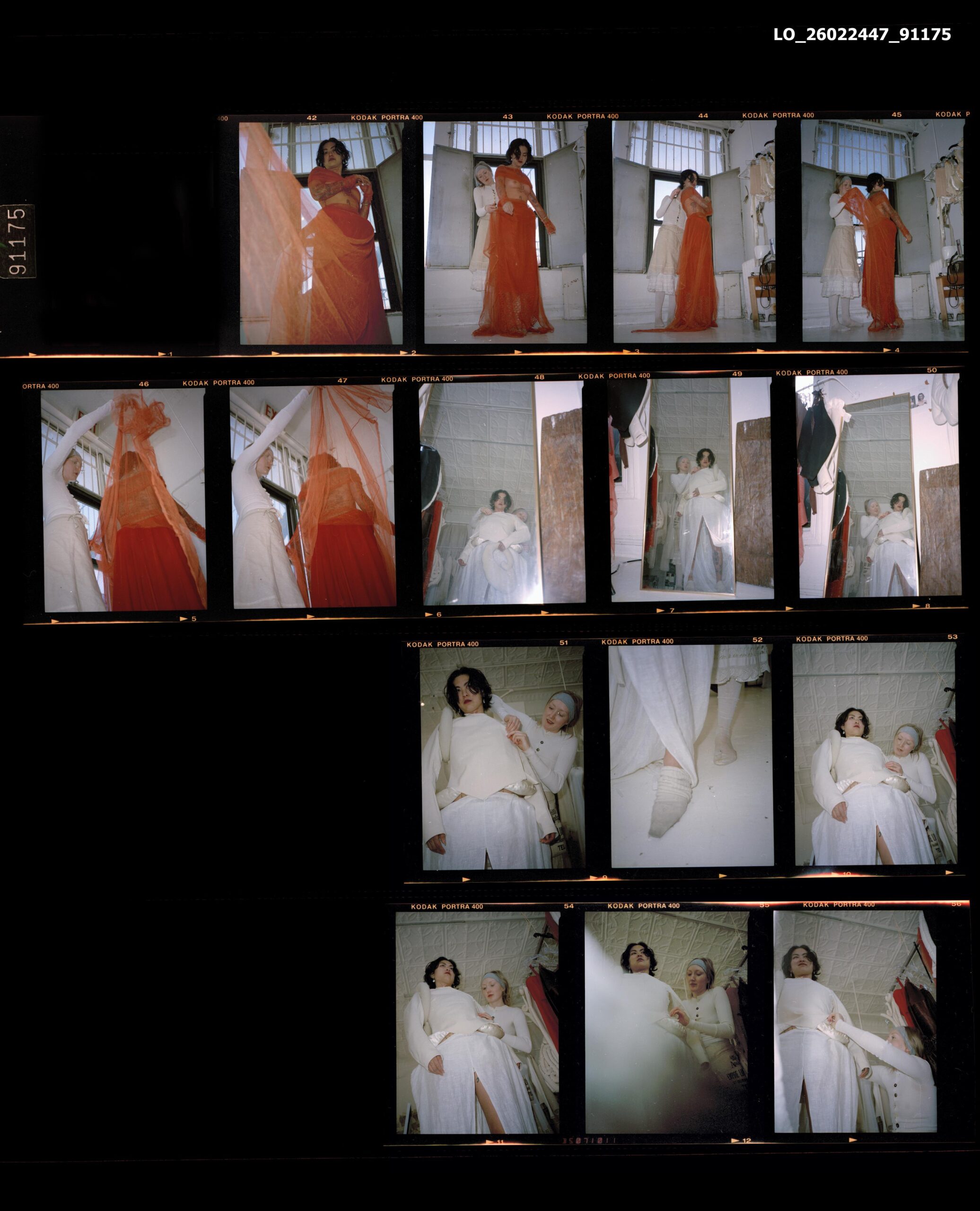
To mark the occasion, we paired three artists featured in “New Humans: Memories of the Future”—the first exhibition to unfurl over the entirety of the new New Museum and the latest in a history of choral group shows that act like temperature checks on the time (this one grapples with the living legacy of technological change)—with three members of another industry that’s indissociable from downtown New York: fashion. Over the last few weeks, independent designers Hillary Taymour of Collina Strada, Claire Sullivan of Miss Claire Sullivan, and Zoe Gustavia Anna Whalen welcomed Camille Henrot, Ivana Bašić, and Cato Ouyang into their studios for a fitting. The freewheeling conversations that followed zigzag from eulogies to bygone downtown eras to the city’s affordability crisis, becoming intimate referendums on what making a life—and a living—as a creative in New York looks like in 2026.
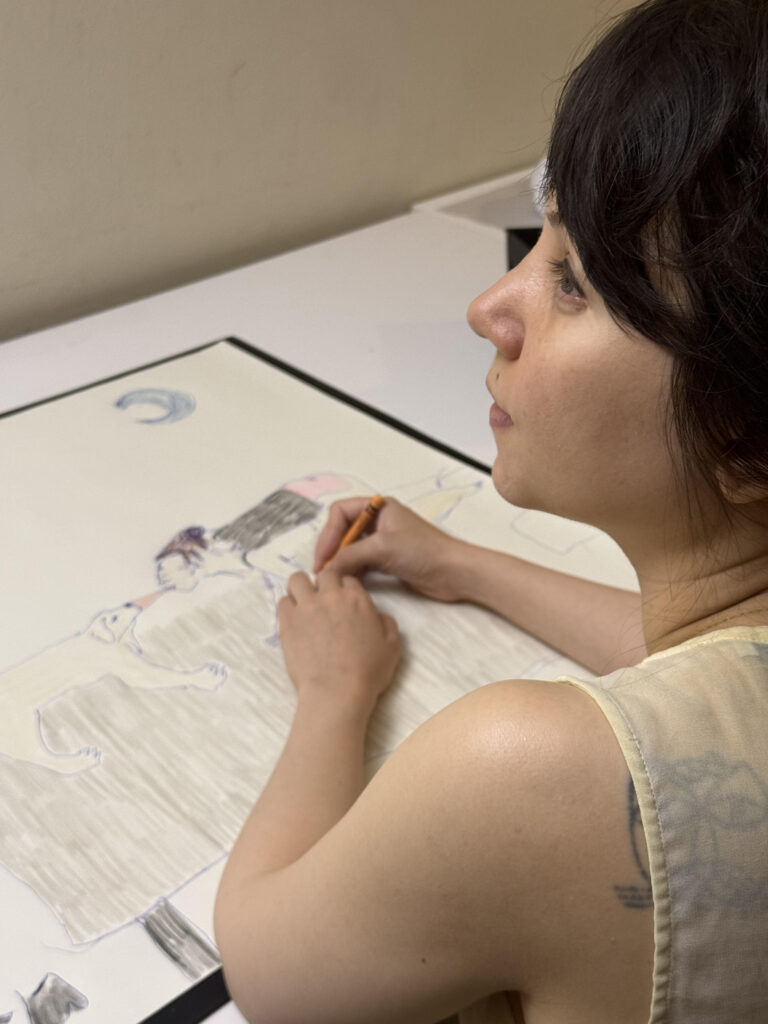
Below, Zoe Gustavia Anna Whalen, who cut her teeth at Eckhaus Latta before striking out on her own with an eponymous label that’s turned fashion shows into ritualistic séances, meets Cato Ouyang, whose iconoclastic installations confront the psychological collateral of objectification, gender violence, and desire’s relationship to devotion. Their work otherwise, spite: 1. whores at the end of the world / 2. from every drop of his blood another demon arose (1829-1840), which takes a propagandist 19th-century British cartoon as its starting point, will be on view in “New Humans.”
What are your New York origin stories?
Zoe Gustavia Anna Whalen: I was very eager to move to New York when I was a teenager. I came once for a friend’s 16th birthday. I cried when I had to leave, which is so crazy. I was just very impatient to start my life. I ended up coming here for school—FIT—when I was 18, which was great. Then I also fell out of love with the city for a long time. New York has this quality—it’s like a mirror. It reflects how you feel about yourself. Whenever I don’t like it, it’s usually because I’m unhappy in other ways. When I do like it, it’s because life is generally good.
Cato Ouyang: I lived in Illinois until I was 7. After we moved to New Jersey, we lived in a town called Parsippany, which was about an hour by bus from Port Authority. My first real memory of coming into the city is my parents driving us to Flushing with some extended family friends. We went to this giant mall food court, and I had a mango pudding that I fell in love with. Going to public school in New Jersey, we would occasionally take trips into the city for trips to the Met. As rebellious teenagers, we’d take the bus into the city and wander around Chinatown or Washington Square Park. But I wasn’t very hard as a kid—these were very wide-eyed and innocent excursions. I ended up going to school in the Midwest, at Washington University in St. Louis. That was the first time I met wealthy kids from New York, and being around them actually made living in New York feel more impossible to me. As I started taking art seriously and thinking about my future, I thought New York was off the table—that it just wasn’t possible.
I really felt this way, even through finishing graduate school at Yale. I was applying for all kinds of scholarships and opportunities—basically anything that wasn’t in New York—but nothing really wanted me. At the time, a lot of my friends were living here, and someone I knew had an opening in a studio here, and I just took it. I thought, Well, I guess I’m moving to this place and I’ll hope for the best.
What’s something you’d love to tell yourself back when you first moved here?
Ouyang: Do not move in with random Internet people in a basement just to save a little money. That did not turn out well. I responded to one of these ads looking for a queer-friendly, POC-friendly roommate. Of course, it was a white guy writing the ad. I was in the basement; it had no door. On the same night I had watched Parasite in the cinema, I came home as it was raining. My room was covered in two inches of water. I had been there less than a month, and I was so overwhelmed. I thought I could make this work, maybe build a walkway out of pallets and elevate everything. But I really just needed to leave.
Whalen: Eighteen is an overwhelming age in so many ways. I remember living in a dorm, having a very sheltered, cute college life in the middle of Manhattan. The campus had a weird walking campus feel, and also felt like a concrete high school. I remember my mom leaving after moving me in, and just thinking, What am I doing? This is so crazy.
I was still coming out of my suburban upbringing. I had gone to a countercultural hippie school where nothing was mandatory, everyone had a vote, and I had a New Age-y mom. I was clinging to a sense of being a normal teenager, dressing in what was normal for 2013—tight black skinny jeans and cute tops. I was trying to be a girl I wasn’t, but there was another side to me I was trying to figure out. It’s always embarrassing to reflect back, remembering what it felt like and looked like at that point in my life. Could it have been any other way? There were things I loved about this normie side of myself that loved pop music and wanted so badly to conform.
[FIT] gave me an introduction to the city in a way I could comprehend. I had all of these amazing experiences: going to Central Saint Martins for a term, studying in Florence. I was working and interning the whole time I was in school; I was so eager to be in the industry. I interned for Eckhaus Latta for much of my time during school because I knew people who were also interns there. It reopened my mind to how I could dive into the countercultural, hippie side of myself that I had been repressing. I had no idea how these things connected, and I was going through a very research-driven process.
In some ways, I don’t know if things could have happened any other way. I wish I could tell my younger self, “You don’t have to try so hard.” But I don’t know if I would be who I am if I hadn’t been trying so hard all the time. In college, I was suffering through immense loss and grief. I lost my father, followed by friends and family members, my childhood home, and my mom struggled with cancer. It was a massive upheaval and a reckoning with the underbelly of what it means to be alive. Having something material to cling to and dedicate myself to kept me afloat. I would go back and say, “You are doing great, you’re on the right path—just keep going.”
What did downtown New York mean to you at the time, and what does it mean to you now?
Ouyang: I remember when I first visited the city from grad school in New Haven, Chinatown—especially anywhere between Canal Street and East Broadway—was the only place in New York where I felt comfortable being. Seeing my friends living precarious, hectic lives, thinly spread, and then coming into the city to work, I would think, Am I resilient enough to do that? Uptown felt posh in a way that felt really forbidden to me. Downtown, the crowded streets, noises, and different Chinese dialects made it all feel more alive. Many artists I knew living in Brooklyn and Queens would come into the city to congregate. At the time, all the galleries were still in Chinatown and the Lower East Side. They hadn’t moved to Tribeca yet. In 2017–18, I was very much anti-Eurocentric in my thinking. I was considering what it meant for these galleries to exist in historically Chinese neighborhoods.
I finished undergrad in 2015, having been almost consecutively in St. Louis for four years. Apart from wealthy international Chinese and South Korean students, there was not a large Asian American demographic. It was a very segregated city. Seeing people of all races on the subway was so new to me. Having a studio in Sunset Park and hanging out downtown, taking the N-R train connecting these ethnic enclaves, and seeing so many Chinese people in one place—I would sometimes burst into tears on the train because I felt at home, compared to the suburbs. It’s made me feel safe and included.
Whalen: My first introduction to downtown was when I was interning at Eckhaus Latta near East Broadway. I would get lunch at Dimes—this was around 10 years ago—before the height of Dimes Square, but while it was building toward it. China Chalet was in its heyday. Telfar would have these crazy after-parties after shows, it felt magical. Maybe in my head I didn’t feel like I belonged there, but there was space for me to be there and experience these parties in my early 20s. I feel like something’s changed, and the zeitgeist of what’s cool downtown is about more kindness and communication compared to then. It’s also funny that that comes with less opportunity for real-life social engagement. So much of the scene has shifted to Brooklyn. Bushwick has some of that energy, but downtown is still centered around East Broadway, pretty much. From other conversations I’ve had, there seems to be a truth in the way people are willing to engage with one another, and that gives me hope for what it trickles down to in the future.
Ouyang: I love China Chalet. I had one very magical introductory night there. It was the night I was accepted into grad school. I was on the sidewalk outside. We had just come from a bar, I had a can of celebratory Sprite in my hand, and I got the email. I was screaming, jumping up and down, telling myself, No, no—people thought I hadn’t gotten in. Then I went into this Chinese buffet-restaurant, with people smoking inside, thinking, Where am I? The grunginess of it felt very grounded, as if the crowd had another energy. I have very specific memories of it.
Where do you go to feel inspired in New York? Where do you go to feel seen?
Ouyang: Whenever I feel like my soul or psyche needs nourishment, I go to Grace Church on East 10th and Broadway. The organist, Patrick Allen plays Bach for an hour most weekdays at noon. The program is called Bach at Noon, and anybody can go in. They have this beautiful little yard in front that has a single apple tree; the church inside is really just a respite. There’s also Louise Nevelson’s Chapel of the Good Shepherd, which is inside of kind of a new-age church in Midtown. It has a lot of Nevelson’s artwork, in white and gold rather than her customary black. It’s a tranquil space.
I don’t really think so much about being seen. Most occasions when I have to go downtown recently, it’s only if I feel compelled or obliged to go to an exhibition opening or reading, and be perceived by a jury of my friends and enemies.
Whalen: When I really need something, I try to leave the city and go be in nature; I feel like that’s kind of the reset point. As soon as I’m able to look around me and not see a structure, I feel relief wash over my body. I’m starting to get to that point right now. I just kind of need to go see some trees—real trees, not manicured ones. I feel very perceived because of where I’m living and where my studio is located right now. I’m in the Dimes Square-downtown trifecta point, so I feel like any time I leave my house, it’s an opportunity to see someone I know. I’m kind of trying to counter that. So much of my practice is about trying to inject a little bit more realness or humanity into a passion, which can be so much about creating an image. I’m trying my best to arrive as I feel each day with the acknowledgement that I might be perceived. There are days that I walk into my studio with sweatpants and greasy hair. Other days, I wear heels and a full look because I feel like it.
What New York texts resonate the most with you?
Ouyang: I don’t think it’s so much about work that’s been made about New York specifically. It’s more about the huge gap between the mythology of New York in the media and the reality of artists actually living and working here—trying to make a living and inevitably responding to that experience in their work. I think about someone like Louise Nevelson, walking the streets of Soho with her son, picking up pieces of wood and discarded materials and bringing them home to turn into sculptures.
I think about Martin Wong, making these huge paintings in what was basically a closet-sized apartment. His Lower East Side paintings capture a moment when the neighborhood really looked like hell on earth—everything broken, buildings on fire. The energy was just so intense. One of my favorite albums is Temple IV by Roy Montgomery. He’s from New Zealand, but the album was inspired by the death of his first great love. Afterward, he spent a night camping on top of a Mayan temple in Guatemala, and then he came back to the East Village and recorded the album alone in his apartment over the course of a week. Living here was probably much harder back then in some ways, but it was also more flexible. People just found ways to make it work.
Whalen: I love watching TV shows about New York. Living here can be a bit of a struggle, and I think learning how to exist—and even thrive—within that struggle is such a universal experience for people in the city. In a strange way, that’s part of what makes it work. There’s also such a rich lineage of artists responding to New York. I know it’s kind of a cliché to mention, but Patti Smith’s Just Kids is something I think about a lot. I didn’t read it for ages because I thought it was too mainstream, but when I finally did, it honestly sparked this renewed obsession with the city for me. The way she writes about New York—especially Manhattan—is so succinct and vivid. You understand immediately why the book is so popular. It feels like a love letter, not just to a time in her life but to the city itself, and it really encapsulates the experience of being here.
I also think about Kathy Acker’s writing. I don’t necessarily resonate with her in the same way. She’s much more of a badass than I am, but I find her incredibly inspiring. Her stories make me want to live with less of a plan, to just go out and let experiences unfold. The more willing you are to wander down a random street, or go to something without knowing what will happen, or let the city’s mysteries reveal themselves, the more magical it becomes. That sense of mystery feels like something we’ve lost a bit in contemporary life. With our phones, we’re always in control—we have maps, we know exactly where we are, we’re in constant communication. But that also means we don’t always allow ourselves these random moments of connection or inspiration anymore. I think we need more of that. I need more mystery.
How has the spirit of the city made its way into your practices?
Ouyang: A core part of my work is stubbornly Old World and romantic in a way that sometimes feels un-American and frictive against—or at the very least disconnected from—the no-nonsense spirit of this city. Perhaps where we intersect is in irreverence and simultaneity. My references are multitudinous and unfixed, my handling of material is simultaneously precise and unskilled in a way that’s maybe related to how the palimpsests of this city are so dense and free of self-consciousness. There’s a freewheeling quality to it. In October, I was in China for a few months, in Hangzhou and Beijing, where the new developments and constantly-updated subway systems are functional and clean to the point of being faceless. There’s this kind of glossy, child-friendliness to that city infrastructure that really unnerved and bored me. I got so restless and fed up there. Coming home, taking the J train from the Jamaica AirTrain station, I felt a profound joy and identification with this city. We are both unapologetic and unfazed.
Whalen: It’s made its way into my practice through the magical realism and grit that I associate so much with New York. I love to highlight the lives lived with the textiles I use—the stains and handwork that go into each garment, or even working with rust to intentionally create stains to use as dye. There’s also real glitz, glamour, and fantasy to New York. The whole body of work that I’m creating is a fashion practice that holds this perception of myself in a world that I want to inhabit, and to have a community of people inhabit it with me. But it’s also real clothing. There’s a real person making it, and there are real emotions and textiles behind it.
What do you think is missing from New York right now?
Ouyang: Places to smoke cigarettes indoors, and a few extra subway lines in Brooklyn! But also, you know, fixed income for artists and affordable studio space. There is so much empty real estate in New York, sat on by mercenary landlords. I have heard stories of certain visual artists privately finessing access to work space for rates below market or even for free, but as much as a part of me is drawn to unregulated markets and under the table transactions, it would be nice for these opportunities to be more equitably accessed. I say that with the caveat of observing how an abundance of state funding for the arts in countries like Germany and the Netherlands has also produced a kind of neutering effect on work made, where there emerges in creative trends a kind of generic toothlessness. It’s a maligned trope, but a certain degree of urgency does keep work sharp. That is also increasingly rare to encounter or allow for in New York, as artists with few exceptions are now expected to traffic in respectability politics and affirmational soundbites.
Whalen: What’s missing from New York right now is public funding for the arts, and more places to do beautiful things for free, like beautiful parks and more access to publicly-funded beauty. While I love the grit of New York, beauty is an essential part of life that is desperately missing when you create barriers between connection with nature, with ourselves, and with other humans. If I could add one thing to New York, it would be that—more parks, more attention to the craft and detail in the architecture, interiors and trees.
More of our favorite stories from CULTURED
Dries Van Noten Opens Up About His Next Chapter: ‘We Didn’t Stop to Have a Quiet Life’
Psychoanalysts Jamieson Webster and Adam Phillips on How to Get the Life You Want
The Best Oscars Red Carpet Looks of All Time, According to 14 Very Opinionated People
Love Story’s Costumes Could Have Tanked the Show. Then Rudy Mance Stepped In.
Is the 82nd Whitney Biennial Weird Enough to Match Our Chaotic National Mood? John Vincler Thinks So
Sign up for our newsletter here to get these stories direct to your inbox.



 in your life?