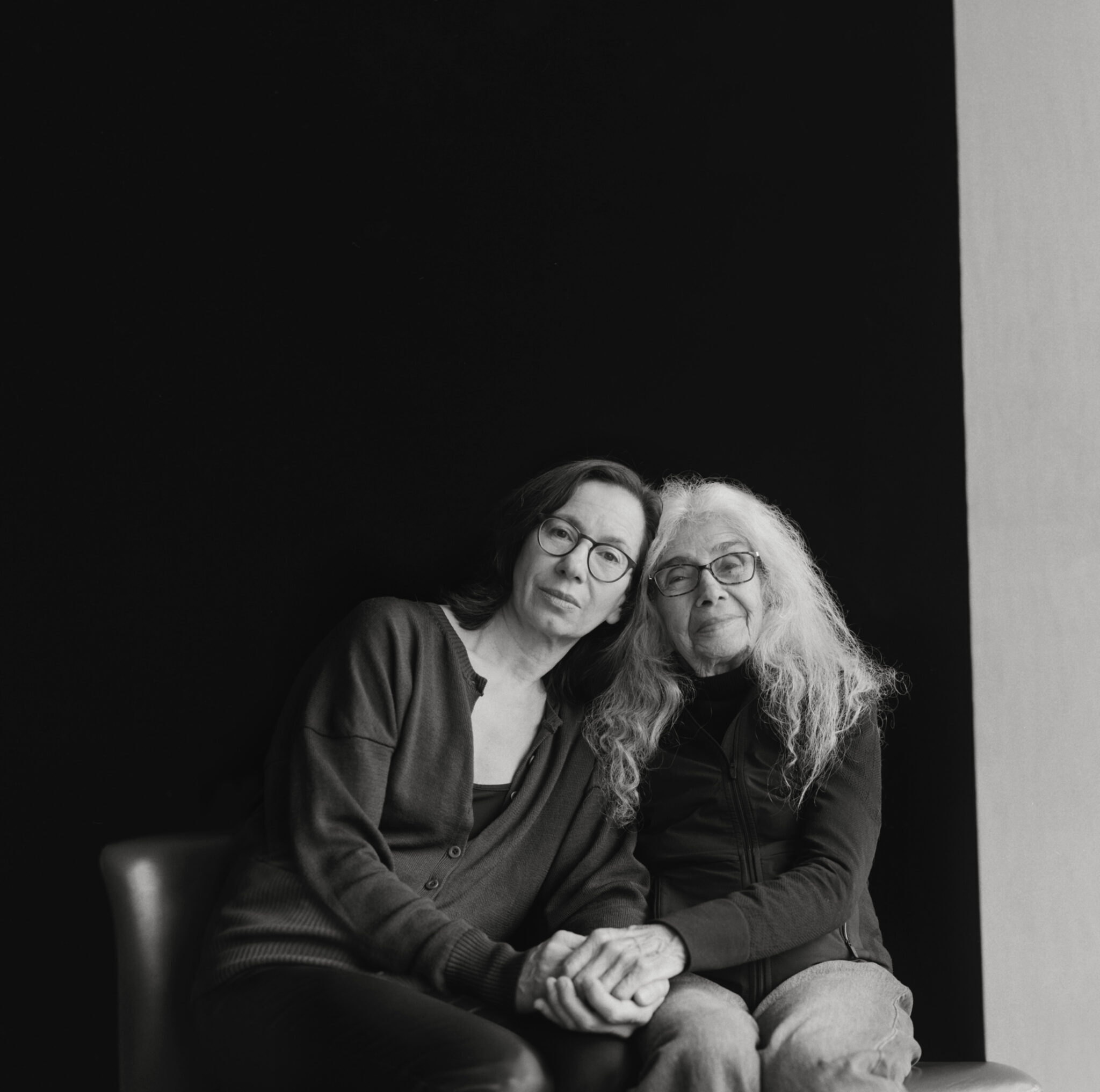
The artist Andrea Fraser warns me what might happen when she and her 92-year-old mother, Carmen de Monteflores, start talking about art. “It becomes a bit of a family therapy session,” she says.
The two women are at the Whitney Museum of American Art in New York, where they are presenting work side by side in the Whitney Biennial. This is Fraser’s third time in the storied exhibition, which offers a snapshot of contemporary art in America. It’s the first time de Monteflores has ever shown her work in a museum.
The elder artist moved away from her home in San Juan at 16 to study at Wellesley College and the École de Beaux-Arts in Paris. She eventually began making monumental shaped canvases of heads and intertwined bodies. Rendered in an electric, tropical palette, they radiate energy from the wall. But every time she attempted to show her paintings, she was rebuffed. By 1970, de Monteflores decided to give up art entirely. She went on to build a prominent career as a psychotherapist (and also wrote five novels).
Looking back on her own upbringing, Fraser—the youngest of de Monteflores’s five biological children and a prominent conceptual artist—admits that it can’t be a coincidence that she dedicated so much of her career to critiquing the very art system that rejected her mother. In the 1990s, Fraser dressed up as a docent and filmed herself giving satirical tours that exposed museums’ exclusionary practices and colonial histories.
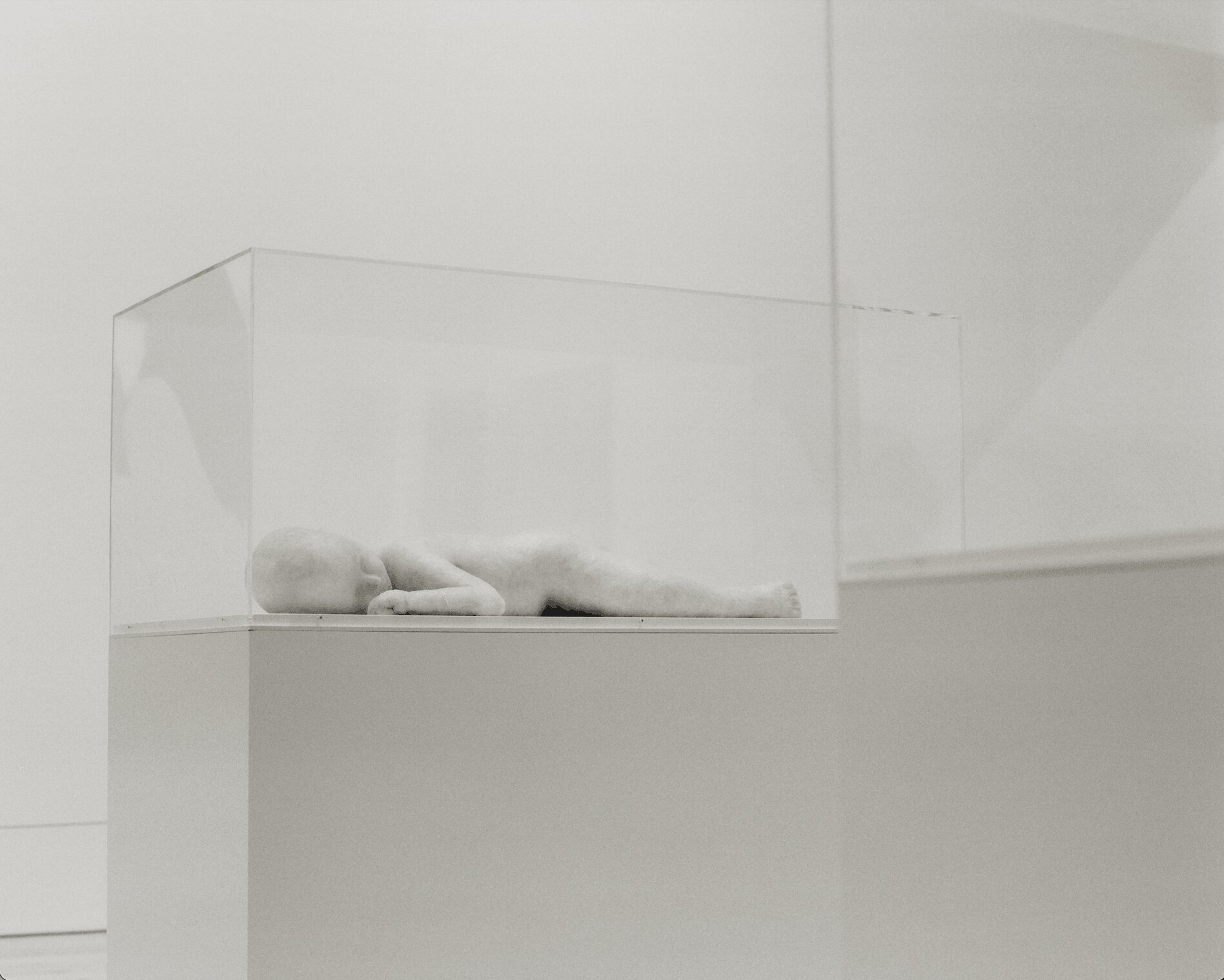
At the Whitney, Fraser is showing a very different kind of work: five tender wax sculptures of toddlers, lying vulnerably on a series of plinths. The children are positioned next to exuberant paintings by Fraser’s mother. (Even though de Monteflores stopped making art more than 50 years ago, she never stopped paying rent on her storage unit.)
After an emotional few days of installation and reflection, the two artists spoke about this new chapter of their lives—with Fraser becoming an advocate for her mother’s work and de Monteflores revisiting the art she made decades ago and wondering what could have been. At several points during the interview, mother and daughter turned to address one another directly. Even after all this time, de Monteflores says, “We keep finding things out.”
How did your dual participation in the Whitney Biennial come about?
Andrea Fraser: About two and a half years ago, we were at the beach in Southern California, and I asked mom, “Would you be interested in showing your paintings?”
Carmen de Monteflores: I said, “Absolutely.” No hesitation.
Fraser: It seemed like there were a lot of women who were in their 80s who had not received the recognition they deserved and were being discovered. I saw that work, and I thought, Well, Mom’s work is better than that. [Laughs]
I sent PDFs to Marcela [Guerrero, the co-curator of the biennial]. She responded immediately. I went up to Berkeley to meet them [Guerrero and Drew Sawyer, the other biennial curator] and Mom. It didn’t go exactly as we had planned.
De Monteflores: My paintings were at the storage space in Oakland. I had not visited them for a while. After the earthquake, they had put beams there.
Fraser: We couldn’t actually fit through. We couldn’t get the paintings out. The other thing was that [the facility] changed owners and hours, so you couldn’t even access your paintings.
So what happened?
De Monteflores: I had some paintings at the house.
Fraser: Then [a while later] they called and said, “We want to put your mother in the biennial. We’d like you to be in it, too. What would make sense for you to include?” I said these sculptures. They developed partly out of my history with your work and being a toddler while you were making those paintings.

Let’s back up to the mid-’60s, when Carmen began making the shape paintings. Can you talk about how you arrived at that idea of uniting the subject and the shape of the canvas?
De Monteflores: I was exposed to what was going on in the art world, even if we were out of the way in Billings [Montana, where de Monteflores and her family lived in the 1960s]. It was inspired by things I had seen in magazines, especially [Frank] Stella. That was attractive to me because I was always interested in sculpture. I had wanted to study sculpture in Paris after I went to college.
It’s pretty amazing that you made more than 100 paintings between 1960 and 1965. How did you sustain that kind of studio practice while raising five kids?
De Monteflores: I was very disciplined about drawing and painting while they were napping. I think they got used to the fact that I was doing this. I would draw everybody.
Andrea, I’m curious about how growing up with your mom shaped your understanding not only of aesthetics, but also of what being an artist meant.
Fraser: There were some fundamental things that I learned about art from you. There’s this idea about drawing that you don’t draw a thing, you draw the relationships between things. This way of attending to the relationships between things and the narrative [informed the way I think]. We were hippies, so that was another thing. There was an ethos of performance. We would dress up in wild clothes.
You’ve said that part of why you gravitated towards institutional critique was having seen the art system fail your mom. Was that a connection you were aware of at the time?
Fraser: Not so explicitly. I remember thinking very clearly when I stopped painting and became a conceptual artist when I was 18 that I didn’t want to end up like my mother, having all this stuff that nobody wanted that I had to store and take care of.
It was a little later that I became more conscious of how my ambivalent, critical thinking about the art world had its roots in your experience. I inherited your ambition to be part of art history and your belief in art as something valuable and important. I also had reason to distrust all that, having seen how it operated through exclusion. But I realized, for almost 45 years, I’ve been trying to understand what art is and why it’s valued. I think I was trying to understand why it was important to you.
Carmen, what was it like to see Andrea become famous as an artist for critiquing the art system that repeatedly let you down?
De Monteflores: I was very proud. I was a good Catholic girl, even in the midst of coming out as a lesbian and doing all those things. For you to be facing these institutions in such a precise and creative way—to me, the courage was off the map.
Fraser: You say that, and then it’s like, this is a woman who left home at 16, went off to Paris and New York. You got involved in the women’s movement and came out as a lesbian. I grew up marching in Gay Pride [parades] with you in San Francisco, and you had this sense of putting your body on the line.
De Monteflores: I had a community of lesbian and gay people. You were doing this on your own, practically.
Fraser: I mean, we had a community of artists and writers. One difference is that you didn’t have the resources to fight back when you were rejected over and over again. You just felt, Oh, I must not be good enough. But you knew you were good.
De Monteflores: I knew I was good. At some deep level, I knew that. This was just crushing. I kept knocking at doors. I didn’t give up instantly. It took a while. Also, her father and I were separating. I needed to take care of other business. I was drawn to being with women, and then I had to deal with the kids and how they felt about that.

What has it been like to look at your work again after all this time?
De Monteflores: I started thinking more about why I stopped. Trying to get back in touch with the feelings I had when I was doing the work. I was so focused, which must be why the kids felt like, in some ways, I wasn’t there. What would it have been like if I had continued?
I told you an idea that I had—it was a long time ago, but it came back to me. I was thinking it would be wonderful to do a park or an outdoor gallery of billboards, except billboards in shapes.
Fraser: When I was painting, I was definitely thinking about your paintings. Then I stopped. There’s a kind of repetition. I could have been a different kind of artist. Would that have been more rewarding? Financially, definitely. [Laughs]
De Monteflores: That’s for sure.
Fraser: Ellen [de Monteflores’s former partner] would sometimes say, “Oh, I want to be rich.” You would say, “I want to be famous.” That always stuck with me. These were two different options. Well, I want to be famous like you. More than anything, I wanted to be respected.
Has this process with your mother changed your own relationship to the market?
Fraser: In 2012, I told my gallery in Germany that I would continue working with them, but I did not want to sell my work to individuals, only to institutions. Then I decided to sell my work to individuals again around 2022, and I started working with Marian Goodman Gallery. That shift had a lot to do with approaching 60 and also feeling that there was a historical shift happening and perhaps my approach was not so relevant anymore.
A lot of younger artists who I was working with as a professor were rejecting critique. Affirmation and care were being taken up as a political model, a rejection of critique. It was coming out of Black feminism and queer feminism, but also artists with disabilities who were working with the politics of care.
Untitled, [a performance] I did in 2003 when I slept with the art collector who pre-purchased the video, is very much about the entanglement of financial value with a sense of self—especially in the art market, where artists are so closely identified with their work. There was a grappling with my relationship to those questions of value.
It’s interesting what you said about care, because it’s something that comes up in the conversation you two did for the biennial’s catalogue. Carmen, you talk about how you feel really cared for by the work that Andrea has done for you. How are you thinking about the relationship between art and care through this experience?
Fraser: There was a certain amount of neglect in my childhood that, in some ways, was very typical of counterculture families. I do think that your focus on your work was a part of that.
De Monteflores: Yes, definitely.
Fraser: Your paintings were my competition. I had two older brothers and two older sisters, so there was a lot of competition. I can’t plausibly ignore the connection between [my] being anti-painting [as a conceptual artist] and the fact that you were a painter. How much of that had to do with my competition with your paintings? There has to be a connection.
De Monteflores: So many layers of this.
I couldn’t help but notice that you have five toddler sculptures in the show and you are one of five children.
Fraser: They were conceived for an exhibition in Paris to be shown with the videotape, Untitled, in which I’m having sex with the collector. That video was produced in an edition of five. Then, of course, I thought, Yes, family of five. [Laughs] You walk into the gallery, you see the video, you see these toddlers. I assumed that connection would exist in people’s minds: “Are these the offspring of the sex with the collector?”
There’s also the enactment of the metaphor of selling art as prostitution and the materialization of the metaphor of art as offspring.
There is a dimension that doesn’t get talked about in connection with the work: how difficult it remains for women artists to also be mothers. You were not taken seriously not only because you were a woman, and a Puerto Rican woman, but because you had five kids.
De Monteflores: Definitely, yes.
I did want to ask about sex in both of your works because—
Fraser: Nobody’s asked about that! [Laughs]
Oh, good. For Andrea, sex is often a proxy for other things, like—
Fraser: Neoliberalism?
I was going to say power. Carmen, your work is much more about bodily experience and your own sexuality. I’m curious if you think about sex as a throughline in your work.
De Monteflores: Well, it’s there. It’s definitely in the shape of paintings.
Fraser: There’s your “Man and Woman” series, one of which is in the show. They’re all really sexy. You also talk about this burst you felt, not only of creativity, but also of sensuality, after you finished having children.
De Monteflores: Oh, yes. Cat on a hot tin roof.
Fraser: But you did grow up Catholic and went to parochial school. Even while you were partaking a bit in sexual liberation, you were pretty close to an all-men-are-rapists lesbian feminist. Which wasn’t very encouraging of a young woman trying to figure out how to deal with men.
De Monteflores: This is true.
Fraser: And in my work, I was associated with being a very proper, prim woman in a double-breasted suit: Jane Castleton from Museum Highlights. Then, when I did Official Welcome and took my clothes off, it was like, “What is going on?”
Andrea, how has advocating for your mother’s work changed your relationship to your own Puerto Rican heritage? I’m especially interested because I feel like you’re one of very few artists to make work explicitly about white womanhood.
Fraser: For this piece called This Meeting is Being Recorded, I convened a group of white women to examine our roles in white supremacy. In the context of that group, I talked about having a mother who’s Puerto Rican and the sense of passing. Early on, [when my family lived] in San Mateo and Billings, I was brown. Then, when we moved to Berkeley and I was in a Black-majority school, I suddenly became white. Then I had to grapple with being white. Also, Mom, we haven’t talked about this, but I’m kind of the whitest person in the family.
De Monteflores: Yes, you are.
Fraser: I’m also the only child who didn’t get a name or nickname from your side of the family. I have a completely Anglo name.
De Monteflores: That’s interesting. I hadn’t thought of that.
Fraser: I felt pushed to the white side a little bit. I think you didn’t necessarily want us to identify with being Puerto Rican.
De Monteflores: I did a lot of passing myself. Some of it I couldn’t pull off. We were rejected in New York when your father and I were looking for an apartment because they realized I was Puerto Rican.
Fraser: See, I’m going to start crying. I think about institutional critique as working with ambivalence—a love-hate relationship to the field of art. This duality defines [my relationship to] art in many ways—being in a very powerful social space and also somehow being a guest there. Being critical of the institution, but also wanting access to it.
De Monteflores: Yes, of course.
Fraser: This plays out very explicitly early on in my work Welcome to the Wadsworth [a performative guided tour of the Wadsworth Atheneum in Connecticut], where I very explicitly thought, Well, this is a settler-colonial institution in a Hispanic and Black majority city that has been emptied out by white flight. What position am I going to take? Am I going to take the position of a DAR [Daughters of the American Revolution], which I could be on my father’s side? Or am I going to take a position of the Puerto Ricans, who were brought here to work the tobacco plantations in the Connecticut River Valley? I’m going to take the position of the DAR, but I’m going to take that position critically and speak its racism. Even though I’m taking that position, I hold this other part, the Puerto Rican part.
It’s interesting that with this show, your work is quite literally being seen in the context of your Puerto Rican heritage—it’s being shown in a familial context.
Fraser: Yes. I’m curious whether now people will see my work differently. But I’ve had this weird experience. When I tell people, “Oh, my mother’s Puerto Rican,” they say, “Oh, that makes so much sense.” Like in Brazil, because I samba better than most Brazilians. They start seeing me as a Latina. I think that’s so weird. I’m thinking, How racial is this? This kind of essentialism.
De Monteflores: My father was a good dancer, by the way.
Fraser: Well, so was my father. Scottish background.
De Monteflores: Yes, that’s right.
More of our favorite stories from CULTURED
The Substack Stars: 21 Newsletters That Your Favorite Writers Can’t Get Enough Of
In Wayne Koestenbaum’s First Novel in Two Decades, Gay Lust Incarnate Is a Rabbi With a Dad Bod
Eva Victor Made the Breakout Indie of the Year. Now, They Have to Do It All Over Again.
What Is It Really Like to Work at a Black Art Institution Right Now?
In Paris for Fashion Week? Catch These 11 Must-See Exhibitions While You’re There
Sign up for our newsletter here to get these stories direct to your inbox.






 in your life?