
New to the Hamptons, en route to an off-season rental, a woman on the run—from her man, her social scene, her stagnated creative vision—stops by the grocery store for supplies. Eggs, liquor, the local paper. At the house, she turns the heat up. We’re on the blustery bay side of Long Island, at a bungalow surrounded by dogwood trees in the dead of winter. Leafing through the East Hampton Star, an obituary stops her short. Her friend Hannah Wilke, the daring and experimental visual artist, has died at 52.
The woman narrating this story, a lightly fictionalized iteration of its author, Ann Rower, orbited Wilke for decades. The two went to high school together, attended the same debauched downtown art openings, strolled brusquely past each other as neighbors on Greene Street, and even shared a gynecologist.
Our narrator is immediately thrust back in time, to one of Wilke’s performances, “where she, and audience chewer helpers, unwrapped and masticated bubblegum that she shaped into cunts and stuck all over her body.” At the time, Wilke told a journalist that she chose chewing gum as her medium because “it’s the perfect metaphor for the American woman—chew her up, get what you want out of her, throw her out and pop in a new piece.” News of her friend’s death sends Rower’s narrator into a spiral: down into the sticky substrata of American femininity, the bowels of the art world, a cemetery in the woods, and the uncharted territory of her own erotic urges.
She hops in the car, handwritten directions to Green River Cemetery clutched between her incisors. Green River is famously the final resting place for a menagerie of the art-world famous: Jackson Pollock, Frank O’Hara, Stuart Davis, and now, Wilke. Rower begins visiting regularly, sometimes bringing along her lover, an aspiring artist and the first woman she’s fallen for since adolescence. Together, they stumble upon the grave of painter Elaine de Kooning (wife of Willem de Kooning). A few visits later, Rower spies a petite rocky outcropping in the shadow of Jackson Pollock’s grave: Lee Krasner, Pollock’s wife. Another woman painter painted into a corner by her marriage and her era.
Suddenly, an obsessive line of inquiry cracks the flat rock face of Rower’s life: what if these “painters who were more famous for being the wives of famous painters” were not simply cocktail acquaintances, but secret lovers, locking lips in coatrooms, or at least friends and comrades, sharing watercolors? This wishful fixation forms the molten core of this novel—or is it a memoir, a group biography, a ghost story, a dream journal? Lee & Elaine, first published by Serpent’s Tail in 2002, will be brought back to bookstores next month in a new edition from Semiotext(e).
Rower, the author of the 1990 essay collection If You’re A Girl and the 1995 novel Armed Response, predicts and parodies a raft of now-popular genres in Lee & Elaine. Her autofictional protagonist attempts to pen a joint biography of Krasner and de Kooning that also operates as a journey of self-discovery. When she fails to find evidence that Krasner and de Kooning were lovers (their associates insist they harbored nothing but animosity for each other), Rower is eventually forced to write a love story between ghosts.
Krasner’s character could have been shading any number of the past decade’s ostensibly feminist group biographies—of “difficult” women, “gutsy” women, women writers, women mathematicians, women crossword puzzle designers—when she remarks, ruefully, of a group show entitled “Women and Abstract Expressionism,” that it’s quite a “stupid idea, lumping us all together. Just because we’re women.”
In the end, the book becomes an accidental love letter—not to de Kooning or Krasner, but to Wilke, a lost peer; to a short-lived love affair; and to Rower’s own past and future lives. And Rower’s lover’s viscous lip gloss becomes a glue—a gummy substance stretching across generations, so women who might have hated each other can become friends, those who never met can trade secrets, and those who never knew how to phrase their compliments can simply smack their lips and smile.
Ahead of her book’s republication next month, I visited Rower at her home on the Upper West Side to discuss midlife stories, artistic friendships, cemetery sex, giving gossip a good rap, coming out narratives, and more.
This novel is extremely prescient from a genre perspective. It predates the rise of group biographies, autofiction, and intrepid-narrator-obsessed-with-dead-person-they-identify-with books, while roving between all those forms. What has it been like to watch those styles become commonplace?
That mixture—it’s always been my genre in a way, whatever it is, whatever genre ever was. I almost want to ask you what genre you’d call my work. That’s how I have always written, just straight from the heart. I’m interested in the way [autofiction] has become a popular mode now, but it makes sense to me because it’s a wonderful way to write, as well as a wonderful way to tell the truth. The best blurb I ever received was from Gary Indiana, a very good friend of mine. He called me not a “storyteller, though she is that. She’s a born truth-teller, too: a much rarer bird.”
Friendships forged through art—whether collaboration or simple admiration—form the connective tissue for much of the community depicted in this book. The story is sparked by the narrator’s grief in the wake of the death of her friend, the artist Hannah Wilke.
Hannah’s obituary launched this book. I went to high school with Hannah. Her name was Arlene Butter at the time, and she lived across the street from me in Soho forever. I always loved art involving nudity, and she was very brave in her work, I thought. The book begins when I got out to the house in Springs, and I opened the East Hampton Star, and there was her obituary. It was so shocking to learn of her death that way.
That accidental discovery—you said, in an interview with your friend and editor Chris Kraus, that you’ve “always cherished accidents. I think I believe in that if I believe in anything.” Your writing also feels motored by a belief in fate. Do you use these potentially fated accidents as punctuation marks in your work?
In a way, I don’t even think accident is the right word. What we consider accidental ends up feeling like part of a greater plan, eventually. The man I lived with for 20 years, Vito, the man the narrator is leaving in Lee & Elaine—we got back in touch just recently. I actually talked to him right before you came; I’ve sort of fallen back in love with him. [Laughs] He is a music composer, but he’s written these amazing stories. And he came to me with them because someone said to him, “You should really have a book. Do you know anyone that has any connections with Semiotext(e)?”
That’s amazing. While we’re talking about social webs: One of the narrator’s interview subjects accuses her of looking for gossip, not truth. What’s the difference, in your view?
Truth—that’s what gossip is. The things that people tell each other in private—secrets, especially. That’s why they’re secrets, because they’re true. Gossip gets a bad rap, but it shouldn’t.
Speaking of secrets—this book is in some ways positioned as a coming-out journey for the narrator, and there’s a poignant moment when she wonders, recalling her mother discovering the love letters she’d secretly been exchanging with a girlfriend, “Did I want to be found out again? Or just found?”
In this book, I’m framing my coming out as something that happened in midlife. But while it was kept secret from my parents for a time, I had a girlfriend when I was 14. So in a way, I didn’t need to come out late, because I was already out. That late coming out, it’s a strange trope. The archetypal coming-out-late tale is a trend now. When they read this book, Eileen Myles said something hilarious about Lee and Elaine “getting hot for each other in that dirtiest of places: midlife.”
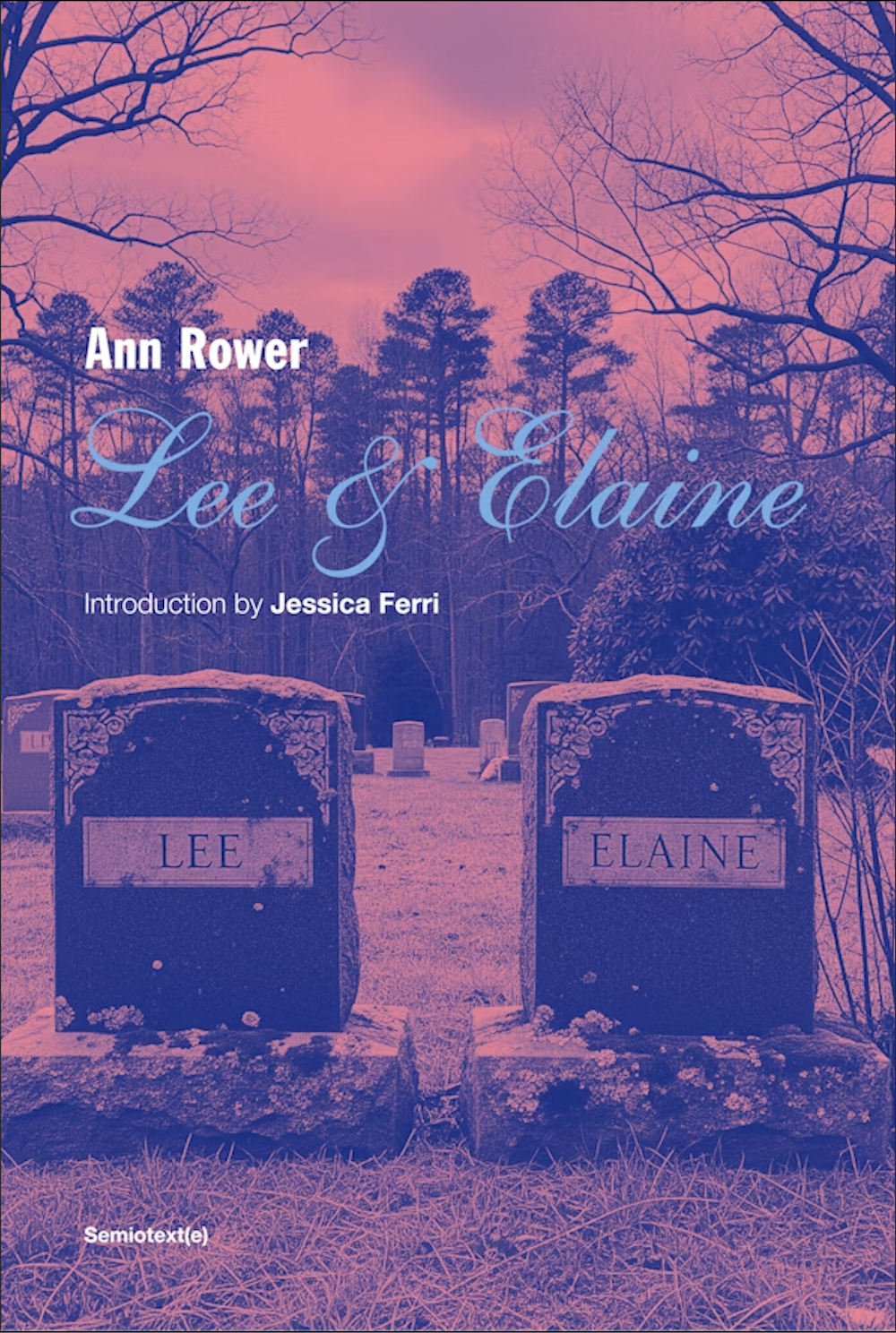
That has multiple resonances, since in this novel their fictional ghosts are falling in love from beyond the grave, in the literal dirt of the cemetery where they’re both buried. The introduction to the new edition mentions the eroticism that you and Jessica Ferri, who wrote the introduction, ascribe to graveyards.
Jessica also took the picture for the cover. It’s a picture of Lee and Elaine’s gravestones, side by side. It’s a beautiful cover, but it scares me a little bit. The book’s original cover was pale blue; it was a picture of a beach with two girls running across the sand toward the water. Someone put a subtitle on it—it said “The Wives’ Tale”—without ever asking me. I felt like that subtitle completely destroyed what I was trying to say. Luckily, no one ever even mentioned it. When Ferri and I met, she asked me about this line in the book, “Cemeteries always made me hot.” We started exploring what that was about, and I’m not really liking this as the answer right now [Laughs], but there’s something about the fact that graveyards don’t change too much. Everybody’s already dead.
That’s intriguing, especially since the narrator is constantly daydreaming about these dead people changing in their graves—radically altering their lifestyles, shifting their affections, finally following what she hopes were their true passions.
Someone once said, about the ending of this book, that it “shimmers.” What’s funny is, the ending of this book is not the ending that I originally wrote. The ending I wrote first, which was the literal truth, was a scene where Heather [Lewis, a novelist and Rower’s eventual partner until Lewis’s death in 2001] and I go to Green River Cemetery and fuck in the graveyard. We were completely prepared for the conditions—we knew that there would be dew, so we brought shower curtains, and we safety-pinned them to a blanket. So we had wonderful sex in the back of the cemetery and that’s how I wanted to end the book. But my editor wouldn’t let me. I understand why she didn’t want me to, and it probably is better the way it is. What I did instead was, since I knew I couldn’t write about fucking in the cemetery, I went home, I had a hit of some extremely good pot that Vito was selling at the time, and wrote the scene that’s there now. It turned out to be about de Kooning’s ghost sort of floating around above me, and shimmering.
Wordplay is a consistent predilection throughout your writing. You have a knack for the astute yet startlingly concise pun.
Capacious is a nice word for what humor can do. Jokes have always just felt like the most comfortable way to tell the truth for me. Like the beautiful Emily Dickinson line, Tell the truth, but tell it slant. I sort of get off on telling the truth, now that I think about it. It’s a similar thrill to sharing gossip, in a way. There’s a rush of exposing, revealing, and all that. A fancy word for it is revelation.
Speaking of revelation, the narrator of this book at one point calls the project “a dream book,” and says it seems to be “writing itself,” rather than being written by her.
I do feel that way with all my writing. Partly maybe because it fulfills the plan I mentioned before. Writing about Heather—that was such a big love, and so much felt like part of the plan. Though I didn’t end up writing about her directly in this book, I’m always writing about Heather.
Heather surfaces a lot in the reissue of If You’re A Girl, which Semiotext(e) put out in 2024, and which you’ve also referred to as your “pink book.” Pink appears in this novel over and over again too—your lover’s pink lip gloss, the pink dogwood at the house in Springs. What does the color mean to your work?
I’ve always been drawn to pink. It’s a slang word for pussy and slang for truth. I think I’m drawn to pink and pinkness for that reason. Think about going pink, that expression—it’s a corny way of saying going nude, taking your clothes off.
You often write in a mode you call transfiction, a fictionalized form of oral history based on interviews you conduct. Your fiction is generally rooted in a sense of artistic community. Was that approach a way of inserting collaboration into fiction-writing, which is too often a really solitary pursuit?
I always felt it was sort of fake, that I was making up a reality that didn’t really exist, using people’s real words in my work. On the other hand, I love being edited. I like someone messing around with my work. Some people don’t like it, and even feel violated in a way. I encourage it—but that’s not even a strong enough word. I try to make it happen. It feels like a way of connecting.
Sex is a central avenue to connection for your narrator, and you write erotic scenes that are really drenched in wit, attuned to the ultimately comic depravity of sex, but without abandoning the earnest grasping for another person that’s happening in those moments.
I can only write about sex as humor. I wish that I could write about it in a more traditionally dirty way. Some of the writers I admire most write about sex wonderfully, sexily, in a way I can’t. Richard Hell, for one thing. He’s also an idol and a punk god, and I’ve always had a huge crush on him. I found this little piece that he wrote recently. He’s writing about trying to come while he’s kicking dope, and making all these weird noises. I mean, to even try to reproduce those noises—it’s wonderful.
What do you think is underrated, overrated, or accurately rated these days?
I feel like it’s all good.
Life in general? I have to say, I don’t hear that every day.
Yes, in general. The older I get, the better it gets. Which is a strange thing to say, especially because there are certain things—physical things—that are not better. I am in a wheelchair and my memory isn’t as great. But the parts of life that I get to carry with me: it’s all good. Talk about life having a plan. I just found out that the Wooster Group is going to restage my old piece about Timothy Leary’s community and LSD. Seeing my work revived in new ways, with re-publications like this, with new introductions. I love Jessica’s introduction—she and I became fast friends, and I love it when people become friends through writing. My way of relating to people is through what they write. And it’s a very deep, lovely way to connect with someone. It happens a lot to me, partly because I don’t go out very much.
More of our favorite stories from CULTURED
A Movie Deal Is a Writer’s Dream—or Is It? 5 Authors Get Real About the IP Machine
Shrinking Actors Sherry Cola and Jessica Williams Talk Therapy (On Screen and Off)
Kenturah Davis Lost Her Home and Studio to the LA Fires Last Year. Here’s How She’s Remade Her Practice.
The Pitt’s Shawn Hatosy Is an Emmy Winner, a TikTok Star, and a Secret Literature Nerd
Why Are Artists So Interested in Making Playgrounds?
Sign up for our newsletter here to get these stories direct to your inbox.







 in your life?