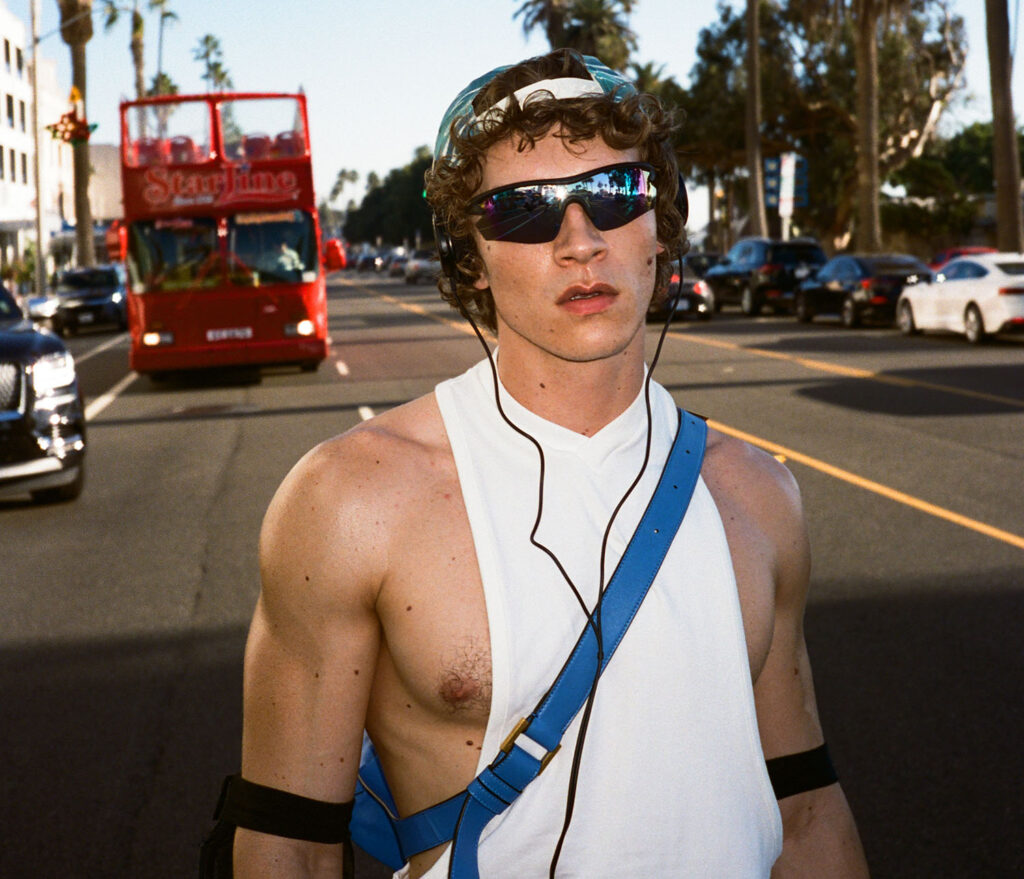

When Eva Victor started writing their debut film, Sorry, Baby, one piece of feedback cropped up more than any other: “You should not do that.” The story is an intimate look at the life of Agnes, a New England graduate student, in the aftermath of an assault at the hands of her thesis advisor. The psychological impact of sexual violence blends with the kind of gentle, absurdist humor that finds Agnes rescuing a stray kitten and then hiding it in her hoodie at the grocery store. With its nonlinear structure, Victor (who also plays the lead) casts trauma recovery as a fragmented, unsensational, and, sometimes, strangely funny journey.
The Paris-born, San Francisco-raised triple threat possesses a keen sense of life’s terrors and frivolities. They got their start writing deliciously caustic articles for Reductress (“I Never Thought I’d Find Love. And Then I Didn’t,” “Woman Who Finds ‘They’ Pronouns Confusing Has No Problem Calling Her Car ‘She,’” “Confident Woman, But How”) before becoming a cult favorite for their short-form video comedy on Twitter. In 2021, Barry Jenkins, the Academy Award-winning director of Moonlight, cold DM’d Victor, offering his production services in case they ever wanted to make a feature. He mentored Victor through the making of the film.
Sorry, Baby’s Cannes and Golden Globe nominations thrust the 32-year-old into an unfamiliar—and at times unsettling—world of press tours and publicity. But the semi-autobiographical project also caught the attention of Halina Reijn, the Dutch director behind 2024’s erotic thriller Babygirl, 2022’s Gen-Z murder-in-the-dark flick Bodies Bodies Bodies, and a fellow creative known for honest depictions of the thorniest aspects of human sexuality.
As Victor gears up to begin writing their next project, they met up with Reijn for a therapeutic conversation about dark humor, panic attacks, and surviving test screenings.
Halina Rejin: I am so obsessed with your movie. What kind of wild ride have you been on?
Eva Victor: The year of releasing a film is a totally different beast. It’s cool that the movie is still being talked about. My god, you never, ever think that’s going to happen.
Rejin: I really agree: You have the baby, and then suddenly everybody’s taking the baby from you. That whole year of promoting and campaigning is very much outside of yourself. Are you tired?
Victor: I’m so tired. I’m confused. What was the year like for you when you released [Babygirl]?
Rejin: I constantly had panic attacks. I thought I was gonna faint.
Victor: I’m glad. Not that you were gonna faint, but that we both were gonna faint. I have questions for you about returning to your body after all of that and returning to your creative self, but I don’t have to ask you that on the record.
Rejin: Oh, you can ask me anything on the record.
Victor: Well, then, how do you fucking…get back?
Rejin: It was much harder than I expected. I would say to you: Take a real vacation. Tell yourself, These weeks, I’m not allowed to write anything. I’m just gonna go somewhere or be with friends. I did not do that. I just felt immediately I needed to be creative because my creativity gets me back into my body.
Victor: When I’m not creative, I’m very unbalanced.
Rejin: I get very scared and mad at everyone. But I’m supposed to ask you questions, Eva.
Victor: That’s not fair because I am, honestly, so sick of myself.
Rejin: I have a question that everybody already asked you, but I want to know. Everyone is praising Sorry, Baby for dealing with the darkest subject that we women experience in a way that is incredibly funny. How does it feel that everybody’s so touched by it?
Victor: I decided I wanted to make a movie about this, and that it was going to be funny. It makes me feel like vengeance has been achieved. When you go through something that scares people—and they’re afraid of you and don’t know how to talk to you and are talking about you—the craziest defense mechanisms manifest.
But also, the joy of friendship is its own, pure thing. That is the reason I made the movie. That is not necessarily what we see in movies about someone who’s gone through this. I wanted the film to start with this burst of laughter. These are full people. That’s the greatest rebellion against the kind of taking that the professor does in the film.
Rejin: That’s why it’s such an important movie. I felt less alone watching it. It’s just like life is: completely absurd.
“At my first test screening, people were saying some of the meanest things I’ve ever heard. I wore an outfit with boots, and I kept thinking, This is so embarrassing. I’m in boots at the front of the room, writing down, ‘Did not like character.’”—EVA VICTOR
Victor: The darker things you go through—or that I go through—reveal how fake everything else is. Maybe not fake, but fragile. You have no control over anything. You go through the worst day of your life, and you walk by someone who is having the best day of their life. If we’re talking about the most personal wounds, the most scary-to-share things, your film, Babygirl, is a total uncovering.
Rejin: I was so scared. Doing it on that world stage makes it even crazier: You cannot control all the reactions, good or bad. Nobody really prepares you for it.
Victor: I am in the hellish zone of like, Who wrote this movie? What did I understand about writing then that I need to understand now? I’m a different person because so much time has passed.
Rejin: I started writing again when I was really depressed. What helped me a lot was that I got to know a very small number of people, maybe three, who I trusted as readers. I would send them my dumbest ideas, and I would say, “Come to my house for a couple of hours and brainstorm about these.” That helped me to feel out where I wanted to go.
Victor: My instinct when writing Sorry, Baby was to hide it away. Don’t share it ’til it’s done. Now I’m like, I’ll die if I do that again. I need people. The isolation doesn’t really work the second time because there’s so much pressure, and the pressure paralyzes you. Other people can, in a playful way, take you out of it.
The cool thing about experiencing a year like this is that you meet all these directors and writers. It is crazy how deep you go with someone when you’re on this ride together. They become sisters or brothers or mentors.
Rejin: I was working on a script that I got really stuck in, because I was trying so hard. I started writing my new film on the side. I was like, I need something for myself that will never go anywhere. I never expected it to be the one I was actually going to do. How does it feel that this wild ride is winding down?
Victor: As the director, you’re on the ride the longest, especially if you wrote the film. There are seasons of making a film, but you’ve been there for every single stage of it. It’s very difficult to explain to other people how emotional it is to say goodbye at the end.
The beautiful thing is that you start alone, and then people find their way to the film. Then you’re not alone. Then you’re in production, which is the most psychotic experience. I really enjoyed it, but once I got to post-production, I learned that those are more my people. I like a dark room. I like to cry. I like to make sick jokes. This is more my pace.
Rejin: It is really lovely to create history with people. I was part of a theater group for basically all my life, and we were always together. As an actress, I love that. Working with people you care about is everything. Because in America, you have to make money as well. It’s not a joke. It’s not like Europe, where you can just get some amazing subsidy. Coming from my hardcore arthouse world and then entering America, it’s very exotic. The test screenings—I find those really interesting. You have to be a total masochist to get through it.
Victor: At my first test screening, I sat at the front of the room because I didn’t know what it would be like. People were saying some of the meanest things I’ve ever heard.
Rejin: They don’t know that you’re there.
Victor: I wore an outfit with boots, and I kept thinking, This is so embarrassing. I’m in boots at the front of the room, writing down, “Did not like character.”
Rejin: Spike Jonze is one of the people who has recently become very important in my life. We did a Gucci short film together, and he would just show it to people wherever he went. It’s called Let the Tiger Eat You, and that was his whole thing. Just let the reactions come. Just let it wash over you.
Victor: You can feel when someone’s getting bored.
Rejin: Or when they’re entertained. It’s like when you perform live. You can feel the audience losing you. In the beginning, it scared me to show a project before it came out—I worried I would get lost. But Spike taught me that there’s nothing to be scared of. “Let the tiger eat you” is my new motto. Would you star in your own film again? I’m asking this for myself, of course, as an actor.
Victor: I would. I think you need to, too, as long as it’s the right thing. You know when you read something if your soul wants it.
Rejin: I completely agree.
Hair by Hikaru Hirano
Makeup by Hadia Kabir
More of our favorite stories from CULTURED
10 Collectors Share the Book That Changed How They Think About ArtNobody Sings About Sex Like Peaches. With Her First New Album in a Decade, She Shows Us Why.Stylist Jason Bolden Spotlights 3 Young Black Designers You’ll Soon Be Seeing a Lot More OfMasturbation on the Moors: Emerald Fennell’s ‘Wuthering Heights’ Is a Bodice-Ripper for the Internet AgeThe 14 Horniest Places in New York, According to Jordan Firstman, Francesca Scorsese, and More
Sign up for our newsletter here to get these stories direct to your inbox.






 in your life?