
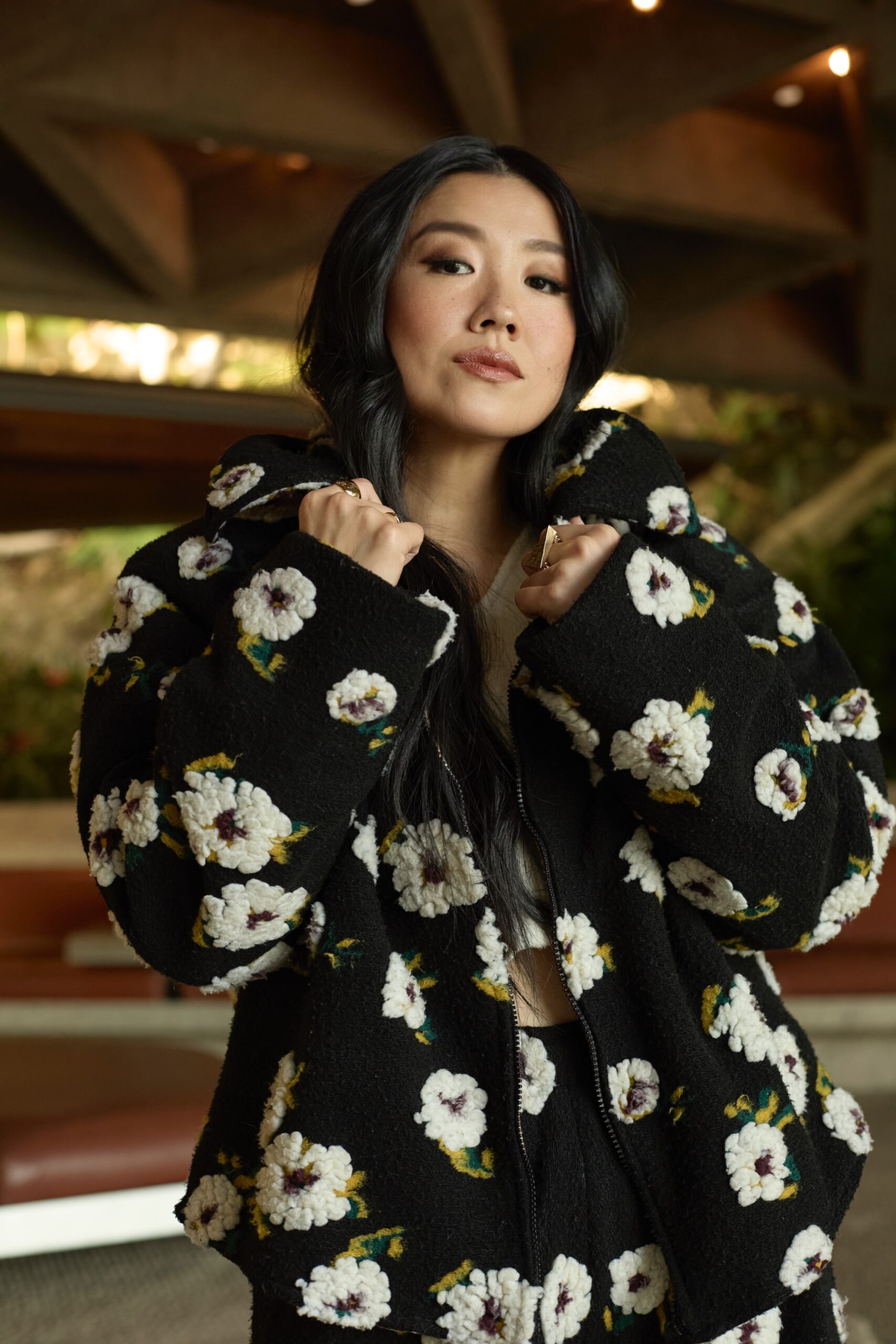
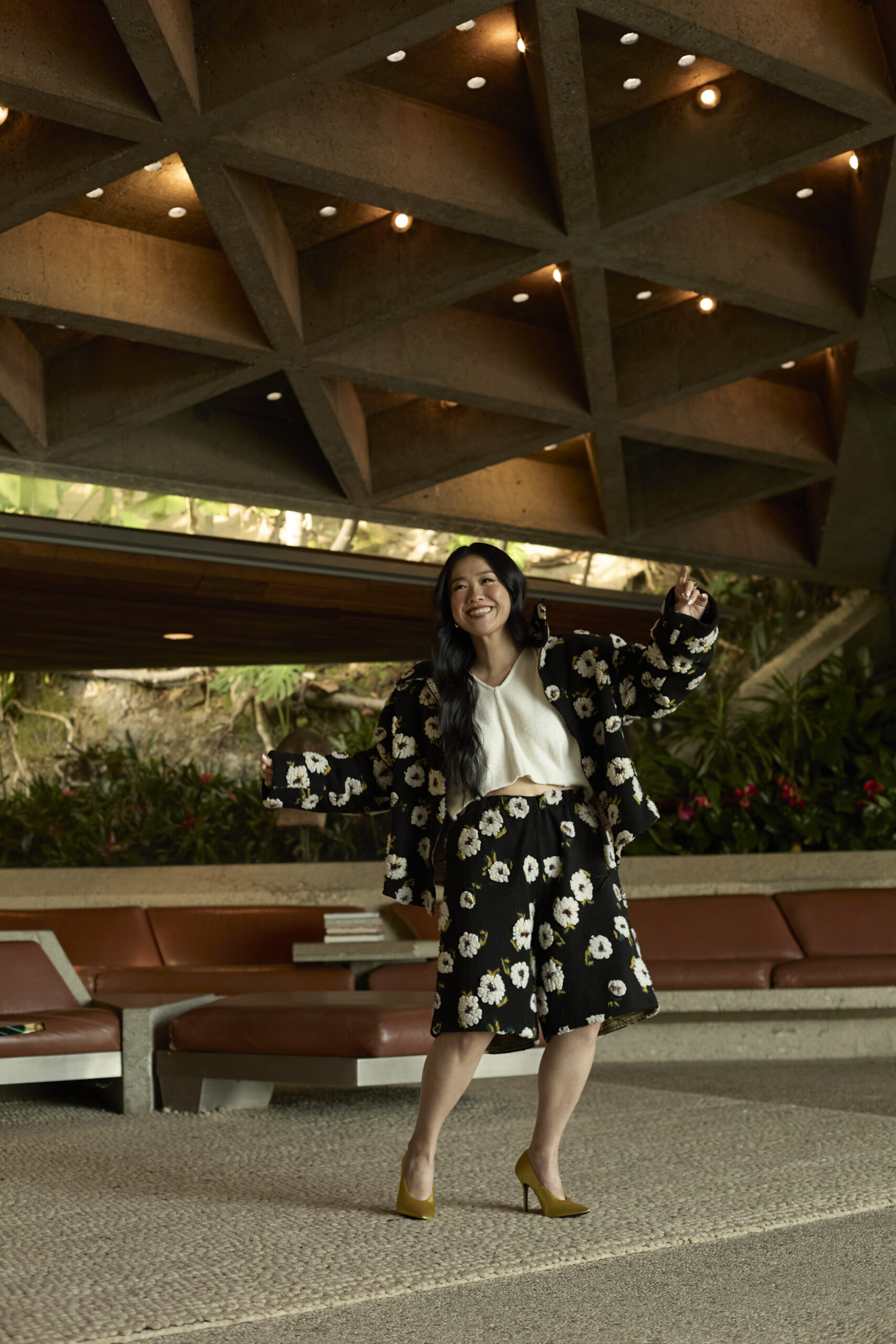
Comedy is tragedy plus time, the old adage goes. It’s that kind of confessional self-examination that drew comedians Sherry Cola and Jessica Williams to Apple TV+’s therapy dramedy Shrinking. In the show, which is currently in the midst of its third season, the therapist Gaby (Williams) meets her match in Maya (Cola), a sharp new character navigating grief, identity, and the messy work of healing on her couch. Off-screen, the actors speak with the same candor and humor that defines the show itself—jumping from Los Angeles’s “cheap and cheery” architecture to stigmas around mental health in immigrant communities without missing a beat.
Both performers came up in the world of comedy before expanding into drama, a trajectory they see less as a pivot than an evolution. After taking classes at the Upright Citizens Brigade and making her way through Los Angeles’s stand-up comedy gauntlet, Cola got her first big TV break with a recurring role on Amazon’s Chris Kraus adaptation I Love Dick. Williams leapt into film and narrative television from The Daily Show and her hit podcast 2 Dope Queens, which helped define the tone of long-form comedic chat shows.
Last Friday, the pair caught up for CULTURED, reflecting on representation, Millennial cringe, and the Aaliyah movie that changed them.
Jessica Williams: So you majored in entertainment studies. What the fuck is entertainment studies?
Sherry Cola: It was communications with an emphasis in entertainment studies. And tourism. Here’s the tea: I was in college for seven years. They added tourism in the second half.
Williams: Tourism?
Cola: Yes, because Disneyland theme parks are technically entertainment, so they added that. But I was there for that long. I was just lollygagging and partying. Definitely not the model minority.
Williams: Where did you go to school?
Cola: Cal State Fullerton. You went to Long Beach right?
Williams: Oh my God, yes. I partied there a lot. My good friends that I went to high school with lived in those apartment dorms on campus. I remember watching DVDs of Lost and The Office season premieres there, discovering Vampire Weekend there.
Cola: What a time.
Williams: Four Loko.
Cola: Sometimes I still put on Asher Roth’s “I Love College” just to feel something.
Williams: Me and my boyfriend say those lyrics to each other a lot: “Thirsty Thursdays,” whatever.
Cola: Listen, I don’t kink shame, ’cause that is a form of foreplay. [Laughs.] But I think it’s really special that we’re both from LA. Just SoCal to the bone. And the fact that Shrinking is set in Pasadena. The fact that we filmed in Old Town, where I grew up in the San Gabriel Valley.
Williams: Oh, that’s right. You used to go to bars there.
Cola: Yes, those were my old stomping grounds.
Williams: Around what age?
Cola: Twenty-one. Wokano, Barney’s.
Williams: Oh God.
Cola: Wokano. It’s so nostalgic.
Williams: I feel very triggered by Wokano.
Cola: No, truly. Like, why do I have goosebumps right now? Only because these are memories I tried to erase. Especially us both being born in 1989—there’s something really cool about Millennials, because we experienced the before and the after. We remember simpler times. Yet we’re still savvy with the new times.
Williams: I’m falling behind though now. I’ve been getting older and I care less about figuring out how to edit my TikTok the right way. This next generation just knows how to do it. When I was younger, I had energy to figure that stuff out. We grew up sharing the family computer. I remember my mom made me use talking-typing software to learn. It was called Talking-Typing Tutor. You needed a CD-ROM.
Cola: The sound of construction/dubstep when we were signing onto AIM. And the fact that we were HTML coding on MySpace. We had the chops.
Williams: That’s true.
Cola: Where did you grow up?
Williams: Torrance.
Cola: I was born in Shanghai, and then we came to Alhambra and Temple City. My mom still lives in Temple City. Do your parents still live in Torrance?
Williams: They’re still there. Do you go back to China a lot?
Cola: I wish I could go more often, but it is a 16-hour flight. I have my grandma, auntie, and cousin [there]. The last time I went back was a couple years ago. Shanghai is like the New York of China. Such a cool city. I did actually go to school for one year there before we came to America. We’re completely surpassing our ancestors’ wildest dreams. We didn’t think this was possible.
Williams: They really fell on the sword for us. Even actresses before us—women of color—had much more limiting roles. We’ll have had limited roles compared to the next generation too, but there’s something really special about being part of that chain from our ancestors to now. It makes me really grateful for being able to do the work. Acting is such a silly and embarrassing job—it’s purely to transmit a feeling and tell a story.
Cola: No doubt. It’s a privilege. Because of those trailblazers, we have this luxury of being in the industry right now. That ripple effect for younger artists to feel inspired—I always recognize how lucky we are. Which is why Maya [Cola’s character in Shrinking] is impactful for me. I’ve been in therapy for over four years, and I rarely see Asian women onscreen telling this kind of story, emphasizing that you don’t have to be alone.
Williams: Why is that, that you don’t see depictions of Asian women in therapy?
Cola: Mental health only recently became a conversation in the community. There’s generational cultural gaps in trauma. Sometimes I vent to my mom and she says, “Forget about it. Don’t rock the boat.” And I’m like, “Mom, we have to speak up.” Shrinking is about grief and joy and all the moments between—it couldn’t be more human.
Williams: Another thing about getting older is crossing the age our parents were when they had us and realizing they did the best they could with the tools they had. For my parents, if they cried, their parents would hit them and say, “Go outside and get a switch.” That’s what they knew. My mom had this phrase: the buck stops here. The stuff my mom couldn’t reconcile from previous generations, she tried not to pass on. There’s something about generational trauma and doing the work—trying not to spread that to your circle.
Cola: My grandparents definitely had moments of being controlling, and my mom has told me she doesn’t want to do that with me—she just wants me to be happy. We’ve had our own journey with that, me being queer as well. It goes back to them not having exposure to so many concepts we’re bringing to the table. We’re shifting the narrative in real time, unlearning.
Williams: As people of color, we’ve learned to live with imperfect people to survive and assimilate. Accepting your parents’ limitations and working with them while they process—or don’t. Being a person of color or queer shapes how you relate to the world.
Cola: Life is imitating art, because this is therapy right now between you and me. The process is not overnight. I’ve had to learn empathy and patience with my parents because they’re in this world for the first time too. Because of our identities and what society puts on us, the resilience and ability to give extra grace has been a superpower.
Williams: I wasn’t always like that either. Your teens and 20s are rebellion and questioning—baseline upset. Learning to live with generational trauma and cope without numbing out is the exercise.
Cola: And because there’s so much to be angry at, I’m grateful we get to tell those layers through stories on screen. I’ve been in Maya’s position, [Williams’s character] Gaby’s position. The show is so human. These are your friends going through it.
Williams: I remember every director being blown away by you, your naturalness. We shot out of order because of the fires. I knew how important our characters’ relationship was. Acting with you the first day, there was an ease and familiarity. That speaks to your warmth and craft. You knocked it out of the park.
Cola: Thank you. I was a fan of 2 Dope Queens, seeing your rise and hustle. For us to collaborate at this point in our careers feels serendipitous.
Williams: How was it, coming from comedy, doing drama on the show?
Cola: A lot of comedy comes from dark things in life. Comedians are wrapping their heads around fuckery. We cope with laughs, and then realize we can also cope with tears. Being both comedic and dramatic actresses is the multidimensional experience of being alive—pain and joy. Maya touched me because of everything she was unpacking.
Williams: Acting lets me process feelings on screen and help people feel less alone, aside from making people laugh. And to have healthcare from it—what a joke. What an evil system.
Cola: It’s a prank show.
Williams: Growing up, as women of color consuming media, we had to relate to James Bond or whoever. We developed empathy to enjoy media—putting ourselves in characters who don’t look like us. But there were fewer people we could point to and say, “I want to be like that.” Who did you love growing up?
Cola: Living Single, Fresh Prince. Disney Channel: Lizzie McGuire, Even Stevens. In Asian representation, Romeo Must Die is one of my favorite movies.
Williams: I just rewatched it. I’m working on something inspired by it.
Cola: That movie was ahead of its time. For years, Asian faces were the punchline. But because representation was scarce, we held tighter—Margaret Cho, bold queer Asian stand-up. I wanted to be like her.
Williams: We had Amy Poehler, Maya Rudolph, Molly Shannon, Tina Fey, Queen Latifah. But still often putting ourselves in others. It’s wild, we’re doing it now. When I saw Sinners, I was like, Is this what it’s like to see yourself on screen? I felt invincible.
Cola: It’s overdue. We want more of those stories. They’re not niche—they’re universal.
Williams: Did you see it at the Chinese Theatre?
Cola: Yes. Biggest IMAX.
Williams: I love the Chinese Theatre. It’s so theme-y—like Knott’s Berry Farm or Rainforest Cafe. I love immersive stuff. It’s hard to get to as a local, but when you’re there, it’s magic.
Cola: I love CityWalk. Vegas. Cheap and cheery.
Williams: Same. There’s a whole YouTube world analyzing theme parks and restaurants: Planet Hollywood, Hard Rock, Rainforest Cafe. That boom we grew up with. A year ago, my friends and I went to Halloween Horror Nights and did Buca di Beppo first. Full CityWalk experience.
Cola: Ride or die for Bubba Gump.
Williams: My dad proposed to my mom at Tony Roma’s at that CityWalk. I remember seeing The Matrix there.
Cola: I love the Long Beach Bubba Gump. That whole area—Laugh Factory, King Taco.
Williams: I just had King Taco last night.
Cola: Salsa verde is a lifestyle.
Williams: All of this is so specific to growing up in LA.
Cola: Our culture for CULTURED. I love a mall. Do you love a mall? My first job was at Hollister.
Williams: Mine was at Beach Works.
Cola: Four-hour shifts for $7.50.
Williams: Retail is hard.
Cola: I worked fitting rooms and people would steal. I’d see sensors on the floor and be like… Okay.
Williams: Actors are terrible employees.
Cola: We’re just going with the flow.
Williams: Comedy people hustle because everything hurts your feelings. It’s humbling trying to do this silly job.
Cola: I’d drive across LA doing stand-up sets all night. We were hungry. Living in the car basically. That hunger is still there, because nothing is handed to us. We work triple time. Now it’s balancing knowing my worth but not letting opportunities slip. Constant before-and-after awareness.
Williams: In your 30s, you have less energy but more intention. Hopefully you’ve done the early grinding. Now you’re tired earlier but wiser. Maybe you have a lawyer who asks the network for a car.
Cola: Exactly. Time and energy aren’t free. Quality over quantity. Protecting peace. Saying yes to three things instead of eight.
Williams: I’ve never been better, but also terrified.
More of our favorite stories from CULTURED
10 Collectors Share the Book That Changed How They Think About Art
Nobody Sings About Sex Like Peaches. With Her First New Album in a Decade, She Shows Us Why.
Stylist Jason Bolden Spotlights 3 Young Black Designers You’ll Soon Be Seeing a Lot More Of
Masturbation on the Moors: Emerald Fennell’s ‘Wuthering Heights’ Is a Bodice-Ripper for the Internet AgeThe 14 Horniest
Places in New York, According to Jordan Firstman, Francesca Scorsese, and More
Sign up for our newsletter here to get these stories direct to your inbox.



 in your life?

