

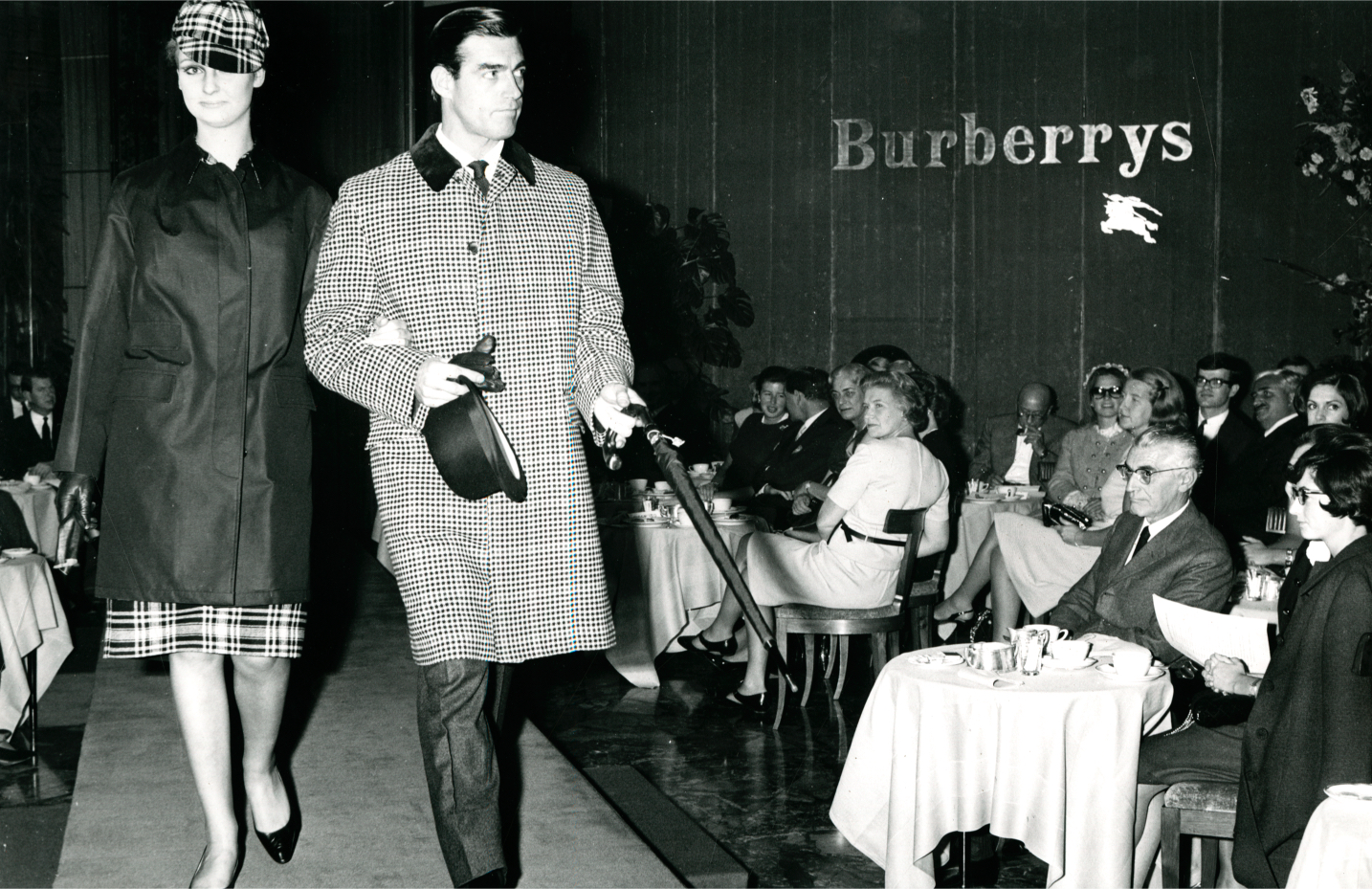
In August 1926, Sir Alan Cobham became the first person to fly from London to Australia and back again. The 47-day, 13,000-mile trip was long, arduous, and closely followed by the press and public. A crowd of thousands gathered at the aerodrome in Sydney to watch Cobham touch down and emerge from his plane, his smart tan trench coat flapping in the wind. Burberry, the designer of that coat, recently released a new version, a century later.
It’s reversible, wool on one side and gabardine on the other, making it ideal for the daring exploits of Cobham or those of the explorer Sir Ernest Shackleton, who wore Burberry gabardine on three Antarctic expeditions in the early 20th century. But over time, Burberry—along with the likes of popular brands Barbour, Filson, and, more recently, Salomon—has seen its functional and hardy gear transform into coveted objects of style worn by everyone from Queen Elizabeth II to Britpop stars.
How did that happen? Carly Eck knows. She boasts a 14-year tenure in Burberry’s archival department, and became VP last year. “Items such as the Burberry trench coat have been culturally adopted and reinterpreted by successive generations who celebrate them not only for their function but for their timeless style, their humble backstory,” says Eck.

If anyone would know about every beat of the house’s 170-year history or its most iconic customers, it’s Eck. Her job is part detective, part preservationist, part storyteller. The extensive archive includes more than 25,000 garments and accessories, as well as a trove of advertisements, fabric sample books, and sales catalogs, “some of which are works of art in and of themselves.” She’s traveled as far as Singapore and Australia to hunt down rare pieces to add to the collection.
Eck knows she’s lucky to have the kind of job that would have fashion geeks green with envy. (And yes, if you’re wondering, she does sometimes get her pick of vintage styles and runway samples in unreleased colors.) But her role as the archive’s steward comes with no small amount of responsibility. As a wave of new designers takes the helm at historic fashion houses, there has been plenty of heated debate about what “is” or “isn’t” a house code.
“Continuity and change are not mutually exclusive, but interdependent,” Eck notes, “and both play a unique role when it comes to style and fashion.” But in an industry as cyclical as hers, what Eck loves most are the hidden histories that can make something as simple as a tan trench coat feel new again and again. As she says, with fashion, “there is often more than meets the eye.”
More of our favorite stories from CULTURED
Tessa Thompson Took Two Years Out of the Spotlight. This Winter, She’s Back With a Vengeance.On the Ground at Art Basel Qatar: 84 Booths, a Sprinkle of Sales, and One Place to DrinkHow to Nail Your Wellness Routine, According to American Ballet Theater Dancers‘As Close to Art as Pop Gets’: Jarrett Earnest on Charli XCX, ‘The Moment,’ and Our Culture of Hyper-Exposure10 of New York’s Best-Dressed Residents Offer the Ultimate Guide to Shopping Vintage in the City
Sign up for our newsletter here to get these stories direct to your inbox.








 in your life?

