
This week, our What’s On column distills Critics’ Table coverage from recent neighborhood roundups (as well as from a review for a show in Philadelphia). If Chelsea seems to get short shrift here, we swear it’s only due to our reviewing cycle. Our late-breaking picks include Simone Fattal’s heart-quickening large-scale bronzes at Greene Naftali as well as her smaller, no-less enchanting ceramic pieces and works on paper (which are also at kaufmann repetto in Tribeca, through Saturday). Sol Lewitt’s “Works from the 1960s” contains multitudes at Paula Cooper; and West 24th Street is the spot for legends of film installation—Charles Atlas’s new portraits at Luhring Augustine and John Akomfrah’s eight-channel work at Lisson are must-sees (and up for weeks). Also highly recommended is the endlessly inventive painter Brenda Goodman’s new exhibition, which just opened at Sikkema Malloy Jenkins. As always, to map our picks and plan your route, enter the Critic’s Table hashtag #TCT in the search bar of the See Saw app. Easy!
UPPER EAST SIDE
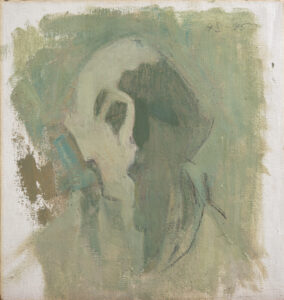
Helene Schjerfbeck
Metropolitan Museum of Art | 1000 Fifth Avenue
Through April 5
Helene Schjerfbeck is Finland’s best modern painter. She is more fascinating, more troubling, and certainly more elusive than Norway’s best modernist, Edvard Munch, with whom she is sometimes compared. Same goes for the Dane, Vilhelm Hammershøi, whose oeuvre has attracted considerable appreciation on our shores for at least the last decade. Schjerfbeck is likewise more interesting than James McNeill Whistler, her American contemporary, with whom she is also sometimes compared. It shouldn’t be a contest, and yet these are the stakes of “Seeing Silence” at the Met… —Sam McKinniss
Read more from our critics’ Upper East Side guide here.
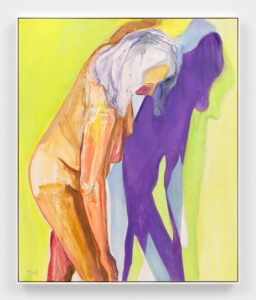
Joan Semmel
Jewish Museum | 1109 Fifth Avenue
Through May 31
To the left, upon entering the gallery, three paintings from the 1970s show Joan Semmel holding the sexual revolution to its word. As the women’s movement sought to level the playing field, she rotated the picture plane to deal with the horizontal space of sex and self-observation, presenting the POV of the reclining nude. Through the Object’s Eye, 1975, as it’s titled, is a radically foreshortened view of Semmel’s own body, cropped, from the collar bone down. The composition can be seen as a lush and nervy turning-of-the-tables, with something like Courbet’s Origin of the World, 1866, in mind. Ten of the 16 paintings on view are from this breakthrough early period, but the others show Semmel’s fiery rigor vis-à-vis the nude (her own unclothed body in various positions) undimmed throughout the subsequent decades… —Johanna Fateman
Read more from our critics’ Upper East Side guide here. And watch Fateman’s video tour of the exhibition here.
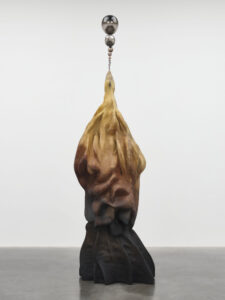
Marguerite Humeau *Last Chance*
White Cube | 1002 Madison Avenue
Through February 21
Marguerite Humeau has long looked to other species—termites, bees, “weeds”—not as metaphors, but as collaborators in thinking outside an anthropocentric logic. At White Cube, her new show “scintille,” inspired by her travels through cave systems in West Papua, names the cave and its most mythical inhabitants—bats—as collaborators, establishing a world where perception, action, and meaning emerge collectively. Just inside the ground-floor gallery, a sculpture shows a tiny, frosty pink creature perched on a seemingly younger stalagmite. The delicate, blown and cast-glass being—part anemone, part axolotl—unfurls two billowing forms from its head. These feel less like organs than auguries: sensory structures without analogy, suggesting ways of knowing that cannot be mapped cleanly onto human systems… —Ajay Kurian
Read more from our critics’ Upper East Side guide here.
CHELSEA
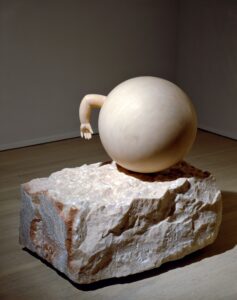
Louise Bourgeois
Hauser & Wirth | 542 West 22nd Street
Through April 18
Twosome, 1991, is constructed from a pair of black-painted steel tanks on a Stygian track. The smaller of the horizontal capsules slowly moves away from, then retreats into, the body of the other, while a red light strobes within. Here, a signature Bourgeoisian theme of (un)coupling is enacted at a terrifying industrial scale, in keeping with the artist’s anything-goes scenography of the unconscious. Throughout the exhibition, curated by Philip Larratt-Smith, less severe objects (made from glass, marble, bronze, and all manner of found materials) are just as eerie, angry, sexual, and exquisite. In the next room, the wall-mounted fountain Mamelles, 1991/2005, never before shown in New York, spouts water from more than a dozen breasts… —Johanna Fateman
Read more from Fateman’s “60 Minutes in Chelsea” tour here. And watch her video tour of the exhibitions here.
LOWER EAST SIDE
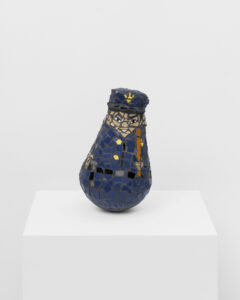
Elberto “SLUTO” Muller
Post Times | 29 Henry Street
Through March 1
Walking down Henry Street with the Manhattan Bridge at your back, you’ll find glyphs and signs all around you. Two standouts are low-hanging mosaics by Elberto “SLUTO” Muller, whose tile works translate his ecstatic, anti-style graffiti into a more permanent form—one of which he installed on Post Times’s exterior wall before he even knew it was a gallery. Two years later, Daisy, 2024, his girl on a motorbike, welcomes you into “Intermodal 53,” a solo show comprised of sculpturally ambitious mosaic works that dissolve the boundary between Post Times and the street outside.
The show’s title refers to the 53-foot shipping containers that dominate freight transport, and it gestures to Muller’s years spent train-hopping. Muller’s work resists domestication. On the windowsill, Muller’s zines, mixtape, and novel sit alongside a wobbling, tile-embossed, pig-snouted, nightstick-carrying cop… —Will Harrison
Read more from Harrison’s review here.
TRIBECA
Tom Burr
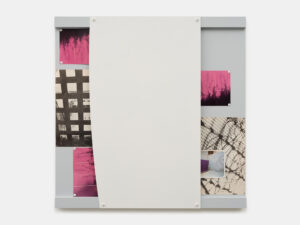
Bortolami | 39 Walker Street (upstairs)
Through February 28
“Journal Works,” the title of the show of Tom Burr’s 15 gnomic, framed assemblages upstairs at Bortolami, aren’t exactly diaristic but they are cooly personal. While trying to parse and contextualize them, I was reminded of that bit of timeless wisdom from John Waters: “If you go home with somebody, and they don’t have books, don’t fuck ’em!”
There are books here: two pages from Heretical Aesthetics: Pasolini on Painting, 2023; the orange cover of a public library copy of Rainer Crone’s catalogue raisonné of Andy Warhol, 1970; Howl and Other Poems, by Allen Ginsberg, 1956; and pages of James Baldwin’s Giovanni’s Room, from the same year. Fragments of books; clothing (Dries Van Noten seems to be a favorite designer); and media, like an Arthur Russell vinyl record; and printed ephemera (a psoriasis drug brochure, an article offering “A critical incident review of the Orlando public safety response to the attack on the Pulse nightclub,” 2017) all find their way into Burr’s compositions… —John Vincler
Read more from Vincler’s review here.
Lucas Blalock & Julia Rommel *Last Chance*
Bureau | 112 Duane Street
Through February 21, 2026
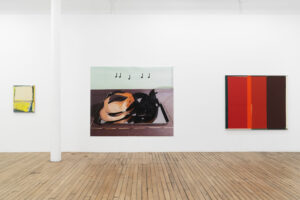
Nothing, at a glance, suggests that these two New York artists—Julia Rommel, a painter, and Lucas Blalock, a photographer—are a fitting match. But the pairing makes for an intriguing, even brilliant, combination, with the artists’ works creating distinct but complementary melodic lines as they intermix across the two floors of Bureau’s gallery.
Rommel makes post-minimalist, post-geometric abstractionist paintings that remain personal, rejecting any ideal of formal austerity. The Brooklyn-based artist folds her canvases—stretching, unstretching, and restretching them as she paints—which usually results in monochrome passages of rectangles, sometimes triangles, in various configurations, with raised seams (from the folding). If the likes of Ellsworth Kelly or Carmen Herrera deemphasized the presence of the hand with their hard-edged approach, Rommel’s methods produce edges that hint at the alchemy of her process. The margins become central. You can—and should—spend as much time looking at her paintings in profile, as you do straight on; up close, as much as you look from far away… —John Vincler
Read more from Vincler’s review here.
Joseph Jones *Last Chance*
Chapter NY | 60 Walker Street
Through February 21, 2026
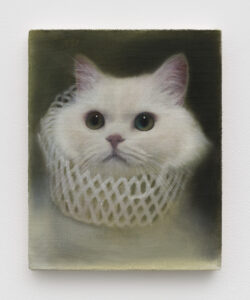
The British painter Joseph Jones’s White cat with gemstones, 2026, on view in a solo showing at Chapter NY in Tribeca, is a great little painting. Bejeweled (with children’s plastic stickers), the Persian cat with different colored eyes—one amber, one blue—in a trompe l’oeil cardboard box provides plenty of exacting details, but the composition is most interesting because of how it dares the viewer to dismiss it. For all of the cultural significance of having a pet, pet portraiture vies only with tourist-destination landscape painting for genre schlock.
Each photorealist cat in the show—there are seven, alongside one dog, and four paintings of flowers—is painted as if it is someone’s obsession, which Jones has taken up and internalized. It’s a conceptual swerve that the sheer force of the dozen little paintings, in oil and acrylic on linen, manage to escape their head-on collision with kitsch… —John Vincler
Read more from Vincler’s review here. And watch his video tour of the exhibition here.
BROOKLYN
Torkwase Dyson
Brooklyn Bridge Park, Pier 1, Bridge View Lawn
Through March 8
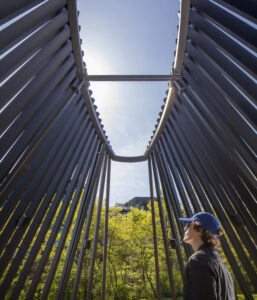
My timing is misaligned: I visit Torkwase Dyson’s Public Art Fund commission Akua on a Monday, even though the sculpture takes its name from the Akan word meaning “born on a Wednesday.” But I’m afforded another form of synchronicity: a rhyming between the artwork and the atmosphere. It’s raining; water saturates the air around me, dampens my breath. Accordingly, inside the sculpture—which is adjacent to the East River—the sound of water circles a ring of eight speakers, cascading from one to the next. I find myself surrounded by whirling, gurgling, frothing sonorities, as though set adrift or submerged in water. Akua beckons us to swim with—and battle against—the current of history: Its aqueous sounds are stitched into an assemblage that also includes voices such as those of Christina Sharpe and Dionne Brand, who read on the ecstatic possibilities of Black life and the impossible terror that begets black death. Cradled in Dyson’s sculpture, I feel a high register of affective intensity harmonize with low sonic frequency. The water vibrates like a bass, rumbling and roiling underfoot… —Zoë Hopkins
Read more from Hopkins’s review here.
PHILADELPHIA
“A World in the Making: The Shakers”
ICA Philadelphia | 118 South 36th Street, Philadelphia, PA
Through August 9
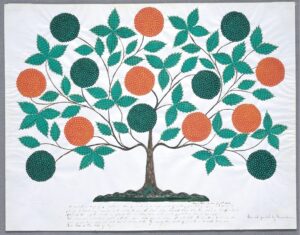
Last week I was served ads for “sustainable fly tying” and a digital “improv quilting” workshop—a small data point in a broader return to handicraft and renewed attention to skill sharing. There’s an urge to build things together right now, but we’re trapped in the singular, online performance of it. Against this backdrop, “A World in the Making: The Shakers” at the Institute of Contemporary Art, Philadelphia arrives less as historical survey than contemporary interface. The exhibition sets up a relay between Shaker material culture and seven contemporary artists’ interdisciplinary work, asking what happens when communal structures are encountered through objects, archives, and bodies. Here, calm translates most easily while discipline, belief, and labor resurface more unevenly. How does this interest in traditional handmaking sit within the sticky Venn diagram of the trad wife, the MAHA mom, and the curation of the homemade for public consumption or aspiration? —Blakey Bessire
Read more from Bessire’s review here.


 in your life?