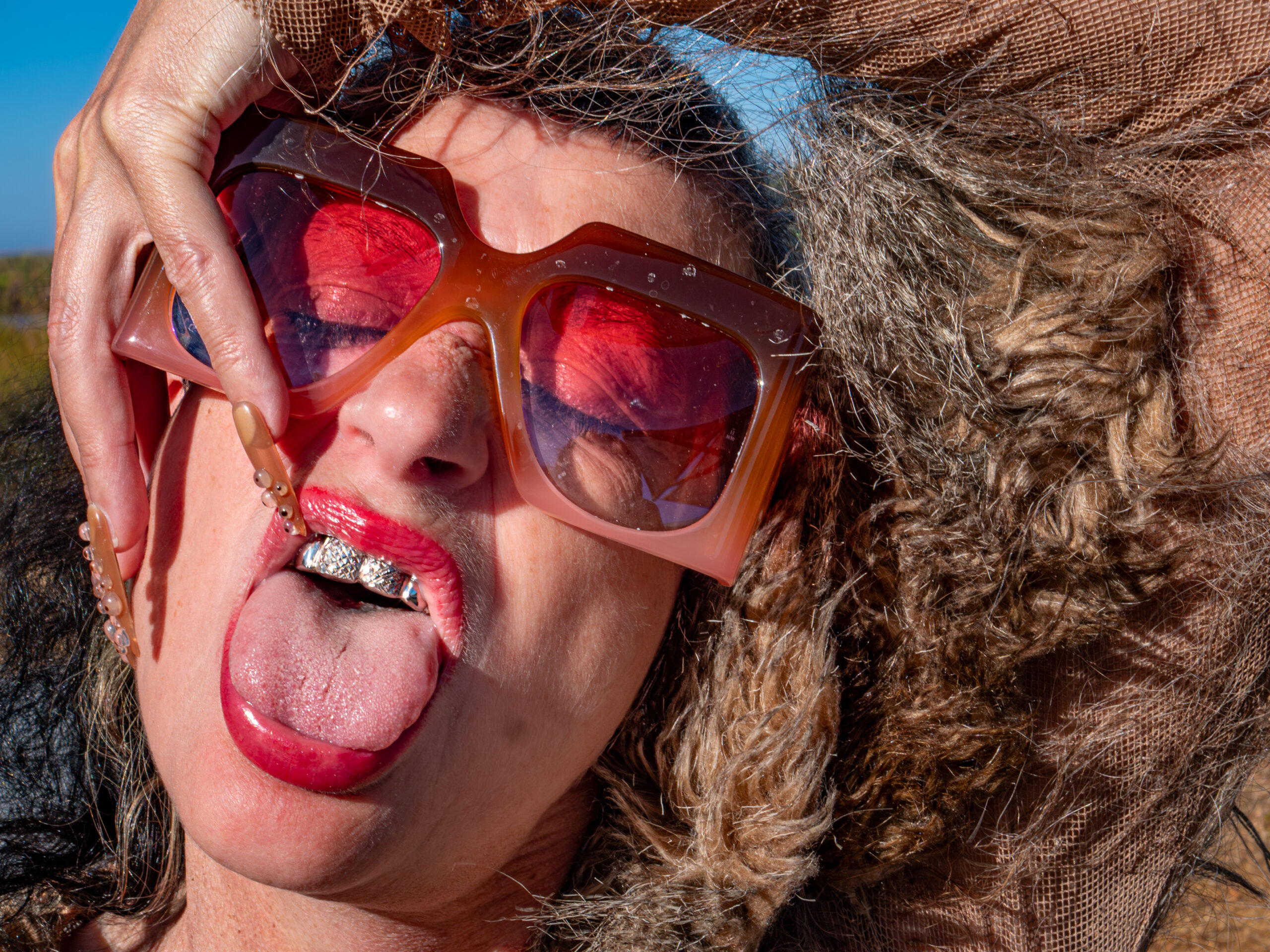
Sex is still sex in Peaches’s world, but maybe now, more than 25 years after the arrival of “Fuck the Pain Away”— the dirty electro-indie club classic that announced her—it’s also the inexhaustible, throbbing metaphor for everything else she wants to talk about. The title track on her first album in a decade, No Lube So Rude, is as filthy as anything she’s written (“Dead heat / Complete / Slide it off your butt cheek,” she raps in her signature fast-rhyming deadpan), yet the song is less about literal fucking than “how fucking rude the world is,” she tells me. “With lube you can get from an uncomfortable situation—one that maybe you’re just trying to endure—to another, more interesting place, to a new level or deeper understanding,” she explains. “Lube is the grace we bring to each other in conversation. Or conflict.” The song might impart a message about care and connection, but its lyrics are set to the cold speed and laser-demon ambience of the hard-techno production she favors now: music for a harder time.
When Peaches first appears on my screen in a Zoom window, a week before Christmas, I gush that she’s a sight for sore eyes. Somehow, the phrase is now my go-to greeting for old friends—to signal my own world-weariness, I guess, and to preempt the state-of-the-world caveats that otherwise preface every answer to “How are you?” But my eyes really do feel less sore—I feel relieved—seeing her face, her new music still ringing in my ears (I’d been playing it on repeat all morning).
In 2000, it was love at first listen for me. The opening salvo of groovebox handclaps and the feral, desultory entrance of her vocal on The Teaches of Peaches (“Sucking on my…”) was everything. But it might be even more thrilling now to witness her evolution—the expansive, imaginative world she’s built, across mediums, atop that blazing groundwork. Some things haven’t changed much: She has only drilled down harder on the wordplay, her dogged blurring of acts and anatomy in her lyrics. And in embracing slicker production (for No Lube, she worked with the Berlin-based producer the Squirt Deluxe), she hasn’t compromised her sense of formal economy (I hold an image of her standing on stage in underwear, with just her Roland MC-505 and mic, in my heart).
“When I started doing what I was doing, there wasn’t the vocabulary to express a more fluid, non-binary way of being. The question was, how do I make that language? With my little bedroom ideas, I was trying to figure out who I was, and why me and the people around me weren’t represented,” Peaches reflects when I ask how the significance of her triple-X tropes has changed with—or against—shifts in culture. “That understanding of fluidity has been an exciting change. But all of that change has been cut short; we’re in the backlash now.”
Referencing the ban on gender-affirming care for minors in the U.S. (RFK Jr. and Dr. Oz announced new federal rules to this effect the day before our conversation), she brings up her track “Not In Your Mouth None of Your Business.” It’s a furious singalong with a ’90s Digital Hardcore vibe, driven by a floor-shaking, metronomic kick and tinny, distorted vocals shout-chanting the title’s defiant slogan. (In the brilliant psychedelic, strobing video for the Boys Noize remix, she struggles to sing as she squashes her face between two glass casseroles.)
I tell her she’s sick for starting her tour in Florida—but also, it’s perfect—and she nods. “Exactly. I’m taking the queer cavalcade of chaos straight into the lion’s den.” We’re joking but not laughing. The danger of being on stage or the road, the way her fans need her right now, the cultural stakes of our moment—it all goes without saying between us. Peaches and my own band, Le Tigre, though from different cities and scenes, came up together, releasing our debut albums within a year of each other. At the dawn of electroclash, we were both experimenting with a raw, post-indie rock, electronic sound; at the beginning of the end of the third wave, before social media changed the face of feminist performance and image-making, we pushed like-mindedly against the industry’s sneering sexism to expand the freedom we’d found. Peaches opened for Le Tigre when we played our first show in Berlin in 2000. And then we were friends.
So, when she confides, looking ahead to her February tour dates, that “somehow, it feels more surreal than any other time,” I think I know what she means. She doesn’t mean surreal as in working with a pop star (Peaches rapped—brilliantly—over the bridge of the awkward “My Girls,” which Le Tigre co-wrote with Christina Aguilera for the singer’s 2010 commercial flop Bionic), as in being tapped to perform Yoko Ono’s 1964 canonical feminist Fluxus Cut Piece (that also happened), or simply in the delirious, adrenaline-intoxicated way that performing can be. It’s surreal because, this time, the cultural dissonance is dizzying. A Peaches show won’t be a celebration in the context of struggle and social progress, but a small stand against a fascist revanchism worse than we ever imagined. (“The joyful revolution—that’s important,” she says, “I’m keeping that in mind.”)
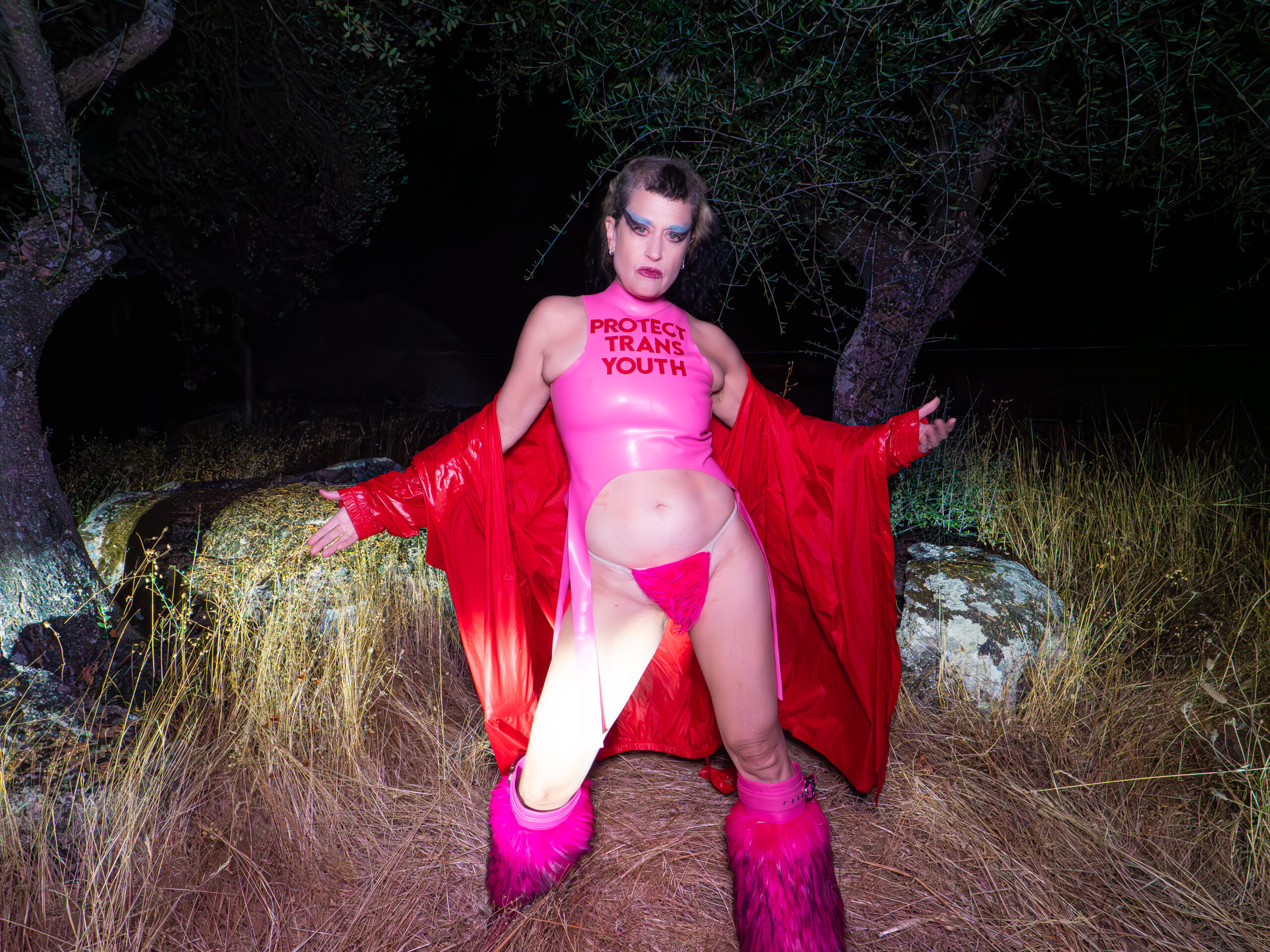
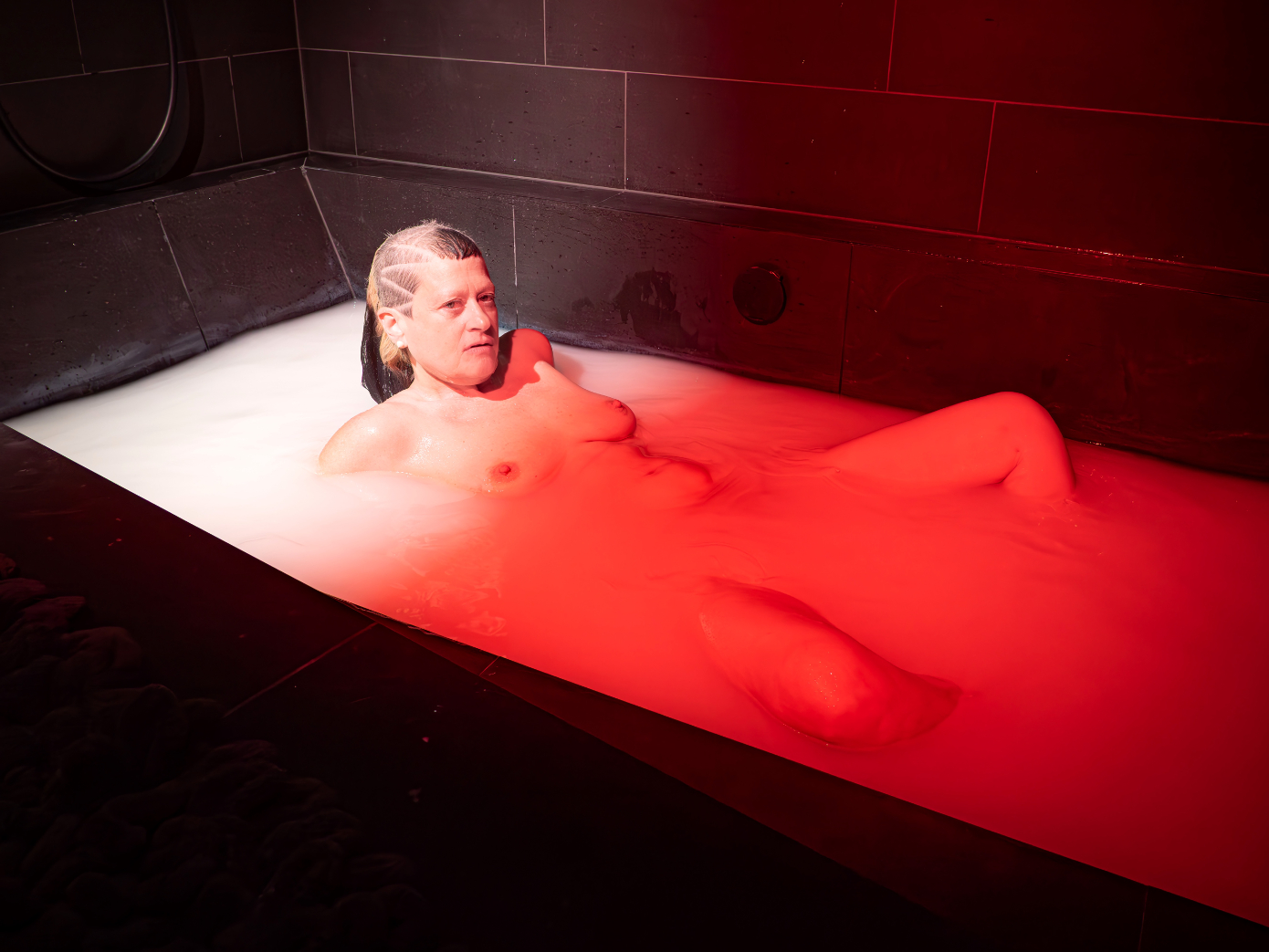
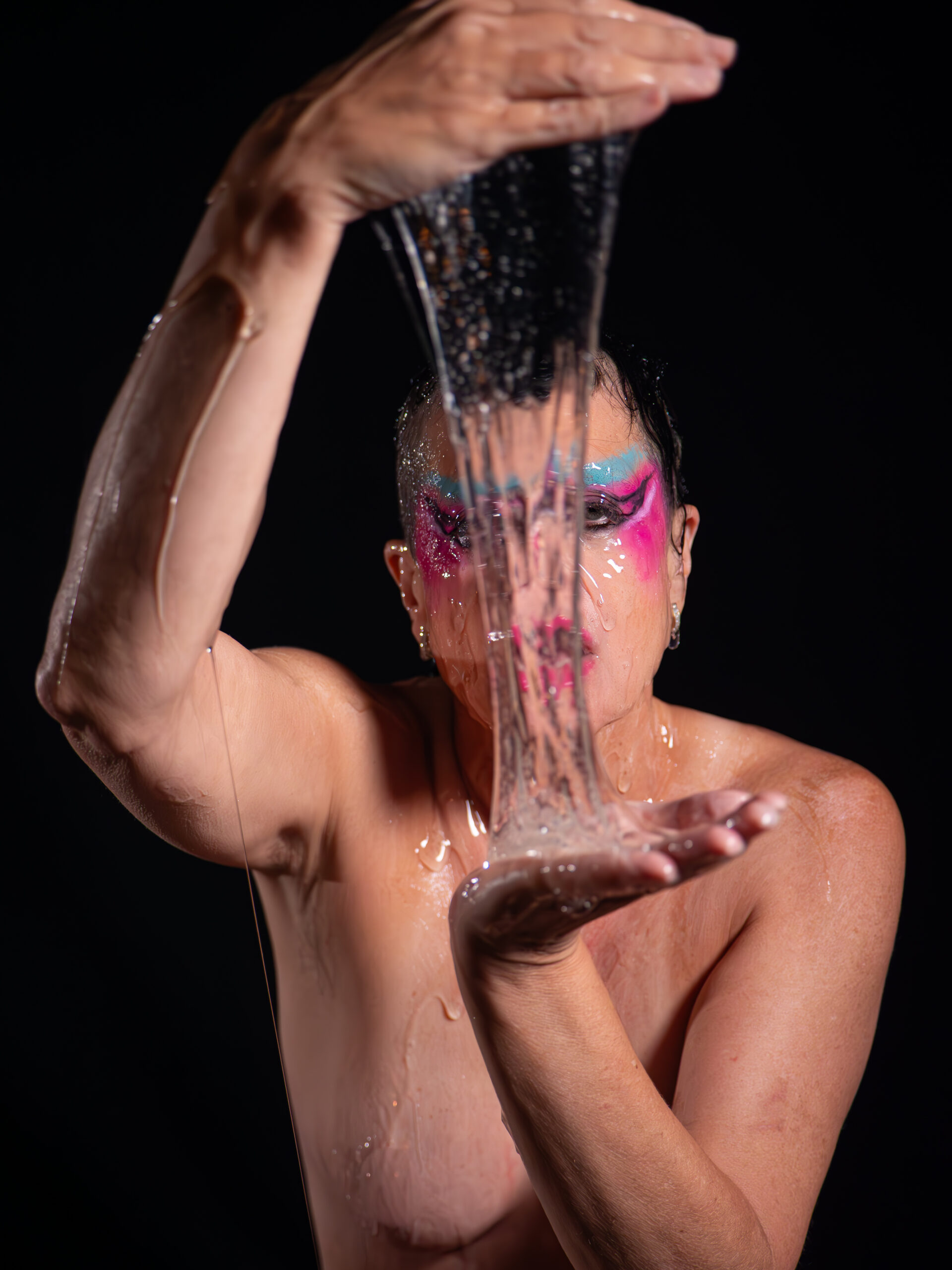
Peaches’s work has, over time, become more consciously oracular, explicitly liberationist, and campy in its kaleidoscopic vision of gender, sex, and bodies. But she’s always retained her edge—an air of prowling menace; a baiting, needling presence; a pleasure in being disgusting. In her album artwork, she’s absurdly armored against our rude world, drenched in lube. Glistening in black space, she seems reborn, just hatched, slippery with alien albumen, guarding her crotch with spread fingers. (It’s a close-cropped shot recalling the cover of The Teaches, that below-the-waist image of her in pink hot pants that ushered in the camel-toe noughties.) On the verso, she appears with her mullet and Liquid Sky eye makeup, stretching a band of slime between her hands, observing the substance with beatific fascination.
“I think this album is a lot about desire,” she says, “but not all desires are sexual.” That’s true, but at a Peaches show, every fan knows and loves that the horny pursuit of catharsis has never been just about sex—it’s freedom in practice, an unrelenting political demand, a party in the lion’s den.
More of our favorite stories from CULTURED
Tessa Thompson Took Two Years Out of the Spotlight. This Winter, She’s Back With a Vengeance.
On the Ground at Art Basel Qatar: 84 Booths, a Sprinkle of Sales, and One Place to Drink
How to Nail Your Wellness Routine, According to American Ballet Theater Dancers
10 of New York’s Best-Dressed Residents Offer the Ultimate Guide to Shopping Vintage in the City
Sign up for our newsletter here to get these stories direct to your inbox.





 in your life?